Mindset· 12 min read
Bad Day Ahead? Why You Overestimate How Long It Will Hurt
Bad Day Ahead? Why You Overestimate How Long It Will Hurt
The email came back with two words: "not interested."
You'd spent six weeks on that pitch. Rewrote the numbers, polished the opening paragraph, rehearsed the structure on the morning commute. When the reply landed — polite, brief, final — you sat with the notification on your screen and thought, with real conviction: This is going to stay with me for weeks.
By Thursday you were already planning the next version.
If that gap between forecast and reality sounds familiar, you've run straight into one of the most reliable miscalculations the human brain makes. It has a name — the impact bias — and once you understand what actually drives it, you'll start pricing risk more accurately than your anxiety ever could.
Why your emotional forecast is almost always too gloomy
Affective forecasting is the technical term for predicting how you'll feel about future events. Psychologists Timothy Wilson and Daniel Gilbert — Gilbert based at Harvard — spent years systematically measuring the gap between people's emotional predictions and their actual emotional experiences.
Their findings are summarized in their 2005 paper "Affective Forecasting: Knowing What to Want" in Current Directions in Psychological Science. The pattern is consistent: when it comes to negative events, people tend to overestimate both the intensity of their reaction (how bad it will feel) and the duration (how long the bad feeling will last). The bad thing often stings less, and heals faster, than predicted.
This has been examined across a range of scenarios: rejected job applications, exam failures, relationship endings, missed promotions, sports team losses. Wilson, Gilbert and colleagues gave the pattern its name, the impact bias (Wilson, Wheatley, Meyers, Gilbert & Axsom, 2000), and Gilbert's 2006 book Stumbling on Happiness brought these findings to a wider audience — and remains one of the more readable accounts of how systematically we misread our own emotional futures.
Worth stating plainly: much of the foundational research involved college students in controlled settings, and some results have shown mixed replication when tested across broader populations and more serious life events. The impact bias is a reliable tendency, not a universal law. But the direction of the error — overestimating pain rather than underestimating it — is consistent enough to be practically useful.
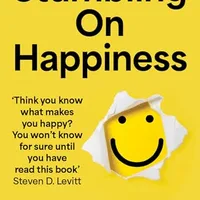
Stumbling on Happiness — Daniel Gilbert (Paperback)
As an Amazon Associate, we earn from qualifying purchases — at no extra cost to you.
Two mechanisms driving the miscalculation
The impact bias doesn't work through a single process. It has two distinct drivers.
The first is focalism. This is the tendency to focus so intensely on one anticipated event that you forget to account for everything else that will fill your time. When you try to predict how you'll feel on a specific future Thursday, you effectively picture Thursday as though it consists entirely of that one difficult thing. No afternoon run, no podcast, no evening habit, no unexpected conversation that takes your mind elsewhere. Just you and the weight of what happened. That frozen, isolated image is emotionally vivid. And it's wrong — because Thursday always has texture, and that texture does real repair work that your forecast never includes.
Wilson and Gilbert demonstrated this directly in their research by giving one group of participants a detailed schedule of what else would occur on the target day. That group's emotional forecasts were significantly more accurate than those who focused only on the bad event itself. Knowing Wednesday also contains other things — unrelated to the rejection — pulled the forecast back toward reality. The fix is surprisingly mechanical: add context, and the prediction improves.
The second is a failure to anticipate how quickly you'll make sense of what happened — which brings us to the recovery system running in the background.
The recovery system running in the background
Gilbert and colleagues proposed that people neglect what they called the psychological immune system (Gilbert, Pinel, Wilson, Blumberg & Wheatley, 1998, "immune neglect").
It's not a metaphor for resilience or toughness. It describes the unconscious cognitive processes that quietly help you reframe and adapt to setbacks — typically without you noticing they're running.
Here's how it usually operates: the rejected proposal becomes "maybe the timing wasn't right." The relationship that ended becomes, with some weeks, "we weren't compatible in some important ways." The missed promotion shifts into "this might free up energy I can direct somewhere better." These aren't self-deceptions or forced positivity. They're genuine recalibrations — real cognitive updates your mind produces, often overnight, often between tasks, with no particular deliberate effort on your part.
What makes the immune system effectively invisible during forecasting is timing. Research typically measured recovery across intervals of one to four weeks — enough time for meaningful reframing to have occurred. The person who, in week one, said "this will ruin my entire month" often found, by week two or three, that the wound had been integrated into the ongoing story. Daily tasks had continued, some went well, perspective had quietly shifted. The forecast was made by someone in acute distress; the experience unfolded for someone already, without realizing it, reorganizing around what happened.
The challenge is that you can't feel this system coming. You can forecast the wound. You can't forecast the repair. So the forecast consistently underweights recovery.

Kindle Paperwhite (12th Gen, 16GB)
As an Amazon Associate, we earn from qualifying purchases — at no extra cost to you.
One important boundary: this framework applies well to ordinary setbacks — professional disappointments, goal failures, social rejections. For serious grief, trauma, or persistent low mood, the psychological immune system isn't sufficient and isn't designed to be. If what you're carrying feels beyond the scope of an ordinary bad week, talking to a professional is the right path, not a reframe.
self-compassion-science-resilience
The decisions your miscalculation is quietly blocking
Here's where the impact bias stops being an interesting research finding and starts being expensive.
If you consistently overestimate how bad setbacks will feel, you consistently underestimate your own tolerance for them. And that underestimation shapes the choices you make — particularly the ones you don't.
The job application you don't send because rejection "would be too hard." The conversation you don't start because the awkwardness "would linger for days." The risky project you shelve because failure "would take months to get over." In each case, you're not calculating an accurate emotional cost. You're calculating a miscalculated one. The downside you're protecting yourself from is likely smaller and shorter than your forecast suggests.
The same pattern shows up in creative and personal work. The writer who keeps the draft private because bad feedback "would be discouraging for weeks." The side project you don't launch publicly because embarrassment "would follow you." The vulnerable first attempt at anything, deferred indefinitely, because the forecast for how it would feel to fail looks far worse than what actually tends to happen to people who try and don't succeed the first time.
Accurate forecasting doesn't remove the downside. It just prices it correctly. And a correctly priced risk looks very different from an inflated one.
A simple recalibration in three steps
You don't need an overhaul. Three practices, used consistently, can help close the gap between forecast and reality.
- Keep a short recovery log. When something difficult happens, write down how bad you expect to feel and for how long. Then check back after four or five days and record what actually happened. Many people find that recovery was faster and milder than the prediction. After a handful of entries, you have a personal dataset that makes future forecasts more accurate than gut instinct alone — a correction running on real data rather than on today's anxiety.
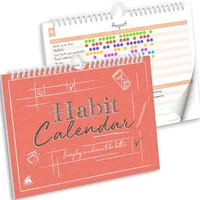
Clever Fox Habit Calendar Circle (24-Month)
As an Amazon Associate, we earn from qualifying purchases — at no extra cost to you.
-
List what else will happen that day. When you're dreading a specific future event, deliberately name three or four other things that will also occupy your time that day or week. The difficult conversation is on Wednesday, but Wednesday also has a walk, a meal, a few hours of work, an evening. Focalism thrives on isolation; a short, concrete list breaks it. You're not minimizing the hard thing — you're giving it the accurate context your brain keeps stripping away.
-
Check your actual track record. Think of three genuinely difficult things you've recovered from in the last two years. How long did recovery actually take, compared to how long you predicted at the time? For many people, the gap is real and consistent. Your personal history is a better predictor of your resilience than your current state of anxiety is.

Philips SmartSleep Wake-Up Light HF3520
As an Amazon Associate, we earn from qualifying purchases — at no extra cost to you.
Forecast with better data
Here's the larger principle beneath all of this: the future version of you is more capable than the present version can currently see.
Every emotional forecast is made by today's you — with today's sleep, today's stress, the cumulative weight of this particular week. The future you will have adapted, found new information, been surprised by things you couldn't have predicted when you were making the forecast. The prediction is made by one version of you; the event is experienced by a different, partially recovered one.
post-traumatic-growth-adversity-makes-you-stronger
This is the essence of designing your evolution rather than defending against it. When the downside is correctly priced — not minimized, just accurately sized — the choices you're willing to make get bolder. Not carelessly bold, but correctly calibrated to your actual resilience rather than to what today's distress imagines you can barely survive. You build a life shaped by what you've demonstrated you can handle, not by what anxiety projects at the worst hour.
Knowing you recover faster than you predict doesn't mean outcomes stop mattering. It means you hold the downside at its real size. And when that size is accurate, the life you're willing to build reflects what you can actually handle — which turns out to be considerably more than you usually think.
What's the last setback you dreaded that turned out to be less devastating than you expected? Leave a comment — it's useful calibration for you, and it might be exactly what someone else reading this needs to hear.
Was this helpful?