Productivity· 10 min read
The Science of Flow: How to Enter Peak Performance On Demand
Mihaly Csikszentmihalyi's 30-year research identified 9 conditions that produce flow. Steven Kotler's 4% challenge rule shows how to engineer them daily.
The Science of Flow: How to Enter Peak Performance On Demand

It was 11:47 PM on a Tuesday when I finally looked up from my laptop.
I'd sat down at 7:30 to "knock out a few paragraphs." I hadn't eaten. I hadn't heard my phone buzzing in another room. The mug of coffee beside my keyboard was cold proof that at some point I'd poured it, meant to drink it, and immediately forgot it existed. Four hours had dissolved like they were nothing — I was deep in a flow state, producing the best work I'd put out in months.
I called it a lucky night.
It wasn't luck. And that's the part nobody tells you.
What Researchers Found When They Studied Optimal Experience
In the late 1960s, a Hungarian-American psychologist named Mihaly Csikszentmihalyi — pronounced roughly "cheeks-sent-me-high," which is worth practicing because you're going to want to drop his name in conversation — noticed something strange while studying chess grandmasters, surgeons, and rock climbers. These people, across wildly different domains, kept describing their moments of peak engagement with the same metaphor.
Not "I worked really hard that day."
More like: the activity was carrying me.
Csikszentmihalyi spent the next three decades turning that observation into one of the most empirically thorough bodies of research in psychology. He developed the Experience Sampling Method — participants carried beepers that went off at random intervals during their days. At each prompt, they'd record their current activity, their level of engagement, and their emotional state. Tens of thousands of reports. Hundreds of participants. Multiple cultures, over years.
The pattern that emerged was consistent: the highest quality of conscious experience — what Csikszentmihalyi named flow after the accounts he gathered — didn't occur randomly. It occurred under specific, identifiable, and reproducible conditions. That's the part that changes everything. Flow isn't a personality trait you either have or don't. It's a state with a known architecture, and that architecture can be built.
If you've never read his primary account of this research, that's where to start.

Flow: The Psychology of Optimal Experience — Mihaly Csikszentmihalyi
The primary account of the 30-year ESM research — the source the whole article is built on. Reader wants the cross-cultural data, not a summary.
As an Amazon Associate, we earn from qualifying purchases — at no extra cost to you.
No summary does it justice — the cross-cultural ESM data alone makes the case in a way a quote never will.
The Challenge-Skill Balance: Why You're Either Bored or Anxious
Csikszentmihalyi's central finding is the challenge-skill balance.
Flow occurs in a specific corridor: when the difficulty of a task is approximately matched to the skill you bring to it — and when both are above a threshold of genuine significance. Not a trivial task done competently. Not a hard task overwhelming a beginner. The narrow channel between those two failure modes is where flow lives.

The map is simple:
- Too low a challenge relative to skill → boredom. The work is completable without real engagement, so your mind wanders to whatever is more interesting.
- Too high a challenge relative to skill → anxiety. The task feels threatening rather than absorbing, and attention fragments into self-protection mode.
- Challenge and skill matched at a meaningful level → flow.
This is why the same task produces flow for one person and restlessness for another. Playing a Bach piece calibrated to your current level produces flow for a pianist at that level. The same piece produces panic for a beginner and tedium for a concert performer. Flow isn't a property of the activity. It's a property of the relationship between the activity's demands and your current capacity.
The first practical question before any work session isn't "am I ready?" It's: "Is this task about 4% harder than what I can do comfortably right now?"
deep work and focused productivity
The 4% Rule: How Kotler Quantified the Zone
Steven Kotler, who runs the Flow Research Collective and whose research in The Rise of Superman analyzed how extreme athletes systematically produced flow states to achieve unprecedented performance leaps, synthesized Csikszentmihalyi's conditions with neuroscience and arrived at a specific calibration number.
The optimal challenge level for flow induction is approximately 4% above your current demonstrated ability.
Not 50% harder. Not at your ceiling. Specifically, just outside your comfortable competence — far enough to require genuine effort and prevent boredom, close enough that success feels within reach. At less than 4% above current ability, the task is too easy and attention drifts. Significantly above 4%, the challenge-to-skill ratio tips into anxiety, and the flow channel closes.
This is why breaking complex projects into smaller components isn't just good project management. It's flow architecture. A project that feels overwhelming as a whole is often a collection of 4% challenges that, handled one at a time, sit right in the corridor.
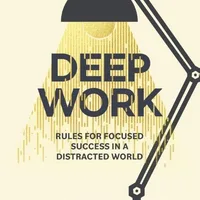
Deep Work — Cal Newport
Reinforces the 'break complex projects into 4% challenges' point — Newport's framework for protecting deep, distraction-free focus blocks.
As an Amazon Associate, we earn from qualifying purchases — at no extra cost to you.
Kotler also identified what he calls the "flow cocktail" — the neurochemical cascade the state activates: norepinephrine, dopamine, anandamide, serotonin, and endorphins all releasing simultaneously. That combination produces the characteristic mix of hyper-focus, reduced fatigue and pain perception, elevated pattern recognition, and the intrinsic pull to keep going. It's the most productive neurochemical state a human can access — and it's self-reinforcing. The better the work goes, the more dopamine releases, the more absorbed you become.
The challenge is you have to earn the entry. And the entry price is honest calibration of the task you're actually sitting down to do.
The Nine Conditions That Describe (and Trigger) Flow
Csikszentmihalyi's decades of systematic interviews identified nine components that characterize flow when it's happening. Here's what's important: understanding these as entry conditions — not just descriptions of the state after the fact — changes how you approach any work session.
Clear goals. Flow requires knowing precisely what you're trying to accomplish in the next focused interval. Not "work on the report." Something more like: "write the argument connecting claim B to evidence 3." Vagueness is flow's enemy. Your brain needs a specific target to generate the feedback loop that deepens the state.
Immediate feedback. The activity needs to tell you, in real time, how you're doing. This is why writing, coding, playing music, and athletic training reliably produce flow — the loop is short. You write a sentence; you can judge immediately if it works. You run a function; it either runs or it doesn't.
Merging of action and awareness. This is what people mean when they say "I lost myself in the work." The self-monitoring gap — the inner narrator observing you as you perform — dissolves. You stop doing the task and effectively become it.
Loss of self-consciousness. Related but distinct: the social anxiety of being evaluated, of how you appear to others, temporarily lifts. This is part of why open-plan offices are flow's architectural antagonist. Low-grade social performance anxiety keeps the prefrontal cortex just active enough to prevent the state from deepening.
Distorted sense of time. Four hours become one. Or a single complex moment expands to fill a subjective hour. Which direction depends on the domain — but some form of temporal distortion is nearly universal.
Sense of personal control. You perceive your skill as adequate to meet the challenge. Not easy — adequate. This is the psychological correlate of the 4% calibration.
Intrinsic reward. What Csikszentmihalyi called the "autotelic" experience — from the Greek autos (self) and telos (goal). The work is worth doing for its own sake. You don't need external validation to continue; the continuing itself is the reward.
Deep embodiment. Full engagement of sensory, motor, and cognitive systems simultaneously. This is why physical activities — cooking, woodworking, sport — reliably produce flow even when their intellectual demands are modest. You're not thinking about the work; you're in it with your whole body.
Effortless involvement. Despite objective difficulty, the engagement runs as flow rather than grind. You're not forcing it. You're gliding — and the distinction is felt, not inferred.
habit design for consistency
What's Actually Happening in Your Brain
Arne Dietrich at the American University of Beirut proposed the neuroscientific mechanism underlying flow in a landmark 2003 paper: a phenomenon he called transient hypofrontality.
During flow states, activity in the prefrontal cortex — the brain's center for explicit self-monitoring, the inner critic, deliberate conscious control, and the running narrative that evaluates everything you do — is genuinely reduced. Meanwhile, the systems responsible for automatic, skilled performance maintain or increase their activity.
The inner critic doesn't get quieter because you've suppressed it through willpower. It gets quieter because the brain's resource allocation has genuinely shifted, and the prefrontal self-monitoring system has less work to do.
This is the neural explanation for why experienced performers describe their best work as "getting out of their own way." They're not speaking metaphorically. The prefrontal inhibition on automatic skill systems literally decreases during flow, allowing skilled behavior to run with less friction than in normal waking consciousness.
It's also why flow isn't accessible at the very beginning of building any skill. You need a real foundation before the brain has anything to run on autopilot. The student who hasn't mastered the fundamentals can't flow through a problem set — there's nothing sufficiently automatic for the flow systems to operate on top of. But once that foundation exists? The conditions can be engineered.
How to Design Your First Real Flow Session
The research is unambiguous about what blocks flow before it can deepen: attention competition.
Notifications, open browser tabs, the low-grade awareness that messages are waiting, the ambient possibility of being interrupted — all of these keep the prefrontal cortex in a background monitoring state that prevents transient hypofrontality. You can't partially commit to not-monitoring. The brain is either doing it or it isn't.
Here's the protocol the research supports:
1. Write one specific, challenging goal before you start. Not "work on project X." Write it on paper: "Draft the three arguments in section 2, each with a concrete example." The specificity creates the feedback loop. A time-blocking planner with a dedicated daily goal field makes this habitual rather than effortful.
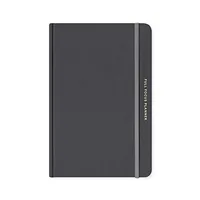
Full Focus Planner by Michael Hyatt (Linen Hardcover)
Directly supports protocol step 1 — a dedicated daily-goal field makes 'write one specific, challenging goal' habitual rather than effortful.
As an Amazon Associate, we earn from qualifying purchases — at no extra cost to you.
2. Protect at least 90 minutes of uninterrupted time. Flow research consistently shows that shorter blocks don't give the state enough runway to deepen after the initial friction of entry. The first 15-20 minutes often feel like resistance; flow arrives in the second half of the session. An analog timer — not your phone — keeps the time boundary without creating a reason to look at a screen.
3. Eliminate attention competition before you sit down. Not "silence notifications." Remove them. Phone goes to another room. Browser closes. Noise-canceling headphones handle the ambient sound that splits auditory attention without your noticing it — this is one of the most underrated practical interventions, because you can't feel the cognitive cost of background noise until you've experienced a session without it.
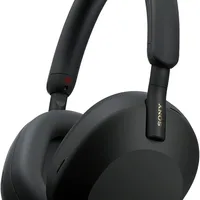
Sony WH-1000XM5 Noise Cancelling Headphones
Highest-ticket anchor for EN/ES. Directly supports protocol step 3 — noise-canceling removes the ambient auditory attention-competition that blocks transient hypofrontality.
As an Amazon Associate, we earn from qualifying purchases — at no extra cost to you.
4. Calibrate the challenge honestly. Ask before every session: is this task about 4% harder than what I can do comfortably? If it's below that threshold, add a constraint — a tighter deadline, a higher quality bar, a complexity requirement. If it's significantly above it, break it down until the immediate component sits in the corridor.
5. Track where flow actually happens for you. Flow isn't uniformly distributed across tasks, times of day, or environments. The most useful thing you can do across the next 30 sessions is record when it happened, what the task was, what time it started, and what the environment looked like. The pattern that emerges is specific to you — and it's more actionable than any generic advice. A dedicated flow session log makes the pattern visible.
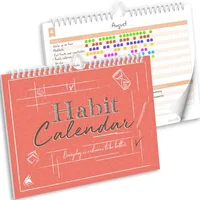
Clever Fox Habit Calendar Circle (24-Month)
Supports protocol step 5 — a dedicated log makes your personal flow pattern (task, time, environment) visible across 30 sessions.
As an Amazon Associate, we earn from qualifying purchases — at no extra cost to you.

morning routine habit design
The Discipline Is in the Design, Not the State
Most people treat flow as something that occasionally happens to them — a lucky Tuesday night, a good stretch in the morning before the day complicates itself.
The research says it doesn't have to work that way.
Csikszentmihalyi spent 30 years documenting that flow is not a mysterious gift distributed to the naturally talented. It's a state with conditions. And conditions can be designed. The 4% rule gives you the calibration principle. The nine components give you the entry checklist. Transient hypofrontality explains why eliminating attention competition isn't optional — it's structural.
The discipline isn't in the flow itself. You can't force the state. What you can do is remove everything that prevents it, calibrate the task to sit in the channel where it becomes available, and show up consistently enough that your brain learns which conditions to drop into it. That's what "Design Your Evolution" actually means in practice — not grinding harder. Not optimizing every minute. Designing better conditions. And then trusting the state to arrive.
One question worth sitting with: what's one project in your life right now that you could break into a smaller component and run the 4% test on? Drop it in the comments. I'm genuinely curious where people find the zone showing up.
Sources: Csikszentmihalyi, M. (1990). Flow: The Psychology of Optimal Experience. Harper & Row. | Kotler, S. (2014). The Rise of Superman. New Harvest; see also flowresearchcollective.com. | Dietrich, A. (2003). Functional neuroanatomy of altered states of consciousness: The transient hypofrontality hypothesis. Consciousness and Cognition, 12(2), 231–256.
Was this helpful?