Productivity· 10 min read
How to Stop Multitasking and Focus on One Thing
Multitasking doesn't make you faster — it makes you worse. Here's the neuroscience behind monotasking and a single-task setup that actually works.

How to Stop Multitasking and Focus on One Thing
I had 11 tabs open, an email half-written in the background, and my phone face-up beside the keyboard when my editor asked me the question that stopped me cold.
"What were you actually thinking about when you wrote that paragraph?"
The paragraph was bad. Not bad like "needs a light edit" — bad like it had been assembled by someone who was physically present but mentally scattered across four different contexts. Which is exactly what had happened. I'd been on a voice note, writing, checking Slack, and half-watching a tab refresh — convinced the whole time that I was being impressively productive.
I wasn't productive. I was busy. And I'd spent years treating those words like synonyms.
Here's what nobody tells you about multitasking: the damage isn't in the seconds you lose switching between tasks. It's in what those switches do to every minute that follows. Gloria Mark, a researcher at the University of California, Irvine, spent years measuring exactly this. She embedded herself in real workplaces and tracked what happened to people's concentration after interruptions. Her finding is one of those numbers that sounds manageable until you do the arithmetic: after a single interruption, it takes an average of 23 minutes and 15 seconds to return to the original task at the same level of focus.
Twenty-three minutes. Per interruption.
If you switch contexts — between apps, tasks, conversations, or browser tabs — just five times before noon, you're not losing a few minutes to the switches themselves. You're losing more than two hours of deep cognitive bandwidth to the invisible tax of attention recovery. And if you're a knowledge worker in a modern office environment, five switches before noon is generous.
This is the multitasking debt most people carry without ever seeing it on a balance sheet.
Why Your Brain Physically Cannot Multitask (And What It Does Instead)
The word "multitasking" migrated from computing into human vocabulary and brought a false promise with it. Computer processors can genuinely execute multiple operations simultaneously. Your brain cannot. What it can do — and does, compulsively — is switch rapidly between tasks. Each switch looks like multitasking from the outside. Inside, it's something much more costly.
When you shift from writing a report to answering an email, your prefrontal cortex — the region responsible for complex reasoning, working memory, and sustained attention — has to disengage from the current task, orient to the new context, load the relevant mental framework, and re-engage with the new material. Sophie Leroy at the University of Minnesota studied this transition process and identified what she called "attention residue": even after you've moved your conscious focus to the new task, your brain continues running background processing on the previous one, creating cognitive competition that measurably degrades your performance on both.
You can't close a previous mental context the way you close a browser tab. The old context keeps running in the background, and you're paying the processing cost whether you're aware of it or not.
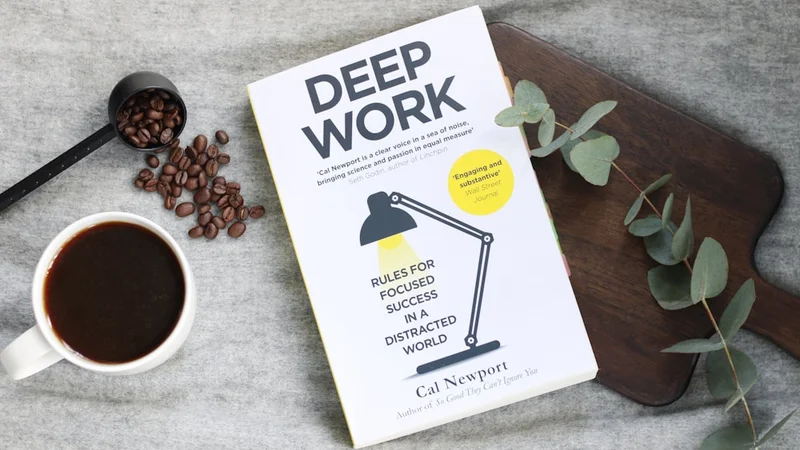
Cal Newport documented the professional consequences of this in Deep Work — a book that remains one of the most practically honest things written about knowledge work in the past decade. His central argument is that the capacity for sustained, focused work on a single cognitively demanding task is becoming simultaneously rarer and more economically valuable. Not because focus is some exotic skill — it isn't — but because the default architecture of modern work (open-plan offices, always-on messaging, notification-saturated devices) has systematically dismantled the environmental conditions that make sustained focus possible. We've built elaborate coping mechanisms for the chaos of fragmented attention rather than questioning whether fragmented attention was the right design choice in the first place.
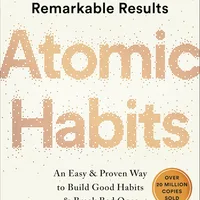
Atomic Habits
Cal Newport’s Deep Work argues that sustained focus is becoming the rarest knowledge-worker skill. Atomic Habits gives you the system layer underneath — the small, environment-driven changes that compound into a focus…
As an Amazon Associate, we earn from qualifying purchases — at no extra cost to you.
The result is that most people's best cognitive work — the thinking that actually moves things forward — happens in whatever accidental gaps appear between interruptions. That's not a productivity strategy. That's hoping for leftovers.
The Hidden Cost You Never See on Any Invoice
Here's an exercise worth doing once.
Think about the hourly value of your most cognitively demanding work — the kind of thinking that produces real output. Now multiply that by the number of context switches you make on a typical morning. Conservative estimate: five switches between 9 AM and noon. At 23 minutes of recovery time per switch, that's 115 minutes — nearly two hours — of cognitive bandwidth quietly consumed by attention recovery alone. Before you account for the quality degradation that comes from never giving any single task your full computational resources.
The loss isn't just time. It's ideas that don't fully form. Decisions made at 60% of their potential quality. Writing that's technically correct but somehow flat. Projects that take weeks because they've never received a single sustained block of genuine attention long enough for your best thinking to surface.
Chris Bailey, who wrote Hyperfocus, frames this with a distinction that's worth internalizing: attention and time are not the same resource. You can spend identical amounts of time on two pieces of work and produce dramatically different output depending on the quality and depth of attention you bring. Multitasking trades your time while stealing your attention. You show up on the clock, but you're never really there.
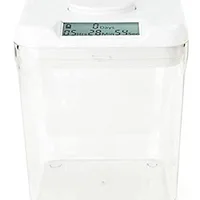
kSafe Time-Locking Container
If multitasking trades your time while stealing your attention, the phone is the single largest attention thief on most desks. The kSafe makes ‘phone out of sight’ a structural rule — once the timer starts, the box is…
As an Amazon Associate, we earn from qualifying purchases — at no extra cost to you.
This is why the shift to single-tasking produces better results in less time — not because you're working harder, but because you're finally directing your full cognitive resources toward one thing at a time instead of thinly spreading them across several.
How to Stop Multitasking: A Single-Task Setup That Actually Works
The reason "just focus on one thing" fails as advice is that it treats attention as a discipline problem rather than an architecture problem. Your environment is optimized for distraction. Every notification system, every messaging app, every open-tab browser was designed by people whose incentives involve you interacting with their software more frequently — not producing better work. Willpower can't win that fight indefinitely.
What works is redesigning the environment so that single-tasking is the path of least resistance rather than an act of constant self-overriding.
Use a physical timer as a commitment signal.
Digital calendar blocks are invisible. A physical timer on your desk is not. When the timer is running, the rule is simple: one task, nothing else, until it stops. The act of setting the timer is itself a commitment ritual — your brain interprets it as the start of a bounded focus period, which makes sustaining attention significantly easier than staring down an open-ended block of "I should concentrate." The Pomodoro Technique — 25 minutes of focused work, a short break, repeat — is the most widely used implementation of this. The specific duration matters less than the physical signal and the finite endpoint. Knowing there's a defined stop coming makes the focus feel achievable rather than indefinitely demanding.
Create a single-task physical workspace.
One browser window. One tab. Notifications off — all of them, not selectively. Phone out of sight. On your desk: only what directly serves the current task.
Noise-cancelling headphones have become, for many knowledge workers, the most useful single tool in their physical environment — not primarily because of the music or audio they deliver, but because of what they remove. Ambient conversation, office noise, and environmental interruptions are among the most common involuntary attention captures. More importantly, putting them on functions as a behavioral signal: you're entering a focus state. Over time, that association deepens.

Sony WH-1000XM5 Noise Cancelling Headphones
Noise-cancelling headphones aren’t primarily about audio — they’re about removing involuntary attention captures and signalling ‘focus mode’ to your nervous system. The Sony WH-1000XM5 is the benchmark in that categor…
As an Amazon Associate, we earn from qualifying purchases — at no extra cost to you.
Go analog for your most cognitively demanding thinking.
There's something the research consistently confirms but most people resist: digital environments — even clean, distraction-free ones — carry contextual associations with email, messaging, and browsing that create subtle attention competition even when those apps are closed. Your laptop screen is where notifications live. That association doesn't disappear just because you've opened a writing app.
Analog tools — a good notebook, a pen, paper — carry none of those associations. For thinking-intensive work, outlining, problem-solving, initial brainstorming, and first-draft writing, many consistently high-output thinkers work longhand specifically because the medium doesn't prompt context-switching impulses. Darwin's working notebooks. Leonardo's codices. Virginia Woolf's diaries. These weren't quaint affectations — they were environments engineered for sustained thinking.

Moleskine Classic Notebook
Darwin’s notebooks. Leonardo’s codices. Virginia Woolf’s diaries. Analog tools carry no notification associations — they don’t prompt context-switching impulses the way a screen does. The Moleskine Classic: hardcover,…
As an Amazon Associate, we earn from qualifying purchases — at no extra cost to you.
Sequence your cognitive load deliberately.
Not all focused work is equally demanding, and the cost of switching depends heavily on the cognitive weight of the tasks on either side of the transition. Moving from deep analytical work to shallow administrative tasks is far cheaper than switching between two high-attention projects.
Design your days with this in mind. Do your most demanding single-task work first, when your attention is freshest — before meetings, before email, before the day's friction accumulates. Batch your email into two or three designated windows rather than maintaining an always-open inbox. Group shallow, low-attention tasks together in a single block at the day's edge. Gary Keller and Jay Papasan built an entire planning philosophy around the clarifying question worth asking every morning: "What's the one thing I can do such that by doing it, everything else becomes easier or unnecessary?" It's a forcing function that strips the day down to its most important single focus before the noise starts.
What the Numbers Actually Show About Monotasking vs Multitasking
A few findings worth knowing — because evidence is more durable than inspiration.
A Stanford University study by Clifford Nass, Eyal Ophir, and Anthony Wagner tested heavy multitaskers against light multitaskers on a battery of cognitive tasks. The heavy multitaskers performed worse on every single measure — including filtering irrelevant information, switching between tasks efficiently, and maintaining working memory. People who multitask constantly are, demonstrably, worse at multitasking than those who rarely do it. The habit degrades the very capacities it's supposed to exercise.
Research from the American Psychological Association found that task-switching costs can consume as much as 40% of productive time. A study published in the Journal of Experimental Psychology: General found that interruptions of just 2.8 seconds doubled error rates on sequential tasks.
The scientific literature is not ambiguous. Multitasking as a productivity strategy doesn't deliver on its promise. It creates a convincing feeling of productivity — busyness, activity, responsiveness — while quietly undermining its substance.
It's also worth noting what happens in the opposite direction. Studies on surgeons, air traffic controllers, and software engineers consistently find that the highest performers in each field share one common behavioral signature: they are dramatically less interruptible during their most consequential work than their average-performing peers. They don't have better focus genes — they have better focus environments. Environments they built deliberately, or were placed into by the nature of high-stakes work.
The most productive people you've probably observed aren't the ones with the most browser tabs and the fastest reply times. They're the ones who seem unreachable for stretches of hours and then emerge with something you couldn't have produced in a week of fragmented afternoons.
How to Start Single-Tasking Today: Your First Experiment
You don't need a productivity overhaul. You need one 45-minute experiment.
- Identify the one task in your current work that most needs your full thinking — the thing you keep deferring because you "need to really concentrate on it."
- Set a physical timer for 45 minutes and put your phone in another room or on airplane mode.
- Close everything on your screen that doesn't directly serve this task.
- Write the task name at the top of a physical notepad. This anchors your intention. Any stray thoughts that surface during the session go on the notepad — not into a new tab, not into a text message.
- Work until the timer ends. Don't optimize the conditions first. Don't check anything. Begin.
The reason this experiment is worth doing before committing to any larger system is simple: you need to feel the difference yourself, not just understand it intellectually. Reading about monotasking is like reading about cold water swimming — the information tells you very little compared to getting in. Once you've experienced the quality of thinking that 45 uninterrupted minutes produces, going back to fragmented work feels like a demotion you'd never voluntarily accept.
At the end of 45 minutes, look at what you produced. Compare it — honestly — to what you typically produce in an equivalent period of distracted, multi-window work. That single comparison is usually all the persuasion anyone needs.
The Attention You Give Is the Work You Get
Seth Godin put it simply in a recent post: we're not multitasking — we're slicing our focus and jumping compulsively between fragments of things. Nothing gets our whole mind. Everything gets a piece of it.
Flip that observation and you have one of the most counterintuitively powerful ideas in productivity: when something gets your whole mind, even for a bounded, finite period, you get back a quality of thinking — and a quality of experience — that's categorically different from anything assembled in fragments.
Jim Rohn used to say that success is the study of the obvious things most people overlook. Giving one thing your full attention, one task at a time, is exactly that. It's not a sophisticated technique. It doesn't require expensive tools or extreme discipline. It requires something simpler and, for most people, considerably harder: deciding what deserves your attention — and then actually giving it.
Your attention is the most finite resource you have. Unlike money, you can't earn more of it. Unlike time, you can't schedule more of it into existence. You can only allocate what you have. And the quality of your work, your thinking, and your output across every domain is, in the end, a direct reflection of where that attention goes.
Designing your evolution starts with one question: what would change if, starting tomorrow, you gave one thing at a time your full mind?
What's the task that's been waiting for your whole attention that you've been giving only a fraction of?
Was this helpful?