Mindset· 11 min read
Lofty Questions: Why Asking Works Better Than Affirming
Affirmations often fail because the brain resists statements it doesn't believe. Lofty questions bypass that resistance — here's how to use them.

Lofty Questions: Why Asking Works Better Than Affirming
The Post-it note lasted three days. Then it fell off the bathroom mirror, and I didn't bother putting it back.
"I am confident. I am successful. I attract abundance."
I'd been reading them aloud every morning for a little over a week. Somewhere around day four I caught my own reflection mid-recital and had the thought every honest person eventually has about affirmations: my brain knows I'm lying to it. That small, uncomfortable moment is where this article starts. Because what I stumbled into next — almost by accident, after picking up a book I'd shelved for months — turned out to be one of the most quietly transformative mental habits I've ever built. It's called a lofty question. Once you see how it works, affirmations start to feel like a hammer trying to do a surgeon's job.
The uncomfortable science of why affirmations often fail
For decades, self-help has sold the same idea on an endless loop: say it enough times, and your subconscious will eventually believe it. Louise Hay built an empire on mirror work. Every motivational poster on every dentist's wall carries some flavor of "I am enough." Some people swear it changed their life, and I don't want to dismiss them — repetition of any belief produces something.
But here's what usually gets left out of the pitch.
In 2009, the psychologist Joanne Wood and her colleagues at the University of Waterloo published a study in Psychological Science titled "Positive Self-Statements: Power for Some, Peril for Others." They asked participants to repeat the phrase "I am a lovable person" over and over. For people with high self-esteem, the effect was mildly positive. For people with low self-esteem — the exact audience affirmations are typically sold to — the effect was the opposite of what you'd expect. They felt worse afterward. Not neutral. Worse.
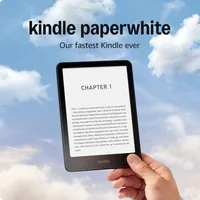
Kindle Paperwhite (2024)
This article references seven major authors on mindset and the subconscious. A Kindle puts their full libraries one tap away — no excuses to delay going deeper.
As an Amazon Associate, we earn from qualifying purchases — at no extra cost to you.
Your brain has an internal fact-checker. Psychologists call it cognitive dissonance, but you can think of it as a friend who interrupts every exaggerated story you tell. When you declare "I am confident" and a deeper part of you disagrees, you don't absorb the new belief. You reinforce the old one. Your nervous system files the statement under things we're pretending, and the gap between who you are and who you claim to be gets louder, not quieter.
You've felt this. The awkwardness of saying something out loud your body doesn't agree with. That micro-flinch you cover with a smile. That isn't weakness. That's an accurate signal your brain is giving you, and ignoring it has a cost.
So the real question isn't whether positive thinking matters. It does. The question is: how do you introduce a new idea to your brain without triggering the immune response?
That's where lofty questions come in.
What a lofty question actually is
A lofty question isn't an affirmation in a clever disguise. That distinction matters more than it looks.
An affirmation says: I am wealthy.
A lofty question asks: Why is it so easy for me to create wealth in my life?
Notice what just happened. Your brain didn't have time to argue with the premise because it was too busy reaching for an answer. You didn't have to believe you're wealthy. You just had to let your mind wander into the reasons it might be easy. And while you wandered, your attention was quietly gathering evidence.
This is the move Vishen Lakhiani popularized through Mindvalley, but the underlying mechanism predates the name. Noah St. John called a related practice "afformations." Socrates built an entire method of inquiry on it twenty-four centuries ago. Good coaches have been using it for a century. The reason lofty questions work isn't mystical — it's cognitive.
Your brain runs a search engine in the background. Neuroscientists describe the relevant circuit as part of the reticular activating system, the filter that decides which slice of the infinite sensory input around you gets through to your conscious mind. Ask it a vague question, and it returns vague results. Ask it a precise, lofty question — one that assumes a positive outcome and asks why — and the filter starts working for you, often without you noticing.

Why the question format slips past your internal skeptic
There's a word in linguistics called presupposition. It's the hidden information baked into a sentence that the listener has to accept before they can even engage with the surface content. "Have you stopped lying to your partner?" presupposes you were lying. You can't answer the surface question without first processing the hidden one.
Lofty questions use the same move — except in your favor.
Why is my energy so sharp at 6 AM?
Why do ideas come to me so easily when I sit down to write?
Why am I becoming the kind of person who follows through on what they start?
Each of those questions carries an assumption. And because the assumption is wrapped inside an inquiry, your brain accepts the frame without debating it. You don't have to convince yourself you're sharp, creative, or reliable. You just have to wonder, honestly, why you might be.

Sony WH-1000XM5 Noise Cancelling Headphones
The morning lofty-question practice only works when external noise isn't competing for attention. These headphones create the sensory container the ritual needs — silence on demand.
As an Amazon Associate, we earn from qualifying purchases — at no extra cost to you.
Tony Robbins has said that repetition is the mother of skill. He was right, but he was talking about something deeper than rote practice. Every question you ask yourself installs a groove in your thinking. The difference between someone who asks why does this always happen to me? for a decade and someone who asks what might this be teaching me? for a decade isn't personality. It's the accumulated weight of a million tiny questions, each one steering attention a few degrees, every day, for years.
How to design a lofty question that actually works
Bad lofty questions sound like affirmations wearing a costume. Good ones feel slightly thrilling to ask — like you almost don't want to know the answer, because the answer might make a demand of you.
Three tests. Run them on every question you write.
Test one: The honest flinch. Read the question aloud. Does anything in you resist? Good. A small resistance means you've picked a question that's outside your current self-image but not so far outside that your brain rolls its eyes. If the question feels completely comfortable, go bigger. Comfort is a sign you're restating what you already believe.
Test two: The why frame. Most lofty questions start with why or what is it about. "Why do I finish every book I start?" works. "Am I a person who finishes books?" doesn't — it's a yes-or-no trap, and your brain will gleefully answer no and move on.
Test three: The specific texture. Vague questions produce vague answers. "Why is my life so good?" is lazy writing. "Why is it getting easier to say no to the second glass of wine on Wednesday nights?" gives your brain something to actually grip.
Here's a starter set, deliberately generic. Adapt, don't copy.
- Why is it getting easier for me to focus for long stretches without my phone?
- Why do the right people keep showing up at the right moments in my life?
- Why am I becoming someone who handles discomfort with more grace?
- Why do I notice the quiet signals before the loud ones?
- What is it about my mornings that feels so different lately?
You'll notice none of them claim a present-tense fantasy. They assume a trajectory. That assumption is what your brain goes to work on.
The compound interest of asking better questions
Napoleon Hill wrote that thoughts become things. He was under-selling it. Thoughts don't become things — questions do. A thought passes through. A question stays until it's answered, and if you don't answer it consciously, your subconscious will answer it for you, usually while you're doing something else.
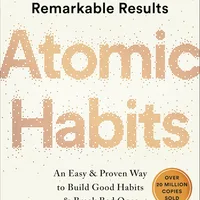
Atomic Habits — James Clear
The article argues questions compound over years like habits do. This is exactly the identity-based framework Clear built Atomic Habits around — the modern synthesis of Napoleon Hill and Jim Rohn.
As an Amazon Associate, we earn from qualifying purchases — at no extra cost to you.
This is why Jim Rohn spent so much time on the quality of your daily input. He wasn't being precious about books and audiobooks because he loved reading. He was talking about the compounding effect of the questions your environment forces you to ask. If every piece of content you consume asks what's wrong with the world, you will become, over a decade, an expert in what's wrong with the world. If you start your day asking why is my focus improving, you become, slowly, an expert in your own focus.
Joseph Murphy described the subconscious as the soil in a garden — it grows whatever seed gets planted, without judging the seed. You, he wrote, are the gardener. A lofty question is a better seed than a worried one. That's the whole game, stripped of mysticism.
If you want to build a morning that primes your questions rather than your anxieties, the habits that support that kind of focus are worth examining. A morning routine designed around deep focus rather than reactive scrolling changes the kind of questions you naturally start asking.
What I noticed after 30 days
I kept a page at the back of a journal with seven questions. Every morning, before coffee, I read them. I didn't try to answer them. I just let them sit.
The effects weren't mystical. My life didn't suddenly rearrange itself. But three things shifted, and I'd bet they'd shift for you too.
First, my problem-definition got sharper. Instead of circling the same vague dissatisfaction — I feel stuck — I started naming specific frictions, which meant I could actually address them. Questions forced precision. Complaints never do.
Second, my evidence-collection changed. When I asked why is it getting easier to write in the mornings, I started noticing the mornings where it was easier, instead of only the ones where it wasn't. The good days had always been happening. I'd just been filtering them out of memory.
Third, my self-talk got quieter. Not louder, and not more positive — quieter. A brain busy looking for an answer to a real question doesn't have spare bandwidth for the usual background noise.

How to start today (the five-minute version)
You don't need an app. You don't need a course. You don't need to buy anything, technically. But if you want a container for the practice — something so it doesn't evaporate by Friday — a physical journal does the work better than a Notes app ever will. Writing slows you down just enough for the questions to land.
Here's the whole protocol.
Step one. Find a notebook you actually like the feel of. Something you'd be willing to open on a Monday morning. Mine's small, hardcover, and fits in a coat pocket. Aesthetic matters more than people admit — you open what pleases you.
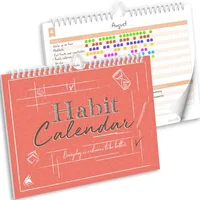
Clever Fox Habit Calendar Circle
The literal notebook this protocol calls for — 24 colorful pages with inspirational cues and space for daily habit tracking over two years. Aesthetic matters: you open what pleases you.
As an Amazon Associate, we earn from qualifying purchases — at no extra cost to you.
Step two. Write five lofty questions on the inside cover. Use the three tests above. Don't overthink it. You'll revise them within two weeks, and that's the point.
Step three. Every morning, before your phone, read them. Out loud if the room allows. Do not try to answer them. Do not journal a response. Just read, pause, and let them sit there.
Step four. Once a week, notice which ones stopped producing any flicker when you read them. Those are the ones your brain has absorbed. Replace them with bigger versions — the next layer of who you're becoming.
Step five. Every few months, read the journal pages from the beginning. You'll notice something quietly remarkable: the questions you used to ask, you no longer need to.
The small habits that compound over a year are often the ones that feel almost too simple when you start them — and this practice is one of the simplest, most durable ones you can build into a morning.
If you want to stack this with reading — and this practice pairs naturally with books that speak the same language of intentional design — it doesn't need to be a stack of ten. One good one, read slowly, matters more than ten skimmed.
The honest caveat
Lofty questions aren't magic. They won't compensate for chronic sleep deprivation, unresolved relationships, or a career you actively hate. No mental practice does, and anyone selling otherwise is selling you a pretty bottle of nothing.
What they do — what they reliably do — is shift the search your brain runs in the background from what's wrong to what's working. That shift alone doesn't fix your life. It changes what you see. And what you see eventually determines what you do, which, stubbornly and quietly, changes what your life becomes.
Tony Robbins is right about one thing in particular: the quality of your life really is the quality of your questions. Affirmations skipped the question entirely and tried to hand your brain the answer. Lofty questions do the opposite. They hand your brain a better question — and then they have the good sense to get out of the way.
Closing: the question worth carrying
Every evolution you've ever designed — the body you built, the career you shaped, the relationships you chose — started with a question you decided to live inside. Most people inherit their questions from parents, culture, algorithms. A few people sit down and write their own.
The practice isn't complicated. It doesn't need a guru, a subscription, or a 21-day challenge. It needs one notebook, five minutes, and the willingness to ask something slightly more interesting than you asked yesterday. That's the whole architecture.
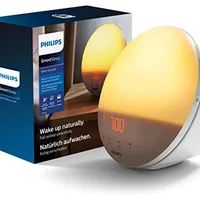
Philips Wake-Up Light
The protocol says "every morning, before your phone, read them." This solves the unstated prerequisite: how do you wake up without reaching for a screen? Sunrise simulation wakes you to light, not notifications.
As an Amazon Associate, we earn from qualifying purchases — at no extra cost to you.
So here's mine, for you, to carry out of this page: what would your life look like, six months from now, if the first sentence you read every morning quietly assumed you were already becoming who you wanted to be?
Tell me in the comments. I read every one.
Was this helpful?