Mindset· 10 min read
Overthinking Isn't a Thinking Problem. It's a Loop Problem.
Overthinking isn't a discipline problem — it's a loop your brain runs automatically. Here's what 30 years of rumination science says about breaking it.

Overthinking Isn't a Thinking Problem. It's a Loop Problem.
Sunday evening. 9 PM. You've been staring at the same email draft for forty minutes, and it's a three-sentence reply that doesn't require any real deliberation. Or maybe it's a job offer you've been "thinking through" for two weeks. A relationship you keep rotating from every angle. A business decision you've re-examined so many times that it looks different every time you look at it.
That thing you're calling "thinking it through"? Psychologists have a specific name for it — and understanding the distinction changes everything about how you approach your own mind.
Here's the mistake most people make: they treat overthinking as a discipline problem. If they could just be more decisive, more confident, less anxious, they'd stop getting stuck inside their heads. So they try to force their way through the loop — thinking harder, gathering more information, waiting for the certainty that never quite arrives.
Twenty years of research says this approach doesn't work. It makes things measurably worse. And the reason why is more specific, and more fixable, than most people realize.
The research nobody quotes (but everyone should know)
Susan Nolen-Hoeksema spent two decades at Yale and Michigan building the foundational science of what she called the ruminative response style — the tendency to respond to distress by repetitively and passively focusing on feelings of distress and their possible causes, rather than taking action.
Her longitudinal research documented outcomes that should make anyone take this seriously: ruminators show significantly higher rates of depression onset than non-ruminators in prospective studies. They experience longer and more severe depressive episodes. They're significantly more likely to use alcohol as a suppression strategy. A 2008 review in Perspectives on Psychological Science, co-authored with Blair Wisco and Sonja Lyubomirsky, documents all of this with striking clarity. These aren't consequences of whatever you're worrying about. They're consequences of the rumination itself.
But here's the finding that matters most: rumination is not failed problem-solving.
It feels like problem-solving. The internal experience is of working through something important. But the cognitive structure is circular, not progressive. You're covering the same ground, generating the same emotional activation, and arriving at the same impasse — while depleting the mental resources that actual decision-making requires.
The distinction she established is operationally precise. Productive reflection generates new information, considers possibilities not yet examined, and produces decisions or commitments — even provisional ones. Rumination generates emotional intensity without new information and produces no decisions. Only increased ambivalence and fatigue.
If you've been circling the same question for more than thirty minutes without arriving somewhere new, you're not problem-solving. You're running a loop.
Building mental clarity through a daily reflection habit starts with knowing which kind of thinking you're actually doing.
Why loops feel like progress
The reason overthinking is so persistent is that it masquerades as usefulness. When you're stuck in a ruminative loop, there's no obvious moment of failure. You don't hit a wall. You just keep going in circles with a vague sense that you're not quite done yet — that if you just think a little longer, clarity will arrive.
It rarely does. And there's a structural reason for that.
Barry Schwartz's research at Swarthmore identified a specific pattern that makes people particularly vulnerable to the overthinking loop: the maximizer mentality. Maximizers set an internal standard of needing to find the best possible option — not just a good one, but the optimal one. And that standard guarantees there is always more analysis to do before the threshold for "confident decision" is reached.
The threshold keeps moving.
What his research consistently shows is counterintuitive: maximizers make worse decisions and end up less satisfied with their choices than people who apply a "good enough" standard (satisficers). Because the maximizing standard ensures that every option you choose comes loaded with a mental catalogue of all the potentially better options you didn't choose. You pick the restaurant, but you spend the whole dinner thinking about the three other restaurants you researched.
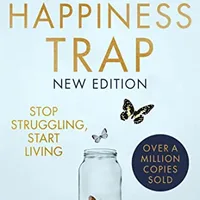
The Happiness Trap (2nd Edition) — Russ Harris
Harris's ACT framework targets the maximizer trap directly — the catalogue of better options not chosen that loads every decision with regret. The practical companion to Schwartz's research on satisficing.
As an Amazon Associate, we earn from qualifying purchases — at no extra cost to you.
More options and more analysis don't produce better choices in genuinely uncertain domains. They produce the illusion of thorough consideration while increasing the regret that follows any decision you actually make.
Gerd Gigerenzer at the Max Planck Institute for Human Development has spent thirty years documenting this effect from the opposite direction. His "recognition heuristic" — choose the recognized option when one is recognized and one is not — and his "take the best" heuristic — make decisions based on a single best predictor rather than integrating all available information — consistently outperform complex decision strategies in environments with genuine uncertainty.
His conclusion is one the productivity industry tends to avoid: in genuinely uncertain domains, more analysis does not produce better outcomes. It produces the illusion of progress while eroding the intuitive signal that good heuristics are designed to use.

Sony WH-1000XM5 Noise Cancelling Headphones
Gigerenzer's heuristics work in environments with clear signal — but overthinking is triggered by environmental noise that crowds out intuition. Physical sound isolation creates the cognitive space to actually hear yo…
As an Amazon Associate, we earn from qualifying purchases — at no extra cost to you.
Three interventions that actually work (with research behind them)
The science of overthinking isn't just diagnostic. It's prescriptive. Three specific interventions emerge from the research with the strongest empirical support — and none of them involve trying harder.
1. The third-person shift (Ethan Kross)
Ethan Kross at the University of Michigan discovered that a deceptively simple shift in language produces genuinely different neural processing during ruminative episodes.
Instead of asking yourself "why am I so stuck on this?" — first person, inside the problem — you ask: "why is [your name] so stuck on this?" Third person. Outside the problem, looking in.
The shift reduces activation in the medial prefrontal cortex — the brain's self-referential processing region associated with rumination and emotional reactivity — producing the detached, evaluative quality of a wise adviser rather than the immediate emotional reactivity of someone standing in the middle of the situation. In multiple experimental paradigms, this single reframing produced measurably better emotion regulation and clearer conclusions.
You already know this intuitively: you give better advice to your friend than you give yourself. Not because you're smarter about their problems. Because you're not standing inside them.
The practical application is immediate. Next time you're stuck, open a notebook and write one sentence in the third person: "[Your name] is trying to decide whether to..." Often the answer becomes clear within two or three sentences. You don't need a thirty-minute journaling session. You need the perspective that comes from stepping outside the first person.

Moleskine Classic Notebook — Hardcover, Large, Ruled
The third-person shift described here explicitly says: open a notebook and write one sentence in the third person. The notebook IS the intervention vehicle — not a metaphor, not optional.
As an Amazon Associate, we earn from qualifying purchases — at no extra cost to you.
2. The scheduled worry window (Thomas Borkovec)
Thomas Borkovec's research on "stimulus control treatment" for worry at Penn State — first published in 1983 in Behaviour Research and Therapy — established something practically important: you don't have to stop a thought. You just have to move it.
His protocol: designate a specific 15–30 minute daily window for worries and unresolved questions. When a ruminative thought appears outside that window, you acknowledge it — "I'll think about this at 5pm" — and redirect, rather than engaging or suppressing.
This works because it interrupts the association between environmental cues and automatic ruminative activation. The thought appears because something in your environment triggered the loop. Postponing it breaks the immediate cue-response chain without requiring you to simply "stop thinking about it" — which, as you probably know, doesn't work.
Most people discover, when the designated window arrives, that half the things they were planning to worry about have resolved themselves or no longer feel urgent. The ones that remain are genuinely worth the allocated attention.
The setup matters: write the thought down the moment you postpone it. Don't trust your working memory to hold it safely. A simple notepad — physical or digital — serves as the container that lets your brain actually let go.

3. The 10-10-10 framework (Suzy Welch)
Suzy Welch's framework for interrupting analysis paralysis asks three questions about any stuck decision: How will I feel about this in 10 minutes? In 10 months? In 10 years?
This time-expansion technique reliably reveals something most people intellectually know but can't feel during an overthinking episode: the vast majority of overthought decisions are completely invisible at the ten-year horizon. The email draft. The awkward social moment. The minor career choice. From ten years out, they simply don't appear.
Only genuinely significant decisions survive that horizon — and those decisions, it turns out, rarely require more analysis. They require more clarity about your values. Which is something no additional research can provide, but a single honest conversation with yourself usually can.
The 10-10-10 rule doesn't tell you what to decide. It reveals which decisions actually deserve the mental real estate you're giving them.
The perfectionism connection nobody talks about
There's a specific dynamic worth naming directly, because it's far more common than most people admit: perfectionism doesn't produce better work. It produces more thinking and less output.
The perfectionist's logic is that the additional thinking is leading somewhere — toward a final, defensible, optimal result that won't invite criticism. But what the additional thinking usually produces is decision fatigue, narrowed perspective (you've stared at the same question so long you can no longer see it freshly), and the particular anxiety that comes from having invested so much time in a decision that you now need it to be right.
The hidden cost of perfectionism and how to actually let go runs deeper than most people expect — and it's directly connected to the loops described here.
Nolen-Hoeksema's research is unambiguous about this: the loop doesn't produce better decisions by running longer. It just produces more emotional activation around the same set of considerations. And that activation narrows your thinking — threat-response states decrease creative problem-solving, increase cognitive rigidity, and reduce access to the broader associative thinking that actually generates new ideas.
Put simply: if you've been thinking about something for longer than it would take to just do it, you're no longer in service of the outcome. You're in service of the anxiety. And those are two very different things.
How to start today: your anti-overthinking system
These are specific, actionable steps — each one interrupts the loop at a different point in the cycle.
Step 1: Name your trigger contexts. Where do you most reliably get stuck? Sunday evenings? Right before bed? After an ambiguous conversation with your boss? The loop runs on cues. Identifying yours is the prerequisite to interrupting them.
Step 2: Apply the third-person shift immediately. The next time you notice you're rotating on something, write one sentence in third person: "[Your name] is trying to decide whether to..." Observe what becomes visible from outside the first person. Do this before any other intervention.
Step 3: Set a physical worry window. Choose a specific 20-minute slot in your day — not before bed — and let that be the exclusive time for unresolved worries. When something intrudes outside that slot, write it down, close the tab, and continue with what you were doing. Keep a small notebook or an open note on your phone as the official holding space.

Clever Fox Habit Calendar Circle — 24-Month
Step 3 says: keep a small notebook as the official holding space. A dedicated 24-month habit tracker reinforces the worry-window routine long enough for the cue-response chain to actually break — not just for a week.
As an Amazon Associate, we earn from qualifying purchases — at no extra cost to you.
Step 4: Apply the satisficer standard to decisions below a defined threshold. Most decisions don't warrant maximizing. Identify in advance the categories that genuinely do — major financial choices, career pivots, significant relationship decisions — and give everything else the good-enough standard: what's sufficient to move forward with confidence?
Step 5: Set a specific, non-negotiable decision deadline. Not a vague "I'll decide soon." An actual moment: Wednesday at 11am. This isn't arbitrary pressure — it's the recognition that an external constraint converts an open question into a closed one, and the brain treats open and closed questions with fundamentally different urgency levels.
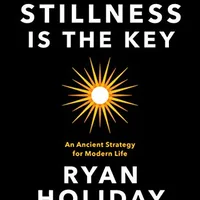
Stillness Is the Key — Ryan Holiday
The article's final argument: overthinking ends through deliberate interruption-by-design, not more thinking. Holiday's Stoic and Buddhist framing of stillness as an engineered state mirrors Nolen-Hoeksema's conclusio…
As an Amazon Associate, we earn from qualifying purchases — at no extra cost to you.
How to break a bad habit when willpower isn't the answer covers the same cue-interruption logic from a behavioral angle — useful if the overthinking feels automatic rather than intentional.

The loop was never going to end on its own
Here's what Nolen-Hoeksema's research makes explicit and most people discover too late: the loop doesn't end because you've thought long enough. It ends because something interrupts it — a phone call, a deadline, a commitment you made to someone else, sheer exhaustion.
Every instance of natural relief from an overthinking episode wasn't the result of the thinking. It was the result of the interruption.
That's important to sit with. Because it means the interruption is the intervention. Not better thinking. Not more thinking. The deliberate, engineered break in the pattern that gives your prefrontal cortex the reset it needs to actually evaluate something — rather than rotate it indefinitely while calling the rotation progress.
Jim Rohn used to say that you can't change your destination overnight, but you can change your direction. The ruminative mind doesn't need a destination change. It needs a direction change — from circular to forward — and that change doesn't happen through effort. It happens through design.
Designing your evolution means deciding what your mind actually works on, not just what it gets stuck on. That's not a discipline exercise. It's an engineering one. And it starts the moment you stop trying to think your way out of the loop and start building the specific interruption mechanisms that break it at its source.
What's the one decision you've been rotating longest? The one that shows up again every Sunday evening without invitation?
Name it in the comments. Sometimes the act of putting it in writing — in third person — is all the perspective shift you needed to finally see the answer that was there all along.
Was this helpful?