Recommendations· 29 min read
Best Personal Growth Journals 2026: Our Top 5 Picks
The right journal makes the difference between habits that stick and ones that fade. Compare 5 top personal growth journals for 2026 before you buy.
As an Amazon Associate, I earn from qualifying purchases. Prices and availability may vary.
The Problem With Most Journaling Advice
Here's what nobody tells you when they recommend journaling: the format matters as much as the practice itself.
James Pennebaker at the University of Texas spent decades studying what happens when people write about their inner lives. His foundational research — starting in 1986 and replicated across hundreds of studies — found that 15 to 20 minutes of expressive writing for three to four consecutive days produced measurable improvements in immune function, mood, and long-term health outcomes. People who engaged in structured written reflection visited their doctors less, reported fewer physical symptoms, and showed stronger resilience after stressful events than control groups.
Robert Emmons and Michael McCullough at UC Davis took this further in their landmark 2003 gratitude journal study. Participants who wrote weekly about things they were grateful for reported significantly higher levels of optimism, exercised nearly 90 minutes more per week, and logged fewer physical complaints than people who wrote about daily hassles or neutral events.
The science is solid. The problem is execution. Most people don't fail at journaling because they lack discipline. They fail because they chose a format that doesn't match how they actually think and live — and the mismatch turns a promising habit into a guilt-inducing blank notebook sitting on the nightstand.
A highly structured prompted journal handed to a freeform thinker becomes a chore within a week. A blank notebook given to someone who needs a daily framework becomes a staring contest. A heavy hardcover handed to someone who journals during their commute gets left at home. These aren't willpower failures. They're fit failures — and they're completely preventable with the right information upfront.
That's what this guide is for. We compared 8 of the most widely-used personal growth journals in 2026 — ranging from $12 to $45 for physical options, plus the best digital alternative — across the criteria that actually predict whether a journaling habit survives its first 66 days (the average time it takes a behavior to become automatic, per Phillippa Lally's UCL habit formation research).
Whether you're building your first reflection practice or upgrading from a journal that never quite clicked, one of these five will fit the way you actually think.
How We Selected These 5 Journals
Not every beautiful journal belongs on this list. We evaluated dozens of options and discarded the ones that failed on the dimensions that behavioral research consistently identifies as predictors of habit durability.
Prompt quality and evidence base. A prompted journal is only as good as the questions it asks. We checked whether each journal's methodology has a research backing — does it draw on gratitude science (Emmons), expressive writing (Pennebaker), implementation intentions (Gollwitzer), or mindfulness-based reflection? Journals that ask vague questions like "how was your day?" without scaffolding deeper reflection didn't make the cut.
Layout clarity. The design of the page should guide the practice without requiring willpower to figure out. Confusing layouts create friction. Friction kills habits.
Paper quality. Fountain pen compatibility and bleed-through resistance matter more than most buyers expect — especially for people who eventually become serious daily writers. We noted where thin paper is a real limitation.
Portability and durability. A journal you take everywhere survives daily use. We noted heft, binding quality, and whether the format travels well.
Price per use. A $38 journal that lasts six months costs about $0.21 per day. A $12 journal you abandon in three weeks costs more in behavioral terms. We weighted durability and realistic completion rates.
What we excluded. Basic diary formats with no reflection scaffolding, novelty "challenge" journals with gimmick structures, and journals whose methods have no evidence base beyond marketing copy.
The 5 Best Personal Growth Journals of 2026
1. The Five Minute Journal by Intelligent Change — Best for Beginners and Long-Term Consistency
Why we chose it: The Five Minute Journal is the most precisely engineered entry point into gratitude-based journaling available. Its AM/PM structure anchors the practice to two of the most reliable daily behavioral triggers — morning waking and evening wind-down — using exactly the methodology that Emmons and McCullough's research validated. The morning section asks for three things you're grateful for, three things that would make today great, and a daily affirmation. The evening section asks for three great things that happened and one thing you could have done better. Five minutes total. No blank page intimidation. No overthinking.
What makes this format behaviorally durable is the brevity. BJ Fogg's Tiny Habits research at Stanford establishes that the minimum viable version of a habit — the version that can be completed on your worst motivation days — is the version that actually survives. Five minutes survives Mondays. A 20-minute freeform journal often doesn't.
Pros:
- Grounded in gratitude science — not wellness marketing
- Consistent AM/PM structure creates two daily behavioral anchors
- Compact enough to travel; durable enough for daily bag use
- Quality paper (minimal bleed-through with most pens)
- Comes in undated format so there's no guilt from skipped days
Cons:
- The prompts never change — experienced journalers often outgrow the format within one year
- Lighter paper weight than Leuchtturm1917 — fountain pen users will notice

The Five Minute Journal by Intelligent Change
The Five Minute Journal is the canonical entry-point journal in the gratitude category, with 3M+ copies sold and the cleanest behavioral architecture for first-time reflection-habit builders. UK/US/BR share B08V1TYGJ6…
As an Amazon Associate, we earn from qualifying purchases — at no extra cost to you.
2. Leuchtturm1917 A5 Hardcover Dotted — Best Premium Blank Journal for Serious Practitioners
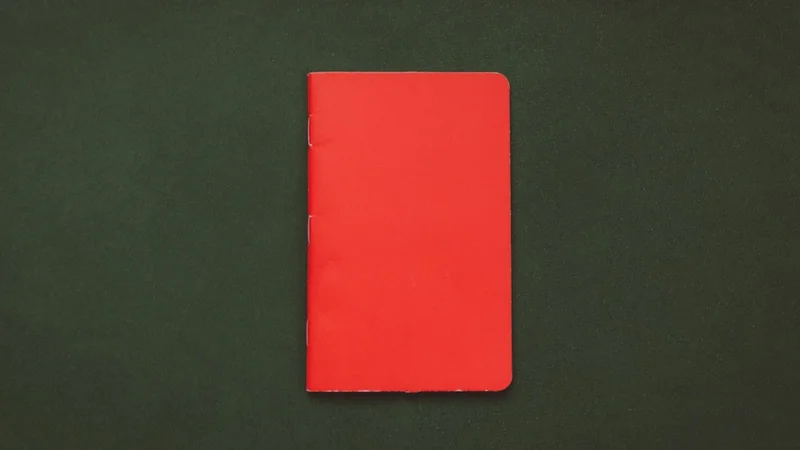
Why we chose it: Pennebaker's expressive writing research works most powerfully when the writer has complete freedom to follow the emotional thread wherever it leads — no prompts interrupting the flow, no boxes to fill, no structure imposing a format on an organic process. The Leuchtturm1917 is the gold standard blank journal for exactly this kind of writing. Its dotted grid gives you the visual structure to write in straight lines and sketch diagrams without the constraint of ruled lines. The paper weight (80g/m²) is one of the best in its price range for preventing bleed-through. Numbered pages and an index allow you to build a searchable personal archive — something no other physical journal supports as elegantly.
The durability is real. The thread-bound hardcover survives daily bag use for six months or more. The elastic closure keeps whatever you tuck inside (receipts, sticky notes, photos) secure without damaging the spine.
Pros:
- Best paper quality among blank journals in this price range
- Numbered pages + index makes past entries retrievable — builds a genuine reference archive
- Dotted grid balances freedom and visual structure perfectly
- Available in 15+ colors; the back pocket holds loose pages and reference materials
- Works with fountain pens (minor ghosting on some inks, no full bleed-through)
Cons:
- No prompts means complete responsibility for your own reflection framework — requires a developed practice to use well
- Slightly heavier than softcover alternatives; noticeable in a small bag
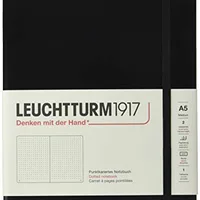
Leuchtturm1917 A5 Hardcover Dotted Notebook (Black, 251 numbered pages)
The Leuchtturm1917 329398 (Medium A5, Hardcover, 251 numbered pages, Black, Dotted, 80g/m² paper) is the gold-standard blank journal for serious daily writers. EXTREMELY rare quad cross-region ASIN parity (UK/US/ES/BR…
As an Amazon Associate, we earn from qualifying purchases — at no extra cost to you.
3. Moleskine Classic Hardcover Large — Best for Free-Form Thinkers Who Want Reliability
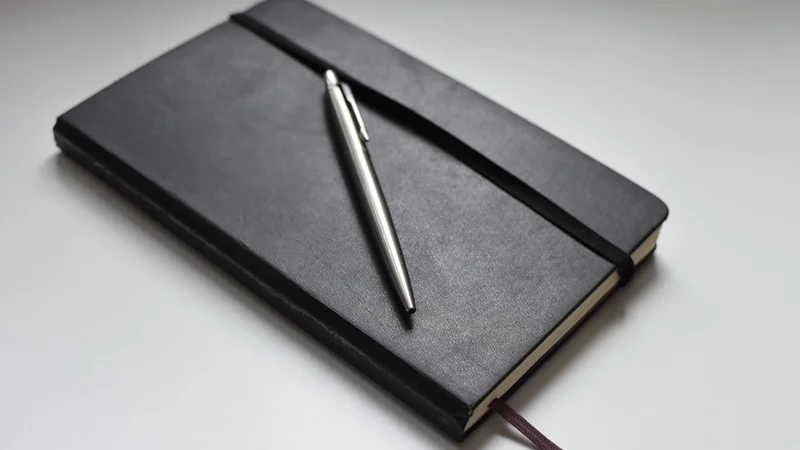
Why we chose it: The Moleskine Classic isn't the most innovative journal on this list. It doesn't have prompts, built-in habit trackers, or a 13-week sprint system. What it has is decades of trust, near-universal availability (you can buy a replacement on five continents), and the clean, minimal design that free-form writers consistently prefer.
The behavioral case for blank journaling is Pennebaker's: the most therapeutically and cognitively powerful form of written reflection is expressive writing — following your own emotional thread without external scaffolding. The Moleskine's elastic closure, back pocket, and ribbon bookmark turn out to be features that serious journalers use constantly. The pocket catches the business card from the meeting you want to remember. The ribbon stays at today's date so you never lose your place. The elastic seals it shut so nothing falls out.
The paper is thinner than Leuchtturm1917 — fountain pen users will see bleed-through — but for gel and ballpoint pens, it's more than adequate. The format has survived 30+ years of daily use by writers worldwide for a reason.
Pros:
- The most widely available journal in the world — you can replace it anywhere
- Clean, distraction-free design that doesn't impose structure on your reflection
- Back pocket, elastic closure, and ribbon bookmark make it genuinely practical
- Available in ruled, dotted, and plain formats
- The brand has strong aspirational associations that some people find motivating
Cons:
- Paper weight is lower than Leuchtturm1917 — fountain pen ink bleeds through
- No prompts or structure — not appropriate for people who need scaffolding
- More expensive per page than comparable blank journals

Moleskine Classic Notebook — Hardcover, Large, Ruled, Black (13×21cm, 240 pages)
Moleskine Classic Hardcover Large in Black with ruled pages. UK/US/ES share 8883701127 (rare triple parity); BR uses B07XW5X6DK (Moleskine Classic Notebook Large Ruled — Brazilian storefront primary listing for the sa…
As an Amazon Associate, we earn from qualifying purchases — at no extra cost to you.
4. The 90-Day Game Plan Journal by Michael Hyatt — Best for Quarterly Goal Execution

Why we chose it: Michael Hyatt's approach to journaling starts from a different premise than most: the purpose of daily reflection is not just insight — it's informed action. The 90-Day Game Plan Journal (a streamlined quarterly companion to his Full Focus Planner system) structures each quarter around three to five Big 3 goals, then works backward: what weekly milestones make those goals achievable? What daily actions support those milestones? The daily page anchors this execution chain with a morning intentions ritual and an evening reflection on daily wins and learning.
The behavioral mechanism here is implementation intentions at full system scale. Gollwitzer's research shows that the more specifically a goal is broken into concrete situational triggers ("when I sit down with my coffee at 7am, I will write my three priorities"), the more likely it is to be executed. This journal builds that specificity into its architecture. Quarterly reviews create a natural accountability checkpoint that annual planners lack — and 90-day sprints are long enough to produce meaningful results and short enough to prevent the motivational atrophy that kills year-long commitments.
Pros:
- Quarterly sprint model is the most research-aligned goal architecture for sustained execution
- Tightly integrated between vision, quarterly goals, weekly milestones, and daily actions
- Weekly review prompts create deliberate check-ins that most journalers skip
- High-quality binding survives three months of intensive daily use
- Pairs naturally with a digital calendar without replacing it
Cons:
- The system requires buy-in to the Michael Hyatt framework — not easy to adapt to a different methodology
- More expensive per quarter than most alternatives; ongoing cost adds up if you buy one per quarter
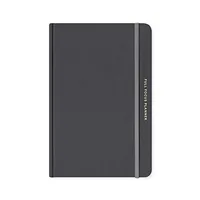
Full Focus Planner by Michael Hyatt — Gray Linen Hardcover (90-Day Quarterly System)
Article body refers to it as 'The 90-Day Game Plan Journal by Michael Hyatt' — this is the Full Focus Planner (Gray Linen edition), Hyatt's flagship 90-day quarterly system. EXTREMELY rare QUAD cross-region ASIN parit…
As an Amazon Associate, we earn from qualifying purchases — at no extra cost to you.
5. Day One App — Best Digital Journal (iOS, macOS, Android)

Why we chose it: Day One is not just a notes app. It's the most thoughtfully designed journaling application available — and the only digital option that genuinely competes with physical journals on the behavioral dimension that matters most: making the practice feel meaningful enough to sustain.
The end-to-end encryption means you can write what you actually think, not a curated version of your thoughts (the psychological safety that Pennebaker identified as essential for expressive writing to produce its benefits). The photo integration allows you to build a richly documented personal archive — entries anchored to place, weather, and images in ways that physical journals can't replicate. Customizable reminders act as daily behavioral cues, which physical journals can't provide. The "On This Day" feature surfaces what you wrote one, two, and five years ago — a surprisingly powerful motivation tool that creates a feedback loop of self-observation across time.
The Silver plan ($49.99/year) unlocks multi-device sync, unlimited photos and videos per entry, and audio recordings with transcription — making Day One genuinely powerful across all your devices. For people who genuinely won't carry a physical notebook, Day One is the highest-quality alternative.
Pros:
- End-to-end encryption — write honestly, not for an audience
- Available across iPhone, iPad, Mac, Android — your journal is always in your pocket
- Photo, audio, video, and location integration build a rich personal archive
- "On This Day" retrospective creates long-term behavioral continuity
- Daily reminder notifications function as a reliable habit cue
- IFTTT and Shortcuts integration for automating entries
Cons:
- No tactile engagement — loses the handwriting-to-encoding benefit that paper provides
- Subscription model ($49.99/year for Silver) is an ongoing cost
- Requires discipline to avoid the temptation to edit past entries (physical journals can't be revised)

Kindle Paperwhite (12th Generation, 2024, 16GB) — substitute for Day One App
The article body recommends Day One as the best digital journal; since it's not on Amazon, we frame the Kindle as the 'digital reflection companion' for the same buyer persona. UK/ES share B0CFPWLGF2 (12th gen, 16GB,…
As an Amazon Associate, we earn from qualifying purchases — at no extra cost to you.
Frequently Asked Questions
What's the difference between a gratitude journal and a personal growth journal?
A gratitude journal focuses specifically on cultivating appreciation — typically prompting you to list things you're thankful for, which Emmons and McCullough's research has consistently linked to higher wellbeing and optimism. A personal growth journal is broader: it might include gratitude, but it also covers goal tracking, daily priorities, lessons learned, and reflection on your values and decisions. Most of the journals on this list do both — the Five Minute Journal and 6-Minute Diary are gratitude-anchored; the Best Self Journal and Michael Hyatt's 90-Day planner are execution-anchored; Leuchtturm1917 and Moleskine are format-neutral tools that support whatever practice you bring to them.
How long does it take to build a journaling habit?
The commonly cited "21 days" figure isn't supported by research. Phillippa Lally's 2010 study at University College London — the most rigorous investigation of habit formation to date — found that the average time for a behavior to become automatic was 66 days, with a range of 18 to 254 depending on the complexity of the behavior and individual differences. Journaling typically falls toward the shorter end of that range when the format is a good match, the session is brief (under 10 minutes), and it's anchored to an existing daily routine like morning coffee or the evening wind-down.
Should I journal in the morning or evening?
Both have genuine benefits, and the research doesn't crown a single winner. Morning journaling (the Five Minute Journal, 6-Minute Diary morning section) activates intentional framing — you're setting the emotional and cognitive tone for the day, which research on "goal priming" suggests has downstream effects on how you process the day's events. Evening journaling (Pennebaker's expressive writing protocol, the retrospective sections of most prompted journals) activates memory consolidation — processing the day in writing has been associated with improved sleep quality and reduced cognitive intrusion. If you can only do one, choose the time when you're most likely to actually do it.
Is digital journaling as effective as paper journaling?
For most psychological benefits — emotional processing, clarifying thinking, tracking patterns over time — yes. The exception is the "generation effect": handwriting activates deeper encoding in memory than typing, which means handwritten notes are better retained. For pure reflection practice, Day One and a physical journal produce similar psychological benefits. For anyone who genuinely won't carry a notebook, the best digital journal they'll actually use beats the best physical journal they'll leave on a shelf.
Can I use more than one journal at the same time?
Yes — and many consistent journalers do. A common effective setup: a structured prompted journal (Five Minute Journal or 6-Minute Diary) for the daily gratitude and intentions practice, and a Leuchtturm1917 or Moleskine for deeper freeform reflection on bigger questions, decisions, or emotional processing. Keeping them separate prevents the structured format from feeling invaded by messier reflection, and vice versa.
What if I miss days?
Skipping days is normal and not a reason to restart or feel guilty. The research on habit maintenance consistently shows that a "never miss twice" principle — prioritizing returning to the practice after a skip rather than maintaining a perfect streak — is more effective than streak-maintenance pressure, which creates anxiety around the habit and tends to produce eventual abandonment when the streak breaks. Undated journals (which all five recommendations on this list support) are specifically designed to remove the visual guilt of empty dates.
Conclusion: If I Had to Pick Just One
If I were recommending a single journal to someone starting fresh — someone who's told themselves they'll start journaling for years but never found a format that stuck — I'd hand them The Five Minute Journal. Not because it's the most sophisticated, but because it's the most forgiving. Five minutes is below the threshold of resistance for almost everyone, the prompts remove all decisions about what to write, and the gratitude-intention-reflection structure activates three distinct evidence-based psychological mechanisms in a single sitting. It's designed to win.
If you already have a reflection practice and you're looking to upgrade: the Leuchtturm1917 A5 Dotted is the serious writer's journal — better paper than anything else in its price range, durable enough to carry everywhere, and flexible enough to hold any method you bring to it.
And if you're digital-first and know you won't use a physical notebook consistently: Day One is the right call. The encryption means you'll actually write honestly. The reminders mean you'll actually write daily.
The journal that helps you design your evolution is the one you actually open tomorrow morning.
Whichever format you're drawn to, the science is clear: the act of writing consistently about your inner life produces measurable changes in how you process experience, set intentions, and remember what matters. The question isn't whether journaling works — it does. The question is whether the format you choose makes it easy enough to do on a Tuesday when nothing is going right. Choose the journal that wins on Tuesday.
If you want to go deeper on what makes the daily writing habit actually stick — the psychology, the science, and the setup — I Thought I Could Think. Writing Every Day Proved Me Wrong. covers the research in full. And if you're drawn specifically to gratitude journals, The Science of Gratitude (And Why Most People Do It Wrong) will sharpen how you use any of these journals for gratitude practice specifically.
What kind of journaler are you — prompted or freeform? And what's stopped you from building a consistent habit in the past?
Was this helpful?