Mindset· 9 min read
Social Clock: Why You Feel 'Behind' in Life
Feel 'behind' in life? Neugarten's social clock research shows it's an invisible cultural timetable — not anything actually wrong with you.

The Social Clock: Why You Feel 'Behind' in Life (When Nothing Is Actually Wrong)

Someone said something at a family dinner — or a work happy hour, or in a text message you can't stop re-reading — and now it's lodged somewhere behind your sternum.
"Still not married?" "Haven't bought yet?" "Still figuring things out?"
Nothing about your actual life changed in that moment. Your rent is paid. You have people you care about. The work is going reasonably well, most days. But something shifted anyway — a quiet, persistent sense that you're running late. That everyone else is further along. That there's a schedule you never agreed to, and somehow you're already behind on it.
That feeling has a name: researchers call it the social clock. And it has a research trail going back nearly fifty years.
The Invisible Timetable You're Already Running On
In the late 1960s, a developmental psychologist named Bernice Neugarten began studying something that most researchers at the time treated as intuition rather than science: the implicit sense of timing people carry through their lives.
What she found was more specific than most people expect. People don't just measure themselves against other individuals — they measure themselves against a generalized cultural timetable. A kind of internalized clock. Neugarten called it the social clock: a set of age-linked expectations, broadly shared within a given culture and generation, specifying roughly when major life events are supposed to happen.
You should be settled in a career by this age. Married by that one. A homeowner by somewhere in the middle. If children are part of the picture, they should arrive within a certain window. Most people have never consciously signed up for this schedule. But Neugarten's research — developed through the late 1960s and crystallized in a widely cited 1979 paper, "Time, Age, and the Life Cycle," published in the American Journal of Psychiatry — found that people carry it anyway, largely without awareness, and that this invisible timing system actively shapes how they interpret and feel about the events in their own lives.
Here's the finding that makes this more than an interesting footnote: being off-time — either notably early or notably late relative to the social clock — predicted more psychological distress than the objective content of the milestone itself. In other words, it often wasn't the marriage, the career transition, or the parenthood causing the discomfort. It was the timing of those things, relative to when the social clock said they were supposed to arrive.
The clock. Not the event.

Clever Fox Habit Tracker Journal
The article's first practical step is to name the exact clock you're running on and write it down. A physical tracker turns that invisible timetable into something you can actually audit on the page.
As an Amazon Associate, we earn from qualifying purchases — at no extra cost to you.
Why Being 'Late' Hurts More Than the Thing Itself
Sit with that finding for a moment, because it's genuinely strange once you press on it.
Two people go through the same life event — say, completing a graduate degree at 36 rather than 26. The outcome is identical. The credential, the knowledge, the achievement — the same. But the person who experiences it as late relative to their social clock will feel meaningfully worse about it than someone who hit the same milestone "on schedule" would. Not worse about the event. Worse about the timing.
What Neugarten's research suggests is that the distress isn't really about the event at all. It's about the timetable violation. The quiet, pervasive sense of being out of step with something — some invisible standard that everyone seems to agree on but no one ever wrote down.
This is why you can have a life that's genuinely going well — a life you'd describe as pretty good, honestly, most days — and still feel that particular low-grade ache of being behind. The social clock doesn't evaluate how you're actually doing. It only evaluates whether you're on schedule.
And here's what makes this especially worth understanding: the distress that comes from being off-time is often sharper and more persistent than the distress that comes from genuinely difficult things going sideways. People adapt to real hardship with remarkable speed — psychologists have documented this kind of resilience and adaptation extensively. But being seen as out of step with the cultural timetable? That can quietly sting for years, because it activates something deeper than situational frustration. It activates a feeling of social illegitimacy.
You're not just dealing with a hard thing. You're dealing with the sense that you've failed a test you didn't know you were taking.
The Clock Is a Social Construction — And It Has Already Changed
Here's the part of Neugarten's work that rarely gets quoted, but that changes everything once you absorb it.
She also found that the social clock itself shifts across generations and cultures. The timetable you feel judged against isn't fixed. It isn't biological. It's historically contingent — it has been different before, it's different right now in different parts of the world, and it will continue to change.
In the 1950s in the United States, the social clock said you should be married by your early twenties, have children not long after, and be settled into a stable career well before 30. Today, data from the National Center for Family & Marriage Research shows the median age at first marriage has climbed to roughly 30 for men and around 29 for women — up from the mid-twenties just a couple of decades ago. In several northern European countries, including Sweden, Denmark, and Norway, the average age at first marriage runs even higher, into the low-to-mid thirties. The age at which people buy their first home has climbed so substantially that it barely resembles what it was two generations ago.
What felt like a near-biological imperative to one generation was always just a cultural norm. And cultural norms move, because they're not rooted in anything fixed. They're rooted in economic conditions, in available opportunities, in what was simply common practice within a given window of time.
This matters because the social clock you're currently measuring yourself against was likely programmed into you before you were old enough to examine it. It came from your family's expectations, your peers, the media you absorbed as a teenager, the implicit messaging of the culture and class you grew up in. You didn't choose it. You absorbed it the way you absorbed an accent — gradually, unconsciously, completely.
And absorbing a timetable without questioning it means letting a norm that was set by someone else's generation, someone else's economic reality, and someone else's idea of what a good life looks like run quietly in the background, evaluating yours.

The Good Life — Robert Waldinger & Marc Schulz
The section on how the clock has already changed across generations pairs naturally with the Harvard Study of Adult Development — 85+ years of data on what actually makes a life feel well-lived, versus what the cultur…
As an Amazon Associate, we earn from qualifying purchases — at no extra cost to you.
This Is Different From Just Comparing Yourself to Other People
You might be thinking: isn't this just the comparison trap again? The Instagram scroll, the keeping-up-with-everyone, the same old social comparison story?
It's related. But the distinction matters practically, and it's worth being precise.
Leon Festinger's social comparison theory, developed in 1954, describes how we evaluate ourselves by comparing to specific other individuals. Your college roommate just got promoted. Someone from your hometown just bought their second property. You measure your standing against theirs.
The social clock operates differently. It's not a comparison to any actual person. You can feel behind on the social clock while sitting alone in your apartment at 11pm, not looking at any social media, not thinking about any specific person. The comparison isn't to someone else. It's to an internalized, generalized standard — a vague sense of where "people your age" tend to be, a composite that doesn't correspond to any real human being.
This is why the usual advice — "stop comparing yourself to others," "get off Instagram," "run your own race" — doesn't fully fix the feeling. You can successfully disengage from everyone else's highlight reel and still feel late. Because the timetable isn't located out there in other people's lives. It's already installed in you.
That's the bad news and, oddly, the better news. Other people's timelines you can mute and scroll past. Your own internalized timetable is something you can actually audit, examine, and in many places, deliberately revise — but only if you know it's there.
Why You Can't Stop Comparing Yourself to Others
What Actually Happens When You Run on Someone Else's Schedule
Motivational speaker Les Brown used to say: don't let someone else's opinion of you become your reality. I'd push that a step further: don't let someone else's timeline for you become your schedule.
Because when you're unconsciously running on a social clock you didn't choose, a specific kind of distortion enters your decision-making. You start making choices not because they're right for where you actually are, but because they're "on time." You rush milestones that deserve more patience. You skip internal readiness for external optics. You feel shame about pauses that are actually productive — preparation stages that Prochaska and DiClemente's research on behavior change found are real, meaningful internal work, even when they're completely invisible to anyone watching from the outside.
A person in their late thirties who's building something that genuinely excites them but hasn't yet "settled down" isn't running late. They're running a different race entirely. But the social clock doesn't offer a "different race" option. It only offers on time, early, or late — and because it was designed around the modal life trajectory of a specific era, most people are in the "late" column for at least something, most of the time. The timetable is rigid. Lives are not.
The cost isn't just the feeling. The cost is the decisions you make to quiet the feeling — the rushed commitments, the choices made out of deadline anxiety rather than genuine readiness, the life chapters you enter not because the moment is right but because the clock said now. Those decisions carry real consequences that outlast the original pressure.

Liforme Original Yoga Mat
The article warns that decisions made to quiet deadline anxiety carry real cost. A grounding daily practice creates the pause where you can tell the difference between a genuine pivot and a panic-driven rush.
As an Amazon Associate, we earn from qualifying purchases — at no extra cost to you.
How to Start Designing Your Own Timeline Today
The practical move here isn't to wholesale reject every social norm. Some timetables carry real logic — financial compounding genuinely favors earlier saving; some biological realities aren't infinitely flexible; some windows do close. The move is to consciously audit which timelines you're actually running on, decide deliberately which ones you actually endorse, and quietly release the rest. That's what designing your evolution looks like in practice — not a grand overnight transformation, but a deliberate reckoning with inherited schedules.
Here's what that audit looks like:
1. Name the specific clock you're running on right now. Pick one area where you feel "behind." Write down the exact expectation: by what age were you supposed to have this thing, and where did that number come from? A parent? A peer group? A cultural default you picked up without noticing? Seeing it written out explicitly often reveals how contingent it is — not universal, not biological, just one version of one timetable from one generation's context.
2. Separate the event from the timing pressure. Ask yourself honestly: would I want this thing if there were no schedule attached to it? Sometimes the answer is yes — you genuinely want it, and the timing is just noise. Sometimes the answer is more complicated: you want the right version of it, not the rushed version that fits the schedule. Those are two very different problems, and they require different responses.
3. Build a parallel timeline that's actually yours. What milestones actually matter to you, in your own order, at your own pace? This doesn't need to be carved in stone. But having even a rough sketch of a self-authored timetable gives you something to move toward instead of something to run away from. The research on goal-setting — Locke and Latham found across decades of studies that specific, difficult, self-chosen goals produce reliably better outcomes than vague aspirations like "do your best" — suggests that writing this down matters more than most people assume.
Designing Your Life by Bill Burnett and Dave Evans is one of the better books I've found for exactly this kind of reframe. Their "Workview" and "Lifeview" exercises — where you write out what you actually believe work and life are for, not what you've absorbed that they're supposed to be — are a practical starting gun for replacing the social clock with something you actually chose.
4. Distinguish between delays and pivots. Not every departure from the expected timetable is a detour. Sometimes it's a recalibration toward something more genuinely yours. The social clock doesn't distinguish between those two things — it just marks you late. But you can. A useful question: if I knew no one was watching, would this pace still feel wrong — or only the watching makes it feel wrong?
5. Treat internal preparation as real progress. The stages of change research found that meaningful movement often happens in internal stages — reconsidering, rehearsing mentally, preparing — long before any externally visible action appears. If you're in that quiet internal phase right now, you're not stalled. You're working. The social clock can't see that. But it's happening.
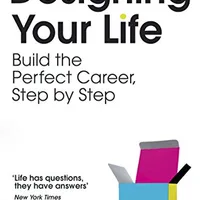
Designing Your Life — Bill Burnett & Dave Evans
Named directly in the article as one of the best books for this exact reframe — the 'Workview' and 'Lifeview' exercises are the practical starting gun for replacing an inherited social clock with a timetable you actua…
As an Amazon Associate, we earn from qualifying purchases — at no extra cost to you.

There's a line from Neugarten's own work, easy to miss in the more cited parts, that gets at the whole thing: the people she found reporting the strongest sense of subjective well-being weren't necessarily the ones who hit every milestone on the culturally expected schedule. They were the ones who felt like the authors of their own life trajectory — who experienced the decisions they'd made, on whatever timeline, as genuinely theirs.
That's the distinction worth sitting with. Not running the race faster. Running your race, with eyes open to the fact that the one you've been trying to run might have been designed by someone who wasn't you, for a life that wasn't quite yours.

What's one area of your life where you've been measuring yourself against a timeline you never consciously chose — and what would your own version of that timetable actually look like? Drop it in the comments.
See also: Are Your Goals Actually Yours? Find Out Before It's Too Late
Was this helpful?