Mindset· 9 min read
You Don't Miss Your Ex. You Miss Who You Were
Memory research shows we don't replay the past accurately — we reconstruct it. And the person you're really grieving after a breakup might be yourself.

You Don't Miss Your Ex. You Miss Who You Were
It's 11:47 PM on a Tuesday and you're fine. You've been fine — surprisingly fine, for weeks. You've told people you're fine, and you almost believed it yourself. But then a song shuffled on in the grocery store, or you drove past that restaurant, and now you're lying in bed scrolling through three-year-old photos wondering what on earth is happening to you.
You know this doesn't make sense. You know the relationship ended for reasons that haven't changed. You know — intellectually, firmly, with documented evidence — that going back would be a mistake. And yet here you are, doing the thing you swore you'd never do, feeling something that doesn't match the narrative you've been presenting to everyone, including yourself.
Here's what nobody says clearly enough: what you're probably feeling isn't longing for that person. It's longing for who you were when you were with them. Why you miss your ex so intensely often has less to do with who they were — and almost everything to do with who you became.
That's not a philosophical consolation prize. That's what the neuroscience of memory and identity actually suggests — and once you see it, the entire question of how to "get over" someone changes shape entirely.

Why Your Memory of That Relationship Is Wrong
The first thing to understand is that the relationship you're replaying at midnight is not the relationship that actually existed.
This isn't a figure of speech. Daniel Schacter, a cognitive neuroscientist at Harvard University, spent decades cataloguing what he called "the seven sins of memory" — the systematic ways human memory distorts, suppresses, and reconstructs the past. His central finding, confirmed across hundreds of independent studies, is this: memory is not a recording system. It's a reconstruction system.
Every time you retrieve a memory, it gets partially rewritten. The emotional tone shifts based on your current mood. The significance of recalled moments gets inflated or deflated by your present circumstances. The specific cues that trigger retrieval — a song, a smell, a particular stretch of road — act as emotional amplifiers, not neutral triggers. They color everything they touch.
A memory retrieved while you're lonely at nearly midnight will register as warmer, more significant, and more positive than the exact same memory retrieved on a busy Wednesday afternoon when you're running late and mildly annoyed at something completely unrelated.
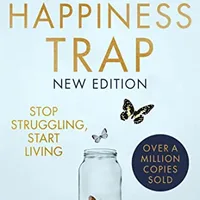
The Happiness Trap (2nd Edition) — Russ Harris
Right after the memory-reconstruction reveal: an ACT-based, evidence-led handbook for the exact midnight-spiral pattern — the 2nd edition adds dedicated chapters on loneliness and grief.
As an Amazon Associate, we earn from qualifying purchases — at no extra cost to you.
Neuroscientists have identified a process called "reconsolidation": when a memory is retrieved, it briefly becomes unstable — a kind of open edit — and is then re-stored, partially rewritten, in its new emotional context. This happens every time you remember something. Each retrieval is both a playback and a revision. Schacter's own research, including a 2013 museum-tour study with Peggy St. Jacques, demonstrated this directly: retrieval selectively enhances some elements of a memory while distorting others, updating what gets stored based on what the brain expects to be important now.
Timothy Wilson at the University of Virginia and Daniel Gilbert at Harvard have documented a related phenomenon in their affective forecasting research: people systematically misremember how good or bad past experiences felt, in the same direction they mispredict future experiences. We overestimate how positive the high points were. We underestimate how frequent the friction was. We remember peak moments with high fidelity and forget the long stretches of ordinary difficulty that surrounded them.
The practical implication is uncomfortable: the relationship you're grieving may be substantially better than the relationship that actually existed. The fights were more frequent than you're remembering. The silences were longer. The mismatch was more persistent. Your memory is editing the past in ways that make the present feel like a worse trade than it actually is.
This doesn't mean the relationship had no value. It means you might be grieving a director's cut.
The Person You Became — and Then Lost
Here's where it gets more interesting.
Art Aron, a psychologist at the State University of New York at Stony Brook, spent decades studying why close relationships feel as significant as they do. His answer — developed into what he calls "self-expansion theory" and backed by a substantial body of empirical research — is striking: in meaningful relationships, the other person's resources, perspectives, identities, and social worlds become genuinely incorporated into your own self-concept. You don't just feel connected to them. You expand. You become measurably different from who you were before the relationship began.
The partner who loves hiking takes you to trails you'd never have found. The musician rewires how you listen to everything. The entrepreneur lifts your sense of what's possible to a new floor. The person from a different background makes your own assumptions suddenly visible. None of this is incidental to the relationship. It is the relationship, in a significant sense. You were changed, not just accompanied.
And when it ends?
The expanded self doesn't gently contract back to the pre-relationship baseline. That's not how it works. You've been enlarged. The loss of access to the version of yourself that had those capacities, moved in those circles, and felt those particular possibilities — that's a real psychological event. Separate from, and additional to, the loss of the person themselves.
This is why "why am I still thinking about them?" is usually the wrong question. The more honest question is: what version of myself am I missing, and what conditions made that version possible?
how identity changes through major life transitions
What Nostalgia Is Actually Searching For
Constantine Sedikides, a psychologist at the University of Southampton, found in his 2015 research on nostalgia and self-continuity something that reframes the experience entirely: nostalgia is primarily triggered by discontinuity in self-concept, not by social loss.
It's not a social emotion at its core, even though it often has social content. It's the self responding to disruption — a search for continuity, for the thread that connects who you were to who you are now. When the self-concept shifts suddenly (as it does when a significant relationship ends), nostalgia is the system's attempt to restore the sense of a coherent, continuous "you."
What the nostalgia is searching for in a post-relationship context isn't the other person. It's the version of yourself that felt most coherent, most alive, most fully expressed — the self that existed inside that particular relational context. That version of you was real. The longing for it is legitimate. It's not confused or weak or a sign you haven't moved on enough.

The Good Life — Robert Waldinger & Marc Schulz
In the nostalgia/self-continuity section: the 85-year Harvard study reframes what we actually grieve — relationships and the self they built — pointing forward rather than back.
As an Amazon Associate, we earn from qualifying purchases — at no extra cost to you.
What it is not, however, is retrievable through the return of the relationship.
This is the part that breaks people. Going back to that person wouldn't return you to that version of yourself. The relationship that produced the expanded self existed between two specific people at a specific moment in time. That context is gone. Returning to the relationship means returning two different people to a different time — and the expansion wouldn't replicate, because the conditions that generated it no longer exist.
Think about visiting your childhood home. The house is the same. The streets are the same. But you're not the child who lived there, and re-entering the building doesn't make you that child again. The self who belonged to that place was built in a context that can't be reconstructed simply by returning to the location.

Why Some People Stay Stuck Longer Than Others
R. Chris Fraley's research at the University of Illinois on adult attachment patterns and relationship memory adds a layer that's especially useful if the nostalgia keeps pulling you back harder than seems proportionate.
People with anxious attachment orientations — and a meaningful portion of adults lean this way — show a specific form of relationship idealization over time. Negative experiences in the relationship get systematically underweighted in memory while positive ones remain vivid and accessible. The result is an increasingly romanticized retrospective that becomes more emotionally compelling the longer the relationship has been over.
This isn't a personal failing or a sign of unusual sensitivity. It's the anxious attachment system running its own crisis protocol: by constructing a version of the past that makes the loss feel more significant than it actually was, the system keeps the psychological possibility of reconnection emotionally alive. It's a protection mechanism, not a character defect.

Kindle Paperwhite (2024, 16GB, Black, Without Ads)
The lowest-friction way to rebuild an inner life: a library in your pocket, a tool for the long project of expanding yourself again.
As an Amazon Associate, we earn from qualifying purchases — at no extra cost to you.
People with avoidant attachment patterns show almost the opposite tendency: positive memories get suppressed rather than amplified, which reduces the apparent magnitude of the loss. This can create its own problems — difficulty acknowledging and processing what was genuinely valuable — but it rarely produces the midnight spiral.
Neither pattern is producing an accurate account of the relationship. Both are producing a version of it that serves the attachment system's current regulatory needs. Knowing which pattern you tend toward is the beginning of working with it rather than being run by it.
understanding your attachment style and how it shapes relationships
How to Start Today: Grieving the Right Loss
If the core of what you're feeling is grief for a past version of yourself — and the research suggests it largely is — then the question shifts from "how do I get over this person?" to "what did that version of me have access to that I want back?"
That's a question with actual answers. And those answers point somewhere forward rather than backward.
Step 1: Map the expansion specifically. Don't settle for "I was happier" or "I felt more alive." Get granular. What specific capacities emerged during that relationship? Were you more spontaneous? More willing to take creative risks? Did you engage more intellectually, feel more emotionally open, try things you'd have otherwise avoided? Write it down. The specificity is what makes it actionable rather than just wistful.
Step 2: Separate the conditions from the person. The person was a vehicle, not the source. What they gave you access to — those qualities, those experiences, those modes of being — didn't belong to them. They unlocked something in you that was already present. Which means you can unlock it again. The question is: what conditions, available to you now, would allow that version of you to re-emerge?
Step 3: Balance your memories deliberately. The next time you're in a midnight spiral, try Schacter's homework: recall a difficult moment from the same period with the same level of detail you're applying to the good ones. Not to poison the memory, but to rebalance it. Your nostalgic retrieval isn't giving you the full account. You're entitled to a more accurate one.

Clever Fox Habit Calendar Circle (2-Year Habit & Goal Journal)
On Step 3 'Balance your memories deliberately' / Step 1 'Map the expansion': a tangible vehicle for Schacter's written-recall homework and mapping the capacities to rebuild.
As an Amazon Associate, we earn from qualifying purchases — at no extra cost to you.
Step 4: Grieve the loss that's real. The grief for the past self is legitimate. Don't rush past it or dismiss it with "I know this is just nostalgia." Something real was built in that relationship. You grew in ways that mattered. Honoring that grief — as grief for a version of yourself you valued, not as a case for the relationship's reinstatement — lets it move rather than stagnate.
Step 5: Build the conditions, not the relationship. Aron's self-expansion doesn't require the specific person who originally triggered it. It requires conditions: novelty, genuine mutual vulnerability, shared challenge, exposure to perspectives that stretch you. Those conditions are not the exclusive property of one person or one chapter. They're available to you. They don't require permission.
Liforme Original Yoga Mat (Blue, 4.2mm, Free Bag)
On Step 5 'Build the conditions, not the relationship': a low-cost anchor for novelty + embodied practice — recreating self-expansion conditions independent of any one person.
As an Amazon Associate, we earn from qualifying purchases — at no extra cost to you.

The Part Nobody Wants to Hear
Here's the view that tends to make people uncomfortable: the longing most of us feel after significant relationships is at least 70% grief for ourselves and 30% grief for the actual person. We are not as deeply in love with our exes as the midnight feelings imply. We're in love with who we were when we were alongside them.
That's not cynicism. It's actually a more respectful reading of what relationships do — they genuinely expand us, bring versions of us into being that might not have emerged otherwise, and leave us changed in ways that persist long after the relationship itself is over. That's remarkable. That deserves real grief when the context that supported it is gone.
But it also means the grief has a destination.
And the destination isn't the other person. It's the self — reclaimed, rebuilt, expanded again through conditions you can actually create.
Jim Rohn put it directly: "The greatest gift you can give somebody is your own personal development." Not for them. For the version of yourself that has more to offer the next chapter.
The person you were in that relationship taught you something precise about who you're capable of being.
That capacity belongs to you. It always did. The project ahead isn't about recovery — it's about deliberate expansion. Design your evolution.
The question worth sitting with — maybe even writing down somewhere before the next midnight rolls around — is this: what would it look like to build a life that the best version of you actually deserves, without waiting for someone else to unlock it again?
Was this helpful?
Continue Your Evolution
The Frozen Goal Problem: Why Tiny Wins Beat Grand Plans
Rejection Sensitivity: Why You Keep Assuming They're Upset
The Science of Nostalgia: Why Looking Back Helps
Sedikides and Wildschut found nostalgia boosts mood, meaning, and social connection — not mere sentimentality. Here's the science and how to use it.