Mindset· 10 min read
Attachment Styles: Why You Keep Repeating Relationships
Anxious, avoidant, secure — your attachment style shapes every relationship you have. Here's the science of adult attachment and how to actually change it.

Attachment Styles: Why You Keep Repeating Relationships
Three different partners. Three different cities. Different jobs, different accents, different ways of ordering coffee. And at month four of every relationship — the same conversation. The same slow withdrawal. The same hollow feeling that the person across from you is somehow slipping away, even while physically right there.
If that sounds like your life, you're not cursed. You're not a bad judge of character. You're running an operating system that was installed in early childhood, and nobody ever handed you the manual. The science of adult attachment is that manual. And once you understand it, the pattern that felt like fate starts to look like something far more workable: a strategy.
What John Bowlby Discovered That Changed Everything
In 1969, British psychiatrist John Bowlby published the first volume of his attachment trilogy — work that would eventually reshape developmental psychology, clinical therapy, and neuroscience. His central observation sounds simple enough: infants don't just need food and physical safety. They need a responsive, available attachment figure whose consistency creates a biological sense of security.
But Bowlby went further than that. He argued that from repeated experiences with a caregiver, the infant builds what he called an internal working model — a cognitive and emotional map of how relationships work. This map encodes answers to three questions that no one consciously asks but everyone operates from: Are other people reliably available? Am I worth being cared for? Is emotional closeness safe?
These aren't philosophical positions. They're automatic predictions that your nervous system runs before your conscious mind gets involved. And here's the part that matters most for adults: Bowlby's internal working models don't stay in childhood. They travel with you — invisibly, efficiently — into every significant relationship you have decades later.
Mary Ainsworth confirmed the mechanism in the lab. Her "Strange Situation" experiment in the 1970s observed how toddlers responded when briefly separated from and reunited with their caregivers. The results were remarkably clean: some children explored freely, grew distressed at separation, and calmed quickly when their caregiver returned (secure). Others clung and couldn't be soothed even after reunion (anxious-ambivalent). Others appeared unaffected entirely, suppressing visible distress — while subsequent physiological research, including cortisol and heart-rate measurements, confirmed their underlying stress was very much present (avoidant).
The leap that made all of this relevant to your adult love life came in 1987. Psychologists Cindy Hazan of Cornell University and Philip Shaver of the University of California, Davis showed that adults sort into the same attachment patterns in romantic relationships. The same proximity-seeking. The same distress responses. The same variation in how people manage closeness and distance. Three decades of research since has only strengthened that finding.

The Good Life — Robert Waldinger & Marc Schulz
The 85-year Harvard longitudinal study on what makes a good life. Relationship quality — not money, status, or achievement — turns out to be the single strongest predictor of adult wellbeing. Here's what the data actu…
As an Amazon Associate, we earn from qualifying purchases — at no extra cost to you.
The Four Attachment Styles in Adult Relationships
Psychologist Kim Bartholomew at Simon Fraser University refined the original three categories into four, organized around a simple axis: your internal model of yourself (am I worthy of love?) and your internal model of others (are people reliably available?). The result maps every adult attachment pattern with unusual precision:
Secure (positive self, positive other): You're comfortable with intimacy and with being alone. You can ask for what you need without the conversation feeling like a crisis. You don't interpret a late reply as a verdict on your relationship. Roughly 55–65% of adults in Western samples fall here.
Anxious / Preoccupied (negative self, positive other): You crave closeness but live under a low hum of fear that it won't last. You're attuned to the slightest relational signals — the shift in tone, the shorter text, the cancelled plan — and your nervous system treats them as potential catastrophes. Around 15–20% of adults.
Dismissing-Avoidant (positive self, negative other): You value independence, sometimes ferociously. Emotional need feels uncomfortable, in yourself and others. You've constructed a life that works well alone, and you'd call that a strength. You're probably right that it is — and also that it's costing you something. Around 20–25%.
Fearful-Avoidant (negative self, negative other): You want intimacy and it frightens you simultaneously. You might understand perfectly what's happening in your relationships — have the whole dynamic mapped out — and still find yourself unable to act differently. Around 5%, but overrepresented in clinical settings.
None of these are character flaws. They're adaptive strategies that made sense in the environment where they formed. The anxiously attached child wasn't being irrational — they had a caregiver whose responsiveness was unpredictable, so hypervigilance was the logical solution. The avoidant child didn't stop caring — they learned that expressing attachment needs produced withdrawal, so suppressing those needs was self-protection. The strategy was intelligent. It's just become obsolete.
For a technical definition of each pattern as it appears in the clinical and research literature, the APA Dictionary of Psychology's entry on attachment style provides a precise, peer-reviewed reference.
Why Your Brain Keeps Choosing Familiar Over Good
Here's the finding that tends to land hardest: your nervous system isn't optimizing for "good relationship." It's optimizing for familiar.
Bowlby's internal working model isn't a passive record. It's an active prediction machine — scanning incoming relational data and comparing it against the accumulated evidence of early experience. When something matches the model (a partner who's sometimes available, sometimes cold — familiar from childhood), the nervous system registers that as safe. When something doesn't match (a partner who's consistently warm, direct, and emotionally available), it can register as strange. Even threatening.
This is why people with histories of inconsistent or emotionally unavailable caregivers so often find themselves inexplicably drawn to partners who replicate exactly that dynamic. Not masochism. Not stupidity. The nervous system is running the relational equivalent of autocomplete.
Mario Mikulincer and Phillip Shaver at Bar-Ilan University have documented the neural mechanisms with unusual specificity. Anxiously attached individuals show hyperactivation of threat-detection systems in response to relational cues — they process signals of potential rejection more intensely, more quickly, and more persistently than securely attached people. Avoidantly attached individuals show systematic deactivation of attachment-related information processing — they literally attend less deeply to relationship-relevant emotional cues, not because they don't care, but because deactivation is the strategy that historically worked to reduce pain.
Understanding that your nervous system learned this makes the pattern less personal. It makes it a system problem rather than a character problem. And system problems have engineering solutions.
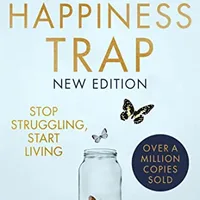
The Happiness Trap (2nd Edition) — Russ Harris
The most widely read practical guide to ACT — Acceptance and Commitment Therapy. Russ Harris breaks down how to stop fighting unhelpful thoughts and start building a life that matters. Revised and expanded second edit…
As an Amazon Associate, we earn from qualifying purchases — at no extra cost to you.
Anxious Attachment: The Feedback Loop You're Probably Already Living
If you've ever found yourself checking your phone for the fifteenth time after sending a vulnerable message, or cycling through interpretations of a two-word reply, or being told by someone you loved that you're "too much" — you're probably familiar with anxious attachment from the inside.
The specific cruelty of the pattern is that it's self-perpetuating. Hypervigilance to rejection produces behaviors — repeated reassurance-seeking, emotional escalation when threatened, interpretations of neutral events as potential abandonment signals — that genuinely do create distance. The fear of being left generates the very dynamics that make being left more likely. It isn't a character flaw. It's a feedback loop with a specific origin and, importantly, a specific point where it can be interrupted.
What's worth sitting with: the emotional intensity of anxious attachment doesn't mean you feel more deeply than secure people. It means your threat threshold has been miscalibrated. The nervous system learned to treat relational uncertainty the way a smoke alarm treats burnt toast — the alarm works, it's just triggering too readily. The goal isn't to feel less. It's to recalibrate the trigger.
how-to-set-healthy-boundaries-without-guilt
Avoidant Attachment: When Distance Masquerades as Strength
Dismissing-avoidant attachment looks like independence from the outside. And from the inside, it often feels exactly like that. "I just don't need people the way others do." "Relationships feel like a lot of maintenance for uncertain return." "I'm better alone."
The research complicates this self-portrait in an important way. Studies by Mikulincer and Shaver that imposed cognitive load on avoidantly attached individuals — conditions that prevented the effortful suppression of attachment-related thoughts — revealed that the underlying attachment needs were entirely present. The difference between avoidant and secure isn't absence of need. It's suppression of access to that need. The deactivation strategy doesn't eliminate the desire for connection. It buries it deep enough that the person stops being able to feel it clearly.
This has significant consequences for the avoidant person's relationships. Their partners — particularly if more anxiously oriented — feel the unavailability acutely and pursue. The pursuit triggers more avoidant withdrawal. Which activates more anxious pursuit. This anxious-avoidant pursuer-distancer dynamic is probably the most common destructive cycle in Western relationship therapy, and it runs almost entirely on two people's nervous systems doing exactly what they were trained to do.

Liforme Original Yoga Mat
The yoga mat serious practitioners trust. Liforme's precise alignment grid gives real-time feedback on form so every session is more productive than the last. Free carry bag included.
As an Amazon Associate, we earn from qualifying purchases — at no extra cost to you.
why-hyper-independence-is-secretly-holding-you-back
Earned Security: The Finding That Changes Everything
Here's the research result that gets the least coverage in the popular conversation about attachment, and probably deserves the most:
Attachment style is not your destiny.
Mary Main at UC Berkeley spent years developing the Adult Attachment Interview — a structured conversation that doesn't ask people whether they had a good childhood, but how they talk about it. The critical finding: it wasn't the content of the history that predicted adult attachment security. It was the coherence and integration of the narrative about that history.
People who'd experienced genuinely difficult or disrupted early attachment — but who could describe it coherently, acknowledge its emotional complexity without either idealizing or dismissing the original attachment figures, and make sense of how that history had shaped them — showed what Main called earned security. Their attachment behavior in adult relationships was functionally equivalent to people who'd had secure attachment from birth.
This is not a small finding. It means the path to secure attachment doesn't run through having had the right childhood. It runs through understanding the one you actually had.
Daniel Siegel at UCLA calls this process "making sense of your life" — developing a narrative that integrates your attachment history without being controlled by it. The mechanism is specific: the left brain's narrative-making function combined with the right brain's emotional processing creates the integrated autobiographical understanding that is the neural signature of earned security. Not forgetting. Not forgiving in the simplistic sense. Understanding — clearly, honestly, with appropriate grief — what happened and why, and how the strategy you developed in response made sense at the time.
At the relational level, Sue Johnson's Emotionally Focused Therapy (EFT) has the strongest empirical evidence base of any couples therapy model. Its central premise is that most couples conflict is, at its core, attachment distress — and that the de-escalation of the negative cycle, the re-engagement of attachment communication, and the creation of new bonding experiences can produce lasting changes in attachment orientation.
You don't have to resolve your childhood to have a good relationship. But you do have to be honest about it.
How to Start Today
Understanding your attachment style is not the work. It's the beginning of the map. Here's how to start using it:
1. Identify your actual pattern — not your preferred one. Not what you aspire to, but what your behavior reveals in high-stakes relational moments. When you feel your partner pulling away, what do you do? When you feel smothered, what do you do? The Experiences in Close Relationships questionnaire (Brennan, Clark & Shaver, 1998), summarized alongside related evidence-based tools at the Greater Good Science Center at UC Berkeley, is a reliable starting point. Be honest.

Clever Fox Habit Calendar Circle (24-Month)
Twenty-four months of undated habit tracking in one compact circular calendar. Colorful, satisfying to fill in, and built for the kind of long-game behavioral change that actually sticks.
As an Amazon Associate, we earn from qualifying purchases — at no extra cost to you.
2. Write out the implicit predictions your behavior assumes. Not your stated beliefs — your enacted ones. "When I send multiple follow-up messages after vulnerability, my behavior assumes that without that escalation, the person will disappear." "When I go quiet rather than expressing need, my behavior assumes that expressing need will be punished." These predictions are the internal working model made visible.
3. Practice narrative integration deliberately. Take one significant early attachment relationship and write about it honestly — not to condemn or excuse, but to understand the strategy it produced. What did that strategy make adaptive sense for then? What is it costing you now? Main's research suggests this kind of coherent, emotionally honest processing is the mechanism behind earned security — not insight as an abstract concept, but the actual narrative work.

Full Focus Planner by Michael Hyatt (Linen Hardcover)
Structured quarterly planning to close the gap between intentions and action. Michael Hyatt's Full Focus system is used by over 300,000 people to consistently deliver on what matters most.
As an Amazon Associate, we earn from qualifying purchases — at no extra cost to you.
from-people-pleaser-to-self-trust
4. Treat secure functioning as a learnable set of behaviors. Stan Tatkin distinguishes between people who are naturally secure (because their history supports it) and people who practice secure functioning — who've deliberately learned the specific relational behaviors that generate safety in a partner: transparency over guardedness, turning toward over turning away, repair over avoidance. The behaviors can be learned even before the internal working model fully updates. Practice changes the model, partly by changing the behavior first.
5. Consider the interpersonal laboratory. Solo cognitive work has real limits when what needs to change is a pattern that only shows up in relationships. Attachment-informed individual therapy, EFT couples work, or interpersonal group therapy all provide something journaling alone can't: a real relational environment in which the old strategy gets activated — and you have a chance to try a different response.

Kindle Paperwhite (2024, 12th Generation, 16GB)
Every book cited in this article — and thousands more — in your pocket. The fastest, lightest way to go deeper into anything that matters. Weeks of battery, glare-free display.
As an Amazon Associate, we earn from qualifying purchases — at no extra cost to you.

The research on attachment has a quality that most self-help adjacent fields lack: it's honest about difficulty. Changing an internal working model that was built across years of early experience, and has been running quietly in the background of every close relationship since, is not a weekend project. It's not a mindset shift. It's closer to learning a second language — the first language (your original attachment strategy) doesn't disappear, but with enough practice in the new one, it stops being the automatic response.
What changes first isn't the feeling. It's the behavior. And changed behavior, sustained long enough, changes the feeling. That's not optimism — it's what the developmental data shows.
Jim Rohn used to say that you can't change your destination overnight, but you can change your direction. Every relationship you've had has been your nervous system going in the direction it was programmed to go. The question worth sitting with is this: once you understand the programming, what direction do you actually want to choose?
Design your evolution. It starts here.

Which attachment pattern do you recognize most in yourself — and what's one thing you're actively doing to shift it? Leave a comment below.
Was this helpful?