Mindset· 9 min read
The Regret You'll Actually Feel in 20 Years
A 1994 study found regret over inaction grows with time while regret over action fades. Here's the research on which choices will actually haunt you later.
The Regret You'll Actually Feel in 20 Years
My grandfather kept a photograph on his desk until the day he died. Not of his family. Not of any vacation. It was a faded black-and-white print of a small printing shop on a side street, the kind of place that smelled like ink and ambition.
In 1971, a friend had asked him to co-found it. The buy-in was $800 — a stretch at the time, but not impossible. My grandfather said no. He was being careful, he told himself. Protecting his family. He filed the option under responsible decision and got on with his life.
The shop grew. The friend who did say yes retired at fifty-two. My grandfather worked until seventy-one, occasionally mentioning with a rueful half-smile that he'd turned down an $800 stake in something that turned out to matter. He never stopped thinking about it.
I assumed for a long time that this was just a personality quirk — he was a ruminator by nature, and the story happened to have an obvious protagonist to blame (himself). Then I read a 1994 study in the Journal of Personality and Social Psychology, and the whole thing clicked into something much more structural than personality.
What Thomas Gilovich and Victoria Husted Medvec Actually Found
In a paper titled "The Temporal Pattern to the Experience of Regret," Cornell psychologist Thomas Gilovich and his colleague Victoria Husted Medvec documented something specific and, once you see it, genuinely difficult to ignore.
When people are asked about their biggest regrets shortly after a decision — days or weeks later — regretted actions dominate the list. The thing you did that went wrong stings most. You tried something new, it backfired, and the outcome sits in your mind like a bruise you keep touching.
But when the same question is asked over a longer time horizon — a year, a decade, a lifetime — the ranking flips entirely. Regretted inactions take over. The path not taken. The chance not seized. The conversation you never started, the application you never sent, the move you kept promising yourself you'd make next year.
Gilovich and Medvec found this pattern held consistently across different domains of life — career choices, romantic pursuits, educational paths. It wasn't confined to any single type of decision. And crucially, they traced the reversal to two fundamentally different psychological mechanisms operating on two different categories of regret.
The Good Life — Robert Waldinger & Marc Schulz (Hardcover)
The section explains Gilovich & Medvec's finding that inaction regret dominates over a lifetime. The Harvard Study of Adult Development — 85+ years of longitudinal data on what people actually value looking back —…
As an Amazon Associate, we earn from qualifying purchases — at no extra cost to you.
Why the Decisions That Go Wrong Stop Hurting
When you make a decision that goes badly, you have an actual outcome to work with.
You tried for the promotion and didn't get it. You moved to a new city and hated it. You started a project that failed spectacularly enough that you still cringe a little when someone mentions it. These outcomes are concrete. They're bounded. They happened, and because they happened, your mind can do something with them.
Psychologists call this the psychological immune system — the unconscious machinery that reframes, contextualizes, and slowly makes peace with negative experiences over time. Daniel Gilbert at Harvard spent years documenting just how effective this system is. The key feature is that it needs something real to work on. A concrete outcome to grab hold of and gradually incorporate into the story you tell about your life.
So the failed move becomes "the year that showed me what I actually wanted from a city." The relationship that ended becomes "the one that clarified what I was really looking for." The business that folded becomes "the education that cost less than an MBA and took roughly the same amount of time, if I'm honest about it." You've probably already done this with at least one significant disappointment in your own life — found the frame that made it fit, made it mean something, made it feel like something you could move forward from.
This isn't self-deception. It's adaptation. It's the system working exactly as it evolved to work.
The problem is that this system only operates on outcomes that actually exist.
Why the Things You Didn't Do Keep Getting Worse
Here's the part that should give you pause.
An inaction doesn't give your psychological immune system anything to work with. You didn't take the chance. There's no outcome to rationalize, no concrete failure to reframe, no sequence of events to reconstruct with the benefit of hindsight. What's left is an open space — and your imagination will fill that space, indefinitely, with idealized versions of everything that might have been.
You didn't start the company. So your mind creates a version of it that would have thrived. You didn't ask the person out. So your mind conjures the relationship that could have developed. You didn't apply for the position that seemed just out of reach. So your mind builds the career trajectory that would have followed — carefully populated with promotions, with interesting problems, with the version of yourself who would have shown up for those opportunities.
None of that imagined life ever has to contend with a difficult co-founder, a slow quarter, a lease that costs more than projected, a Tuesday when nothing works. In your mind, it remains unmarked by reality. Perfect in the way only untested things can be.
Gilovich and Medvec traced this to what they described as open psychological loops. A concrete bad outcome eventually gets closed — it happened, it's over, and the mind can file it. An inaction leaves the loop open, because there's no actual event to anchor against and accept. With time — with distance — the open loop doesn't fade. It draws interest. It compounds.
That's why my grandfather's photograph was still on his desk fifty years after the fact. Not necessarily because the printing company would have made him wealthy. But because the imagined version of it never had to face a single setback. In his memory, it remained the thing that could have been everything.
The asymmetry in a single glance:
| Action Regret | Inaction Regret | |
|---|---|---|
| Short-term (days–weeks) | Peaks | Minimal |
| Long-term (years–decades) | Fades | Intensifies |
| Why | Psychological immune system rationalizes real outcomes | Imagination idealizes the unrealized alternative indefinitely |
| Result | Reframed as part of your story | Stays vivid — "uncontaminated" by reality |
The Decision Trap Nobody Tells You About
This is the part of Gilovich and Medvec's research I find most practically useful — and most uncomfortable.
People making decisions in the present moment systematically overweight the short-term sting of a potential bad action and underweight the long-term ache of a chosen inaction. Which means real decisions, made by real people under real uncertainty, are being shaped by a prediction about regret that the data shows will turn out to be wrong most of the time.
You're standing at the edge of something uncertain. You can try, and risk a concrete failure — or hold back, and preserve the possibility. Your mind runs the simulation: if this goes badly, that's going to hurt. And it's right. In the short term, a concrete failure does hurt more. The bruise is real. You feel it.
But the research says that twenty years from now, the probabilities are almost certainly reversed. The bad outcome you survived will have been processed, filed, and turned into part of your story. The path you didn't take will still be there, quietly accumulating detail, immune to rationalization, preserved in its original, uncontaminated state of pure potential.
It's worth being precise about where this sits in relation to other work on regret. Bronnie Ware, the Australian palliative care nurse, collected moving observations about dying patients' regrets in her book The Top Five Regrets of the Dying — it's cited constantly, and the observations ring true. But Ware's work is informal and anecdotal, drawn from conversations at bedsides. What Gilovich and Medvec did is different in kind: they experimentally measured how the felt weight of action versus inaction regret shifts across time, documenting not just that the pattern exists but that it operates through specific, identifiable psychological mechanisms.
That specificity matters if you want to use the research to actually make better decisions, rather than just feel the general weight of it.
The 20-Year Test: A Framework for Decisions That Actually Matter
None of this is an argument for recklessness. It's an argument for accurate accounting.
What the Gilovich and Medvec research gives you is something like a correction factor — a way to adjust for the systematic bias that makes action feel riskier than inaction when you're standing in the middle of a decision. You don't abandon caution. You apply it to the right fear.
Jim Rohn used to say that the disciplines of success are easy to do. He also said they're easy not to do. He meant something specific by that: small inactions rarely feel like much in the moment. It's only from a distance that their cumulative cost becomes visible.
The Gilovich research adds a mechanism to that observation. The reason small inactions don't feel costly in the moment is that the imagination hasn't yet had the time to build up what might have been. Give it a decade, and the picture fills in. Give it twenty years, and you may find yourself keeping a photograph on your desk.
How to Start Today
Four adjustments you can make immediately — without becoming reckless about it:
- Ask the 20-year question before running the "what if this goes wrong" simulation
- Track your near-misses in a decision journal and review them at six months
- Classify each inaction as reversible or irreversible — irreversible ones carry far more long-term weight
- Evaluate major choices at three time horizons: 6 months, 2 years, 20 years
Ask the 20-year question first
Before you run the mental simulation of how a bad outcome would feel, run a different one: How will I feel about not having tried this, twenty years from now? Not the abstract, vague "I suppose I might have some regret" — but a genuine, specific, imagined version of yourself at that distance, looking back at this exact moment. That question has a very different emotional weight than "what if this goes wrong," and the research suggests it's actually the more accurate predictor of what you'll feel.
Track your near-misses in writing
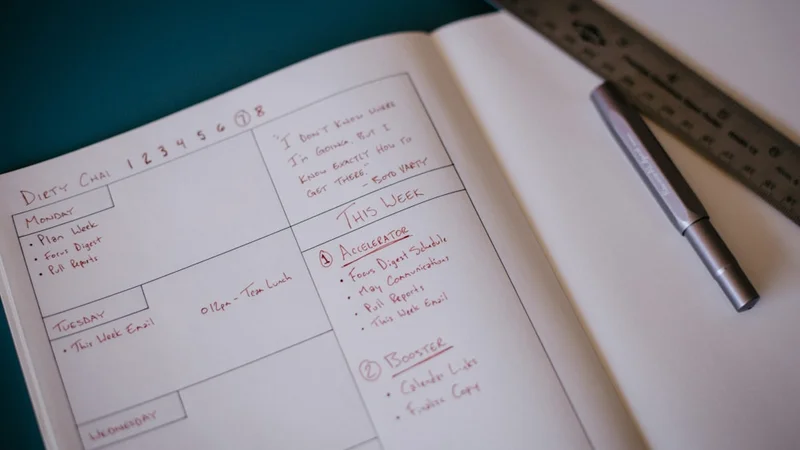
Keep a decision journal — nothing elaborate, just a running record of the choices you're considering, what you did, and why.

Clever Fox Habit Calendar Circle (2-Year Tracker)
The article literally says: 'Keep a decision journal... Review it six months later.' This is the most on-nose placement in the piece — a physical, dated tracker that makes Gilovich & Medvec's asymmetry visible in…
As an Amazon Associate, we earn from qualifying purchases — at no extra cost to you.
Review it six months later. You'll often find that the actions you feared embarrass you a lot less than the inactions you settled for. This is Gilovich and Medvec's asymmetry made visible in your own specific life, not just in a study from Cornell.
Separate reversible from irreversible inactions
Not all inactions carry the same long-term weight. Some doors re-open; others don't. The Gilovich research concentrates most heavily on the irreversible kind — the career you didn't pursue because you thought you'd get around to it, the conversation you postponed until the opportunity closed, the application you didn't send because the timing wasn't quite perfect.
Irreversible inactions are where the imagination loop runs longest, because the absence of an actual outcome is permanent. Give them more weight when you're deciding. Give reversible inactions proportionally less. But be honest with yourself about which category a given choice actually falls into — most of us are quite creative about convincing ourselves that a closing door is still technically open.
Use multiple time horizons explicitly
When you're weighing a meaningful choice, evaluate it at three distances: six months, two years, twenty years. Write down what each version looks like. The answer often shifts across those three distances in ways that are genuinely informative — and where it shifts is usually the most honest signal you have about which option you'll actually be able to make peace with.

Kindle Paperwhite 2024 (12th Gen, 16GB, Black, Without Ads)
The closing section cites Gilbert's 'Stumbling on Happiness', Burkeman's 'Four Thousand Weeks' and Ware's 'Top Five Regrets of the Dying'. A Kindle is the high-ticket, low-friction way to start reading the very source…
As an Amazon Associate, we earn from qualifying purchases — at no extra cost to you.
The Photograph on the Desk
Oliver Burkeman, in Four Thousand Weeks, makes an argument that's quietly devastating: you will never get to all of it. Not the books, not the careers, not the versions of yourself you've planned to become somewhere down the road. A finite life means every yes is also a no to something else, and the only question is which no you can actually live with.
The research gives you a specific, calibrated answer to that question. Not a platitude about living boldly — an experimentally documented asymmetry that holds across domains and decades. The short-term sting of a wrong choice fades as your mind does what minds do with real outcomes. The long-term ache of an unchosen path tends not to, because there's nothing for your mind to close the loop against.
Designing your evolution doesn't mean eliminating bad outcomes from your life. It means making sure the fear of a concrete failure isn't quietly outweighing the far larger, far more durable cost of an open question you never answered.

My grandfather's photograph is still in my mind, even now. Not because I think he made the wrong call — he had a family, real pressures, reasonable fears. But because I can see clearly what his mind did with that unchosen path over fifty years. It grew. It stayed vivid. It never had to face Tuesday.
Twenty years from now, the decision you regret most probably won't be the one that went wrong.
What's the open question you've been carrying — the one imagination has already started furnishing with everything it might have been?
Sources: Gilovich, T., & Medvec, V.H. (1994). The temporal pattern to the experience of regret. Journal of Personality and Social Psychology, 67(3), 357–365. Gilbert, D. (2006). Stumbling on Happiness. Alfred A. Knopf. Ware, B. (2012). The Top Five Regrets of the Dying. Hay House. Burkeman, O. (2021). Four Thousand Weeks: Time Management for Mortals. Farrar, Straus and Giroux.
Was this helpful?