Mindset· 10 min read
Rumination: Why Overthinking Makes You Feel Worse
Rumination makes overthinking feel productive but actively worsens mood. Nolen-Hoeksema's research explains why — and what breaks the loop.

Rumination: Why Overthinking Makes You Feel Worse (According to Real Research)
It's 2 AM. You should be asleep. Instead you're replaying that conversation from Tuesday — examining every word you said, every pause, that one moment where you could've said something else entirely. You've run this loop at least a dozen times. You haven't reached a new conclusion in the last ten.
You tell yourself this is problem-solving. That eventually, if you think about it long enough and hard enough, from enough angles, you'll arrive at some kind of peace. But you wake up at 7 AM feeling worse about Tuesday than you did Tuesday night. You're exhausted. And somehow, the problem feels bigger than it did before you spent five hours examining it.
This isn't a willpower failure. It's not weak thinking or catastrophizing or a lack of perspective. It's rumination — and the research doesn't just suggest it fails to help. It shows, with uncomfortable specificity, that it actively makes things worse.
Here's what the science actually found.

The Psychologist Who Followed an Earthquake
In October 1989, a 6.9-magnitude earthquake tore through the San Francisco Bay Area, killing sixty-three people and displacing thousands. Susan Nolen-Hoeksema, a psychologist then at Stanford University, saw something in the aftermath that most researchers would have missed: a rare, large-scale natural experiment in human distress.
She was already deep into a program of research on how people respond when their mood drops — when life deals something painful and the question becomes how the mind handles what comes next. What the earthquake gave her was a real-world population of people with genuine, quantifiable distress, whose psychological trajectories she could track over time.
The pattern she found was striking.
People who responded to their distress by intensely focusing on it — turning it over, examining why they felt the way they did, tracing causes and implications and the general unfairness of it all — showed measurably longer and more severe episodes of depression than people who responded by shifting their attention elsewhere. Even temporarily. Even to something completely unrelated.
This finding became the foundation of what Nolen-Hoeksema called Response Styles Theory, first published in 1991 in the Journal of Abnormal Psychology. She named the first pattern a ruminative response style. The second she called a distracting response style.
And here is the part that should stop you cold: the ruminators weren't simply reflecting a worse situation. They were generating one. Rumination predicted worsening mood over time, independent of how objectively bad things were at the start. The act of overthinking wasn't just failing to help — it was doing measurable damage.
What Rumination Actually Is (And What It Isn't)
Before going further, it's worth being precise — because people use the word "rumination" to mean almost anything, and the precision matters.
Rumination is not careful thinking about a problem. It's not reflecting on a past experience to extract a lesson. It's not your mind drifting while you're in the shower. And it's not general anxiety about something that might go wrong.
Rumination is specifically a repetitive, passive focus on distress itself — on the feelings, the possible causes, the implications — without movement toward resolution or action. The key word is passive. You're not analyzing to decide something. You're circling without landing.
Mind-wandering is a different animal entirely. When your attention drifts from what you're doing to a memory or a plan or a fantasy about next weekend, that's the default mode network doing its ordinary business — Killingsworth and Gilbert, in their 2010 study published in Science tracking 2,250 people across their waking hours, found the mind wanders roughly 47% of the time. Wandering is unfocused. It meanders.
Rumination has a target. It keeps returning, with increasing urgency, to the same wound. And it masquerades brilliantly as productivity. Ruminators often feel like they're doing something — working through the problem, being responsible, not avoiding what's hard. That feeling is the trap. The loop is spinning. It just isn't moving.
See also: Experiential Avoidance: Why Fighting Feelings Backfires
The 7 Ways Overthinking Shows Up
Research has identified distinct patterns in how rumination expresses itself. They feel different on the surface — some feel like responsibility, some feel like self-awareness, some genuinely feel like problem-solving. But they share the same underlying architecture: repetitive focus on distress without resolution.
1. Replay rumination. The social post-mortem. You replay a conversation — a meeting, a dinner, an argument — examining what you said, what you should have said, how they looked when you said it. You're not preparing for next time. You're just running the tape, again, looking for something you won't find.
2. Self-blame loops. Every outcome connects back to your own failures. Even events that had genuinely nothing to do with your choices become evidence of some fundamental flaw. This one feels like accountability. It isn't. Taking real responsibility means making a decision. This is just circling the same evidence without a verdict.
3. Counterfactual spirals. "If only" thinking. If only you'd left earlier. If only you'd handled that year differently. If only you'd said no. Counterfactual thinking is useful when it generates insight about what to do differently next time. Rumination takes it into territory that cannot be changed and stays there indefinitely.
4. "Why me" questioning. Abstract interrogation of why bad things happen, why you specifically attract certain patterns, why the universe operates the way it does. These questions sound like philosophy. They aren't — there's no actionable answer waiting at the end of them. You can ask "why does this keep happening to me" for decades without the answer arriving.
5. Catastrophic projection. Taking a current difficulty and fast-forwarding mentally to the worst plausible outcome — then treating that outcome as already determined, as something you need to emotionally process now, before it's happened and possibly before it ever will.
6. Identity brooding. "Why am I like this?" These feel like self-knowledge. They're usually distress wearing the costume of self-inquiry. Genuine self-inquiry produces something actionable. Brooding produces more brooding, and a growing sense that the answer to who you are is something unflattering.
7. Anticipatory replaying. Pre-experiencing a future event by running through all its possible negative versions in advance. Not preparation — rehearsed suffering. There's a real version of preparation that reduces anxiety. This isn't it.
If you recognized yourself in more than two of these, you're not broken. Nolen-Hoeksema found the ruminative response style is remarkably common, and it's especially prevalent among people who score high on conscientiousness and emotional sensitivity — people who genuinely care about things, who take their lives seriously. The very qualities that make someone thoughtful can make them vulnerable to this particular trap.
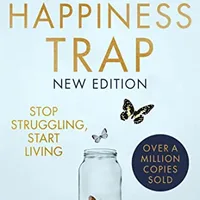
The Happiness Trap (2nd Edition) — Russ Harris
You recognised yourself in several rumination patterns — this is the ACT playbook for relating to those loops differently instead of fighting them.
As an Amazon Associate, we earn from qualifying purchases — at no extra cost to you.
The Watkins Breakthrough: Not All Overthinking Is Equal
Here's the part of the research that doesn't get enough attention. And in many ways, it's the most practically useful finding to come out of this entire body of work.
In 2008, Edward Watkins — then a professor at the University of Exeter — published a landmark review that introduced a crucial distinction into Nolen-Hoeksema's framework. Not all rumination is equally harmful. The style of processing, specifically the level of abstraction, matters enormously.
Watkins found that abstract, evaluative rumination — asking broad, unanswerable "why" questions about the distress itself ("Why does this always happen to me?", "Why am I so bad at this?", "Why can't I just handle things better?") — reliably worsens mood and measurably impairs problem-solving performance. This is the classic Nolen-Hoeksema pattern. This is the loop that hurts.
But concrete, experiential processing — asking specific "what" and "how" questions about the actual situation ("What specifically happened in that moment?", "How did I handle a similar situation before?", "What is one concrete thing I could decide in the next 24 hours?") — can support genuine problem-solving without triggering the same emotional cost.
The difference isn't how much mental energy you're spending. It's what level of abstraction you're operating at.
Abstract rumination works in the realm of global meanings: who you fundamentally are, why the universe distributes outcomes the way it does, whether everything will be okay in the largest imaginable sense. These questions don't have resolvable answers. There's no procedure for closing them. So the mind circles.
Concrete processing works in the realm of specific events, specific decisions, specific next steps — and those are domains where thinking actually has something useful to do.
Watkins's research became the empirical foundation for Rumination-Focused Cognitive Behavioral Therapy (RFCBT), a specific therapeutic approach built around deliberately shifting from abstract "why" processing to concrete "what next" processing when the loop starts.

Full Focus Planner — Michael Hyatt
Watkins's fix is moving from abstract 'why' to concrete 'what next' — a structured planner gives that next-step question a fixed, answerable place to live.
As an Amazon Associate, we earn from qualifying purchases — at no extra cost to you.

Why Your Brain Defaults to the Wrong Mode
Understanding why rumination feels like problem-solving is the key to actually interrupting it. Without that understanding, you'll keep trying to think your way out of the loop using exactly the kind of thinking that generates it.
The brain's default mode network — the set of regions that activate when you're not focused on an external task — is deeply involved in self-referential processing: thinking about yourself, your relationships, your past, your imagined futures. Rumination hijacks this system and makes it feel like introspection. It recruits the same mental regions as genuine reflection.
The difference is in what the process produces.
Genuine reflection is iterative. You think, you arrive somewhere new, you stop. Rumination is recursive. You think, you return to the same point, you go around again. There's no convergence. The loop doesn't close because it can't — the questions it's asking don't have resolvable answers. They're not that kind of question.
Jim Rohn used to say that the mind is like a garden: you grow what you plant, and if you don't deliberately plant something, weeds take over. Rumination is exactly this. Not malicious — just filling available cognitive space with whatever requires the least resistance. And distress-focused processing, despite being unpleasant, is neurologically easy. Your brain has deep, practiced grooves for it. That's partly why it keeps returning there.

Philips SmartSleep Wake-Up Light HF3520
The article opens at 2 AM and ends waking at 7 AM feeling worse — a gentler sunrise wake protects the sleep-wake edge where nighttime rumination does the most damage.
As an Amazon Associate, we earn from qualifying purchases — at no extra cost to you.
How to Actually Break the Loop
Here's where the research has to become practice. Not generic "think positive" advice, not platitudes about acceptance, but specific mechanisms with evidence behind them.
Step 1: Notice the mode, not just the content. Before you can shift from abstract to concrete, you have to catch yourself in abstract mode. The signal is almost always a "why" question with no specific, answerable endpoint. "Why is this so hard?" is abstract. "What specifically made today harder than yesterday?" is concrete. "Why do I always end up here?" is abstract. "What's the one decision that got me here, and what would I decide differently?" is concrete. Train yourself to hear the difference.
Step 2: Schedule the worry. One of Nolen-Hoeksema's own clinical recommendations was a technique called scheduled worry time: a specific 20-30 minute slot, same time each day, when you're actively permitted to ruminate. Outside that window, when the loop starts, you redirect — not because you're suppressing the thought, but because you've already scheduled it. This sounds too simple to actually work. It isn't. A dedicated journal or planner used at the same time each day makes this concrete instead of aspirational, and the research shows the regularity matters.

Clever Fox Habit Calendar Circle
Scheduled worry time only works when it's concrete and repeated at the same time daily — a fixed, visible tracker turns the technique from aspiration into routine.
As an Amazon Associate, we earn from qualifying purchases — at no extra cost to you.
Step 3: Move down the abstraction ladder. When you catch yourself in a "why" spiral, ask one specific narrowing question: "What, exactly, happened? What, specifically, would a next step look like? What's the smallest decision I could make or action I could take in the next 24 hours?" Each question should be more specific than the last. The goal isn't to think less. It's to think at a level where your thinking can actually produce something.
Step 4: Change your physical state, not just your mental one. This is counterintuitive, but it matters. The research on distraction as a coping strategy shows that physical state changes are often more effective at interrupting the loop than trying to think your way out of it. A ten-minute walk, a change of room, cold water on your face — these aren't avoidance. They're circuit breakers for a system that reasoning alone can't reset, because the reasoning is the loop.
Step 5: Externalize the thought, don't perform it. Thought records — a core CBT technique where you write down the ruminating thought, examine its evidence and counter-evidence, and identify a concrete alternative — are among the most empirically supported tools for this. The act of writing changes the relationship to the thought. It stops being an experience you're inside and becomes an object you can look at, examine, and set aside. The research on expressive writing by James Pennebaker consistently supports this mechanism.

Liforme Original Yoga Mat
Step 4's circuit breaker is a physical state change, not more thinking — a mat makes 'change your state' a standing invitation in the room instead of a good intention.
As an Amazon Associate, we earn from qualifying purchases — at no extra cost to you.

The One Question That Changes Everything
Here's the single most practically useful thing Watkins's research actually gives you.
When you notice yourself in a loop — when you can feel the same territory being covered for the fourth or eighth or fourteenth time — instead of trying to think harder or suppress the thought or tell yourself to stop, ask exactly one question:
"What is one specific, concrete thing I can actually do about this in the next 24 hours?"
Not: how do I fix this entirely? Not: what does this pattern say about who I am? Not: will this ever get better? Just: what is one concrete action, actually available, in the next 24 hours?
That question won't solve everything. It isn't supposed to. But it moves the processing from the abstract level where your brain spins to the concrete level where your brain can actually produce something. And according to Watkins's research, that shift — the level of abstraction, not the volume of thinking — is what determines whether your mind is working for you or working against you.
John Wooden was fond of pointing out that most people mistake activity for achievement. Rumination is the mental equivalent of that mistake: the mind is extraordinarily busy while moving in circles. The illusion of effort without the output.
Designing your evolution — which is what this is all about — means making deliberate choices about how you think, not just what you think about. Nolen-Hoeksema and Watkins didn't tell us to think less. They told us to think differently: more concretely, more specifically, more in the direction of a next step that actually exists in the world you can act on.
The loop doesn't close because you think harder. It closes because you find one thing — one concrete, available, specific thing — and you do it.
What's the thought your loop keeps returning to right now? And if you had to name the most concrete, most specific, most immediately actionable version of it — what would that be?
Sources:
- Nolen-Hoeksema, S. (1991). Responses to depression and their effects on the duration of depressive episodes. Journal of Abnormal Psychology, 100(4), 569–582. doi:10.1037/0021-843X.100.4.569
- Nolen-Hoeksema, S., & Morrow, J. (1991). A prospective study of depression and posttraumatic stress symptoms after a natural disaster: The 1989 Loma Prieta earthquake. Journal of Personality and Social Psychology, 61(1), 115–121.
- Watkins, E. R. (2008). Constructive and unconstructive repetitive thought. Psychological Bulletin, 134(2), 163–206. doi:10.1037/0033-2909.134.2.163
- Killingsworth, M. A., & Gilbert, D. T. (2010). A wandering mind is an unhappy mind. Science, 330(6006), 932. doi:10.1126/science.1192439
- Pennebaker, J. W., & Beall, S. K. (1986). Confronting a traumatic event. Journal of Abnormal Psychology, 95(3), 274–281.
Related read: Emotional Hygiene: Treating Psychological Wounds
Was this helpful?