Mindset· 9 min read
Why Fighting a Feeling Makes It Stronger
The harder you fight a feeling, the louder it gets. ACT research by Hayes et al. reveals why suppression backfires — and the technique that actually works.

Why Fighting a Feeling Makes It Stronger
Don't think of a white bear.
There it is. Lumbering around somewhere behind your eyes, in exactly the space where you told it not to be. In 1987, psychologist Daniel Wegner — then a professor at Trinity University who would go on to join Harvard's faculty in 2000 — ran a deceptively simple experiment: he asked participants to think aloud for five minutes while deliberately not thinking of a white bear, and to ring a bell every time the thought surfaced anyway. The bear showed up constantly — more often, in fact, than in a control group that was never told to suppress it at all. Wegner called this the rebound effect. What he'd stumbled on wasn't a laboratory curiosity. It was a window into how the mind handles the instruction to resist itself. The answer, confirmed across decades of research since, is: badly, and at some cost.
This matters because most of us are running some version of that white-bear experiment on ourselves every single day. An old grudge we circle back to despite having consciously "decided to move on." An anxious thought we push below the surface before an important conversation, only to find it flooding back the moment the pressure eases. A version of ourselves — the one who failed, who was wronged, who chose the wrong path — that seems to become more insistent the harder we push against it. The instinct to suppress or control these experiences feels like self-discipline. It looks like composure. But three decades of rigorous clinical research say something different about what's actually happening — and about what works instead.

The Suppression Trap: What's Actually Happening in Your Brain
When you try not to think something, your brain has to hold the unwanted thought active in working memory in order to monitor whether it's appearing. Researchers call this the "ironic monitoring process." In other words, suppression requires a part of your mind to stay constantly tuned to the exact frequency of what you're trying to avoid, acting as a vigilant watchdog.
That watchdog is cognitively expensive. Under normal conditions it keeps the unwanted thought just below the surface, and the suppression mostly holds. But the moment your mental resources get stretched — a bad night of sleep, a bruising work day, the back half of a long week — the watchdog stays online while the suppressor fails. The thing you've been holding back floods in, often with an intensity that feels disproportionate to the original trigger. That's not weakness. That's the predictable consequence of the mechanism you chose.
What Wegner identified for thoughts, Steven Hayes, Kirk Strosahl, and Kelly Wilson extended to full emotional responses over several decades of clinical research. Their work, developed into what became Acceptance and Commitment Therapy and formalized in their 1999 and 2011 texts, centers on a specific, measurable construct they call experiential avoidance: the effortful attempt to suppress, escape, or control unwanted internal experiences — a painful memory, a frightening thought, an emotion you've decided you shouldn't be feeling — rather than letting those experiences simply exist alongside ordinary life.
Their research finding, replicated across multiple populations and settings, is not that people who engage in experiential avoidance are weak or broken. It's that they show worse outcomes — more anxiety, more depression, less engagement with daily life, even in groups managing legitimate chronic physical pain — than people who score higher on measures of psychological flexibility. The effort to control the internal experience turns out to be substantially more costly than the experience itself.
What Three Decades of ACT Research Actually Found
The Acceptance and Action Questionnaire, the primary research measure Hayes and his colleagues developed, assesses how often a person's behavior is restricted by a desire to avoid or reduce an unwanted internal state. Studies using this tool consistently showed a dose-response relationship: the harder someone worked to suppress or escape their internal experience, the worse their outcomes across domains that had nothing obvious to do with the specific feeling they were trying to manage.
This should feel counterintuitive, because suppression looks effective in the short run. The performance of composure is real. You genuinely can hold the expression of an emotion in check through deliberate effort. What the research found is that suppression manages the outward expression without touching the underlying physiology at all — and in many cases, it elevated it. The internal stress response continues or intensifies under a controlled surface. Over time, the sustained effort of maintaining that surface while the internal state remains unchanged produces its own compounding costs.
The most striking studies compared chronic-pain patients. Those who scored high on experiential avoidance — meaning they were working hard to control and suppress the experience of their pain — reported greater suffering and functional impairment than comparable patients who had developed a different relationship with their pain: not eliminating it, not learning to love it, but simply stopping the war against it. Pain plus acceptance produced less total suffering than pain plus the campaign to end it.

Liforme Original Yoga Mat (Blue, 4.2mm, Alignment System)
The chronic-pain studies point to acceptance over war-against-sensation — a grounded body practice like yoga is where psychological flexibility becomes physical.
As an Amazon Associate, we earn from qualifying purchases — at no extra cost to you.
Psychological Flexibility: What It Is and What It Isn't
When the ACT research describes the alternative, it's careful about what it's not recommending.
Psychological flexibility isn't toxic positivity — the performance of being fine when you're not. It isn't forced equanimity that quietly resembles another flavor of suppression. And it isn't acceptance in the passive, resigned sense, the kind that implies you should lie down in front of whatever's hurting you and stop trying.
What the research actually describes is more specific: the willingness to have a difficult internal experience — a feeling, a memory, a threatening thought — without either fighting it or being completely controlled by it. Those two conditions together define the space the research identifies as useful.
Think of the difference between having a difficult conversation and having a difficult conversation while simultaneously telling yourself you shouldn't be feeling nervous. The second version doubles the cognitive load with a second internal battle layered on top of the first. Psychological flexibility means entering the difficult conversation with the nervousness present, acknowledged, not fought — and directing attention toward the conversation itself rather than toward managing the performance of not being nervous.
Motivational speaker Bob Proctor often taught that where you place your attention tends to expand in your experience — a popular framing of focus and attention rather than a clinical finding. Hayes's clinical research gives a related intuition a measurable, evidence-based structure: the problem isn't the feeling itself. It's the concentration of attention and energy dedicated to its elimination.
Cognitive Defusion: The Specific Technique the Research Points To
The practical tool ACT research most consistently validates is called cognitive defusion. The name is clinical; the technique is simpler than it sounds.
"Fusion" in this context is what happens when a thought and a fact become indistinguishable to the person having the thought. When you think I'm not ready for this, the statement lands as a description of reality rather than as a mental event. Defusion creates just enough separation between you and the thought to recognize it as the latter.
The practice looks something like this:
Instead of I'm not ready for this, you notice: I'm having the thought that I'm not ready for this.
Instead of This is pointless, you notice: My mind is offering me the thought that this is pointless.
That grammatical shift — from being the thought to observing the thought — changes the thought's behavioral grip. The research finds this doesn't require the thought to change in content, tone, or frequency. It doesn't have to become a nicer thought. The defusion changes what you do next, because the thought no longer arrives as a direct command. You observe it, you notice it as a passing mental event, and then you have a small but real window of choice about what follows.
Studies using defusion techniques found measurable reductions in the distress caused by unwanted thoughts and feelings, with the crucial caveat that the reduction didn't depend on the thought disappearing or improving. Which is to say: you don't have to fix the feeling to stop the feeling from running the next hour of your life.

The Harder Cases: Grudges, Control, and Old Identities
The ACT framework is particularly precise about one category of experience that suppression handles worst: things that feel like they're part of who you are.
Old grudges, resentments toward people or situations from years back, the story you carry about a failure or a wrong that was done to you — these don't respond well to direct confrontation. Telling yourself to "just let it go" usually adds another layer of avoidance on top of the original experience, which the research would predict makes the material more intrusive, not less. You're suppressing the resentment while simultaneously adding the self-criticism for still having it. That's two ironic monitoring processes running at once.
What Hayes's research suggests instead is a specific question, and it's worth sitting with for a moment: What would you be able to do — today, this week, this year — if this grudge, this old identity, this fear existed inside you, but you weren't required to resolve it before moving forward?
That question is doing something important. It's not asking whether the feeling is justified. It's not asking you to forgive or forget or feel differently. It's asking what you actually want to do with your life if that internal experience simply comes along for the ride — present but not sovereign.
Jim Rohn put it this way: "You cannot change your destination overnight, but you can change your direction overnight." The ACT research makes a similar claim about internal experience: you may not be able to change what shows up in your mind, but you can change your relationship to what shows up — and the research consistently finds that's where the real leverage is.

Clever Fox Habit Calendar Circle (24-Month)
Naming the suppression campaign in plain language and observing thoughts on paper is the defusion practice made concrete — a structured tracker externalises what the mind keeps re-monitoring.
As an Amazon Associate, we earn from qualifying purchases — at no extra cost to you.
Why This Is Different From the Advice You've Already Tried
It's worth being specific about what this research is not saying, because the popular alternatives are everywhere and they mostly don't work.
"Think positive" — replacing an unwanted thought with a better one — is itself a form of suppression if the original thought hasn't been acknowledged. Cognitive reappraisal, which is a legitimate and evidence-backed technique (James Gross at Stanford has done rigorous work on it), involves reinterpreting a triggering situation before the full emotional response develops — which is different from either suppression or defusion. Mindfulness meditation, practiced well, produces some of the same defusion effects, but the specific mechanism and framing ACT offers is more accessible to people who find unstructured meditation difficult to sustain.
And "willpower" — the idea that you can simply force your way past the uncomfortable feeling through sheer discipline — runs directly into the ironic monitoring problem. Willpower is a finite resource applied across a day; the watchdog is not.
The ACT framework's practical advantage is that it doesn't require you to feel better before you act. It doesn't ask you to resolve the internal experience as a prerequisite for the behavior you actually want. The sequence is reversed: you acknowledge the experience, you practice defusion, and you direct your behavior toward your stated values regardless of whether the internal experience cooperates. Which, in practice, is the sequence that most actually produces change.

Philips SmartSleep Wake-Up Light HF3520
The article links out to a morning routine that reduces anxiety — a gradual sunrise wake-up is the physical anchor for starting the day without the immediate cognitive load of a jarring alarm.
As an Amazon Associate, we earn from qualifying purchases — at no extra cost to you.
How to Start Today
If you want to use this research as more than interesting reading, here's a sequence that follows the evidence:
1. Name the suppression campaign. Pick one uncomfortable internal experience you've been working to control or eliminate. Not the biggest one. Pick the one that's quietly consuming the most energy week to week. Write it down in plain language.
2. Audit the cost of the campaign. Not the content of the feeling — the cost of fighting it. How much mental real estate does managing this experience occupy? How often does the watchdog pull attention away from something you actually want to be present for?
3. Practice defusion once, out loud. Take the thought or feeling you named in step one and say: I notice I'm having the thought/feeling that _____. Say it to yourself, out loud, once. Observe whether the grip on the next five minutes loosens even slightly. Not disappears — loosens.
4. Get a structured resource and actually work through it. The Happiness Trap by Russ Harris is the most accessible clinical translation of ACT for non-practitioners, structured specifically so the defusion and values exercises can be done sequentially rather than just read.
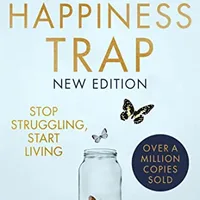
The Happiness Trap (2nd Edition) — Russ Harris
MANDATORY — explicitly named in the article body as the most accessible clinical translation of ACT, structured so the defusion and values exercises can be worked through sequentially.
As an Amazon Associate, we earn from qualifying purchases — at no extra cost to you.
5. Identify one value you've been postponing. Find one thing you've been waiting to pursue until the uncomfortable feeling resolves. Take one action toward it before the feeling resolves. That's the move — behavior before internal readiness, not after it.

The Design Choice Underneath All of This
"Design Your Evolution" doesn't mean designing a life in which nothing difficult ever shows up internally. That person doesn't exist, and the research makes a fairly strong case that chasing that image is itself a form of experiential avoidance — a long-term campaign against the normal texture of a human life.
The design choice the evidence actually supports is building a relationship with your own internal experience that doesn't require it to behave a certain way before you can move. Not eliminating the difficult feeling. Not being paralyzed by it either. Making room for it to exist, extracting whatever genuine signal it might contain, and pointing your behavior at what you actually care about — regardless.
Wegner's white bear is still there. Hayes, Strosahl, and Wilson didn't claim to get rid of it. What their research consistently demonstrates across three decades of studies is that the most important question isn't how to make it disappear. It's whether you're willing to stop organizing your entire day around the effort of making it disappear.

Kindle Paperwhite (2024, 12th Gen, 16GB)
For readers ready to keep working through ACT and mindset literature — a distraction-free reading device supports the 'behavior before internal readiness' habit the article closes on.
As an Amazon Associate, we earn from qualifying purchases — at no extra cost to you.
What's the internal experience that's been draining the most energy lately — the feeling you've been working hardest to suppress or control? And what have you actually noticed when you've tried to push it away? Drop it in the comments. You might be surprised how many people are fighting the exact same bear.
Related read: Why Tiny Delays Feel Enormous, According to Science
Related read: Why Fighting a Craving Makes It Worse
Was this helpful?