Habits· 10 min read
Cyclic Sighing: The Breathing Technique That Beat Meditation
A 2023 Stanford RCT found cyclic sighing outperforms mindfulness meditation for mood in 5 minutes daily. Here's the double-inhale method.

Cyclic Sighing: The Breathing Technique That Beat Meditation in a Stanford Trial
My therapist used to say "just breathe" whenever I told her things felt overwhelming. For years, I wrote that off as the softest possible advice — the therapeutic equivalent of "have you tried turning it off and on again." It felt polite. It felt safe. And it assumed I'd never tried breathing deliberately before.
Then I came across research on cyclic sighing — a specific breath pattern most people have never heard of — and I had to reconsider everything.
Not a wellness blogger's summary of the study. The actual paper, published in Cell Reports Medicine in January 2023, by Melis Yilmaz Balban, Eric Neri, and their colleagues at Stanford's Department of Psychiatry. They ran a randomized controlled trial comparing four five-minute daily practices head-to-head, and one specific breath pattern outperformed all of them — including mindfulness meditation — on both self-reported mood and resting respiratory rate.
That's not a minor finding. Mindfulness meditation has decades of research behind it, billions of dollars of cultural investment, and the backing of everyone from elite athletes to Fortune 500 CEOs. And a five-minute breathing pattern beat it on the two outcomes the Stanford team were measuring. In a month.
Here's what the research actually found, what the physiology behind it explains, and how to start using it today.
The Stanford Trial Almost Nobody Describes Accurately
The thing about the Balban and Neri study is that it's frequently referenced and rarely explained properly. So let's be specific.
The researchers enrolled 108 participants and randomly assigned them to one of four conditions, each involving five minutes of daily practice performed consistently for four weeks. The four practices were:
- Mindfulness meditation — seated attention on present-moment sensations, without directing the breath
- Box breathing — four counts inhale, four counts hold, four counts exhale, four counts hold
- Cyclic hyperventilation with retention — rapid successive inhales followed by a long held exhale, similar in structure to Wim Hof breathing
- Cyclic sighing — two nasal inhales followed by a long, complete exhale through the mouth
Every participant reported daily mood ratings throughout. The researchers tracked resting respiratory rate as an objective physiological marker. By the end of four weeks, cyclic sighing had produced the largest improvement in positive affect — the technical term researchers use for self-reported mood — of any group. It also produced the largest measurable reduction in resting respiratory rate.
Both findings pointed in the same direction, and cyclic sighing won both times.

The Wim Hof Method — Wim Hof (Paperback)
The article opens by grounding cyclic sighing in real respiratory science. Wim Hof's book is the most accessible bridge from 'why does a breath pattern matter' to a self-maintained practice — directly reinforces the S…
As an Amazon Associate, we earn from qualifying purchases — at no extra cost to you.
If you want to go deeper on why the mechanics of breathing matter so much more than most people assume — the full evolutionary, physiological, and historical context — James Nestor's Breath is the most readable treatment of the subject available outside of academic journals. Nestor spent years self-experimenting and interviewing researchers across specialties, and the book provides exactly the kind of "why should I care about this" foundation that makes a practice like cyclic sighing feel worth actually maintaining.
What Cyclic Sighing Is (And the Part People Keep Getting Wrong)
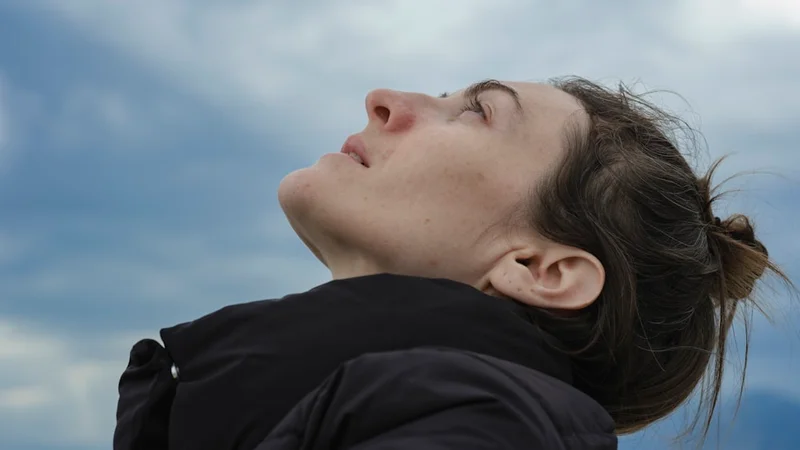
The technique has three steps, and the middle one is what separates it from everything you've probably already tried.
Step one: Take a full nasal inhale, drawing air in until your lungs feel comfortably full.
Step two: Without exhaling, take a second, shorter nasal inhale — topping the lungs off past where you thought they were full.
Step three: Release a long, slow, complete exhale through the mouth, emptying as fully as comfortable.
That's one cycle. You repeat it for five minutes.
The second inhale is the part people skip, either because it feels slightly awkward or because they don't realize how mechanically important it is. Most descriptions of deep breathing techniques treat the inhale as setup and the exhale as the active part. Cyclic sighing depends on both inhales being taken intentionally, because the second inhale is where the technique earns its physiological effect.
You've done this involuntarily before. After crying hard, your body often takes that broken double-gasp before the long exhale that finally releases the tension. After something startles you, a similar reset breath appears. The body already knows this pattern. The research is simply asking you to use it deliberately, before the situation demands it.
If you want to go deeper on the mechanics of nasal breathing specifically, what the research shows about breathing through your nose is worth reading alongside this.
Why the Double Inhale Changes What Happens in Your Lungs
Here's where the physiology becomes genuinely interesting — and where cyclic sighing separates itself mechanically from box breathing, meditation, or any technique that treats all inhales as equivalent.
Your lungs contain roughly 300 million tiny air sacs called alveoli. These are where gas exchange happens: oxygen moves into the bloodstream, carbon dioxide moves out. Under normal, especially shallow-breathing conditions, a subset of these alveoli collapse or partially deflate. It happens gradually, largely below your notice, and it reduces the effective surface area available for each breath cycle.
When you take a full nasal inhale and then add a second one on top of it, you're forcing fresh air into those partially collapsed alveoli and re-inflating them. This significantly increases the total surface area available for the extended exhale that follows — which means more carbon dioxide gets offloaded per breath than any standard single-inhale cycle allows.
Why does CO2 offloading matter? Because the ratio of CO2 to oxygen in your bloodstream is one of the primary signals your autonomic nervous system uses to calibrate threat level. Elevated CO2 drives sympathetic activation — the fight-or-flight state you're trying to get out of. Efficiently reducing it shifts the system toward parasympathetic activity, what the research literature calls "rest and digest," more directly and more immediately than a passive attentional practice like meditation does.
Meditation works through a primarily cognitive pathway: over time, it trains attentional regulation, which gradually reduces emotional reactivity. Cyclic sighing works through a direct physiological pathway, which is why its effects on mood and respiratory rate showed up measurably within a month of daily five-minute sessions.

Amazfit GTR 4 Fitness Smartwatch (HRV / resting respiratory rate)
This slot sits right after the physiology section that references watching parasympathetic shift via HRV. The GTR 4 tracks heart rate, stress and resting respiratory rate — letting the reader SEE the cyclic-sighing ef…
As an Amazon Associate, we earn from qualifying purchases — at no extra cost to you.
If you'd like to watch the physiological shift happen in real time rather than taking anyone's word for it, an HRV biofeedback device such as the HeartMath Inner Balance sensor gives you live heart-rate-variability data — a reliable proxy for parasympathetic nervous-system activation. Five minutes of cyclic sighing before a measurement session makes the effect visible, not just felt. Some people find that visibility alone significantly increases their motivation to keep the practice going.
How Cyclic Sighing Compares to the Other Three Techniques

Being precise about what the other three techniques actually do helps you understand why this comparison matters for your specific situation.
| Technique | Key mechanism | Primary strength | Risk level |
|---|---|---|---|
| Cyclic sighing | Double inhale re-inflates alveoli; extended exhale offloads CO2 | Largest mood improvement + respiratory rate drop in the Stanford trial | Low |
| Box breathing | Controlled breath-holds build CO2 tolerance | Acute calm under high-stakes pressure | Low |
| Cyclic hyperventilation | O2 surge and CO2 clearance produce altered state | Energizing; cold-exposure preparation | Medium–High |
| Mindfulness meditation | Attentional training reduces emotional reactivity | Long-term cognitive and emotional resilience | Low |
Box breathing — the technique popularized by U.S. Navy SEALs — works by introducing controlled breath holds that build tolerance to elevated CO2 states and create regulated calm under acute pressure. It's well-suited to high-arousal situations where you need to perform under stress rather than recover from it. It's a different tool for a different moment.
Cyclic hyperventilation with retention, the Wim Hof-adjacent pattern, temporarily raises CO2 tolerance thresholds and floods the system with oxygen, producing a distinctive altered-state sensation some people find energizing. It also carries meaningful risk — lightheadedness, loss of consciousness — and is contraindicated in water. It's not a low-risk daily reset for most people, and the Stanford data reflects this: it didn't outperform cyclic sighing on mood, despite being a more dramatic intervention.
Mindfulness meditation produced real, measurable improvements in the study. The comparison here isn't "meditation doesn't work." Decades of research say otherwise, and what meditation actually does to your brain is worth understanding on its own terms. The comparison is more precise: for five minutes a day targeting mood improvement and resting respiratory rate specifically, cyclic sighing has now earned the top spot in the evidence hierarchy for that exact use case.
How to Build Five Minutes Into Your Day So It Actually Happens
The technique takes ninety seconds to learn. The harder part — as with any daily practice — is building a consistent cue-routine-reward loop around it so it happens every day rather than whenever you happen to remember it.
A few practical notes before you begin:
Time it precisely. Five minutes feels much longer when you're uncertain how much time has passed, and that uncertainty is often what causes people to cut sessions short before they've completed a full cycle. A dedicated visual timer removes that cognitive load entirely, letting you focus on the breath rather than watching the clock. Even better is a breathing-pacer tool that shows you the rhythm visually — inhale, second inhale, exhale — so your brain has something to follow rather than something to count.
A dedicated breathing exercise app or pacer provides exactly this. Tools like Breathwrk let you configure the cyclic sighing pattern specifically — two inhales and an extended exhale — and set session duration. The visual rhythm becomes the anchor, and within a few sessions the pattern starts to feel automatic rather than effortful.
Commit to nasal inhales. Both inhales in cyclic sighing go through the nose. The exhale goes through the mouth. If you struggle with nasal breathing — congestion, allergies, a deviated septum — the first inhale feels fine but the second becomes genuinely frustrating rather than merely unfamiliar.
Nasal dilator strips applied across the bridge of the nose can meaningfully reduce nasal airway resistance, particularly in the morning when congestion tends to be highest. Worth trying before concluding the technique doesn't suit your anatomy — in most cases, reduced airflow rather than the technique itself is the obstacle.
Anchor it to something fixed in your morning. The research used daily practice, which means the benefit accumulates because you show up consistently, not because any single session is transformative. The most reliable anchor is an existing ritual — right before coffee, immediately after your feet hit the floor, during the two minutes while the shower heats up. The specific anchor matters far less than having one that's non-negotiable.
Expect a different sensation than meditation. Cyclic sighing produces an immediate, physical sense of downshift — a noticeable slowing of your physiological state within the first couple of minutes. Some people find this deeply reassuring. Others find it slightly disorienting the first few times, especially if they're used to living at a baseline of low-grade urgency. Both reactions are normal, and both pass.
For help anchoring this into a routine that actually sticks, see how to build a morning routine that actually sticks.
The Part the Study Doesn't Resolve
There's a conversation the Balban and Neri paper doesn't fully enter, and it's worth naming honestly: the reason you need stress relief in the first place.
Cyclic sighing is a physiological intervention. It modulates your nervous system's arousal state efficiently and measurably. What it doesn't do is alter the meeting scheduled for 9 AM, resolve the project that's been running over capacity for three months, or change the relationship dynamic you've been avoiding thinking about clearly.
Stephen R. Covey once said that you can't talk your way out of a problem you behaved your way into. The same logic applies here in a parallel direction — you can breathe yourself into a calmer state, but a calmer state and a resolved situation are two different things.
That said, there's a strong case that calmer physiological access is precisely where the other work begins. When you're running on a persistently activated stress response, your prefrontal cortex — the part of your brain responsible for complex planning, perspective-taking, and rational decision-making — is measurably less online. Five minutes that shift your resting respiratory rate and mood create a neurological window in which those higher-order processes are more available to you. The breath doesn't solve the problem. It gives you better access to the version of yourself who might.
For a more complete picture of how respiratory physiology interacts with cognitive performance and daily stress management — and how to build a structured multi-technique breathwork practice rather than relying on a single tool — Patrick McKeown's The Oxygen Advantage provides the research stack in practical, accessible form.
What Five Minutes Actually Redesigns
The word "evolution" tends to conjure large, dramatic moments — a career pivot, a new city, a reinvented identity. But most meaningful evolution happens at the resolution of a single ordinary day.
Five minutes. Two nasal inhales. One long exhale through the mouth. Repeat until the timer ends.
A tightly controlled Stanford trial suggests that doing this consistently enough shifts two baseline measures — mood and resting respiratory rate — in a measurable direction, outperforming a practice that carries enormous cultural and scientific prestige. That's not an argument against meditation. It's an argument for being precise about your tools and honest about the time you actually have.
Your body already produces this breath pattern involuntarily, in moments of genuine release. The only thing cyclic sighing asks is that you offer it the same reset before the moment demands it — by design rather than by default.
What would your first hour look like if your nervous system started it from a lower resting baseline? And what decisions made from that state might look different from the ones you're making now?
Sources:
- Balban, M.Y., Neri, E., et al. (2023). "Brief structured respiration practices enhance mood and reduce physiological arousal." Cell Reports Medicine, 4(1). https://doi.org/10.1016/j.xcrm.2022.100895
- Stanford Medicine (February 2023). "Cyclic sighing can help breathe away anxiety." https://med.stanford.edu/news/insights/2023/02/cyclic-sighing-can-help-breathe-away-anxiety.html
- Nestor, J. (2020). Breath: The New Science of a Lost Art. Riverhead Books.
- McKeown, P. (2015). The Oxygen Advantage. William Morrow.
Was this helpful?