Mindset· 10 min read
How to Adapt to Change Before It Leaves You Behind
Adapting to change is a trainable skill, not a personality trait. Here's the psychology behind change resistance — and three tools that actually work.
How to Adapt to Change Before It Leaves You Behind
In 1975, a 25-year-old Kodak engineer named Steve Sasson built the world's first digital camera. It weighed eight pounds, took 23 seconds to record a single black-and-white image, and produced a resolution of 0.01 megapixels — roughly comparable to a 2005 camera phone. His bosses examined the prototype with genuine fascination. Then they shelved it for a decade.
Not because they were oblivious. Kodak executives understood exactly what digital photography would do to their film business — internal memos and interviews from the 1990s confirm this with uncomfortable clarity. They shelved it because acting on that knowledge would require becoming something they had never been: a company without film at its centre. Knowing how to adapt to change — even when you can see it coming, even when the evidence is overwhelming — is a categorically different skill from simply seeing it.
In 2012, Kodak filed for bankruptcy.
Seth Godin observed recently that nostalgia can be fatal. He wrote it in two sentences. But the observation opens up the longer you sit with it.
Alvin Toffler described "future shock" in his 1970 book of the same name — what he called the psychological disorientation produced by too much change in too short a time. He was writing about mainframe computers and long-distance telephony. Today, according to the World Economic Forum's Future of Jobs Report 2025, 39% of existing skill sets will need significant transformation by 2030. Toffler's diagnosis has never been more clinically precise.
You've probably already felt the early edges of this. The low-grade vertigo when a system you understood well has quietly shifted beneath you. That strange grief when a role or routine that once defined you simply isn't what it was anymore. The cognitive exhaustion of being a beginner again in territory where you used to be fluent.
This is not weakness.
It's also not inevitable.
The research across organisational psychology, developmental psychology, and behavioural neuroscience converges on a consistent finding: the primary barrier to adapting to change isn't difficulty grasping what has changed. It's psychological attachment to what existed before. This article maps that attachment — and three specific, evidence-backed tools for loosening it before the world moves on without you.
how to develop a growth mindset as an adult
Why Your Brain Fights Change — And Why That's Not Weakness
Here's the counterintuitive part: you're already extraordinarily adaptable. You've navigated more transitions than you probably give yourself credit for — new tools, new roles, new cities, rebuilt relationships, updated beliefs on things you once held with certainty. Your brain is not opposed to change in the abstract.
What it's exquisitely sensitive to is anticipated loss.
Daniel Kahneman's decades of work on prospect theory found that losses feel approximately twice as psychologically powerful as equivalent gains. Losing £50 causes roughly double the distress of the pleasure from gaining £50. This asymmetry isn't a flaw in human reasoning — it's evolutionary calibration. For most of human history, the cost of losing something already held (food, shelter, social standing) was catastrophically higher than the benefit of gaining something equivalent. Risk-aversion in unfamiliar territory genuinely kept your ancestors alive.
The problem is that this same circuitry — running now in a world of career disruptions, industry transformations, and identity evolutions — registers "releasing something familiar" as loss, even when the familiar thing has long since stopped serving you. Your brain doesn't distinguish between dropping a mammoth bone and letting go of a professional identity you've spent a decade building. The threat signal is identical.
Then there's the status quo bias: the experimental finding that people consistently prefer known outcomes over uncertain ones, even when the known outcome is measurably worse. People stay in jobs they've outgrown for years. They hold declining investments long past any rational justification. They continue living in cities that stopped being right for them half a decade ago. It isn't stupidity. It's the brain doing exactly what it evolved to do: when uncertain, preserve what's already held.
But here's what I want you to sit with: most resistance to change isn't a failure of vision. Kodak's executives didn't lack the ability to see the future — they saw it with painful precision. They understood exactly what digital photography would do to the company, to the workforce, to the careers of thousands of people who'd devoted themselves to mastering photographic chemistry. That's not blindness. That's grief wearing the face of denial. The distinction matters enormously, because you can't solve grief by presenting more evidence.
Adam Grant makes the case in Think Again that the highest-leverage cognitive skill in an era of rapid change isn't acquiring new knowledge — it's being genuinely willing to discard old knowledge. To hold beliefs tentatively rather than defensively. To move from what he calls "preacher, prosecutor, and politician" mode — defending existing positions, attacking opposing ones, campaigning for external validation of what you already believe — into scientist mode: curious about being wrong, energised by better data, freed by the possibility that things you once knew as true simply aren't anymore.
Think Again — Adam Grant
The complete operating guide for moving from defensive to scientific thinking. Adam Grant shows why the highest-leverage cognitive skill isn't acquiring new knowledge — it's being willing to discard old knowledge.
As an Amazon Associate, we earn from qualifying purchases — at no extra cost to you.
The Nostalgia Trap: How Loving the Past Becomes a Cage
There's a version of nostalgia that serves you well. Remembering periods of your life that were genuinely good — drawing from those memories a clearer sense of what conditions allow you to thrive, what values you want to carry forward — that's wisdom. That's the past working for you.
The other kind is different. It whispers this is how things are supposed to be when they demonstrably aren't anymore. It uses past success as ongoing evidence that your current approach is still correct, even as the environment that generated that success has shifted substantially beneath you. It dismisses new tools, new methods, new frameworks — not because they've been genuinely examined and found lacking, but because engaging with them would require becoming a beginner again. And being a beginner, after years of hard-earned fluency, can feel indistinguishable from failure.

This is the identity problem at the core of change resistance. It's not really a skills gap. It's a self-concept gap. When change requires updating not just your circumstances but your identity — who you believe yourself to be, what your competence and value are built on — the psychological cost is categorically higher than any practical skill update. You can learn a new tool in a week. Rebuilding your sense of who you are takes longer, and it hurts in ways that a new software tutorial simply doesn't.
William Bridges, in his quietly essential book Transitions, identified something that changes how you think about all of this: every genuine life transition moves through three phases — an ending, a neutral zone, and a new beginning. Most people desperately want the new beginning. What they avoid — and what causes transitions to fail — is the ending. The deliberate act of naming what is genuinely over, grieving it with appropriate weight, and releasing it with some intention. Without a completed ending, the neutral zone becomes a swamp of disorientation rather than a passage toward something better.
You can't build a genuine new beginning on a foundation that hasn't been properly concluded. That's the whole mechanism. And most people never learn it, because no one teaches the ending.
Three Tools That Actually Build Adaptability — And How to Use Them
Knowing why we resist change is useful up to a point. But understanding the mechanism doesn't automatically change the behaviour. Here are three tools — practical, not merely conceptual — with meaningful evidence behind each of them.
First-Principles Thinking
Every set of practices and beliefs you currently hold is built on a foundation of assumptions. Most of those assumptions were reasonable when you formed them. Some have quietly stopped being valid as the landscape changed around them. First-principles thinking is the practice of periodically stripping a belief or approach back to its foundational assumptions and asking: which of these are still actually true?
Not "what has worked before" — that's reasoning by analogy, which anchors you to past solutions in a changed landscape. But: "Given the world as it currently exists — not as it was when I designed this — what is the most effective approach available to me?" The question feels destabilising the first few times you ask it seriously. That feeling is the point. Stable-feeling questions don't produce novel answers.
Beginner's Mind
Zen Buddhism has a concept called shoshin — the beginner's mind. "In the beginner's mind there are many possibilities," wrote Shunryu Suzuki. "In the expert's mind there are few."
The defensive response to a changing environment is to emphasise and protect existing expertise — to use what you know as a barricade against the vertigo of what you don't yet understand. Beginner's mind reverses this. It approaches unfamiliar territory with genuine curiosity rather than practiced defensiveness. It asks "what can I learn here?" rather than "how does this threaten what I already know?" This isn't ignorance performing as humility. It's strategic openness — and in environments changing faster than any single expertise can fully track, it's the most durable stance available.
Nassim Nicholas Taleb's Antifragile frames this capacity structurally: some systems break under stress (fragile), some absorb stress and return to baseline (resilient), and some gain strength and capability directly from stress (antifragile). The antifragile system doesn't merely survive volatility — it extracts value from it. Building antifragility into your personal operating system starts precisely here: treating disruptive change not as damage to be managed but as information to be mined.
Antifragile — Nassim Nicholas Taleb
Taleb's foundational model: some systems break under stress, some absorb it — and some gain strength directly from it. The structural argument for extracting value from disruptive change rather than managing it as dam…
As an Amazon Associate, we earn from qualifying purchases — at no extra cost to you.
Psychological Flexibility
Acceptance and Commitment Therapy — ACT — developed the concept of psychological flexibility: the capacity to remain in genuine contact with your present experience, including its discomfort, and to act in line with your values rather than in the service of avoiding that discomfort.
What this means in practice: you don't need to feel ready before you respond to change thoughtfully. Waiting until the uncertainty passes isn't a strategy — it's a delay with no guaranteed endpoint and a compounding cost. Psychological flexibility allows you to stay present with the disorientation, acknowledge what is genuinely being lost, and choose action from your values rather than from the impulse to make the difficult feeling stop as quickly as possible.
The difference between someone who adapts well and someone who doesn't isn't usually intelligence or information. It's this capacity: to sit with the discomfort of not-yet-knowing without either fleeing it or being paralysed by it. That's a trainable skill. It just requires the right framework to train it.
Russ Harris's The Happiness Trap is the most accessible route into ACT practice I've found — a book that makes psychological flexibility feel like a concrete, learnable skill rather than a therapeutic concept requiring a clinical setting to access.
The Happiness Trap — Russ Harris
The most accessible route into ACT practice — a book that makes psychological flexibility feel like a concrete, learnable skill. For readers who want to move through change without fleeing from discomfort.
As an Amazon Associate, we earn from qualifying purchases — at no extra cost to you.
emotional regulation techniques for adults that actually work
How to Build Change-Resilience Into Your Daily Life — Not Just Your Good Days
The three tools above are practices, not insights. Understanding them changes nothing on its own. Doing them — even briefly, even imperfectly — is where the compounding begins. Here's how to make them structural rather than aspirational.
Run a quarterly assumptions audit. Every three months, write down three assumptions currently underpinning your most important choices — professional, relational, or physical. For each one, ask: "If I were starting fresh today with full knowledge of the current landscape, would I still make this choice?" Not every assumption will be outdated. But the ones that quietly are will reveal themselves. At three months, correcting course is inexpensive. At three years, you're paying compound interest on the delay.
Build a change trigger protocol. For domains most likely to face significant disruption — your primary skills, your industry, your financial approach — define in advance what specific signals would tell you it's time to adapt. Not "when I feel ready" (that feeling rarely arrives spontaneously) but explicit if-then rules: "When X indicator changes, I will take Y action within Z timeframe." Peter Gollwitzer's research on implementation intentions consistently shows that specific pre-committed plans dramatically outperform motivation-dependent intention. Pre-commitment removes the decision from the domain of willpower entirely.
Invest in learning velocity, not just current knowledge. In a rapidly changing environment, the person who can acquire new capabilities quickly is more durable than the person who currently knows a great many specific things. This is partly a skill and partly an identity shift: moving from "expert in X" to "effective learner of whatever becomes necessary." The posture of the learner is the posture from which genuine adaptability becomes possible — and it can be cultivated with intention.
how to become a lifelong learner
How to Start Today
You don't need a crisis to begin building this capacity. The best time to strengthen it is during relative stability — so it's actually available when you need it.
Step one. Write down one belief about your career, your health, or a major relationship that you haven't seriously re-examined in more than two years. Put it at the top of a page. Below it, write: "What would change about how I act if this belief turned out to be wrong — or only partially right?" Sit with that question for five minutes before you move on.
Step two. Choose one domain where you've been quietly dismissing something new because it conflicts with how you've always operated. Spend one week approaching it with beginner's mind — not to abandon your experience, but to audit it honestly. Notice what resistance feels like, and whether it's coming from evidence or from attachment.
Step three. Read Transitions by William Bridges. It's the clearest map I've encountered for understanding why change so often feels like loss before it feels like possibility — and what to actually do with the disorienting in-between period that most people try to skip. Short, precise, and genuinely useful at every stage of life.
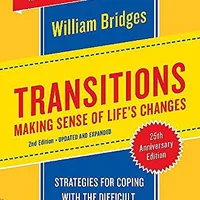
Transitions — William Bridges
The clearest map for understanding why change feels like loss before it feels like possibility — and what to do with the disorienting neutral zone that most people try to skip.
As an Amazon Associate, we earn from qualifying purchases — at no extra cost to you.
Step four. For a more foundational grounding in adapting under conditions entirely outside your control, Viktor Frankl's Man's Search for Meaning belongs on your shelf. Written after surviving the Nazi concentration camps — arguably the most extreme version of change-without-consent a human being can experience — it remains the most searching examination of meaning-making, freedom, and psychological adaptation under impossible constraint. Every modern theory of resilience eventually traces back to it.

Man's Search for Meaning — Viktor E. Frankl
Written after surviving the Nazi concentration camps — the most searching examination of meaning-making, freedom, and psychological adaptation under impossible constraint. Every modern resilience theory traces back to…
As an Amazon Associate, we earn from qualifying purchases — at no extra cost to you.
Step five. Start a change journal. Not a diary — a structured weekly practice. Once a week, write one thing that has shifted in your environment, one assumption you're actively updating in response, and one specific action you're taking. Keep it to five minutes. The consistency matters far more than the depth of any single entry. A dedicated notebook you open only for this works best — something with enough weight to feel like a commitment.

Moleskine Classic Notebook
A dedicated notebook for a structured change journal — the physical commitment object the article describes. Open only for this weekly practice of tracking what shifted, what you're updating, and what you're doing.
As an Amazon Associate, we earn from qualifying purchases — at no extra cost to you.
The Kodak engineers weren't failures. They were intelligent, committed people who built something genuinely extraordinary — and then, like all of us, found it profoundly difficult to release the identity that achievement had created. The failure wasn't personal. It was structural. They had never built the practice of letting go.
You can build it. Not by becoming someone who feels no attachment to what they've created — that's not the goal, and it wouldn't be healthy if it were. But by developing the specific, practicable capacity to move through attachment without being permanently stopped by it. To complete endings deliberately. To stay present in the neutral zone rather than fleeing it. To recognise new beginnings as such, even when they don't feel like them yet.
Adapting to change, at the scale we're all navigating now, isn't a threat to a carefully designed life. It's the precise terrain on which that life either gets designed — with intention, with tools, with practice — or gets decided for you by default. Designing your evolution presupposes exactly this: a living, updating relationship with the world as it is, not a frozen attachment to the world as it was.
What's the one assumption about your current life — professional, personal, or otherwise — that you're most overdue to honestly re-examine? Drop it in the comments. You might be surprised how many people are quietly holding the same one.
how to stop overthinking and start taking action
Was this helpful?
Continue Your Evolution
The Frozen Goal Problem: Why Tiny Wins Beat Grand Plans
Rejection Sensitivity: Why You Keep Assuming They're Upset
The Science of Nostalgia: Why Looking Back Helps
Sedikides and Wildschut found nostalgia boosts mood, meaning, and social connection — not mere sentimentality. Here's the science and how to use it.