Mindset· 10 min read
How to Get Unstuck: Stop Waiting to Feel Ready
Motivation follows action, not the other way around. William James discovered this in 1884 — here's the science-backed method to break inertia today.

How to Get Unstuck: Stop Waiting to Feel Ready
The notebook sat on my desk for six weeks. Getting unstuck, I was convinced, required the right feeling first.
I bought it to start journaling — something I'd been telling myself I needed for years. But every time I picked it up, the same thought arrived before the pen did: I'm not in the right headspace for this. I was waiting to feel calm. Clear. Inspired. The problem was that feeling never showed up on its own. It kept waiting for me to invite it in first.
Here's what I didn't know then: I had the causal arrow completely backwards.
William James — the father of American psychology, the architect of pragmatism, and possibly the most practically useful philosopher the United States has ever produced — figured this out in 1884. He wrote what may be the single most actionable sentence in the entire history of psychology:
"Action seems to follow feeling, but really action and feeling go together; and by regulating the action, which is more directly under the control of the will, we can indirectly regulate the feeling, which is not."
Read that again slowly. He's saying that the standard model — feel motivated, then act — is wrong. Or at minimum, dangerously incomplete. And if you're someone who's been stuck waiting for the right feeling to arrive before you begin, this reframe might be the most useful thing you read all week.
What "action precedes motivation" actually means: behavioral engagement generates emotional readiness — not the other way around. Taking a specific, physical action creates the neurological and physiological conditions for motivation to emerge. This is the central insight of William James's work and the mechanism behind several of modern psychology's most effective interventions for getting unstuck.

The Conventional Trap — and Why Smart People Fall Into It
The conventional wisdom about motivation has a seductive internal logic. You want to feel confident before the difficult conversation. Feel creative before sitting down to write. Feel energized before the workout you've been postponing for two weeks. Waiting for those feelings seems responsible — why force something that isn't there?
The problem is that this logic creates an invisible lock. The feeling becomes the gatekeeper. And the feeling has no obligation to arrive on schedule.
You've probably experienced this exact pattern: the longer you wait to feel ready, the more loaded the task becomes, the more evidence accumulates that you're not capable, and the more distant readiness gets. The waiting is the problem. Not the task.
Zig Ziglar used to say something about this that stuck with me: "You don't have to be great to start, but you have to start to be great." He was pointing at the same mechanism James formalized a century before personal development became an industry — that action is the catalyst, not the result.
James developed this insight through two parallel channels. The philosophical one was pragmatism: the American school of thought James largely founded, which holds that ideas should be judged by their practical consequences, not their elegance. If behaving as though you already possess a quality produces better outcomes than waiting to develop it organically, then the behavior is pragmatically correct. The second channel was scientific: the James-Lange theory of emotion, which he developed simultaneously with Danish physiologist Carl Lange in 1884, proposed that emotions are not mental states that cause physical reactions — they are the physical reactions. You don't tremble because you're afraid. You're afraid because you're trembling.
The mind-body system is bidirectional. And the behavioral channel — what you physically do — is more directly under voluntary control than the emotional channel. You can choose to sit up straight right now. You cannot choose to feel confident right now. But the posture shift will generate a small, real confidence signal that the waiting will not.
The Science That Proved James Right (And Where It Gets Interesting)
Paul Ekman spent decades mapping the relationship between specific facial muscle configurations and emotional states. His directed facial action experiments — where subjects arranged particular muscles without being told what emotion they were producing — generated measurable changes in autonomic nervous system activity consistent with the target emotion. The face wasn't expressing the feeling. It was partially creating it.
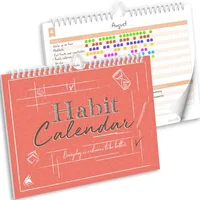
Clever Fox Habit Calendar Circle (24-Month Habit Tracker)
The article opens and closes on an unused journal. A concrete tracker turns 'feeling-ready' into a visible, tickable first action — exactly James's regulate-the-action mechanism.
As an Amazon Associate, we earn from qualifying purchases — at no extra cost to you.
But the most clinically powerful confirmation of James's action-first insight comes from behavioral activation therapy — a treatment for depression that works by scheduling approach behaviors (activities the person has stopped engaging in) without waiting for motivation, mood elevation, or "readiness" to arrive first. Multiple randomized controlled trials have found behavioral activation as effective as antidepressants and cognitive behavioral therapy for moderate-to-severe depression. The mechanism is exactly Jamesian: you don't schedule the walk once you feel better; you schedule the walk, and the feeling-better tends to follow.
BJ Fogg at Stanford's Behavior Design Lab landed on the same insight from the habits direction. His decades of research established that the "motivation wave" — that occasional surge of wanting to act — is profoundly unreliable. It appears unpredictably, fades quickly, and correlates poorly with whether behavior actually changes. What scales reliably is tiny, immediately executable behavior anchored to existing routines. The feeling of capability doesn't precede the habit. It's the residue of the habit.
This is not toxic positivity or the worst version of "fake it till you make it." James wasn't suggesting you pretend to feel confident when you don't. He was saying that if you behave as a confident person behaves — precisely, specifically, in the observable actions — you activate the same physiological and neurological channels that produce confidence. The emotion follows behavior through a real biological mechanism, not through magical thinking.
The Self-Esteem Equation Nobody Taught You
James made a second contribution that's even less discussed — and it has direct implications for anyone stuck in cycles of striving toward the wrong things.
In The Principles of Psychology (1890), he proposed that self-esteem isn't a fixed trait or a simple product of how successful you are. It's a ratio:
Self-Esteem = Success ÷ Pretensions
"Pretensions" here means aspirations — the domains where you're actively measuring yourself. The implication is striking: self-esteem can increase either by expanding the numerator (succeeding more) or by reducing the denominator (genuinely caring less about domains that don't align with your actual values).
The person who is perpetually stuck — who can't start the project, make the decision, take the leap — is often attempting to expand the numerator in domains where the denominator was set by external expectation rather than internal value. They're trying to succeed at someone else's definition of success. And something in them knows it. That resistance isn't laziness. It's misalignment.
This is why the action-first approach sometimes fails to generate momentum: if the action points toward a goal that isn't actually yours, no behavioral technique will produce sustained drive. The first question isn't "how do I start?" It's "start toward what — and does that destination genuinely belong to me?"
Once the direction is authentically yours, James's insight becomes extraordinarily powerful. The causal arrow still points from action to feeling, but now the feelings worth generating are the ones that matter.
Action Precedes Motivation — The Practical Architecture
Mel Robbins's 5 Second Rule is, in essence, William James for the 21st century. The mechanism she discovered (and tested with millions of people) is this: when you have an impulse to act on a goal, count backwards from five and move physically before your brain has time to build a case against it. The countdown interrupts the hesitation pattern; the physical movement produces the emotional shift.
Atomic Habits — James Clear (Paperback)
Mel Robbins / tiny-habits passage: Clear's habit science is the practical companion to James's action-first principle — small action first, identity follows.
As an Amazon Associate, we earn from qualifying purchases — at no extra cost to you.
Peter Gollwitzer at New York University has supplied the research foundation for a related approach called implementation intentions. Where standard goal-setting asks "what do you want to achieve?", implementation intentions ask "when, where, and how exactly will you do this?" The format is simple: If situation X arises, then I will perform response Y.
"I will exercise more" is a goal. "If it is 7 AM on Monday, Wednesday, or Friday, I will put on my shoes and walk out the front door" is an implementation intention. The difference in follow-through is not marginal — Gollwitzer's meta-analyses show that implementation intentions roughly double the rate of goal achievement compared to simple goal-setting alone. The mechanism is specifically Jamesian: implementation intentions don't require motivational readiness. They convert behavioral initiation from a willpower-dependent act into an automatic cue-response sequence. The feeling of wanting to exercise doesn't trigger the behavior. The clock hitting 7 AM does.
Deliberate Difficulty — Why Comfort Is Keeping You Stuck
Here's the counterintuitive part. James didn't just argue that action precedes motivation for easy tasks or pleasant activities. He argued that voluntarily chosen difficulty — the hard workout you didn't have to do, the uncomfortable conversation you didn't have to initiate, the project that exceeds your current capability — builds a resilience architecture that protected comfort cannot build.
He called this "the moral equivalent of war": the idea that voluntary challenge produces in peacetime the psychological qualities — grit, self-discipline, adaptability under pressure — that historically only developed under genuine hardship.

Modern research has formalized this under the concept of beneficial stress. The Yerkes-Dodson curve shows that performance and capability grow with moderate challenge and atrophy without it. The person who stays comfortably inside their competence zone isn't resting — they're regressing. Capability requires active maintenance at the edge of what you can currently do.

Amazfit GTR 4 Fitness Smartwatch (46mm, 150+ Sports Modes, GPS)
Deliberate-difficulty section (the workout you didn't have to do): a smartwatch makes the voluntary challenge measurable and schedulable. High-ticket anchor (£150).
As an Amazon Associate, we earn from qualifying purchases — at no extra cost to you.
The practical implication is uncomfortable but important: if you've been stuck, the solution is rarely to make starting easier. It's to make starting deliberate. Choose a version of the task that sits slightly above your current comfort level, not below it. The resistance you feel toward easy versions of important work is often your nervous system recognizing that the version you've chosen isn't serious enough to respect.
Steven Pressfield calls this Resistance with a capital R. His argument in Do the Work is that the intensity of the resistance you feel toward a project is proportional to how much it actually matters to you. The loudest Resistance is pointing directly at your most important work.
The Upside of Stress — Kelly McGonigal (Paperback)
Pressfield's 'Resistance' / beneficial-stress (Yerkes-Dodson) passage: McGonigal reframes the discomfort of voluntary difficulty as an ally rather than a stop signal.
As an Amazon Associate, we earn from qualifying purchases — at no extra cost to you.
How to Start Today (Before You Feel Ready)
You don't need to overhaul your entire system. Here's the architecture James is pointing at, distilled into five specific moves:
-
Identify the smallest available action. Not the action that will make progress feel meaningful. Not the one that proves you're serious. The one so small that choosing not to do it would embarrass you. One sentence. One push-up. One email. The action doesn't need to be impressive — it just needs to be first.
-
Set the if-then. Don't commit to starting "when I feel like it." Decide: If it is [specific time and place], then I will [specific minimum action]. Write it down physically. Gollwitzer's research is clear: the if-then format does what willpower consistently fails to do.
-
Observe what follows. After you take that first action, notice what happens to the feeling you were waiting for. In most cases — not always, but most — you'll find it either arrives or becomes irrelevant. You're already moving. The question of readiness has been rendered moot by the act of beginning.
-
Build in a completion ritual. Before switching to anything else, spend 90 seconds writing down where you stopped, what the immediate next action is, and one thing that went well. Sophie Leroy's attention residue research at the University of Minnesota shows that an explicit closure signal reduces the cognitive interference of incomplete tasks in subsequent work. You're not just finishing this task — you're protecting the quality of the next one.
-
Choose one degree of voluntary difficulty this week. One thing you're capable of but have been avoiding because it's uncomfortable. Not punishment — a test. That's the architecture James was pointing at: not ease, not self-torture, but the deliberate assumption of challenge as a developmental practice.
The Arrow Points Both Ways — But Only One Way Starts
There's a reason Vanulos's entire premise is Design Your Evolution rather than Wait For Your Evolution. The word "design" is load-bearing. Design is an active posture. It requires taking an action before you know exactly how it will turn out.
William James understood this at the foundation of modern psychology: the feeling of capability is not a prerequisite for capable action. It's a consequence of it. The version of you who feels ready, confident, and clear about the next step doesn't exist yet — but they come into existence through the very actions you're currently postponing.
The notebook I mentioned at the beginning? I eventually started that journal. Not because I finally felt inspired, but because one Tuesday morning I sat down and wrote one bad sentence. Just one. That sentence led to another. Within eight minutes I didn't want to stop.
I didn't find the motivation.
I made it.
Here's the question worth sitting with this week: what is the smallest action you've been postponing because the right feeling hasn't arrived yet — and what would actually happen if you took it before it does?
Was this helpful?