Habits· 10 min read
How to Set Healthy Boundaries Without Guilt
Boundaries aren't walls — they're maps. Here's the psychology of setting and holding limits that protect your energy and deepen every relationship.

How to Set Healthy Boundaries Without Guilt: The Psychology That Changes Everything
My friend called at 9 PM on a Tuesday. I was already in bed, lights off, trying to decompress from a day that had gone sideways before 10 AM. She wanted to talk through a fight she'd had with her sister — the same fight, more or less, that we'd processed together three times that month.
"Sure," I said. "Tell me everything."
An hour later I was still on the phone, more depleted than before but unable to stop nodding along, filling in the silences, performing an attentiveness I no longer felt. Setting healthy boundaries hadn't even crossed my mind. When I finally hung up, I lay in the dark with a specific kind of restlessness — the kind that doesn't come from overstimulation but from a slow, quiet leak of resentment you can't quite name yet. That resentment had nothing to do with my friend. It had everything to do with the word I'd said instead of the one I actually meant.
If that pattern sounds familiar — the automatic yes, the hollow reassurance, the exhaustion that trails you into sleep — you're not dealing with a time-management problem. You're dealing with a boundary problem. And there's a reason the standard advice on this topic ("just say no more!") fails almost everyone who tries it, a reason the difficulty is more precise than it looks, and a reason the actual fix is both simpler and more psychologically demanding than anything involving a productivity hack.
Why Saying "No" Feels Dangerous (Not Just Uncomfortable)
Here's what most writing about boundaries skips over completely: the difficulty isn't motivational. You don't struggle to hold limits because you haven't found the right script, or because you lack willpower, or because you haven't yet read the right self-help book. You struggle because, at some point in your history, your nervous system learned that expressing your own needs was genuinely risky.
Nedra Glover Tawwab — a therapist who has built her practice entirely around this subject — makes a claim in Set Boundaries, Find Peace that sounds sweeping until you sit with it: virtually every client she sees, regardless of what brings them into therapy, has a boundary issue at the root of it. Anxiety. Chronic exhaustion. Career burnout. Resentment that's corroding a relationship they care about. Dig far enough, and it almost always traces back to the specific depletion of managing your life for other people's comfort rather than your own honest expression.

Set Boundaries, Find Peace — Nedra Glover Tawwab
The book behind this article — Tawwab's full psychology of limits, from the roots to the practice. Every idea covered here is developed more deeply inside. Start here if you want to go further than any article can tak…
As an Amazon Associate, we earn from qualifying purchases — at no extra cost to you.
The reason this pattern is so persistent is that it almost always started young. Most people who struggle to set limits were raised in environments — not necessarily abusive, often just emotionally unpredictable or conflict-averse — where expressing personal needs produced some form of relational cost. A parent who withdrew emotionally when pushed back against. A household where keeping the peace mattered more than genuine expression. A social context where likeability was currency and friction was a threat to belonging.
The brain learns from this with remarkable efficiency. It creates an automatic association between self-advocacy and danger — not abstract danger, but the felt, embodied kind. And that association doesn't stay in childhood. It travels into adulthood and activates, reliably, every time a limit needs to be communicated. The spike of anxiety before sending the text that declines an invitation. The flush of guilt that follows a politely held "no." That's not weakness. That's a learned threat response operating in contexts where the original threat no longer exists.
This distinction matters enormously — because if you believe the problem is moral (you're not generous enough, not resilient enough), you'll keep trying to solve it with shame. If you understand it's neurological (a conditioned alarm firing in the wrong situations), you can approach it with something more useful: curiosity, and a bit of patience.
Boundaries Aren't Walls. They're Instructions.
The most persistent misconception about boundaries is that setting one means shutting someone out. It doesn't. A boundary isn't a wall between you and another person. It's information. It's a communication about how you work — and, done well, it's closer to a courtesy than a restriction.
When you tell someone "I don't take calls after 9 PM," you're not rejecting them. You're giving them a user manual. You're explaining, with clarity and specificity, what you need to be actually present and genuinely engaged — which is, in the end, more generous than the alternative of showing up hollowed out and performing availability you don't have.
Tawwab distinguishes between three distinct layers of personal limits that most people blur together:
Physical boundaries govern your comfort with space, touch, and privacy. These are usually the easiest to name and the hardest to enforce with people who violate them casually — because the correction requires a directness that most of us were trained to avoid.
Emotional boundaries define what you're willing to absorb from others: their anger, their crises, their projections and expectations. This is where the most invisible exhaustion lives. Emotional labor is hard to quantify and easy to deny, which makes it easy for the people who demand the most of it to frame your limits as a personal failing rather than a rational response to real capacity.
Time and energy boundaries are about what you commit your finite attention to — what you take on, what you decline, what you protect. This layer tends to generate the most professional conflict, because it requires the specific uncomfortable act of saying "I can't" to someone who genuinely believes you can if you simply cared enough to try.
None of these is inherently selfish. Your physical comfort is real. Your emotional capacity has genuine limits. Your time is finite in a way that cannot be negotiated by wanting more of it. Communicating those realities isn't a failure of generosity. It's the foundation of it.
The Research Nobody Warned You About: Limits Build Better Relationships
Here's the part that genuinely surprises people when they first encounter it: those who consistently set clear, healthy limits tend to have higher-quality relationships than those who don't. Not in spite of the limits. Because of them.
Brené Brown's research on vulnerability and genuine connection arrives at a finding that sounds paradoxical until it clicks: real intimacy — the experience of being truly known and cared for — is impossible without limits. As Brown's documented research on shame and vulnerability makes explicit, vulnerability without boundaries isn't vulnerability at all — it's exposure. The person who says yes to everything isn't building deeper connection. They're building a relationship in which the other person knows only the version of them that never needs, never objects, and never says no. That version isn't you. It's a performance. And relationships built on performances are not built on genuine knowing.

The Five Minute Journal — Intelligent Change
A structured daily journal designed to process your thoughts before they compound. Exactly what Step 5 of this article prescribes: work through the discomfort that follows a held limit — separately from the limit itself.
As an Amazon Associate, we earn from qualifying purchases — at no extra cost to you.
The exhaustion that chronic people-pleasers carry isn't just physical. It's the particular loneliness of being surrounded by people who like you but don't actually know you — because you've never let them encounter the real edges of who you are. There's a kind of invisibility in being endlessly agreeable. You become the person everyone finds easy to be around, and no one finds genuinely interesting to know.
What therapists and clinical researchers in relational psychology consistently observe is also diagnostic: when you set a clear, respectful limit, people reveal themselves. Those who genuinely care about you adjust and stay. Those who were primarily benefiting from your limitlessness get uncomfortable and push. That pushback is painful. It's also some of the most useful relational information you'll ever get. You're not testing the relationship. But you are seeing it more clearly than you were before.
What Setting a Boundary Actually Sounds Like
Most people imagine that setting a limit requires a confrontation — a prepared speech, a formal declaration of grievances, possibly a difficult scene. It doesn't.
The most effective boundaries are communicated simply, directly, and without excessive explanation. This is the piece that feels most counterintuitive, because most of us were trained to justify our needs — to offer reasons, soften the impact, prove that our limit is reasonable before allowing ourselves to hold it. The problem is that over-explaining a limit actually undermines it. Three paragraphs of justification signal ambivalence. They invite negotiation. They communicate, implicitly, that if the other person can refute your reasoning, the limit should fall.
Compare these two responses to the same request:
"I can't host Thanksgiving this year — I've just been really exhausted lately, and work has been intense, and I know this puts you in a difficult position, and I feel terrible about it, but I really don't have the capacity right now and I hope you understand and I'm so sorry..."
versus
"I can't host this year. I hope you find something that works."
Both communicate the same limit. One invites negotiation; the other closes the loop. One signals guilt about the limit; the other signals clarity about it. Clarity isn't coldness. It's respect — for the other person's time and for the integrity of what you're saying.
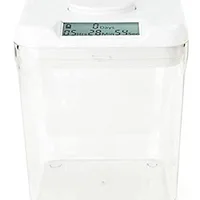
Kitchen Safe kSafe Time Locking Container
Physical enforcement of the time-and-energy limit. When declining the late-night call becomes simpler because the phone is genuinely unavailable — not willpower-unavailable, but physically locked away until morning.
As an Amazon Associate, we earn from qualifying purchases — at no extra cost to you.
The guilt that follows a clearly held limit is almost inevitable, especially early on. Clinical psychologists consistently note that people who struggle most with boundary maintenance confuse the discomfort of setting a limit with evidence that the limit was wrong. But the guilt isn't a signal to reconsider — it's a conditioned response to the old threat association, the same alarm that was trained in that earlier environment where self-advocacy genuinely was risky. It will fire regardless of whether your limit is appropriate or not. The practice is to hold the limit anyway, and let the feeling settle without acting on it.

How to Hold Your Ground When People Push Back
If you set a limit with someone who has benefited from your previous limitlessness, there's a real probability they'll push back. This is normal. It is not evidence that you were wrong.
The pushback tends to take one of three forms.
The first is genuine confusion — the person who simply didn't know your limit existed and needs a moment to recalibrate. This resolves relatively quickly and requires only your patience.
The second is negotiation — an attempt to find an exception, a compromise, a workaround. This is also normal and doesn't necessarily indicate bad faith. The appropriate response here is gentle repetition: "I understand. I'm still not available for that." Said once, calmly, without a lecture. Then silence.
The third — and the form that requires the most internal clarity — is guilt-deployment. The escalation designed to make you feel that your limit is causing harm. The pointed withdrawal. The implication that a truly caring person wouldn't be drawing this line. This is the moment most people cave, because the threat association fires intensely and the discomfort feels like confirmation that the limit was wrong, that you've damaged something important, that the cost is too high.

Sony WH-1000XM5 Noise Cancelling Headphones
Industry-leading noise cancellation for the focus zone a clear boundary creates. Physical signal to others — and your own nervous system — that this time is set aside and protected.
As an Amazon Associate, we earn from qualifying purchases — at no extra cost to you.
What attachment research, clinical psychology, and decades of relational therapy converge on is this: the calm, repeated response is both more effective and more relational than either capitulation or confrontation. "I understand you're frustrated. I'm still not going to be able to do that." Said once. Held consistently. Not as a performance of toughness, but as a quiet expression of what is actually true for you.
Over time, in relationships where genuine connection exists, this produces more respect and more authentic closeness than accommodation ever did. The person who knew you as someone who always said yes didn't know you. They knew an approximation. The person who encounters your actual limits gets to know something real.
How to Start Today: Setting Your First Real Limit
The goal here isn't a complete behavioral overhaul. It's one clear, honest limit — communicated before the end of this week. Here's the sequence that tends to work:
Step 1: Identify the specific drain. Not a general category ("I need more time for myself"), but a recurring situation. The Sunday afternoon call that reliably leaves you depleted. The colleague who adds three items to every conversation on the way out of a meeting. The family member whose crises always somehow become your logistical problem. Specific.
Step 2: Name what you're actually protecting. Before you communicate a limit, you need to know what you're preserving. Not "my peace of mind" — that's still too vague. Try: "my Sunday mornings until noon," or "one hour of uninterrupted focus time before I check messages." The more concrete the need, the more communicable the limit.
Step 3: Write the sentence first. Literally write it down — the limit, in one or two sentences, without qualifiers, apologies, or explanatory preamble. Read it back to yourself several times before you say it to anyone. You're rehearsing clarity, not a confrontation.
Step 4: Start with a lower-stakes relationship. The first limit you practice holding shouldn't be with the most intense person in your life. Find someone you feel relatively safe with, in a situation that matters but isn't catastrophic if it goes imperfectly. You're building neurological evidence that communicating a limit doesn't destroy the relationship. That evidence is what makes the harder conversations possible later.
Step 5: Process the guilt separately from the limit. When the discomfort arrives — and it will, probably more intensely than the situation warrants — journal it, talk it through with someone outside the situation, or sit with it without acting on it. The guilt is information about your conditioning, not a verdict on whether your limit was right. Treat it as weather: real, temporary, and not something you have to fix immediately.
The Person on the Other Side of Your Limits
As the timeless wisdom goes, you can't give what you don't have. The person who has allocated every available resource to everyone who asked isn't generous — they're depleted. The care, the attention, the genuine presence you extend to the people who matter to you — that comes from somewhere. It requires a reserve. And a reserve requires protection.
Every limit you communicate isn't just something you're holding for yourself. It's something you're holding for the person you're becoming — the version of you who shows up with real energy rather than performed patience, with actual interest rather than the hollow motion of engagement, with something genuine to offer rather than the increasingly thin simulation of it.

Kindle Paperwhite 2024 (16GB, No Ads)
The fastest way to extend your psychology and relational reading library. Lightweight, distraction-free, holds thousands of books — including everything Tawwab, Brown, and Clear have written on identity, connection, a…
As an Amazon Associate, we earn from qualifying purchases — at no extra cost to you.
Design Your Evolution.
Designing the relational conditions within which your growth is actually possible means being honest about where you end and where others begin. Not defensively. Not as a declaration of independence. But clearly — because clarity is the most respectful thing you can offer another person, and the most necessary thing you can offer yourself.
The question I'll leave you with is this: where has your default answer been "yes" when your honest answer was something else entirely? And what do you imagine it would actually cost — not the anxious imagined cost, but the real cost — to say the true thing once?
Drop that in the comments. I'd genuinely like to know.
Was this helpful?