Mindset· 10 min read
How to Stop Fearing Aging and Start Designing It
Most people fear aging because they accepted someone else's story about it. Here's how to rewrite that story using psychology, role models, and deliberate design.

How to Stop Fearing Aging and Start Designing It
There's a particular kind of dread that tends to arrive not at funerals, but at birthday parties. You're standing in front of a cake, candles lit, and somewhere between the singing and the first slice, a small voice whispers: Is this it? Is this the beginning of less?
I've heard versions of that question from people in their mid-thirties, people in their fifties, and people who've just turned sixty and feel oddly ambushed by it. The age changes. The fear of aging doesn't. And what's interesting — once you start pulling at it — is that the fear almost never has anything to do with aging itself. It has everything to do with a story you were handed long before you were old enough to question it.
The Story You Didn't Choose
The cultural script around aging was written for a specific purpose: to sell anti-aging products, justify forced retirement policies, and keep younger people from recognizing how much accumulated wisdom is sitting in the generation ahead of them.
Think about the language alone. "Over the hill." "Past your prime." Even "midlife crisis" — as if entering the second half of your life is inherently a catastrophe rather than a pivot. Language shapes expectation. Expectation shapes behavior. Behavior shapes outcome. Which means that the story you accept about aging is, in a very real sense, producing your future.
Here's a counterintuitive truth that most people don't sit with long enough: many of the qualities that drive actual success in life — pattern recognition, emotional regulation, strategic patience, the ability to tolerate ambiguity — get stronger with age, not weaker. Nassim Taleb makes this case in the context of decision-making under uncertainty. Experience isn't just time served. It's compressed learning that cannot be downloaded, outsourced, or fast-tracked.
The problem is that we've built an entire culture around fast-twitch metrics: raw processing speed, physical recovery, the ability to stay up until 3am and show up fresh by 7. These shift with age. That's real. But they're not the only metrics. They're not even the most important ones — unless you're still playing the same game you played at twenty-three.
Most people aren't. And most people, by their forties and fifties, have the chance to play a fundamentally different and more interesting game. The question is whether they've decided to believe that — or whether they're still quietly grieving a version of themselves that was never going to last forever anyway.
How your core values act as the GPS for every good decision
What the Research Actually Says About Aging and Performance
In his 2022 book From Strength to Strength, Harvard professor Arthur Brooks offers one of the most honest and useful accounts of what actually happens to human performance over time. Brooks doesn't pretend that fluid intelligence — raw creative leaps, rapid processing, the ability to learn brand-new things quickly — doesn't decline with age. It does, typically beginning in the late thirties. He's not there to comfort you with a lie.
But he makes a compelling, rigorously researched case that what he calls "crystallized intelligence" — the ability to synthesize, connect, teach, and apply — tends to peak in the later career years. The chess grandmaster who can no longer calculate fifteen moves ahead can still read a position better than a twenty-year-old. The veteran executive who can no longer keep up with every new framework can still identify the one that matters in sixty seconds flat.
The data supports this more broadly. A 2015 study published in Psychological Science by Hartshorne and Germine, drawing on data from nearly 50,000 participants, found that vocabulary and crystallized knowledge continue increasing well into the sixties and seventies — in recent cohorts, vocabulary didn't peak until around age 65. Psychiatrist Gene Cohen spent decades studying creativity in older adults and found that the brain doesn't simply deteriorate — it reorganizes. Older adults show more bilateral brain activation (using both hemispheres simultaneously), which correlates with more integrative, nuanced thinking. The kind of thinking, it turns out, that produces breakthrough work.
Chris Crowley and physician Henry Lodge make an even blunter argument in Younger Next Year: most of what we accept as "normal" physical aging is the result of disuse, not biology. The body's default program, Lodge argues, is either growth or decay — and which one runs depends almost entirely on the signals you send it through exercise, social engagement, and novelty.
The practical implication? If you design your inputs deliberately — how you move, what you learn, who you spend time with, what problems you choose to engage — the trajectory isn't what most people assume. The science of living longer and habits that extend healthspan points to the same conclusion.
The People Who Got This Right
Charles Darwin published On the Origin of Species at 50. Ray Kroc didn't open the first McDonald's franchise until he was 52. Vera Wang didn't design her first wedding gown until she was 40. Julia Child didn't release her first cookbook until she was 49. Frank Lloyd Wright was commissioned to design the Guggenheim Museum at 76 and spent the final sixteen years of his life working on it.
This isn't cherry-picked inspiration. It's a structural pattern.
Psychologist Dan McAdams has spent his career studying what he calls "narrative identity" — the story we tell ourselves about who we are and where we're heading. His research published in Psychological Inquiry consistently shows that people who age well are not the ones who pretend time isn't passing. They're the ones who actively revise their narrative. They replace a chapter title like "decline" with one like "second act" or "distillation" — and then they live as if that chapter is true.
This matters because identity shapes behavior before behavior shapes outcomes. You don't just decide to live differently at fifty. You decide to be someone who is still building, still curious, still in motion. Then the behaviors follow from that.
If you expect decline, you'll stop making the choices that generate growth. The fear of aging isn't passive. It produces the very outcomes it predicts.
Three Beliefs That Quietly Sabotage the Second Half
Most "aging gracefully" content tells you what to do without addressing the deeper work required first. You can't genuinely redesign your aging until you've examined the belief structure underneath it. There are three beliefs that tend to do the most damage.
"The best of me is behind me." This sounds like realism but it's actually surrender dressed in practical clothing. Your deepest relationships, most meaningful work, and sharpest thinking may well be ahead of you — because they require the very things that only come with time: perspective, patience, and earned trust.
"I'm too old to start something new." Research on adult skill acquisition shows that adults learn differently than children — but not worse. Adult learners bring intrinsic motivation, existing mental models, and self-direction that accelerate skill development in ways that youth cannot replicate. The person who accepts the lie about their own learning capacity never finds out what they were actually capable of.
"My window is closing." This is the sneakiest one. It generates urgency, but not the productive kind — the kind that creates anxiety rather than action. Windows of opportunity do shift with time. But they don't close in the catastrophic way the fear suggests. They change shape. New windows open. The person who designs their evolution consciously tends to find themselves at fifty or sixty with more leverage than they had at thirty — more trust, more discernment, more ability to say no to what doesn't matter and yes to what does.
How to shed your old identity and become someone new
How to Start Designing Your Aging Today
This is the part where inspiration becomes architecture. Five concrete starting points:
-
Audit your age-related beliefs. Take fifteen minutes and write out what you actually believe happens to people as they get older. Not what you've been told — what you believe. You'll find cultural programming masquerading as biological fact. Each one of those beliefs is a variable, and variables can be changed.
-
Choose your role models deliberately. Most people's mental image of "what sixty looks like" comes from their parents, their neighbors, or whoever was on television when they were young. This is a small and often unrepresentative sample. Spend real time reading about people who created, built, contributed, and thrived deep into their lives. Your nervous system needs evidence that the story you want to live is actually possible.
-
Design your physical inputs like you mean it. Not for aesthetics — for platform. Your body is the hardware your life runs on. Crowley and Lodge's research is unambiguous: the default program for a body that isn't challenged is decay, not maintenance. Regular resistance training and cardiovascular exercise are the most direct biological signal you can send to your body that you expect it to stay in the game.
-
Invest in crystallized intelligence, not just speed. Stop apologizing for being someone who has deep experience. Ask what that experience uniquely positions you to create, teach, or solve. Read across disciplines. Mentor someone younger. Take on problems that require depth over velocity — those are the ones you're most equipped for now.
-
Build a longer time horizon on purpose. One of the quietest ways fear of aging shows up is in short-term thinking — why plan ten years ahead when everything feels uncertain? Long-horizon planning is one of the most clarifying things you can do for your own psychology. It signals to yourself that you believe there's a future worth designing. Get a journal built for this kind of reflective, forward-facing thinking, and use it consistently.
Here's the thing about designing your evolution: it doesn't come with a retirement date.
The people who get this right aren't the ones who found some biohacking shortcut or discovered a secret that everyone else missed. They're the ones who refused to hand the pen to a cultural narrative that was never written in their favor. They kept asking, year after year, what kind of person they wanted to become next — and then they went about becoming that person.
The fear of aging, at its core, is the fear of irrelevance. Of invisibility. Of running out of things to contribute. Those fears are worth examining. But they're not inevitable. They're the natural result of living on autopilot inside a story someone else handed you.
You can hand it back.
Vanulos exists for exactly this reason: not to help you stay the same, but to keep designing the person you're becoming — regardless of what the calendar says. Evolution doesn't have a cut-off age.
What age-related belief have you been carrying that you've never actually stopped to question? That's where your next design project begins.

Tools mentioned in this article

Kindle Paperwhite (2024, 12th Gen, 16GB)
Crystallized intelligence is built through patient, wide-ranging reading — and a dedicated reader removes the friction that keeps most people cycling through headlines instead of finishing books.
As an Amazon Associate, we earn from qualifying purchases — at no extra cost to you.

Amazfit GTR 4 Fitness Smartwatch (Black, 150+ Sport Modes, GPS, 14-Day Battery)
Crowley and Lodge argue the body's default is decay or growth depending on the signals you send it. A smartwatch that tracks heart-rate, resistance work, and sleep makes those signals visible — and measurable — every…
As an Amazon Associate, we earn from qualifying purchases — at no extra cost to you.

Full Focus Planner by Michael Hyatt (Gray Linen Hardcover, 90-Day Cycle)
Dan McAdams's research on narrative identity maps directly onto planning tools: a 90-day cycle forces you to name the next chapter rather than passively inherit one. This is the most tangible version of 'revising your…
As an Amazon Associate, we earn from qualifying purchases — at no extra cost to you.
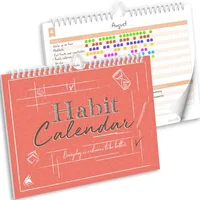
Clever Fox Habit Calendar Circle (2-Year Habit Tracker, Dark Blue & Red)
The sneakiest belief — 'my window is closing' — collapses time horizons. A 24-month tracker is a physical object that insists the opposite: you are planning two years ahead, not bracing for decline.
As an Amazon Associate, we earn from qualifying purchases — at no extra cost to you.

The Five Minute Journal — Intelligent Change (Daily Gratitude & Reflection, Undated)
The article literally ends point 5 with 'Get a journal built for this kind of reflective, forward-facing thinking, and use it consistently.' The Five Minute Journal is the category standard — undated so you can start…
As an Amazon Associate, we earn from qualifying purchases — at no extra cost to you.
Atomic Habits — James Clear (Paperback)
Designing your evolution comes down to systems, not willpower. Clear's argument — identity-based habits — mirrors the article's core thesis: you decide who you're becoming, then the behaviors follow.
As an Amazon Associate, we earn from qualifying purchases — at no extra cost to you.
Was this helpful?