Intentional Living· 11 min read
Your Core Values Are the GPS of Every Good Decision
Most decisions feel hard because your values are unclear. Identify your top 3 and life's biggest choices become dramatically simpler. Here's the exact process.

Your Core Values Are the GPS of Every Good Decision
A friend of mine sat across from me at dinner last winter and confessed she hadn't slept properly in six weeks. She'd been offered a director role — bigger title, almost double her current salary, the kind of jump that's supposed to feel like a win. The catch: 60-hour weeks, quarterly travel, and a daughter who'd just turned three and was going through the phase where she asked for her mum the moment she walked out the door.
She'd made every pro/con list imaginable. She'd talked to her husband, her therapist, her sister, and two mentors. The more input she gathered, the murkier it got. Then, three days before the deadline, someone suggested she do one thing: write down her top three core values — not the ones she admired, not the aspirational ones, but the ones that showed up consistently in the moments she felt most alive. She spent 20 minutes on it. By the end, the decision was obvious. She turned down the role, slept eight hours that night, and told me the next morning she felt nothing but clarity.
That word — clarity — is the thing most people are actually looking for when they say they want help making a decision.
Why Most Hard Decisions Aren't Actually Hard
Here's the uncomfortable truth: most decisions that feel impossible aren't impossible because the choice is genuinely difficult. They're impossible because the person making them doesn't yet know what they actually stand for.
People who live with chronic tension between what they do every day and what they genuinely care about experience a steady, quiet drain — not a dramatic breakdown, but the kind of low-grade friction you chalk up to being tired, or busy, or going through a phase. Psychologists sometimes call this value-goal incongruence. The research consistently links it to lower wellbeing and higher stress over time.
Mark Manson, in The Subtle Art of Not Giving a F*ck, makes an observation that cuts straight to this: the question isn't what you want out of life, it's what pain you're willing to sustain for it. What you'll sacrifice and what you'll protect under pressure — that's what your values actually are. Not the list you'd put on a vision board. The real list.
Think of core values as your GPS home base. Any navigation system can plot a thousand routes. But it can only do that because it knows one fixed thing: where home is. Without that anchor, it doesn't route — it just displays a map with no direction. Most people are living with a map but no destination loaded. They move fast, they stay busy, they accomplish things — but they keep ending up somewhere they didn't want to be, wondering how they got there.
The people who make the right hard choices consistently — refusing the wrong money, leaving the wrong room, saying yes to the scary right thing — are not braver than the rest of us. They are clearer. Clarity is the thing that looks like courage from the outside.
Core Values Aren't What You Wish You Cared About
Core values are the principles that guide your actual behavior under pressure, not the ideals you endorse when life is calm. This distinction matters more than most people realize.
Before we talk about finding your values, we need to talk about the most common mistake people make in the process: writing down the values they'd like to have instead of the ones they actually hold.
Ask a room full of people to list their top values and most lists will include some version of: family, health, integrity, growth, success. Not because everyone is lying — but because those words represent admired ideals, not necessarily lived realities.
Here's the real test: a value is something you protect under pressure, not something you endorse in calm conditions.
Take "health" as an example. Two people both write it down. One wakes at 5:30 AM to train before their kids are up, turns down dessert when stressed because junk food makes them feel worse, and schedules annual health checks the way they schedule business meetings. The other says health matters deeply, but when work gets heavy the workouts disappear first, and sleep becomes a casualty of Netflix. Both believe they value health. Only one is living it as a value.
Jim Rohn used to say: "Don't wish it were easier; wish you were better." What he was really pointing at is this — the discipline to show up for something is only available when that something is genuinely yours, not borrowed. Most of us are running on a values system assembled in childhood, reinforced by peer groups, and never examined under our own light.
The difference between the life you're living and the life you want is often not a skills gap or a resources gap. It's a values clarity gap. And you can close it.
You Probably Inherited Most of Your Values — Not Chose Them
Research on how the subconscious mind absorbs behavioral patterns in early childhood — explored in depth by Bruce Lipton in The Biology of Belief — suggests that many of our default responses and value systems are installed before the age of seven, mostly from our parents and immediate environment. We don't choose those programs. We absorb them. And then we spend decades acting on them without ever checking whether they're actually ours.
This creates a particular kind of confusion. Borrowed values feel like your own values until they don't. They feel normal until the day you find yourself successful by every metric you were taught to pursue — and quietly hollow in ways you can't explain to anyone because the explanation doesn't make sense: "I have everything I was supposed to want, and I'm not okay."
A former colleague of mine spent eleven years building a career in finance. Good money, respect, a clear promotion track. His father had worked in banking his whole life and measured value in professional standing. My colleague absorbed that measurement without question. By 38 he was a senior VP, divorced once, and spending his Sundays dreading Monday in a way that felt physiological. The work wasn't bad. The work just wasn't his. He'd been living his father's values, not his own.
When he finally did the work of identifying what he actually valued — creative autonomy, physical challenge, proximity to nature — the career shift he made seemed reckless from the outside and inevitable from the inside.
That's the thing about living aligned with your genuine values. The decision can look strange to everyone else and feel completely natural to you.
How to shed your old identity and become someone new
How to Identify Your Core Values Step by Step
This isn't a philosophical exercise. It's a diagnostic. Here's the exact method, broken into four steps you can complete in a single sitting.
Step 1: The Peak Moments Audit
Think of three to five moments in your life when you felt most fully yourself — most energized, most clear, most right. Not necessarily the biggest achievements, and not necessarily the happiest moments. The ones where you thought, consciously or not: this is what I'm for.
Write them down. Then, next to each one, write what was true about that moment. Were you working independently, or alongside people you trusted? Were you building something from nothing, or mastering something difficult? Were you needed by someone, or free from obligation? Look at the words you use. They're pointing at something.
Step 2: The Anger Audit
This one surprises people. Your disproportionate anger — the kind that shows up when you feel something has been violated — is one of the most reliable pointers to your deepest values. Think about the last three times you felt genuinely, unreasonably angry or uncomfortable. What was the situation? What rule felt broken?
If you get quietly furious when someone in a meeting takes credit for another person's work, you probably value integrity. If you feel suffocated when a schedule gets imposed on you without consultation, you probably value autonomy. Your anger is your values talking at full volume.
Step 3: Narrow to Three
Start with a long list — there are dozens of values words online, and it's fine to scan a comprehensive one to see what resonates. Then cut. Keep cutting until you reach three. Not five. Not seven. Three.
This is where most people resist. They want to keep eight values because narrowing feels like loss. But eight values give you no real filter — with eight, you can justify almost any decision. Three create genuine constraint, and constraint is what forces clarity. A GPS doesn't list every city on the planet as a destination. It has one at a time.
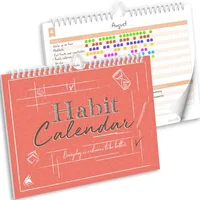
Clever Fox Habit Calendar Circle (24-Month Habit Tracker)
Step 4 of the values audit — testing your three values against real decisions for 30 days — is where most people lose the thread. They identify the values, feel briefly clear, and then let daily life absorb them witho…
As an Amazon Associate, we earn from qualifying purchases — at no extra cost to you.

Step 4: Test Them Against Real Decisions
Once you have your three, put a real decision you're facing through them. Not "does this align with my values?" in the abstract — but specifically: "Does this choice protect or compromise [Value 1]? [Value 2]? [Value 3]?" You'll know when a decision cuts against them. There's a particular feeling — part tension, part dread, part resignation — that accompanies the moment you say yes to something that violates what matters most to you.
That feeling is information. Start treating it as such.
Values in Practice: A Quick Reference
| Situation | Without Clear Values | With Clear Values |
|---|---|---|
| Job offer with trade-offs | Decision paralysis, endless pro/con lists | Run through filter: does it protect your top 3? |
| Saying yes to extra commitments | Default to yes, then regret | Check against values: clean no or informed yes |
| Feeling hollow after achieving something | Confusion, questioning everything | Signal that goal didn't reflect actual values |
| Relationship tension | Hard to articulate what feels wrong | Name the value being violated, address it directly |
| Long-term planning | Chasing metrics that don't satisfy | Align goals to values from the start |
The Decision Filter That Simplifies Everything
Once your top three values are identified and real, something slightly surprising happens: big decisions get easier, not harder.
This seems counterintuitive. You'd think having a filter would add complexity — one more framework to run things through. But a filter doesn't add work to a decision. It removes noise. Most decision paralysis isn't about lacking information. It's about lacking a weighting system. When you have a clear values hierarchy, the weight is pre-assigned.
Napoleon Hill called this "definiteness of purpose" — the idea that the person who knows exactly what they're moving toward makes faster, cleaner decisions than someone with ten equally compelling goals. Your values are the purpose made operational. They're what definiteness of purpose actually looks like in practice, day to day.
Here's how the filter works in practice. Say your top three values are: freedom, deep work, and family presence.
A job offer arrives. High status, significant salary increase, but it requires weekly travel and a mandate to always be available by phone. You run it through the filter: it actively compromises freedom and family presence. Answer already loaded. You can still choose to take it — maybe the financial upside matters enough to override for a defined season. But you're choosing deliberately, with open eyes, rather than sleepwalking into a role that will quietly erode what you actually care about.
The same filter applies to small decisions. Should you say yes to joining another committee at work? Through the filter: does this protect or compress your deep work hours and your evenings? If no and no: the answer is probably no, and you can say it cleanly without guilt.
I couldn't make a big decision until I tried fear setting
Atomic Habits — James Clear
The article quotes Clear's core insight — that identity, not motivation, is what makes behavior hold — because it's exactly what values clarity gives you. When your top three are clear, new habits don't rely on willpo…
As an Amazon Associate, we earn from qualifying purchases — at no extra cost to you.
The Quiet Cost of Living Against Your Values
There's a particular kind of dissatisfaction that's hard to diagnose because it doesn't look like a crisis. It looks like general flatness. Low-grade restlessness. A vague sense that something is off, even when nothing is technically wrong.
This is what living against your values feels like from the inside — and it's worth naming clearly.
Goal conflict research published in academic psychology journals consistently shows that working toward goals that don't reflect what you hold most important is one of the stronger predictors of psychological distress — and this effect holds whether or not the goals are actually achieved. The achievement itself doesn't fix the misalignment. You can win the wrong race and feel worse for crossing the finish line.
T. Harv Eker observed this pattern repeatedly in his work with high-achievers: people who had built impressive financial and professional lives and experienced not triumph but a specific, disorienting emptiness. His diagnosis was usually the same. They'd been optimizing for external validation rather than internal alignment. Their "why" belonged to someone else. For more on this dynamic, James Clear's Atomic Habits addresses how identity — including value systems — shapes behavior more fundamentally than goals or motivation.
The subtle signs are worth learning to recognize: saying yes when your gut says no and feeling the exact moment you do it. Accomplishing something and feeling nothing. Building something that works and not caring. Performing competence in a role that doesn't feel like yours. Getting to Friday and not being able to identify a single moment in the week that felt like you.
These aren't signs that you need a vacation. They're signs that your actions and your values have drifted out of alignment, and the gap is costing you more than you're accounting for.
For a deeper look at the psychological mechanics of this drift, the Greater Good Science Center at UC Berkeley has extensive research-backed resources on meaning, purpose, and the role values play in long-term wellbeing.
Goals vs. purpose: the difference that changes everything
How to Start Today: Your 20-Minute Values Audit
You don't need a retreat, a coach, or an extended journaling practice to do this. You need 20 minutes and something to write with. Here's the complete sequence:
-
Open a notebook or notes app. Write "Peak Moments" at the top. List three to five moments when you felt most fully yourself — alive, clear, right.
-
Next to each moment, write two or three words that describe what was true about it. Were you free, creative, connected, challenged, useful, at peace?
-
Write "Anger Audit" below. List the last three times you felt disproportionately irritated, hurt, or uncomfortable. Next to each: what rule felt broken?
-
Look at all the words you've written. Circle the ones that appear in both lists or appear more than once.
-
From those circled words, choose your top three. Force yourself to narrow it down. If it feels painful to cut something, that tension is useful — it means you're getting honest.
-
Write those three values somewhere you'll see them — your phone's notes app, the inside cover of your journal, a sticky note on your monitor. For the next 30 days, run at least one real decision through them each day, even small ones.

Kindle Paperwhite (2024, 12th Gen, 16GB)
The 20-minute audit works once; living by it is a longer project, and a longer project needs fuel. Bruce Lipton on how early programming shapes adult values, Mark Manson on what you'll suffer for and what you won't, G…
As an Amazon Associate, we earn from qualifying purchases — at no extra cost to you.
The compounding effect of making values-aligned decisions is slow at first and then striking. Within a few months, people who do this seriously report something they rarely expected: they don't feel more restricted. They feel more themselves.

The Navigation Doesn't Require the Whole Map
You don't need to have your entire life figured out. You don't need a ten-year vision, a perfect morning routine, or a clear purpose statement carved in stone. The GPS doesn't need to know every road between here and there. It needs one thing: where home is.
Your values are home. Once you know them — genuinely, not aspirationally — the route starts calculating on its own. You'll still make wrong turns. You'll still face decisions that are genuinely difficult even when your values are clear. But you'll stop feeling lost. And there's a real difference between a hard road and a directionless one that most people don't fully appreciate until they've experienced both.
Designing your evolution doesn't start with habits, or routines, or productivity systems — though all of those matter. It starts with this. Knowing what you actually stand for. The rest builds on top of that foundation, and it builds faster, and it holds.
If you could only protect three things in your life from everything else — three things that, if compromised, would leave you feeling like you'd lost something essential — what would they be?
You probably already know. The answer has been there for a long time, waiting for you to ask the question directly.
What are your top three values? Have they shifted in the last five years — and if so, what moved them? Share in the comments — the most interesting thing about this exercise is how different the answers are for different people, and how clear the pattern becomes once you see it.
Was this helpful?