Intentional Living· 11 min read
Goals vs Purpose: The Difference That Changes Everything
Goals tell you where to go. Purpose tells you why it matters. Learn the structural difference that turns achievement into lasting fulfillment.
I Hit Every Goal I Set for 3 Years. I Still Felt Lost. Here's What Was Missing
The spreadsheet was beautiful. Colour-coded rows, quarterly milestones, percentage trackers that turned green when I crossed the finish line. I'd built it in January 2022, and by December 2024, nearly every cell glowed that satisfying emerald.
I'd lost the weight. Landed the promotion. Read fifty-two books a year — twice. Saved the emergency fund. Ran the half-marathon. And sitting in my kitchen on New Year's Eve, staring at that wall of green, I felt… nothing. Not proud, not grateful. Just a quiet, creeping question: Now what?
That question nearly broke me. It also saved me — because it forced me to confront a distinction I'd been dodging for years. The difference between goals and purpose in life isn't semantic. It's structural. Goals are the scaffolding. Purpose is the building. And I'd spent three years assembling scaffolding around an empty lot.
The Goal Trap: Why Checking Boxes Doesn't Equal Fulfillment
Here's what nobody tells you about goal-setting culture: it's optimised for completion, not meaning. Every productivity book on your shelf — and I've read most of them — teaches you how to set targets, break them into chunks, and execute. SMART goals. OKRs. The 12-week year. They're brilliant machinery for getting things done.
But machinery needs a purpose.
Jim Rohn used to say, "The major reason for setting a goal is for what it makes of you to accomplish it." Read that again. He didn't say what you get. He said what it makes of you. Rohn understood something the modern goal-setting industrial complex has quietly forgotten: the transformation matters more than the trophy.
Research consistently backs this up. A longitudinal study from Rush University Medical Center found that older adults with a strong sense of purpose had roughly 2.4 times lower risk of developing Alzheimer's — but the benefits start much earlier than old age. People who pursue goals aligned with a self-defined purpose report significantly higher life satisfaction than those who pursue equally ambitious goals without that alignment, even when both groups achieve at comparable rates. Same effort. Same results on paper. Wildly different inner experience.

You've probably felt this without naming it. You finish a project, get the congratulations email, and within forty-eight hours you're already anxious about the next target. That's not ambition. That's a hamster wheel with better branding.
Building habits that actually stick
Purpose Isn't a Destination — It's a Direction
Here's where most people get confused. They hear "find your purpose" and imagine some cinematic epiphany — a mountaintop moment where the clouds part and a booming voice tells you exactly why you're here. That's a film script, not reality.
Purpose is more like a compass bearing than a GPS coordinate. It doesn't give you turn-by-turn directions. It gives you orientation. And that orientation changes how you evaluate everything — which goals to pursue, which to abandon, and which were never yours to begin with.
Viktor Frankl, the psychiatrist who survived Auschwitz and wrote Man's Search for Meaning, put it simply: "Those who have a 'why' to live can bear with almost any 'how'." He wasn't being poetic. He'd literally watched it happen. The prisoners who held onto a sense of purpose — whether it was seeing a family member again, completing unfinished work, or simply bearing witness — survived at measurably higher rates than those who didn't.
Now, your Tuesday morning isn't a concentration camp. But the principle scales down perfectly. When your purpose is clear, boring meetings get bearable. Difficult conversations get easier. The gym at 6 AM stops requiring willpower and starts feeling like maintenance for the life you're building.
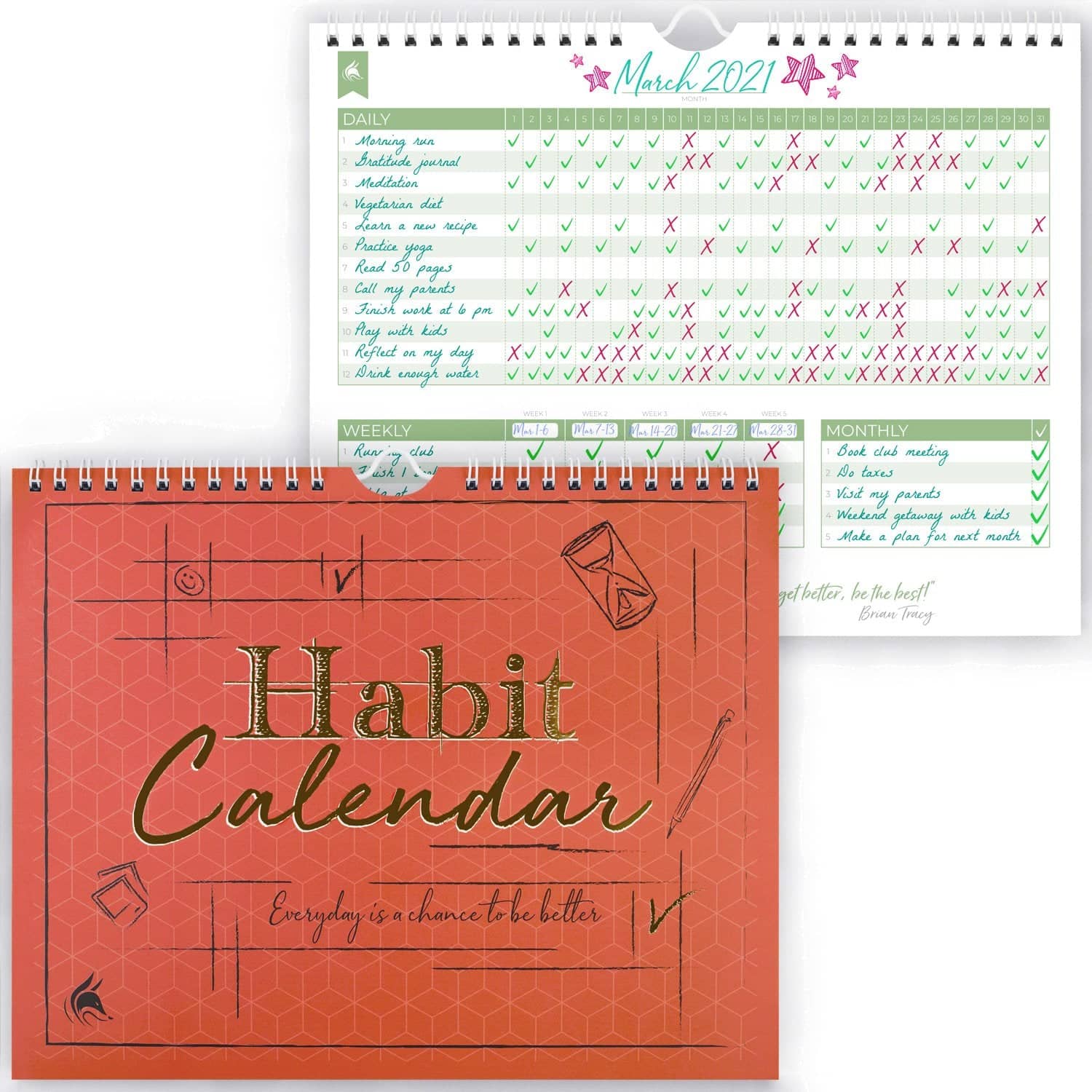
Clever Fox Habit Tracker Journal
Purpose requires honesty, not planning. A habit tracker journal gives you a dedicated space for the honest self-reflection this section demands — not tasks to check off, but patterns to observe.
As an Amazon Associate, we earn from qualifying purchases — at no extra cost to you.
The catch? Purpose requires a different kind of work than goal-setting. Goals need planning. Purpose needs honesty.
The Architecture Analogy: Foundation vs. Renovation
Think of your life like a house. Goals are renovation projects — new kitchen, fresh paint, a deck out back. They're visible, they're satisfying, and they make the place look great in photos.
Purpose is the foundation.
You can renovate endlessly. You can swap countertops every two years, install smart lighting, build the home office of your dreams. But if the foundation is cracked — or worse, if there is no foundation — eventually the floors start sloping. Doors stop closing properly. You feel the instability in your bones before you see it in the walls.
I spent three years renovating a house with no foundation. Every goal I hit was another coat of paint on a structure that couldn't hold its own weight.
Here's the uncomfortable truth: most productivity systems are renovation guides. They assume the foundation exists. They skip the part where you dig into the dirt and pour the concrete, because that part is messy, slow, and doesn't photograph well for Instagram.
Bob Proctor, who spent decades teaching people to think bigger, was surprisingly specific about this. He didn't just say "dream big" — he said you need to understand what's driving the dream. "If you don't know what you want, you'll probably end up somewhere you don't want to be," he'd say. The want underneath the want. That's where purpose hides.
Three Signs Your Goals Have Outrun Your Purpose
Before you scrap your planner and stare at the ceiling for a week trying to "find yourself," let me save you some time. You don't need a sabbatical. You need diagnostic clarity. Here are three patterns I've noticed — in my own life and in conversations with hundreds of readers:
1. You hit the goal and immediately feel anxious, not relieved.
The promotion lands. Instead of celebrating, you're already worrying about the next performance review. The weight comes off, and you're immediately terrified of gaining it back. This isn't discipline — it's a sign that the goal was filling a hole instead of building a wall. Without purpose, achievement becomes a treadmill.
2. You keep changing goals but the emptiness stays the same.
First it was fitness. Then it was finances. Then it was relationships. Then it was career. You're not fickle — you're searching. Each new goal category is an attempt to find the thing that makes the engine run. But swapping destinations won't help if you haven't figured out why you're driving.
3. You feel jealous of people who seem less accomplished but more content.
This one stings. You've objectively done more, achieved more, earned more — and yet your neighbour who works a basic job and spends weekends gardening seems genuinely, annoyingly peaceful. That gap between achievement and contentment is exactly the space where purpose lives.
How to Find the Layer Beneath the Goal
I'm not going to give you a purpose statement template. Those are goals in disguise — another box to check. Instead, here are four questions that actually work. I've tested them over eighteen months, refined them through reader feedback, and used them to restructure my own planning system.
Question 1: "What would I keep doing even if nobody ever knew?"
Strip away the recognition, the social media post, the promotion, the praise. What remains? For me, it was writing. Not "being a writer" — that's an identity goal. Just the act of sitting down and making sense of ideas on a page. When I admitted that, everything else rearranged.
Question 2: "What problem in other people's lives bothers me enough to act on?"
Purpose almost always involves other people. Not in a martyrdom way — in a gravitational way. Something about a specific kind of struggle pulls your attention, and you can't quite look away. Simon Sinek's concept of "Start With Why" gets overused, but his core observation is right: the most resilient motivation points outward.
Question 3: "When have I felt most like myself — not most successful, but most myself?"
These moments are different from peak achievements. They're often quieter. Teaching a friend something. Solving a problem that fascinated you. Building something with your hands. The feelings here aren't pride or victory — they're alignment. You were doing the thing you were shaped to do.
Question 4: "What would 80-year-old me regret not having pursued?"
This is the Frankl question, flipped forward. Projecting to the end of your life creates a strange clarity. The goals that seem urgent right now suddenly look optional. And the things you've been postponing — the art, the relationships, the contribution — suddenly look non-negotiable.

Sit with these questions. Not for five minutes during a commute — for an hour, with a notebook, in a place where nobody needs anything from you.
Rebuilding: How to Align Your Goals With Something That Matters
Once you've done the honest work, the practical work gets easier. Here's how I restructured my system after my green-spreadsheet crisis.
Step 1: Write a one-sentence purpose draft.
Not a mission statement. Not a manifesto. One sentence, starting with "I exist to..." or "My work is about..." It'll feel cheesy. Write it anyway. Mine started as "I exist to help people think more clearly about how they live." It's evolved since, but that first draft was the foundation pour.
Step 2: Audit your current goals against that sentence.
Take every goal on your list and ask: "Does this serve the sentence, or does it just serve my ego?" I cut four goals immediately. The half-marathon went. The "read 52 books" target went — replaced with "read 20 books that directly matter." Fewer goals, but each one connected to something real.
Step 3: Add a "why" column to your tracking system.
Next to every goal, write one line explaining how it connects to your purpose sentence. If you can't write that line, the goal needs rethinking. This is simple, but it's the single most effective change I made.
Step 4: Schedule a monthly purpose check-in.
Not a goal review — a purpose review. Fifteen minutes asking: "Am I still pointed in the right direction? Have I drifted?" Goals drift toward what's easy or impressive. Purpose pulls you back toward what's honest.
Step 5: Share your purpose with one person.
Not on social media. With one human who'll remember it and ask you about it. Purpose thrives in accountability and withers in isolation. T. Harv Eker was right when he said your environment shapes your outcomes — but it's not just physical environment. It's relational.
Morning routine tools that support intentional living
The Uncomfortable Secret About Purpose-Driven People
Here's something that might surprise you: people who live with clear purpose don't actually achieve less. They often achieve more — but differently. They say no faster. They waste less energy on goals that look impressive but feel hollow. They recover from setbacks quicker because the reason for getting back up isn't "I said I would" — it's "this matters."
Remember that Rush University study I mentioned earlier? The Alzheimer's finding was just the headline. The same research team found that purpose also predicted lower rates of disability, depression, and even mortality. Purpose didn't just make people happier — it literally protected their brains and bodies. That's not motivational fluff. That's neurology.
And here's the counter-intuitive part: purpose-driven people are often less busy. Because when you know what matters, you stop filling your calendar with things that don't. The frantic productivity disappears. What replaces it is a quieter, more deliberate kind of effort — the kind that compounds over years instead of burning out in months.
Napoleon Hill spent twenty years studying the most successful people of his era and concluded that "definiteness of purpose" was the starting point of all achievement. Not goals. Not habits. Not discipline. Purpose. Everything else was downstream.
The Green Spreadsheet, Revisited
I still use a spreadsheet. It's still colour-coded. But the structure is different now. The first row isn't a goal — it's my purpose sentence. Every goal below it has a "why" column linking it back to that sentence. Some quarters, I only have three goals. Other quarters, six. The number doesn't matter. The alignment does.
And on New Year's Eve 2025, I sat in the same kitchen, looked at the same screen, and felt something I hadn't felt in years.
Not nothing.
Not triumph.
Just... rightness. The quiet sense that the building matches the foundation. That I'm not just going somewhere — I know why.
That's what designing your evolution actually looks like. Not more goals. Not fewer goals. The right goals, rooted in something that'll still matter when the spreadsheet is long forgotten.

Grovemade Minimalist Desk Setup Kit
Your workspace shapes your purpose practice. A minimalist desk setup is the physical environment where monthly purpose check-ins and quarterly reviews actually happen — the place where the building meets the foundation.
As an Amazon Associate, we earn from qualifying purchases — at no extra cost to you.
How to stop self-sabotaging your progress
What's your purpose sentence — even a rough first draft? I'm genuinely curious. Drop it in the comments. Not because I'll judge it, but because writing it where someone else can see it is the first step toward making it real.
Was this helpful?