Mindset· 11 min read
I Couldn't Make a Big Decision Until I Tried Fear-Setting
Tim Ferriss's Stoic exercise turns anxiety into actionable clarity. Here's how to define your worst-case scenario — and why doing it sets you free.
I Couldn't Make a Big Decision Until I Tried Fear-Setting
I sat in a parking lot for forty-five minutes once, engine running, staring at the steering wheel. I'd just been offered a role that would've doubled my income. Different city. Different life. And I couldn't move.
Not because I didn't want it. Because I couldn't stop imagining everything that could go wrong. That frozen moment is exactly the kind of paralysis that a fear-setting exercise is built to break — but I didn't know that yet.
The apartment I'd have to find. The friends I'd leave behind. The very real possibility that I'd hate it and have nothing to come back to. My hands were shaking — not from the cold, from the sheer weight of a decision I couldn't seem to make.
That was three years ago. Since then, I've made bigger decisions with less anxiety. Not because I got braver or tougher, but because I found a tool that works like a pressure valve for the kind of fear that paralyzes smart people. Fear-setting changed the way I think about risk forever.
Why Your Brain Is Terrible at Evaluating Risk
Here's something most productivity advice won't tell you: the problem isn't that you're indecisive. It's that your brain is running threat-detection software designed for predators, not career moves.
Daniel Kahneman, the Nobel Prize-winning psychologist, showed in his research on prospect theory that humans feel losses roughly twice as intensely as equivalent gains. Losing $100 stings about twice as much as finding $100 feels good. That asymmetry doesn't just apply to money. It applies to every decision where something is at stake — which is every decision worth making.
So when you're weighing a big choice — quitting a job, ending a relationship, starting a business, moving countries — your brain isn't doing a balanced cost-benefit analysis. It's screaming about the losses while whispering about the gains.
Jim Rohn used to say, "If you're not willing to risk the unusual, you'll have to settle for the ordinary." Beautiful line. True line. But it doesn't actually help you at 2 AM when your chest is tight and you're spiraling about what happens if this all falls apart.
What does help is a structured process for looking fear directly in the face. Not ignoring it. Not "pushing through." Examining it, on paper, until it loses its power.
That's what fear-setting does.
What Fear-Setting Actually Is (And Isn't)
Tim Ferriss first shared the fear-setting exercise in his 2017 TED talk, "Why you should define your fears instead of your goals", which has since been viewed millions of times. But the idea didn't originate with him. It traces back to Seneca, the Stoic philosopher who wrote extensively about premeditatio malorum — the deliberate rehearsal of future misfortune.
So what is fear-setting, exactly? Fear-setting is a structured, three-page written exercise that forces you to define your worst-case scenarios, plan how to prevent or repair each one, and calculate the true cost of doing nothing. It turns abstract dread into a concrete list you can actually work through.
Seneca would intentionally imagine worst-case scenarios. Not to wallow. To defang them. He'd eat simple food, sleep on hard surfaces, wear rough clothing — all to prove to himself that the things he feared losing weren't as essential as he thought.
Ferriss took that ancient Stoic principle and turned it into a three-page exercise anyone can do with a pen and twenty minutes. Here's the structure:
Page One — Define. Write down the decision or action you've been avoiding. Then list every single thing that could go wrong. Every worst-case scenario. Every embarrassment. Every financial hit. Get specific. "I might lose money" is vague. "I might burn through $8,000 in savings over four months and need to move back in with my parents" is real.
Page Two — Prevent and Repair. For each fear you listed, write two things: what you could do to prevent it from happening, and what you could do to repair the damage if it did happen. This is where most of the magic lives. Because when you actually write it down, you realize that most worst-case scenarios are either preventable, repairable, or both.
Page Three — The Cost of Inaction. This is the page people skip, and it's the one that matters most. Write down what your life looks like in six months, one year, and three years if you do nothing. If you stay exactly where you are. If you keep avoiding the decision.
Most people never do this third page. They stay so focused on the risk of acting that they never quantify the risk of standing still.
If you want to go deeper into the ancient philosophy behind this exercise, see our guide on Stoic practices that actually work in real life.
The Part Nobody Talks About: Inaction Has a Price Tag
Here's the counter-intuitive truth that fear-setting reveals almost every single time: doing nothing is rarely the safe choice. It just feels safe because the cost is invisible.
When you don't take the new role, nobody fires you. When you don't start the business, nobody rejects you. When you don't have the hard conversation, nobody gets upset. The cost of inaction is silent. It shows up as a vague sense of restlessness, a career that plateaus, a relationship that slowly calcifies.
Bob Proctor put it sharply: "The only limits in our life are those we impose on ourselves." But the mechanism by which we impose those limits isn't dramatic. It's passive. We just... don't act. And we mistake that passivity for prudence.
A study by economist Steven Levitt, published in The Review of Economic Studies, found that people who were on the fence about a major life change and chose to make the change reported being substantially happier six months later than those who chose the status quo. The study was massive — over 20,000 participants. And the pattern held across decisions about jobs, relationships, and major purchases.
The data is clear. When you're on the fence, the bias you should correct for isn't recklessness — it's inertia.
How I Actually Used Fear-Setting (And What Happened)
Let me go back to that parking lot.
A week after that frozen forty-five minutes, a friend recommended Ferriss's TED talk. I watched it on my lunch break and immediately pulled out a notebook.
My biggest fear about taking the role wasn't financial. It was social. I'd written down: "I'll be alone in a city where I know nobody, and I'll be too exhausted from the new job to build a social life."
Then I filled in the Prevent column: "Join one community group before I move. Keep two weekly calls with close friends. Give it six months before judging."
The Repair column: "If after six months I'm genuinely miserable and isolated, I negotiate remote work or find a new role. My industry is portable."
And then Page Three — the cost of inaction. I wrote: "In one year, I'll still be in a role I've outgrown, still wondering 'what if,' and probably resentful." In three years: "I'll have built my entire identity around safety, and the window for this kind of move will feel even harder to open."
Clever Fox Habit Tracker Journal
A structured journal makes fear-setting a repeatable habit, not a one-off exercise. "Reach for a pen" becomes effortless when the right notebook is already on your desk.
As an Amazon Associate, we earn from qualifying purchases — at no extra cost to you.
Reading that back hit me harder than any of the fears on Page One. Because Page Three wasn't hypothetical. It was a prediction I already believed.
I took the role. The first two months were exactly as hard as I'd feared. The third month, something clicked. By month six, I couldn't imagine having stayed.
Fear-Setting vs. Goal-Setting: Why You Need Both
Goal-setting asks: "What do I want?"
Fear-setting asks: "What am I avoiding, and at what cost?"
They're complementary, not competing. Here's how they stack up:
| Goal-Setting | Fear-Setting | |
|---|---|---|
| Core question | "What do I want?" | "What am I avoiding?" |
| Focus | Desired outcomes | Hidden obstacles |
| Emotional direction | Toward pleasure | Away from regret |
| Time horizon | Future vision | Present paralysis |
| Output | Action plan | Decision clarity |
| Best used | When you know the destination | When you can't leave the starting line |
But here's where most people go wrong: they set ambitious goals without ever examining the fears blocking those goals. It's like programming a GPS destination while refusing to look at the roadblocks on the route.
Napoleon Hill wrote in Think and Grow Rich that "every adversity, every failure, every heartache carries with it the seed of an equal or greater benefit." That's a powerful reframe. But reframing alone doesn't dissolve the visceral, physical resistance that fear creates in your body. You need a process that takes the abstract storm in your head and pins it to paper.
Atomic Habits — James Clear
Once fear-setting clears the roadblocks, you need systems to build momentum. Atomic Habits is the complementary framework: small changes, compounded over time, produce the outcomes fear kept you from pursuing.
As an Amazon Associate, we earn from qualifying purchases — at no extra cost to you.
That's what the three-page structure does. It converts emotional overwhelm into a manageable list. And lists, unlike feelings, can be solved.
Tony Robbins talks about the two primary motivators being pain and pleasure. Fear-setting works because it forces you to quantify both — the pain of acting and the pain of not acting — and compare them side by side. For the first time, you see the full picture.
For a framework that pairs well with fear-setting on the positive side, read our piece on goals vs. purpose — the difference that changes everything.
How to Do Your First Fear-Setting Session Tonight
You don't need a retreat. You don't need a coach. You need thirty quiet minutes and something to write with. Here's how to do it properly:
Step 1: Pick the decision that's been circling your head. The one you think about in the shower. The one you bring up with friends and then immediately deflect. You know which one it is.
Step 2: Set a timer for ten minutes. On Page One, write "DEFINE" at the top and list every fear associated with acting on this decision. Be brutal. Be specific. No fear is too petty or too dramatic. If "people will judge me" is on the list, write it down.
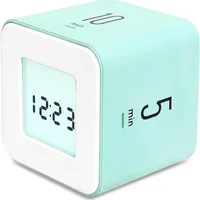
Mooas Cube Flip Timer
Ferriss says "set a timer for ten minutes." A physical cube timer makes the exercise tangible — flip it, the countdown begins, Page One gets filled. No phone, no distractions, no temptation to quit early.
As an Amazon Associate, we earn from qualifying purchases — at no extra cost to you.
Step 3: For each fear, fill in Prevent and Repair. You'll notice something remarkable. For at least 80% of your fears, there's a reasonable prevention strategy or a workable repair plan. The remaining 20% are either extremely unlikely or survivable.
Step 4: Flip to Page Three. Write "COST OF INACTION" at the top. Project forward: six months, twelve months, three years. What does your life look like if you keep avoiding this? Be honest. This is the page that usually tips the scale.
Sony WH-1000XM5 Noise-Cancelling Headphones
You need thirty quiet minutes and something to write with. These noise-cancelling headphones create the bubble of silence that deep self-examination requires — no interruptions, no background noise, just you and the p…
As an Amazon Associate, we earn from qualifying purchases — at no extra cost to you.
Step 5: Read all three pages out loud. There's something about hearing your own voice say "my worst-case scenario is X, and I could fix it by doing Y" that makes the whole thing feel suddenly manageable. It's not magic. It's your prefrontal cortex finally getting a chance to override the amygdala.
When Fear-Setting Works Best (And When It Doesn't)
Fear-setting is exceptional for decisions where the downside feels enormous but is actually recoverable. Career changes. Business launches. Relationship conversations. Geographic moves. Creative projects you've been "meaning to start."
It's less effective for genuinely high-stakes, irreversible decisions — like major medical choices or legal matters — where professional counsel is more appropriate than a journaling exercise. Ferriss himself has been clear about this: fear-setting doesn't replace expertise. It replaces rumination.
There's also a trap worth naming. Some people use fear-setting as another form of procrastination. They do the exercise, feel the relief of having thought it through, and then... file it away and do nothing. The exercise isn't the action. It's the bridge to action. If you finish all three pages and still don't move, the issue might not be fear at all — it might be that you genuinely don't want the thing you're considering, and that's useful information too.

Kindle Paperwhite (2024, 12th Gen)
This article draws on Seneca, Tim Ferriss, Kahneman, Napoleon Hill, Tony Robbins, and T. Harv Eker. A Kindle gives you frictionless access to every one of them — and Stoic texts like Seneca's Letters are free on Kindle.
As an Amazon Associate, we earn from qualifying purchases — at no extra cost to you.
Bruce Lipton's work on the biology of belief is relevant here. Your subconscious mind processes roughly 40 million bits of information per second, compared to about 40 for your conscious mind. When you feel resistant to a decision, that resistance isn't random. It's your subconscious running a pattern — often an outdated one — that equates change with danger. Fear-setting gives your conscious mind the data it needs to override that pattern.
To understand what's really driving the resistance, explore our article on breaking free from the limiting beliefs that keep you stuck.
The Quiet Shift That Happens After
The real benefit of fear-setting isn't the decision you make. It's the relationship you build with fear itself.
After doing this exercise a dozen times over the past few years, I've noticed something: fear doesn't disappear. It just stops being the loudest voice in the room. You start to recognize the pattern — the tightness in your chest, the catastrophizing, the endless "what ifs" — and instead of following the spiral, you reach for a pen.
Liforme Original Yoga Mat
Fear doesn't just live in your head — it lives in your body. Yoga and mindfulness are the physical practice that complement the written exercise, helping you process the somatic response fear creates. The mat is where…
As an Amazon Associate, we earn from qualifying purchases — at no extra cost to you.
T. Harv Eker once said that the biggest difference between wealthy people and everyone else isn't intelligence or luck — it's their willingness to act in the face of discomfort. I'd expand that beyond wealth. The biggest difference between people who design their lives and people who drift through them isn't courage. It's that the designers have a system for processing fear, and the drifters let fear process them.
That's what this exercise gives you. Not fearlessness. Something better: a repeatable protocol for turning fear from a wall into a door.
You don't need to be brave to change your life. You need a notebook, thirty minutes, and the willingness to write down what scares you.
So here's my question for you: what's the decision you've been circling for weeks — maybe months — that you already know the answer to? What would happen if you sat down tonight and put the fear on paper?
Design your evolution. Start with what you're afraid of.
Was this helpful?