Mindset· 12 min read
I Kept Hitting the Same Ceiling — The Belief Behind It
Discover the limiting beliefs silently shaping your choices. A tested framework to identify, question, and break past the ceiling holding you back.
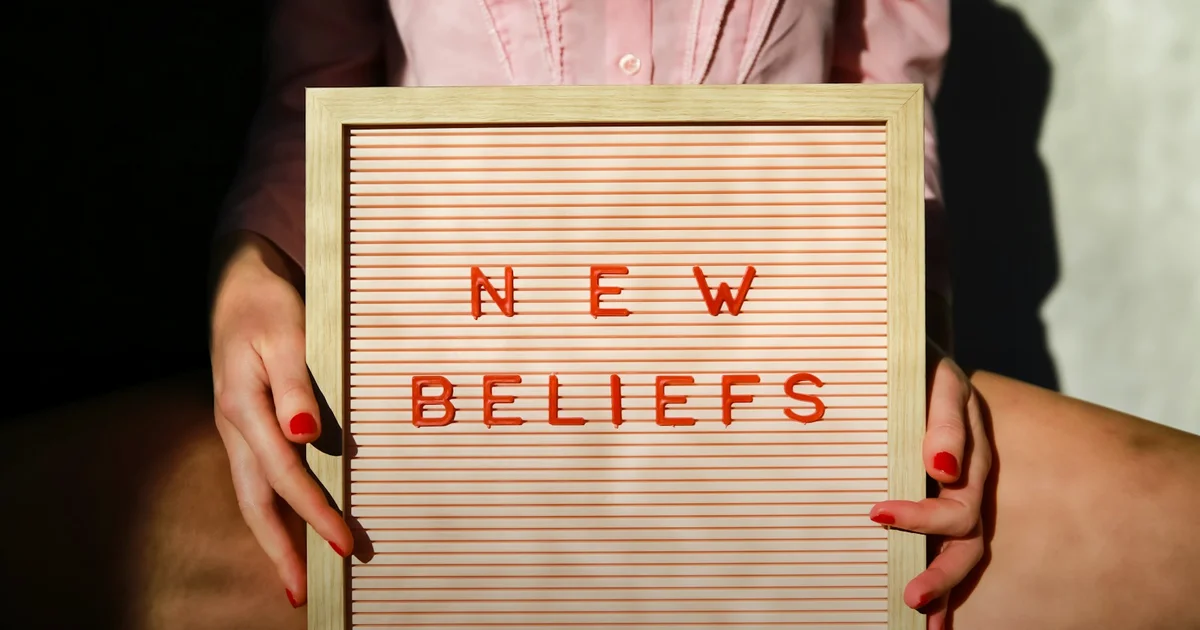
I Kept Hitting the Same Ceiling — Until I Found the Belief Behind It
Three years ago I turned down a freelance contract worth more money than I'd ever been offered for a single project. The client was serious. The scope was clear. And I said no — not because the work was wrong, but because a quiet voice in the back of my skull whispered, You're not the kind of person who handles that much responsibility.
I didn't even argue with the voice. I just obeyed it, the way you obey a traffic light. Automatic. Unquestioned.
It took me six months and one very honest conversation with a friend to realise what had happened. I hadn't made a strategic decision. I'd been overruled — by a limiting belief I never consciously chose, running in the background like software I forgot I'd installed.
If you've ever watched yourself sabotage an opportunity, procrastinate on something you genuinely want, or circle back to the same frustrating patterns despite knowing better, there's a decent chance you've met your own version of that voice. And the worst part isn't that it exists. The worst part is that it sounds exactly like common sense.
So what are limiting beliefs, exactly? A limiting belief is a deeply held assumption — usually formed in childhood and reinforced through repetition — that silently constrains what you attempt and what you achieve. It operates below conscious awareness, filtering your choices before you even recognise a choice exists. It doesn't announce itself as a limitation. It disguises itself as realism.
How Limiting Beliefs Shape Your Choices (Without You Noticing)
Here's something most people never consider: you don't just have beliefs. You live inside them. They're not items on a shelf you can pick up and examine whenever you want. They're more like the walls of a room — so constant, so familiar, that you stop noticing they're there.
Psychologist Albert Ellis, the founder of Rational Emotive Behavior Therapy, spent decades making a single argument: that the emotional suffering people experience is rarely caused by events themselves. It's caused by the beliefs they hold about those events. His ABC model — Activating event, Belief, Consequence — showed that the same situation filtered through a different belief produces an entirely different emotional and behavioral outcome.

Bob Proctor used to say it more bluntly: "If you can hold it in your head, you can hold it in your hand — but most people are holding beliefs that keep their hands closed." That image stuck with me. Not because it was poetic, but because it was mechanically accurate. A belief doesn't just influence what you think. It influences what you attempt. And what you never attempt doesn't leave evidence, so you rarely notice the loss.
Research from Martin Seligman and Peter Schulman at the University of Pennsylvania's Positive Psychology Center backs this up. In their landmark study on explanatory style, insurance agents who scored in the optimistic half of Seligman's attributional style assessment sold 37% more in their first two years than those in the pessimistic half — even when controlling for prior ability. Explanatory style — essentially, whether you believe setbacks are permanent, personal, and pervasive — proved a stronger predictor of performance than aptitude alone. Same talent. Different internal story. Drastically different trajectory.
You've probably felt a version of this yourself. That moment where you talked yourself out of applying, asking, starting, or speaking up — and the reason felt perfectly rational at the time. That's the signature move of a limiting belief. It wears the mask of sound judgment.
How Limiting Beliefs Get Installed (And Why You Don't Notice)
Nobody wakes up at age seven and thinks, I'm going to adopt the belief that I'm not smart enough for leadership roles. These things don't arrive through the front door. They slip in through repetition, emotional intensity, and the sheer authority of the people around you during your formative years.
Bruce Lipton's work in cellular biology — particularly his book The Biology of Belief — makes a compelling case that children under seven operate primarily in theta brainwave states, essentially a form of hypnosis. During this window, the subconscious mind absorbs environmental messages without any critical filter. A parent's offhand comment, a teacher's impatient sigh, a playground humiliation — these get encoded not as memories but as operating instructions.
Jim Rohn had a phrase for it: "You are the average of the five people you spend the most time with." But he was talking about adults. For children, the ratio is more extreme. You're the product of the two or three authority figures who happened to be in the room during your most impressionable years. Their beliefs become your defaults.
Here's where it gets tricky.
By the time you're an adult with the cognitive tools to evaluate these beliefs, they've already been running the show for decades. They feel like you. Questioning them doesn't feel like intellectual growth — it feels like an identity crisis. And most people, understandably, would rather stay comfortable than destabilised.
T. Harv Eker makes the point clearly in Secrets of the Millionaire Mind: the only way to permanently change the temperature in a room is to reset the thermostat. No matter how hard you run the heater, the room will keep returning to whatever the thermostat is set to. Your financial blueprint — and your identity blueprint — work exactly the same way. The thermostat is the belief. The room temperature is your results. And you can hustle all you want, but until you reprogram the thermostat, you'll keep cooling back down to your set point.
How to Stop People-Pleasing and Rebuild Self-Trust
The Three Beliefs That Keep Showing Up
After years of reading, conversations, and — honestly — expensive mistakes, I've noticed that most limiting beliefs aren't unique snowflakes. They cluster into three categories:
1. Identity Beliefs — "I'm Not the Kind of Person Who..."
This is the one that got me with the freelance contract. Identity beliefs define the edges of who you think you are. I'm not a leader. I'm not creative. I'm not good with money. I'm not someone who speaks up in meetings.
The danger here is that identity beliefs are self-reinforcing. If you believe you're not a leader, you won't take on leadership opportunities, which means you won't develop leadership skills, which confirms the original belief. It's a closed loop disguised as evidence.
Napoleon Hill identified this pattern in Think and Grow Rich back in 1937, writing that millions of people "believe themselves doomed to poverty and failure" because of a "negative belief" they never consciously examined — and are therefore "the creators of their own misfortunes." He noticed that the most successful people he interviewed didn't necessarily have fewer fears — they had a different relationship with their own self-concept. They treated identity as something they were building, not something they'd been assigned.
2. Capability Beliefs — "I Can't Because..."
These are the beliefs that explain why something is impossible for you specifically. I can't start a business because I don't have an MBA. I can't get fit because my metabolism is slow. I can't write because I wasn't born with talent.
Capability beliefs almost always confuse current skill level with permanent ceiling. They freeze you at a snapshot in time and treat it as a life sentence.
Carol Dweck's decades of research on fixed vs. growth mindset at Stanford showed that students who believed intelligence was malleable consistently outperformed those who believed it was fixed — not because they started out more capable, but because they kept trying when fixed-mindset students gave up. Belief about capability literally shaped capability over time. Let that sit for a second.
3. Worth Beliefs — "I Don't Deserve..."
These are the deepest ones. Worth beliefs operate below the surface of logic, in the territory of emotion. I don't deserve success. I don't deserve rest. I don't deserve love unless I earn it.
Joseph Murphy, in The Power of Your Subconscious Mind, argued that the subconscious accepts whatever you impress upon it — and then moves heaven and earth to prove it right. If your deep programming says you don't deserve good things, your subconscious will find remarkably creative ways to sabotage them when they arrive. You'll pick fights. Miss deadlines. Lose interest. All without understanding why.
Here's how the three types compare at a glance:
| Belief Type | Core Message | Sounds Like | Antidote |
|---|---|---|---|
| Identity | "I'm not the kind of person who..." | "That's just not me." | Track evidence of who you've already been when you weren't overthinking it. |
| Capability | "I can't because..." | "I don't have the skills/background for that." | Separate current skill level from permanent ceiling. Skills grow; labels don't. |
| Worth | "I don't deserve..." | "Good things don't last for people like me." | Notice the pattern of self-sabotage, then ask: whose voice is that, really? |
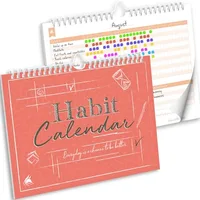
Clever Fox Habit Tracker Calendar
A habit tracker helps you catch limiting beliefs in real time — exactly as Step 1 of the framework recommends. When you procrastinate or shrink, writing the accompanying thought here makes the pattern visible.
As an Amazon Associate, we earn from qualifying purchases — at no extra cost to you.
How to Identify and Overcome Limiting Beliefs: A Questioning Framework
Knowing your beliefs are limiting doesn't dissolve them. If awareness alone were enough, therapy would take an afternoon. What works is structured questioning — the kind that doesn't just identify a belief but puts it on trial.
Here's the framework I use, adapted from Byron Katie's "The Work" and cognitive behavioral principles:
Step 1: Catch the belief in the act.
You won't find your limiting beliefs by sitting quietly and thinking about them. You'll find them in the moments where your behavior doesn't match your intentions. When you procrastinate, avoid, self-sabotage, or feel a sudden spike of anxiety about something you supposedly want — that's a belief surfacing.
Keep a small notebook for a week. Every time you notice yourself shrinking, avoiding, or talking yourself out of something, write down the thought that accompanied it. Not the emotion — the thought. "I'm not ready for this." "People like me don't do that." "It probably won't work anyway."
Full Focus Planner by Michael Hyatt
The one-week belief-catching exercise needs a structured place to live. This planner turns a one-off exercise into a daily practice that bridges catching the belief with replacing it.
As an Amazon Associate, we earn from qualifying purchases — at no extra cost to you.
Step 2: Ask the four killer questions.
For each belief you've written down, run it through this filter:
- Is this actually true? (Not "does it feel true" — is there objective evidence?)
- Can I be absolutely, 100% certain it's true?
- What happens to me when I believe this thought? (How do I act? What do I avoid? What's the cost?)
- Who would I be without this thought? (Not "who would I be if I believed the opposite" — just, who would I be if this thought simply wasn't there?)
That fourth question is the one that does the heavy lifting. It creates a gap — a momentary experience of life without the belief. And in that gap, something shifts.
Step 3: Find the counter-evidence.
Your brain has been selectively collecting evidence to support the limiting belief for years. Now it's time to build the opposing case. Think of three to five moments in your life where the belief was demonstrably wrong. Times you were capable, were deserving, did succeed at something that belief said you couldn't.
They exist. I promise you. Your brain just hasn't been looking for them.
3 Daily Habits Quietly Draining Your Potential
Replacing Limiting Beliefs: How to Rebuild After the Old Wiring
Dissolving a belief isn't enough. You need to install something in its place — not a cheesy affirmation, but a tested alternative. Something that's both true and useful.
The distinction matters. "I am a billionaire genius" isn't a useful replacement belief if you're currently struggling to pay rent. Your subconscious will reject it immediately. But "I have figured out hard things before, and I can figure this out too" — that's something you can actually stand on, because it's grounded in your own history.

Sony WH-1000XM5 Noise Cancelling Headphones
Tony Robbins' raising-standards work requires protected thinking time. Noise-cancelling headphones create the physical quiet needed for the index-card ritual and belief replacement work described in this section.
As an Amazon Associate, we earn from qualifying purchases — at no extra cost to you.
Tony Robbins calls this "raising your standards." Not setting goals — changing the minimum you're willing to accept from yourself. And there's a critical nuance here: you don't raise your standards by wanting more. You raise them by deciding that the old pattern is no longer an option. It's the difference between "I should exercise more" and "I am someone who moves their body every day." One is a wish. The other is an identity shift.
Here's a practical method I've used:
Write the new belief on an index card. Carry it in your wallet. Read it once in the morning and once before bed. Not as a magical incantation — but as a reminder of the decision you've already made. After about three weeks, you'll notice something strange: the new belief starts generating its own evidence. You begin acting in ways that prove it right. That's not woo-woo — that's the reticular activating system in your brain filtering information according to your updated instructions.

Philips Wake-Up Light — Sunrise Simulation
The article describes reading your new belief card once in the morning and once before bed. A sunrise wake-up light creates a gentle, natural anchor for that morning ritual — making the habit feel effortless.
As an Amazon Associate, we earn from qualifying purchases — at no extra cost to you.
The Maintenance Protocol: How to Keep Beliefs From Calcifying Again
This isn't a one-time fix. Beliefs are like software — they need regular updates, or they start running legacy code that slows everything down.
I do a quarterly "belief audit." It takes about 30 minutes. I sit with my journal, look at the areas of my life where I'm stuck or frustrated, and ask: What would I have to believe for this pattern to make sense?

Liforme Yoga Mat — Original with Alignment System
The quarterly belief audit described here benefits from a dedicated physical space. A yoga mat creates a mindful setting that signals to your brain: this is reflection time, not distraction time.
As an Amazon Associate, we earn from qualifying purchases — at no extra cost to you.
The answer is almost always a belief I thought I'd already dealt with — showing up in a new disguise. That's normal. The same core belief can wear different masks depending on the context. "I'm not enough" shows up as imposter syndrome at work, perfectionism in creative projects, and people-pleasing in relationships. Same root, different branches.
Elio D'Anna, the Italian philosopher and author of The School for Gods, builds his entire framework on a single premise: a person's outer world is an exact expression of their inner state. Not metaphorically. Literally. The results you see around you are a printout of the beliefs running underneath.

Which means every time you dissolve a belief that was holding you back, you're not just changing how you think. You're changing what becomes possible in the physical world around you.
Your Move
Here's what I'd challenge you to do this week — not this month, not someday, this week.
Pick the area of your life where you feel most stuck. Write down the one thing you keep wanting but somehow never achieving. Then finish this sentence: The reason I can't have this is because...
Whatever comes after "because" is your belief. Not your reality. Your belief.
Now run it through the four questions. See what shifts.

Kindle Paperwhite (2024) — 7-inch, 16GB
This article references Albert Ellis, Carol Dweck, Byron Katie, Napoleon Hill, Bruce Lipton, T. Harv Eker, and more. A Kindle makes accessing all these authors frictionless — turning the reading list into immediate ac…
As an Amazon Associate, we earn from qualifying purchases — at no extra cost to you.
You don't need to overhaul your entire mental architecture in a weekend. You just need to find one load-bearing wall that's been holding up a ceiling you didn't build — and test whether it's as solid as it claims to be.
Most of the time, it isn't.
Designing your evolution doesn't start with a grand plan or a vision board or a five-year strategy. It starts with one honest look at the invisible rules you've been playing by — and the quiet, uncomfortable question: Did I actually choose this? Or did I just inherit it?
What's one belief you've been carrying that, if you're honest, you never actually chose? I'd love to hear it.
Was this helpful?