Habits· 12 min read
The Mere-Exposure Effect: Why Familiar Starts to Feel Good
The Mere-Exposure Effect: Why Familiar Starts to Feel Good
There's a song I couldn't stand when I first heard it. Too repetitive, I thought. No melody worth remembering. Then I kept hearing it — in shops, through a neighbour's window, in the background of a TV show I was half-watching. By the third week, I was humming it in the shower. By the fourth, I'd added it to a playlist.
Nothing about the song had changed. I had.
This isn't a story about taste being arbitrary, though it might feel like one. It's about a psychological mechanism called the mere-exposure effect — so consistent, so quietly powerful, that researchers have replicated it across six decades of experiments, and yet most people go their whole lives never deliberately using it.
And once you understand how it works, you'll see it everywhere.
In 1968, psychologist Robert Zajonc published "Attitudinal Effects of Mere Exposure" in the Journal of Personality and Social Psychology (Monograph Supplement) — a paper that upended a simple assumption: that we like things based on their qualities. His finding was more unsettling than that. We like things, to a substantial degree, simply because we've seen them before.
Zajonc showed participants Chinese characters they had no prior knowledge of, presented at different frequencies. The more often a character appeared, the more positively participants rated it — even though they had no idea what any of them meant. He ran similar experiments with Turkish-sounding nonsense words and photographs of unfamiliar faces from a college yearbook. Same direction of result each time. Repeated exposure, without any conscious evaluation, shifted how people felt.
The effect held across stimulus types and experimental designs. In 1989, Robert Bornstein published a meta-analysis of 208 experiments in Psychological Bulletin. His conclusion: the mere-exposure effect was real, robust, and surprisingly broad. The average effect size (r = .26) was modest — not life-altering — but consistent enough to call it one of the most reliably replicated findings in social psychology.
You've almost certainly felt this. A city you moved to and found cold, then gradually discovered had everything you needed. A genre of music you dismissed until it became the only thing you wanted on long drives. A morning habit you resented for two weeks, then started protecting.
What you were experiencing wasn't a change of opinion. It was your brain quietly updating its threat assessment. Familiar things are, on balance, safer than unfamiliar ones — that's what our nervous system evolved to believe. And so familiarity, over time, becomes warmth.
This is why the mere-exposure effect lands differently from other psychological findings. It doesn't tell you to try harder or think differently. It tells you that exposure itself is doing cognitive work you can't feel while it's happening — and knowing that changes what you do at the start of anything new.
Why the Mere-Exposure Effect Works the Way It Does
The mechanism behind Zajonc's finding isn't romantic. One leading explanation is perceptual fluency — the ease with which the brain processes something it's encountered before. When you see a familiar face or hear a familiar chord progression, your brain works slightly less hard to categorize it. That reduced effort is quietly mislabeled as liking.
Think of it like a path through tall grass. The first time you walk it, you're pushing through. The tenth time, it's almost comfortable. The fiftieth, you stop noticing you're walking at all.
This matters because it means the preference isn't fake. The warmth your brain generates toward familiar things is real — it just doesn't come from conscious evaluation. It comes from the absence of friction. And you can design for that.
Atomic Habits — James Clear (Paperback)
As an Amazon Associate, we earn from qualifying purchases — at no extra cost to you.
Where the Effect Is Strongest — and Where It Breaks Down
Bornstein's meta-analysis turned up something the headlines tend to skip: the mere-exposure effect is strongest with brief exposures. Stimuli shown very briefly produced stronger liking effects than stimuli studied for longer durations. At subliminal presentation speeds — too fast for conscious recognition — the effect was actually more powerful, not less.
This is counterintuitive. We assume familiarity builds through long, deliberate contact. But the evidence points the other way: many short, low-stakes exposures outperform a few intense, extended ones.
If you want something to feel comfortable — a new habit, a skill, a creative direction — repeated brief contact is more effective than sporadic deep immersion.
There's a ceiling, though. With excessive repetition over time, the effect plateaus and can reverse. Psychologists call this satiation: familiarity that tips past neutral into boredom or mild aversion. Anyone who's had a song played into the ground knows exactly what it feels like. The mere-exposure effect operates best in the zone between first contact and overexposure. That zone varies by person and by what you're exposing yourself to, and it's worth respecting.
Ticktime Pomodoro Cube Timer
As an Amazon Associate, we earn from qualifying purchases — at no extra cost to you.
Using Familiarity to Build a Habit You'll Actually Keep
Here's where this gets practical.
One of the most common reasons habit attempts fail isn't lack of motivation. It's novelty fatigue — new behaviours feel awkward, slightly foreign, and vaguely wrong for longer than we expect. We interpret that discomfort as evidence the habit isn't working, or isn't for us. We quit before familiarity has had a chance to do its work.
The mere-exposure research suggests a different approach. Instead of forcing full execution from day one, the priority is simply showing up repeatedly, at low intensity, long enough for the unfamiliar to start feeling known.
Small daily disciplines compound into something unrecognisable. That's a claim about action rather than perception, but it maps neatly onto what the research shows about familiarity: consistency matters more than effort at the start.
If you're trying to build a writing practice, sitting down with a notebook for five minutes every morning before you feel ready does more psychological work than waiting for inspiration and writing for two hours when it finally arrives. Each five-minute session makes the next feel slightly less foreign. The practice becomes something your brain classifies as known — and therefore, gradually, as wanted.
The Creative Application Nobody Talks About
Artists and writers have been exploiting the mere-exposure effect for a long time, mostly without naming it.
When you study the masters — not to copy them, but simply to let them become familiar — something shifts. Reading Hemingway for a month won't turn you into Hemingway. But it may make a certain kind of spare, direct sentence feel natural to your eye. The style seeps in through repeated contact, not conscious imitation. Your brain begins to process that aesthetic with less friction, which means you may begin to generate it with less effort.
The same applies across disciplines. Learning photography? Time spent looking at great photographs — not analyzing every shot, just looking — builds a visual vocabulary your eye will start reaching for. The pattern recognition runs in the background, quietly, without your supervision.
This isn't passive absorption. It's deliberate familiarity-building. You're giving your perceptual system the raw material it needs to start calling something comfortable — and that's the prerequisite for calling something yours.

Kindle Paperwhite (2024, 16GB)
As an Amazon Associate, we earn from qualifying purchases — at no extra cost to you.
How to Start Today
The simplest way to use the mere-exposure effect is to design what you want to come to like into your regular field of view.
Make the new thing ambient. Put the book you want to read on your desk, not on a shelf. Keep the journal next to your coffee maker. Have the habit tracker visible on your phone's home screen. You don't have to engage with any of it. Just let it register. Passive exposure still counts.
Lower the entry threshold. Don't start with thirty minutes. Start with two. Brief, repeated contact is exactly what the research says is most effective. When the timer goes off, you're done — and you've made a deposit in the familiarity account.
Expect awkwardness and don't treat it as a signal. The discomfort of a new behaviour isn't information about whether it's right for you. It's information about how recently you started. The two feelings are nearly identical before the familiarity curve turns, and you can't rush that curve. You can only feed it.
Kitchen Safe kSafe Time Locking Container (Medium)
As an Amazon Associate, we earn from qualifying purchases — at no extra cost to you.
Reduce competing familiarity. The habit you're building competes with behaviours your brain already classifies as easy and known. Moving those one step out of reach — the extra tap between you and the scroll — shifts the balance without requiring willpower.
Track contact, not performance. For the first thirty days, the metric that matters most is how many times you showed up, not how well you did. Each appearance is a data point on the familiarity curve. Quality follows.
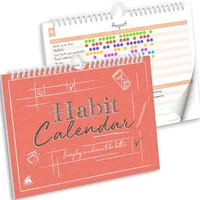
Clever Fox Habit Calendar Circle (24-Month)
As an Amazon Associate, we earn from qualifying purchases — at no extra cost to you.
What the mere-exposure effect really tells you is this: you don't need to like something before you begin. That's not how liking works. Liking comes from familiarity, familiarity comes from exposure, and exposure is a choice you can make today.
The design implication is quiet but significant. You have far more agency over what you eventually value than you probably assume — not through motivation or willpower, but through showing up in small and consistent ways, long enough for your brain to reclassify the unfamiliar as something that belongs to you. Design your exposure, and you design your evolution.
That's the kind of evolution that doesn't feel dramatic. It feels, one morning, like it was always there.
What's one thing in your life that you resisted at first and gradually came to genuinely value? Leave it in the comments — the patterns in those answers tend to be more revealing than you'd expect.
why consistency is so hard science of staying on track keystone habits does one habit really change others
Was this helpful?