Mindset· 12 min read
Nighttime Anxiety: Why Your Brain Spirals at 3AM
Why your brain spirals at 3AM — the cortisol biology, the rumination loop, and the calm, practical tools that actually quiet nighttime anxiety.
Nighttime Anxiety: Why Your Brain Spirals at 3AM
(And how to climb back out without making it worse.)
It is 3:14 in the morning and you are staring at the ceiling, replaying an email from Tuesday, while a small, sensible part of you watches the whole thing happen and thinks: not this again. The house is quiet in a way that somehow feels loud. The duvet has gone from comforting to suffocating in the space of a minute. Your heart is faster than it should be for a body that has been horizontal for four hours. And the worst part is the topic — not a real emergency, just a low-grade worry your daytime self had already filed under "fine."
You shift onto your side. The thought follows. You try the other side. It follows there too. You open your phone, even though you know better, and the screen burns into your retinas like a small interrogation lamp. Twenty minutes later you put it down, more awake than before, and the rumination starts a fresh loop. Somewhere in the middle of that loop comes the question that everyone who has ever lived through nighttime anxiety eventually asks: why does it always happen at this time?
The answer is genuinely interesting, and once you understand it, the whole thing becomes less personal. Your brain is not betraying you. It is running an ancient program at a very specific point in the night, and that program is louder than you in the dark. The fix is not to think harder. The fix is to work with the biology instead of against it.
The Biology of 3AM: Cortisol, the DMN, and a Brain Without a Job
Cortisol gets unfairly described as "the stress hormone," as if it were always bad. It is closer to an alertness dial. It runs on a circadian rhythm that bottoms out around midnight, begins climbing slowly in the small hours, and peaks roughly thirty minutes after you wake. That pre-dawn climb is well documented — sleep researchers call it the cortisol awakening response, and it is real, measurable, and largely involuntary. Your body is preparing you to wake up several hours before you actually plan to.
If you happen to surface briefly between sleep cycles during that ramp — and most people do, several times a night without remembering — your brain is biochemically primed for vigilance. Adults cycle through REM sleep roughly every ninety minutes, and there is a particularly REM-heavy stretch in the back half of the night. Matthew Walker spends a chapter of Why We Sleep explaining why this matters: REM is the brain's emotional consolidation workshop, and it sits right on top of the cortisol climb. Brief wakings during that window are common, brief, and usually forgotten. Unless something snags your attention.

Why We Sleep — Matthew Walker
If you want the full story behind the cortisol awakening response, REM consolidation, and why the back half of the night belongs to the emotional brain, Matthew Walker's book is the canonical place to start. He explai…
As an Amazon Associate, we earn from qualifying purchases — at no extra cost to you.
The other half of the equation is the default mode network. Marcus Raichle, the neuroscientist at Washington University in St. Louis, first described the default mode network in a landmark 2001 PET neuroimaging study — asking what the brain does when it is not doing anything in particular. The answer surprised everyone: it lights up. The DMN is the network that handles self-referential thinking — autobiographical memory, future planning, social rehearsal, and, yes, rumination. It is the part of you that narrates your life. During focused tasks it quietens. With nothing external to focus on, it gets loud.
At 3AM you have all three ingredients in the same room: a brain rising on cortisol, a default mode network with no daytime job to do, and an emotional sleep stage that has just brought a half-processed worry to the surface. The result is not insomnia. The result is your inner narrator on a microphone in an empty stadium.

Why Your Brain Prioritizes Problems at Night
It helps to remember that the brain you are trying to sleep with was not designed for sleep — it was designed for survival. For most of human history, the small hours were the most dangerous hours. Predators hunted in the dark. Fires needed tending. Someone in the band had to stay alert while the rest slept. Hypervigilance at night was not a malfunction. It was the cost of waking up alive.
You inherited that brain. It does not know that your bedroom has a door that locks and a smoke alarm that works. It only knows that the environment has gone dark, the group is asleep, and any threat is now its problem. So it goes looking. With nothing immediate to find, it pulls up the next best thing: that ambiguous comment your manager made, the bank balance, the conversation with your sister, the thing you said at fourteen that still makes you flinch. To the ancient threat-detection system, these are all the same shape. They are all unresolved.

Brentfords Weighted Blanket
Hypervigilance is a body state, not just a head state — and the body responds to weight before it responds to reasoning. Deep pressure stimulation, the principle behind a weighted blanket, helps the nervous system reg…
As an Amazon Associate, we earn from qualifying purchases — at no extra cost to you.
This is the reframe that helped me most, and I pass it on whenever someone tells me about their 3AM brain. The spiral is not a character flaw. It is ancient wiring doing exactly what it was built for, in a context that no longer needs the service. Once you stop interpreting it as personal failure, half the panic about the panic goes away. You are not broken at night. You are an upgraded version of an animal that needed to stay alive in the dark.
That alone changes the texture of the experience. The thoughts still arrive. They just stop carrying the extra freight of and what is wrong with me that I keep having them.
The Rumination Loop: Why Thinking Harder Makes It Worse
Here is the trap. When the spiral starts, the most natural thing to do is to think your way out of it. You analyze the worry. You build a plan. You rehearse a conversation. You consider every angle. It feels productive. It is, in fact, the opposite of productive — it is the engine of the loop itself.
Susan Nolen-Hoeksema spent her career studying this — research spanning positions at Stanford, the University of Michigan, and Yale — and her conclusion was unambiguous: rumination, defined as repetitive passive focus on one's distress, reliably amplifies anxiety rather than resolving it. In her research, people who responded to negative mood by trying to "figure it out" showed worse outcomes than people who took action or shifted attention. Her book Women Who Think Too Much is the gentlest summary of that work, though the findings apply to everyone.
The mechanism is straightforward once you see it. Every time you re-engage with the thought, you re-stimulate the same neural circuit and the same stress response. Cortisol stays elevated. The DMN stays loud. The body interprets the rehearsal as ongoing threat. So the thought you are trying to solve becomes the thing keeping you awake to think about it. The harder you grip, the tighter it holds.
If you want to understand how this same ruminative pattern plays out during waking hours — and what specifically breaks the loop before it reaches midnight — the psychology of overthinking covers the daily mechanisms in practical terms.

MZOO Luxury Sleep Mask
One reliable way to shorten the rumination window is to remove the visual cues that keep the brain alert — a low light bleeding through a curtain, a streetlight outside the window. The MZOO 3D contoured design blocks…
As an Amazon Associate, we earn from qualifying purchases — at no extra cost to you.
What Nolen-Hoeksema found does work is the opposite of grip: structured reflection, scheduled for a fixed window, with a clear stop. The difference is small in description and enormous in effect. Rumination is open-ended thinking that never lands. Structured reflection has a beginning, a middle, and a door it walks out of. The body knows the difference.
This is why the rest of the night-anxiety toolkit, the part everyone wants, has to start with one rule: do not solve the problem at 3AM. Not because the problem is unimportant, but because 3AM is the worst possible boardroom in which to try.

What Actually Works: A Short Toolkit for the Long Run
These are the practices I have seen hold up across years of working with people who do not sleep well, and they have decent research behind them. Pick two and use them for a fortnight. Do not try them all at once — that is its own form of pressure, which is the opposite of what you need.
The 4-7-8 breath. Inhale through the nose for four counts. Hold for seven. Exhale through the mouth, slow and long, for eight. Repeat three or four times. Andrew Weil popularized the ratio, and the physiology is sound: a long exhale activates the parasympathetic branch of the nervous system through the vagus nerve, slowing heart rate and blood pressure within a minute or two. It will not erase the worry. It will lower the body underneath it. That is enough to make rest possible.
The bedside brain-dump. Keep a small notebook and a pen on the nightstand. When a thought refuses to stay in its lane, switch on a low lamp, write the thought down in one or two sentences, and add one tiny next step you can take tomorrow. Then close the book. The trick is that your brain ruminates because it does not trust you to remember in the morning. Once a thought is on paper, the survival circuit relaxes — the captain knows the message has been delivered.
The worry window. Thomas Borkovec's work at Penn State on generalized anxiety produced a deceptively simple intervention: book a fixed fifteen-minute slot during the day, in daylight, when your job is to worry on purpose. Sit with a notebook and let it all out. When the slot ends, you stop. The technique works because the brain stops carrying worry around all day if it knows there will be a meeting. Use it for two weeks and you may notice the 3AM appointments cancel themselves.
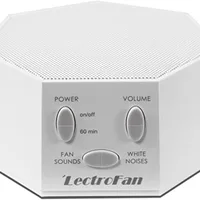
LectroFan Classic White Noise Machine
The brain's threat-detection system listens for sudden changes in sound — a creaking floorboard, a distant siren — and a continuous, non-looping white noise mask gives it a steady auditory floor instead. The LectroFan…
As an Amazon Associate, we earn from qualifying purchases — at no extra cost to you.
The 5-4-3-2-1 ground. When the spiral is too far gone for breath alone, name five things you can see, four you can hear, three you can touch, two you can smell, and one you can taste. It sounds twee in daylight. At 3AM it works because it forces the brain out of the DMN's internal monologue and into the sensory cortex, which is incompatible with rumination. Two laps usually does it.
The twenty-minute rule. Cognitive behavioral therapy for insomnia is unusually clear on this one: if you have been awake for twenty minutes, get out of bed. Go to another room. Sit in a low light. Read something gentle — not your phone. Return only when you feel sleepy. The point is to stop your brain from associating the bed with awake-and-thinking. This is a long-game move; the first night might feel ridiculous and the third night you start to see it pay off. The deeper sleep science behind why stimulus control works — and what most people skip that actually moves the needle — is laid out in how to sleep better.
A small environment audit. Light leaking under the door, a streetlamp through the curtain, the radiator clicking, the bedroom too warm. These are the kinds of low-grade signals that wake people without their knowing and then leave the brain at half-mast. Cooler room, darker room, quieter room — boring, unsexy, and the difference between a night and a long night.
When It Is More Than 3AM
There is a version of nighttime anxiety that responds well to a notebook and a slow breath, and there is a version that needs more support. If the spiral happens most nights for more than a few weeks, if it is paired with daytime intrusive thoughts that frighten you, if you are losing significant weight or function, if the worry includes thoughts of self-harm — please do not try to fix this alone. A general practitioner is a fine first stop, and they will often refer to a therapist trained in CBT-I (cognitive behavioral therapy for insomnia), which has the strongest evidence base of any non-medication approach. Asking for that referral is not failure. It is exactly the kind of structured reflection Nolen-Hoeksema's research recommends, delivered by someone who knows what to do with what surfaces.
The same goes for anxiety that started after a clear event — a loss, a diagnosis, a betrayal. The brain has good reasons to be alert in those moments, and a trained therapist will help it learn that the threat has passed. That is not weakness. It is the kind of repair work the species has always needed and rarely had access to.
A Closing Reframe
The thing about 3AM is that it does not last. It feels eternal at the time because the body is in a state where everything feels eternal, and it ends with the sunrise in a way that almost feels rude — the worry that ran the planet at 4:30AM looks small and ordinary at 7. Hold on to that. The dawn answer is usually the right answer. The 3AM brain is not an oracle. It is a sentry on the wrong shift.
Be gentle with the sentry. It is, on some old level, trying to keep you alive. Thank it, take the watch off it for a minute, write the worry down, breathe the long exhale, and let the cortisol curve do what it was always going to do. The night will end. So will the loop. You are not failing at sleep. You are an animal in a quiet room with a brain built for a louder world, and you are slowly teaching it that the room is safe.
That teaching is the work — and in its quiet, repetitive way, it is how you design your evolution: not through force, but through consistent patience with your own biology. The reward is not that the thoughts never come back — they will, occasionally, the way weather comes back. The reward is that you stop being afraid of them, and the loop, deprived of its fuel, gets shorter every time.
What does your 3AM brain reach for? The email you can't let go, the conversation you keep rehearsing, or something older and harder to name — drop it in the comments. You might be surprised how many people are lying awake with the same thought at the same hour.
Related read: Why Overthinking Makes You Feel Worse: Rumination Science
Was this helpful?