Habits· 10 min read
The Outer Order Effect: How Clutter Taxes Your Brain
Clutter isn't just messy — it's cognitively expensive. Here's what the science says about outer order, inner calm, and how to reclaim your focus.

The Outer Order Effect: How Getting Organized Changes Your Brain (Not Just Your Desk)

It was a Tuesday in February. I sat down at my desk at 8:47 AM with a full cup of coffee and genuinely good intentions.
By noon, I had accomplished approximately nothing. The coffee was cold. My browser had somehow accumulated nineteen tabs. And I felt — the only word that fits — foggy. Like I was thinking through wet cotton.
I blamed myself. Told myself I was distracted, weak, undisciplined. Maybe I needed a stricter morning schedule. A better productivity app. More sleep.
Then I actually looked at my desk. That's when I started to understand what clutter actually costs.
Three notebooks, none of them current. A pile of receipts I'd been meaning to file for two weeks. Two charger cables running to devices not present in the room. A mug that had migrated upstairs three days ago with full intentions of making the return trip. And a Post-it note — just one — that said "CALL ABOUT THIS" with zero indication of what "this" referred to.
Here's what I didn't understand at the time: that desk wasn't just messy. It was cognitively expensive. Every single item in that pile was quietly costing me mental energy I didn't know I was spending. The fog wasn't a character flaw. It was a tax receipt.
Your Brain Is Not a Background Process
The most important thing most productivity advice completely skips over: your brain does not treat your environment as neutral background.
It processes it. Continuously. In parallel with everything else you're trying to do.
Every unresolved item in your visual field — the unpaid bill in the corner, the stack of books you're going to organize "sometime," the three-day-old mug — registers as an open loop. An incomplete task. And the Zeigarnik effect, first documented by Lithuanian-Soviet psychologist Bluma Zeigarnik in 1927 and replicated across nearly a century of research since, shows that uncompleted tasks generate a persistent, low-level cognitive demand until they're either resolved or consciously dismissed.
Clutter isn't ugly. It's computationally expensive.
Every item out of place is the equivalent of an app running in the background of your phone, quietly draining the battery. The cost of any single item is small. Multiply it by the 40 things on a typical cluttered desk, and you begin to understand why you can sit down to work in an environment like that and feel exhausted before you've opened a single document.
Gretchen Rubin has spent years researching this phenomenon and distilled it into a phrase that sounds almost too simple: outer order, inner calm. The mood lift people reliably report after organizing even a single shelf or drawer is, she argues, disproportionate to the scale of the achievement — and that disproportion is the signal. It's not about aesthetics. It reflects something genuine and documented about how directly the brain's threat-monitoring systems respond to environmental signals of unresolved demand.
Her research and the compelling case she builds around it is laid out in full in Outer Order, Inner Calm — and if you've ever wondered why tidying one corner of a room somehow makes the whole apartment feel different, it's worth reading to understand the mechanism you're actually triggering.
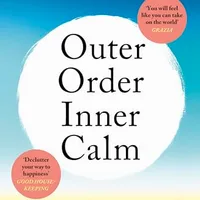
Outer Order, Inner Calm — Gretchen Rubin
After the article introduces Gretchen Rubin's research and the 'outer order, inner calm' concept — direct book recommendation as the source of the framework. The science behind why decluttering produces that dispropor…
As an Amazon Associate, we earn from qualifying purchases — at no extra cost to you.
The Cortisol Your Cluttered Space Is Generating Before 9 AM
Darby Saxbe and Rena Repetti at UCLA measured cortisol levels throughout the day in women with different types of home environments.
The finding was striking.
Women who described their homes using language associated with clutter, unfinished projects, and disorder had elevated cortisol throughout the entire day — including in the evening, when cortisol is supposed to naturally decline as the body shifts into recovery mode. Women who described their homes as restful and organized showed the expected diurnal cortisol pattern: elevated in the morning, declining toward evening, allowing genuine physiological recovery.
The clutter wasn't just making them feel anxious. It was keeping their stress physiology activated at the precise times when the body should have been recovering from the day's demands.

This explains something that most people who live or work in cluttered environments have felt without having words for: the chronic low-grade tiredness, the sense that you never quite fully rest, the vague feeling that something is always requiring attention at the edge of consciousness.
There is. Your brain is responding to environmental signals of unresolved business — automatically, continuously, without your permission.
This reframes the whole conversation. Creating order in your physical environment isn't a luxury or a personality preference. For many people, it's the single most underutilized lever for reducing baseline stress physiology and recovering cognitive capacity that the environment has been quietly consuming all day long.
The Tax You're Also Paying on Your Digital Desk
Most conversation about organization focuses on physical space. The desk, the closet, the pile by the door.
But your digital environment is taxing you through exactly the same mechanism — and for most knowledge workers, it's probably costing more.
Gloria Mark at UC Irvine has been studying digital distraction for over two decades. Her research documents that the average knowledge worker switches tasks every three to five minutes when using a device with full email and notification access enabled. Each switch carries a cognitive cost — the time and mental resources required to disengage from one task and re-engage with another — that compounds invisibly across the day.
Here's the number that lands differently when you actually sit with it: it takes an average of 23 minutes to fully return to deep cognitive engagement with a task after a single interruption.
Twenty-three minutes. Per notification.
A desktop covered in files, an inbox with 4,000 unread messages, seventeen browser tabs each representing a decision you haven't made yet — these are the digital equivalent of the cluttered desk. Every element is a low-grade attentional demand competing for the processing capacity you need for whatever you're actually trying to think about.
The solution follows the same principle as physical clutter: reduce the number of open loops competing for your brain's limited attentional bandwidth. Designated email windows rather than continuous monitoring. A desktop cleared of everything except what's active today. Notifications scoped down to only what is genuinely urgent.
And critically — a single, trusted place to capture every commitment, task, and open loop that would otherwise float in working memory demanding attention. David Allen built an entire system around this insight in Getting Things Done, and the core premise holds as well now as it did when he wrote it: your mind is for having ideas, not for holding them. Every task you're trying to remember rather than capture is a silent cognitive tax.

Getting Things Done — David Allen (Revised Paperback)
After the article quotes David Allen ('your mind is for having ideas, not for holding them') — natural book recommendation in the digital-clutter section. The complete system for capturing, processing, and organising…
As an Amazon Associate, we earn from qualifying purchases — at no extra cost to you.
What I Actually Changed — And What Happened
After understanding what my environment was costing me, I spent three hours on a Saturday not buying things — just making decisions.
The rule was simple: every item had to answer one question. Does this belong in this space, actively and specifically? If yes, give it a permanent home. If no, put it where it actually belongs, or discard it. No third option. No "I'll deal with this later pile."
The receipts went into an envelope, dated, and filed.
The stray notebooks went to a single designated shelf.
The charger cable tangle — the one under the desk that had evolved into something resembling an ecosystem — went inside a cable management box. The kind that hides the power strip and routes cables neatly, so the visual noise beneath the desk stops registering as unresolved disorder every time you glance down.
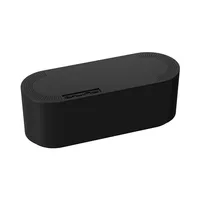
D-Line Cable Tidy Box (Small, Black)
Directly addresses the 'cable tangle ecosystem under the desk' mentioned in this section. Hides the power strip and routes cables neatly — eliminates a consistent source of visual clutter and open-loop cognitive deman…
As an Amazon Associate, we earn from qualifying purchases — at no extra cost to you.
Every floating thought, every "don't forget to" and "I should probably," went into a single capture notebook — kept open on the corner of the desk, serving only this function. Not a beautiful system. Not expensive. Just a consistent, designated place where open loops get written down rather than left to orbit in working memory.

Moleskine Classic Notebook (Hardcover, Large, Ruled, Black)
After the article describes 'a single capture notebook, kept open on the corner of the desk, serving only this function' — Moleskine is the archetypal capture notebook. A designated, consistent place where every open…
As an Amazon Associate, we earn from qualifying purchases — at no extra cost to you.
The monitor went onto an arm, which freed the entire flat surface in front of me. No stand eating up usable space. No clutter migrating into the monitor's footprint because there was nowhere else for it to go. Just desk.

And then — and this is the part that sounds absurdly minor until you try it — I labeled things.
Drawers labeled with what belongs in them. The shelf where the notebooks live is marked. The filing categories are named. This is not decorative. It's a decision-removal move. When something needs to be put somewhere, the decision is already made. The label tells you. Alone, this eliminates the micro-hesitation that previously sent most items to "the pile" instead of their actual home.
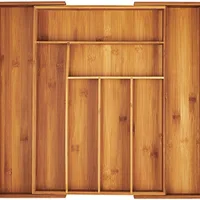
Amazon Basics Bamboo Expandable Drawer Organizer
Directly after 'labeled with what belongs in them' — a bamboo drawer organizer with compartments enables the labeling system described. Creates the physical structure that makes one-touch routing actually possible: ev…
As an Amazon Associate, we earn from qualifying purchases — at no extra cost to you.
The effect was quieter than the big transformations people describe. The fog lifted maybe 30%. I noticed it most in the afternoons, which had previously been reliably awful — that 2 PM wall I'd blamed entirely on post-lunch biology. Turns out at least some of it was my environment running a background tax I was paying all day without realizing it.
The Three Principles Behind an Organization System That Actually Holds
After working with the setup for several months and reading the research more carefully, three underlying principles became clear. Not rules — principles. They explain why some approaches to organization stick and others collapse into disorder within two weeks.
One-touch routing. When something new arrives — a piece of paper, an email, a task, a thing from the bag — handle it once. Discard it, delegate it, do it if it takes under two minutes, or file it immediately in its designated place. The default behavior of setting things aside to be processed "later" creates open loops at a rate that any system will eventually fail to contain. "Later" is where organization goes to die.
Visual simplicity on working surfaces. The surface you actually work on should contain only what you're actively using right now. Everything else is noise. The psychological resistance to this is real — it feels wrong to put things away when you'll need them again tomorrow. But the cognitive cost of keeping them on the surface today reliably exceeds the 30-second cost of retrieving them tomorrow. This is the counter-intuitive core of the whole framework: maintaining clear surfaces is less effort than it looks, because the effort of clearing them is paid once, while the cognitive tax of cluttered surfaces is paid continuously.
The five-minute close. At the end of each work session, spend five minutes restoring the environment to its baseline state. This is the specific maintenance habit that prevents entropy from compounding — because organizational systems don't fail catastrophically. They fail gradually, one deferred decision at a time, until you look up and find yourself back at the pile. The five-minute close catches the drift before it becomes the avalanche.
How to Start Today — The Exact Steps
You don't need a weekend project. You need a decision session. Here's the sequence:
-
Pick one surface. Your desk, your kitchen counter, one shelf. One. Not the whole room — one surface.
-
For every item on that surface, make a decision. Does this belong here, actively and specifically? If yes, define its permanent location. If no, move it there now, or discard it. No pile of undecideds.
-
Identify what ends up in an "I don't know where this goes" category — these are your high-priority organizational gaps. Create a designated place for each one.
-
Implement the five-minute close tonight. Before you stop work, restore that surface to the state it's in right now.
-
Don't expand the project until that surface has held for one full week. Most people who fail at this try to reorganize everything at once, exhaust their decision-making capacity, and collapse back into disorder within 48 hours. Scope controls sustainability.
If you want the complete system — the trusted external structure for capturing, processing, and organizing every commitment so nothing falls through the mental cracks — David Allen's Getting Things Done remains the most thorough architecture available. The physical setup and the task management system address the same underlying problem from different angles. Together, they close the loop.

Clever Fox Habit Calendar Circle (24-Month Habit Tracker)
After the 5-step decision session and the 'five-minute close' habit — the visual companion to the maintenance habit. A 24-month circle tracker makes the consistency of the five-minute close visible, turning an invisib…
As an Amazon Associate, we earn from qualifying purchases — at no extra cost to you.
Here's what the science makes clear: your environment is not passive. It is an active participant in your stress physiology, your cognitive performance, and the emotional texture of your entire day.
The space you inhabit isn't just where your evolution happens.
It's part of what determines how much of your cognitive capacity is available to drive it.
So here's the question worth sitting with today: which one surface in your space right now is running the highest cognitive tax on you — and what's the one decision you've been deferring about it?
Was this helpful?