Mindset· 11 min read
40 Questions That Quiet Anxiety and Sharpen Your Focus
When your mind is noisy, more thinking rarely helps — better questions do. 40 self-inquiry prompts to interrupt anxiety and restore clarity.
40 Questions That Quiet Anxiety and Sharpen Your Focus
The worst anxious night I remember started at 2:47 AM. I know the exact time because I checked my phone, which is of course the worst thing you can do at 2:47 AM. I had been trying to "think my way out" of a work problem for about an hour — rehearsing arguments, drafting emails in my head, imagining three different versions of the conversation I would supposedly have the next morning. None of them helped. In fact, each round of thinking made the knot in my chest tighter.
Then I tried something a therapist had suggested months earlier, and I had filed away as too simple to work. I asked myself a single written question on a piece of paper: What specifically am I afraid will happen in the next twenty-four hours? Five minutes later, the spiral was gone. Not because the problem was solved. Because the noise had finally been given a shape.
Why More Thinking Rarely Calms a Noisy Mind
Most people, when they get anxious, try to out-think the anxiety. They reason with it. They argue with it. They build elaborate contingency plans for things that have a 3% chance of happening. And the mind, loyal servant that it is, keeps feeding them fuel.
The problem is structural. Susan Nolen-Hoeksema, the late Yale psychologist, spent her career showing that rumination — the repetitive, passive turning-over of negative thoughts — doesn't reduce distress, it amplifies it. Her studies found that ruminators feel more helpless, generate worse solutions, and stay depressed longer than people who don't ruminate, even when they're objectively facing the same problems. Thinking harder about what's bothering you, without structure, is like trying to untangle a necklace by yanking on it.
You've probably felt this. You lie awake. You re-read the same email. You open the same app six times. The volume keeps climbing and nothing actually gets clearer. At some point you either distract yourself or exhaust yourself. Neither counts as peace.
What the research also shows, though, is that a specific kind of thinking does help. It's called self-distanced inquiry, and it's been studied in detail by Ethan Kross at the University of Michigan. When you step back and ask yourself a clearly framed question — in particular, one that names what's happening without trying to fix it in the same breath — something shifts in the brain. Activity in the rumination-heavy default mode network drops. Activity in the prefrontal regions responsible for perspective rises. You go from being inside the storm to watching it from across the room.
That is the entire mechanism behind this article. You don't need more thinking. You need better questions.
Clever Fox Habit Tracker Journal
Placed right after the rumination research — the article's entire thesis is that writing questions down beats unstructured thinking. This 24-month habit calendar gives the practice a low-friction home: colorful monthl…
As an Amazon Associate, we earn from qualifying purchases — at no extra cost to you.
The Four Categories of a Useful Question
Not every question calms you down. Some of them — Why am I like this? What's wrong with me? What if they hate me? — actually make things worse. They sound like self-inquiry but they're really rumination wearing a nicer suit.
The questions that work tend to fall into four categories. You can think of them as four different tools, each designed for a slightly different kind of noise. Most people only know how to use one or two, which is why their anxiety keeps coming back.
Ground questions pull you out of the future or the past and return you to the body and the present moment. They are the fastest way to drop the pulse rate.
Frame questions widen the lens. They turn a specific fear into a larger context — a week, a year, a life — in which the thing you're spiraling about becomes visible for what it actually is.
Evidence questions put the anxious thought on trial. They ask what's actually true, what's being assumed, and what would a neutral observer see. They borrow heavily from cognitive behavioral therapy, and they are ruthlessly effective at dissolving distorted thinking.
Forward questions move you from analysis to action. Once the noise has dropped, these questions ask what the next honest step is — not the perfect plan, just the next move that matches your values.
A single anxious moment usually needs two of these, used in sequence. Ground first, then one of the others. Otherwise you're doing cognitive work in a nervous system that's still in alarm mode, and your answers will be garbage.
How the Questions Actually Rewire Your Focus
There's a reason writing questions down works better than asking them silently, and it's not magical. It's neurological. When you write a question by hand, you engage the motor cortex and the language centers together, which forces the thought to become linear and specific. The vague, cloud-like worry gets compressed into a sentence. And compressed worries are smaller than uncompressed ones, almost by definition.
Joseph Murphy, writing decades before neuroscience had names for any of this, said something close to the same thing: the subconscious responds to the questions you ask it more than the statements you feed it. Ask Why am I so tired? and it will happily hunt for reasons. Ask What could make tomorrow 10% easier? and it will hunt for those instead. The engine doesn't care what it's searching for. It only cares what you told it to find.
You can see this in people who journal regularly. They don't have fewer problems. They just have fewer fuzzy problems. Something about writing a question, then answering it honestly, turns the internal weather from fog into something with edges. And once a worry has edges, you can actually do something with it.
One more thing worth naming before we get to the list. The goal of these forty questions is not to feel better immediately. Sometimes they'll surface something uncomfortable. That's fine. The goal is clarity. Clarity is what the anxious mind was trying to produce all along — it just had the wrong method. Questions give it the right one.
The 40 Questions, in Four Sets of Ten
Use these in order if you want a full reset, or pick two or three when you only have five minutes. I'd recommend keeping them somewhere visible — a note on your phone, the back page of a notebook, the inside cover of whatever you write in. You won't remember them in the middle of a 3 AM spiral. That's exactly why they have to be written down in advance.
Ground Questions (come back to the body and the present)
- What can I physically feel right now — feet, chest, hands, breath?
- What are five things I can see in the room without moving?
- Is anything actually happening to me in this exact moment, or only in my mind?
- Where in my body is the anxiety sitting, and what shape does it have?
- What's the slowest breath I can take in the next sixty seconds?
- What time is it, and when did I last eat, drink water, or move?
- If I were watching a friend feel this, what would I say to them first?
- What's one thing in this room I'm actually grateful for?
- What does the air on my skin feel like right now?
- If I close my eyes for thirty seconds, what's the quietest sound I can hear?
Frame Questions (widen the lens)
- Will I care about this specific thing in a week? A month? A year?
- What's the bigger story this moment is part of?
- If my life were a book, what chapter am I actually in?
- What am I treating as urgent that's really just loud?
- Who in my life has already survived something much harder than this?
- What would the calmest version of me make of this situation?
- If a stranger told me this story, what advice would be obvious?
- What part of this is about today, and what part is old baggage wearing today's face?
- What would I tell myself ten years from now about this moment?
- In the grand context of my life, is this a problem or a feeling about a problem?
Evidence Questions (test what's true)
- What do I actually know for certain, and what am I guessing?
- What evidence do I have that the worst-case scenario will happen?
- What evidence do I have that it won't?
- Am I treating a possibility as a certainty?
- Whose voice is this thought really in — mine, or someone from my past?
- If this thought were a headline, would I trust its source?
- What would I need to see to know I was wrong about this?
- Am I confusing I feel it with it is true?
- What has happened the last five times I worried about something like this?
- If I had to argue the opposite side in court, what would I say?

Liforme Original Yoga Mat
After the Evidence Questions — the section that follows the body-first Ground Questions and asks you to return, repeatedly, to physical sensation. A premium yoga mat is the dedicated physical space where those body-fi…
As an Amazon Associate, we earn from qualifying purchases — at no extra cost to you.
Forward Questions (move from analysis to action)
- What's the smallest next step that matches the person I want to be?
- If I had to do only one thing in the next hour, what would actually matter?
- What can I do in the next ten minutes to make tonight easier?
- What would I do right now if I trusted myself completely?
- What do I need — rest, food, movement, contact, silence?
- What is the honest conversation I'm avoiding, and with whom?
- What would I stop doing today if I knew it wasn't serving me?
- What's one thing I've been overcomplicating that has a simple answer?
- If this whole problem were solved tomorrow, what would I spend my energy on?
- What does this anxiety want me to pay attention to that I've been ignoring?
Read that last one again. It's the question that tends to unlock everything.
How to Actually Start Using These Today
Most people, when they discover a list like this, save it, feel briefly inspired, and never look at it again. So let's make this different. Here's the smallest possible version of a practice that sticks.
Pick one time of day that's already yours — coffee in the morning, the ten minutes after you put the kids to bed, the commute, the walk back from lunch. Tie the questions to that time, not to motivation. Motivation is a terrible project manager.
Start with just three questions — one ground, one frame, one forward. That's it. Three questions, three honest sentences each. Total time: under seven minutes.
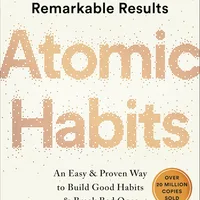
Atomic Habits — James Clear
Placed after "start with just three questions — one ground, one frame, one forward, under seven minutes." This IS the atomic habit: tiny friction, 1% improvement, repeated daily. Clear's framework — make it obvious, m…
As an Amazon Associate, we earn from qualifying purchases — at no extra cost to you.
Keep the same notebook for a week. At the end of seven days, read back through what you wrote. You won't believe the patterns that show up. Most people find that about 80% of their anxious thoughts repeat with slight variations, and naming that pattern alone cuts the volume in half. Tony Robbins likes to say the quality of your life is the quality of your questions. What he rarely adds is that the quality of your questions is the quality of the ones you bother to write down more than once.
If the list feels like too much, start with question #40. Just that one. What does this anxiety want me to pay attention to that I've been ignoring? I have watched people spend years in therapy circling the answer to that single sentence.
A practical note: avoid using a phone for this. The research on handwriting versus typing is consistent — writing by hand slows the thought down enough for the prefrontal cortex to catch up with the amygdala, which is exactly the effect we want. A dedicated paper notebook, whatever feels good in your hand, does the job.

Kindle Paperwhite (2024, 12th Gen)
Right after the explicit "avoid using a phone for this" warning. The Kindle is the ideal counterpart — not a phone, not a distraction device, a reading-only tool with a 12-week battery. The article references Nolen-Ho…
As an Amazon Associate, we earn from qualifying purchases — at no extra cost to you.
The Quiet Point of All This
Anxiety is not your enemy. It's a signal with the volume turned up too loud. Most of the strategies we're taught — distraction, breathing apps, white-knuckled positive thinking — are ways of muting the signal. Self-inquiry does something different. It translates the signal, from the primitive language of the nervous system into a language you can actually negotiate with.
Elio D'Anna once wrote that most people spend their lives fleeing the inside of their own heads, and then wonder why their lives feel so external. The point of these forty questions is not to make you more introspective for its own sake. It's to return the authorship of your own attention to you.
You will still have noisy nights. Everyone does. But you'll stop needing to out-think the noise. You'll have a way in, and a way out, and a small stack of answers in your own handwriting to remind you that the person asking is always, always steadier than the one spiraling.
Which of the forty questions landed hardest when you read it? That's the one to start with tonight.
Was this helpful?