Mindset· 9 min read
Why Getting Their Approval Never Feels Like Enough
Approval-seeking isn't a flaw — it's hardwired survival software. Here's why their validation never sticks, and what to build instead.

Why Getting Their Approval Never Feels Like Enough
The email arrived at 3:47 PM on a Tuesday. "Fantastic work — exactly what we needed." Six words. After three weeks of late nights, three rounds of revisions, and a presentation I'd rehearsed in front of my bathroom mirror more times than I'm comfortable admitting.
Six words. And I felt... nothing. Actually, not nothing. Something worse: a quiet hunger, as if the approval I'd worked toward had simply raised the bar rather than cleared it. By Thursday I was already wondering if they really meant it.
Here's what nobody tells you about approval-seeking: it doesn't feel like a problem when you're doing it. It feels like ambition. It feels like caring. It feels like the responsible thing — of course you want to do good work, of course you want people to think well of you. The problem only becomes visible when the approval arrives and nothing actually changes inside.
That hollow feeling isn't a personal failing. It's the predictable output of a motivational system most of us are running unconsciously — one that evolution built for a very different set of conditions than a Tuesday afternoon email.

Your Brain Was Built to Need Approval — and That's Not a Character Flaw
In 1995, Roy Baumeister and Mark Leary published what is now one of the most cited papers in social psychology. Their review in the Psychological Bulletin made a bold claim: the need to belong isn't a personality quirk or a cultural artifact. It is a primary biological drive — roughly as fundamental as hunger and thirst.
The argument was evolutionary. Our ancestors who were socially included in groups survived and reproduced at dramatically higher rates than those who were excluded. An excluded individual couldn't defend themselves, couldn't find food during a hard winter, couldn't raise children safely. Social rejection, in the ancestral environment, was a genuine survival threat.
So the brain didn't develop a mild preference for inclusion. It developed an urgent, persistent motivational system oriented entirely around securing and maintaining social belonging. That system is what you're running when you carefully word a text message, when you replay a conversation looking for signs you were too much, when you adjust your behavior in real time based on how someone's face is shifting.
You're not being needy. You're running survival software on a problem that no longer requires it.
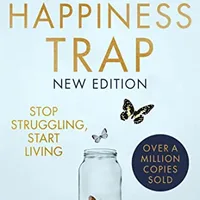
The Happiness Trap (2nd Edition) — Russ Harris
The article names self-doubt and anxiety as the engine of approval-seeking — ACT (Acceptance and Commitment Therapy) is the exact evidence-based framework for working *with* that wiring rather than against it.
As an Amazon Associate, we earn from qualifying purchases — at no extra cost to you.
The practical consequence of this is that you can't simply decide to stop caring what people think. That would be like deciding to stop feeling hungry. What you can do — and what the research suggests is both possible and genuinely worth the effort — is understand the specific mechanism behind the caring. Because once you see it clearly, you can start working with it rather than against it.
The Sociometer: Why Your Self-Esteem Is Actually a Social Radar
Mark Leary didn't stop at the Need to Belong framework. He went further, developing what he called "sociometer theory" — and it reframes self-esteem in a way that's initially uncomfortable but ultimately clarifying.
The standard assumption is that self-esteem is how you feel about yourself in private. Leary's research suggests something more specific: self-esteem functions primarily as a real-time gauge of your social acceptance risk. When your environment sends signals of inclusion — people are warm, engaged, responding positively — your sociometer rises and you feel good about yourself. When signals shift toward exclusion — criticism, indifference, rejection — the gauge drops and produces the aversive emotional experience that motivates corrective social behavior.
In other words: self-esteem, in the conventional sense, isn't primarily an internal assessment of your worth. It's an external monitoring system.
This explains something you've probably noticed. Your self-esteem is remarkably inconsistent across contexts where you're objectively identical. You're the same person presenting to a room that's engaged and presenting to a room that's distracted — but you feel entirely different about yourself depending on which one it is. That's not your imagination. That's the sociometer doing exactly what it evolved to do.
The uncomfortable implication: when you seek external approval, you're not doing something shallow or immature. You're running the program the sociometer runs automatically. The question isn't whether you're wired this way — you are, and so is everyone else in the room. The question is whether the sociometer is the right instrument for the job you're asking it to do.
Why Getting the Approval Never Feels Like Enough
Jennifer Crocker, a professor of psychology at the University of Michigan, spent her career investigating what she called "contingent self-esteem" — self-esteem that rises and falls in direct response to external outcomes: performance evaluations, social comparison, whether people approve or disapprove. Her foundational research, published in the Psychological Review, found that this pattern exacts a measurable cost on wellbeing and performance.
What she found was striking. People who pursue self-esteem contingently — who treat it as something they can earn through good performance and others' positive reactions — experience chronically unstable wellbeing, higher anxiety, worse academic and professional performance, and more interpersonal conflict.
Not worse outcomes despite working hard to secure approval. Worse outcomes because of it.

Here's why: contingent self-esteem is a treadmill. When your sense of worth depends on others' responses, approval gives you temporary relief — the gap between your current state and your needed state closes briefly — and then the system resets. The next performance review, the next social interaction, the next email arrives, and the monitoring begins again. The relief has a half-life measured in hours.
Crocker's research also found that people in contingent self-esteem mode invest enormous cognitive and emotional resources in impression management: monitoring reactions, preemptively adjusting behavior, reviewing social interactions afterward for signs of acceptance or rejection. That investment is expensive in ways that aren't immediately obvious.
Contrast this with what Crocker called non-contingent self-worth — a sense of value grounded in your own values and your relationship with your own experience rather than in others' reactions. In her intervention research, helping people shift toward non-contingent self-worth sources produced durable improvements in wellbeing and relationship quality — not by making them indifferent to social connection, but by changing the basis of their self-regard.
The goal isn't to not care about people. It's to stop making their reactions the evidence for your worth.
The Cognitive Tax Nobody Mentions
Tasha Eurich, an organizational psychologist whose research on self-awareness has produced some of the most practically useful findings in recent organizational psychology, adds a dimension to Crocker's picture that most people don't expect.
Most people who consider themselves self-aware are actually engaged in a form of performance. They're not experiencing their actual values and preferences — they're monitoring how those values and preferences appear to imagined social observers, and adjusting them in real time.
Eurich found that genuine self-knowledge — knowing what you actually think and want, as opposed to what you want to appear to think and want — is genuinely rare. And many introspective attempts, including journaling without structured prompts, can actually reinforce self-monitoring rather than self-knowledge. You sit down to reflect and end up rehearsing the approved version of yourself rather than examining the actual one.

Kindle Paperwhite 2024 (12th Gen, 16GB, Black)
The researchers cited here — Baumeister, Leary, Crocker, Eurich — have written books worth reading in full. A Kindle keeps that reading habit frictionless: one device, battery life measured in weeks.
As an Amazon Associate, we earn from qualifying purchases — at no extra cost to you.
The exhaustion that approval-seeking produces isn't just emotional. It's cognitive. Monitoring how you appear, adjusting behavior in real time to maintain the approved presentation, reviewing interactions afterward for evidence of inclusion or exclusion — all of this consumes executive function resources. The same attentional bandwidth that could be focused on the work itself, on genuine connection, on creative problem-solving, is spent managing the impression instead.
The irony Eurich's research points toward: the version of yourself that's most consistently approved of by the widest audience is the most carefully managed — and therefore the least genuinely you. And the carefully managed version is precisely the one that people connect with least deeply, because real connection requires the risk of genuine self-disclosure.
You're paying a high cognitive price for a social outcome that is simultaneously less satisfying and less effective than the alternative.
How to Start Shifting Today
The escape route isn't indifference to belonging. Baumeister and Leary were right: the need to belong is real and legitimate. What changes is the source of the belonging you're trying to secure.
Here's what the research actually supports:
Identify whose approval you're organized around. Most approval-seeking is highly specific — not everyone's opinion, but particular people whose judgment carries enormous weight (a parent, a manager, a peer whose success you've been benchmarking against your own).

Clever Fox Habit Calendar Circle (24-Month)
A guided journal makes the self-worth audit concrete: whose disapproval would actually change how you live? Written reflection surfaces what mental review keeps buried.
As an Amazon Associate, we earn from qualifying purchases — at no extra cost to you.
A structured self-worth audit forces this into the open: whose disapproval would actually change how you live? And is that a person whose complete value system you'd want to import into your own life?
Build a values-based internal reference point. Crocker's intervention research showed that the shift from contingent to non-contingent self-worth happens most reliably when people identify specific values they hold regardless of external outcomes — and practice evaluating their choices against those values rather than against others' reactions. This isn't positive affirmation. It's building an entirely different evaluation system.
Practice the tolerance of not knowing. A significant portion of approval-seeking is actually anxiety management: you're not primarily seeking approval, you're trying to eliminate the discomfort of not knowing how you're perceived. Deliberately sitting with that uncertainty — not reviewing the interaction, not checking to see how they responded, not tweaking the email you already sent — is the specific practice that produces relief over time. The discomfort diminishes with exposure, the same way any anxiety does.
Let belonging come from being known, not performed. The connections that produce stable belonging — the kind Baumeister and Leary described as a fundamental human need — are built not on consistent approval but on the experience of being genuinely seen. Showing up with your real views, your actual uncertainty, your specific perspective, and finding that it's met with something real in return. That kind of belonging doesn't collapse with the next piece of critical feedback.

The Good Life — Robert Waldinger & Marc Schulz
Closes the article on 'let belonging come from being known, not performed.' Waldinger & Schulz's Harvard 85-year study is the definitive evidence that relationship quality — not approval — predicts a good life.
As an Amazon Associate, we earn from qualifying purchases — at no extra cost to you.

The Approval Loop Is Designed to Never Close
Here's the reframe that helps most: you are not trying to become someone who doesn't care. You're trying to become someone whose caring is aimed at the right targets.
Baumeister and Leary were describing a feature, not a flaw. The need to belong is what makes you a social creature capable of deep connection, collaboration, and genuine care. The problem isn't the need — it's the instrument you're using to meet it. Running a social radar designed to detect survival-level exclusion risk in a modern environment where no one's going to exile you from the tribe for an imperfect presentation is like using a fire alarm to track your mood. The instrument is too sensitive for the job.
The work — and it is real work — is recalibrating where your sense of worth originates. Not from the Tuesday afternoon email. Not from the number of responses to your post. Not from whether the room laughed at your comment. But from the accumulated evidence of living in alignment with what you actually value, and building the kinds of relationships where being genuinely known is the basis of connection rather than the risk you're endlessly trying to manage.
Designing your evolution out of the approval loop doesn't mean caring less. It means caring more accurately.
What's one relationship in your life where you think you're performing more than you're actually showing up? What do you think would happen if you tried it the other way around?
Was this helpful?