Mindset· 9 min read
Why Fighting a Craving Makes It Worse
Wegner's white bear experiment proved suppressing a thought makes it intrude more. Here's the real science of ironic process theory and what to do instead.
Why Fighting a Craving Makes It Worse
I gave up chocolate for exactly eleven days.
Day one was fine. Day two, I noticed I was thinking about it more than usual. By day seven I was watching cooking videos at midnight — specifically ones involving chocolate — not because I'd searched for cooking content, but because my brain had quietly decided that "don't think about chocolate" was the most interesting assignment it had received all week.
I caved on day eleven, felt defeated, and filed it under willpower problem.
It wasn't a willpower problem. It was an ironic process problem. And once you understand the specific mechanism involved, you'll realize you've been fighting a craving in the worst possible way — and so has almost everyone else.
The Russian Novelist Who Accidentally Predicted a Psychology Experiment
Fyodor Dostoevsky wrote a line in his 1863 travel memoir Winter Notes on Summer Impressions that outlasted most of the philosophy in the book: "Try to pose for yourself this task: not to think of a polar bear, and you will see that the cursed thing will come to mind every minute."
He didn't have empirical data. He was a novelist who'd spent a lot of time inside his own head.
A hundred and twenty years later, a social psychologist at Trinity University named Daniel Wegner decided to find out whether Dostoevsky was right.
In 1987, Wegner and his colleagues David Schneider, Samuel Carter, and Teri White published "Paradoxical Effects of Thought Suppression" in the Journal of Personality and Social Psychology. The setup was elegantly simple. One group of participants was asked to spend five minutes thinking aloud about whatever came to mind — but specifically not about a white bear. They rang a bell every time the bear thought intruded anyway. A comparison group was simply asked to think freely, including about a white bear if they liked.
Then both groups were switched: everyone was now asked to actively think about the white bear.
If suppression worked, you'd expect the first group to have the bear well under control by now. Instead, the group that had spent five minutes suppressing reported significantly more intrusions of the white bear than the comparison group — both during the suppression phase and, strikingly, during the subsequent think-about-it phase, where the bear seemed to rebound with almost spiteful intensity.
Dostoevsky, it turned out, was precisely right.
This is distinct from Walter Mischel's famous marshmallow experiments, which concern a child's attentional strategy for tolerating a voluntary wait for a larger reward. Wegner's research concerns the involuntary, often trivial thoughts imposed by a self-created ban — where no reward is being weighed at all, just raw tolerance for a thought you've decided you don't want. And that distinction matters enormously, because the fix for Mischel's problem (distract yourself from the marshmallow) actively makes Wegner's problem worse.
why willpower myths miss the point about self-control
What the White Bear Study Actually Found About Thought Suppression
Ironic process theory is Daniel Wegner's explanation for why trying not to think about something causes you to think about it more. Actively suppressing a thought keeps it perpetually close to awareness, because the suppression mechanism requires continuously scanning for the very thing you are trying to avoid.
The raw numbers from Wegner's original experiment are worth pausing on.
During the five-minute suppression phase, participants who'd been told not to think about the white bear reported intrusions of the bear roughly once per minute on average. That's not the bear sneaking in occasionally. That's the bear becoming a near-permanent presence at the edges of awareness — intruding every sixty seconds despite every conscious effort to prevent it.
But the more striking finding was what happened when suppression ended.
When both groups were finally asked to think freely about the white bear, the previously suppressing group experienced a measurable rebound. They thought about the bear more frequently than participants who'd been free to think about it from the start. The suppression hadn't neutralized the thought's power. It had amplified it — banking the thought, in effect, and collecting interest.
Wegner called this the rebound effect, and subsequent researchers have documented it across contexts that matter considerably more than a fictional white bear: suppressing thoughts about an ex-partner, suppressing thoughts about a craved food, suppressing thoughts about a worry you're trying to minimize. The pattern holds across all of them.
What the research found wasn't a quirk of laboratory conditions. It was a reproducible feature of how the mind responds to deliberate self-censorship — and it's the hidden reason your most disciplined periods of "not doing the thing" so often end in a spectacular relapse rather than a graceful transition.
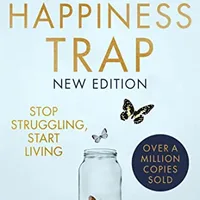
The Happiness Trap (2nd Edition) — Russ Harris
The article's core claim — that suppression amplifies the thought it targets — is the founding premise of Acceptance and Commitment Therapy. Harris is the most accessible clinical translation of 'stop fighting the tho…
As an Amazon Associate, we earn from qualifying purchases — at no extra cost to you.
The Two Processes Running Inside Your Head Right Now
Here's where ironic process theory gets genuinely counterintuitive.
Wegner proposed that successfully not thinking about something requires two simultaneous mental operations running in parallel.
The first is an operating process — the one doing the actual work. When you decide not to think about chocolate, the operating process starts generating substitute thoughts: look at the spreadsheet, think about tomorrow's meeting, check the weather. This is the part of suppression that feels like willpower.
The second is a monitoring process — and this is the one that causes all the trouble. The monitoring process has to continuously scan your conscious awareness to check whether the unwanted thought has crept back in. It's essentially running a background search for the very thing you don't want to find.
Under normal conditions, the monitoring process operates below conscious awareness. You don't notice it working. But by its very design, it keeps the forbidden thought perpetually one step from consciousness — because it has to, in order to catch it the moment it reappears.
Think of it like hiring a security guard whose job is to make sure a specific name never gets mentioned at a party. The guard has to know the name, hold it in mind constantly, and be ready to intervene the instant anyone approaches it. The name doesn't disappear from the building. It becomes the most carefully tracked thing in the building.
That's what suppression does to an unwanted thought. The monitoring process is not a side effect of suppression. It is suppression. You cannot suppress without monitoring. You cannot monitor without keeping the thing alive.
The Worst Time to Suppress Is Exactly When You're Already Struggling
Here's the part that makes ironic process theory almost cruel in its timing.
Wegner's research found that the rebound effect intensifies specifically under conditions of mental load — when you're distracted, stressed, tired, or cognitively depleted. The operating process, the one doing the active work of redirecting attention, is effortful. It requires cognitive capacity to run.
The monitoring process, by contrast, is relatively automatic. It doesn't require much energy.
So when your resources are stretched — when you're dealing with a difficult conversation at work, a bad night's sleep, or something genuinely stressful — the operating process weakens first. The monitoring process keeps running. And now you have a background search-engine for the unwanted thought still operating at full capacity, but the mechanism that was supposed to redirect attention away has lost the resources to do its job.
This is precisely when suppression fails most dramatically. And it's precisely when most people try to suppress most aggressively.
The craving you manage to white-knuckle past on a calm Tuesday will break through on a Thursday when you've had three back-to-back meetings and skipped lunch. Not because your willpower ran out. Because the cognitive architecture of suppression was always running on borrowed time — it only ever worked when you had surplus mental capacity to spare.

Philips SmartSleep Wake-Up Light HF3520
The article's sharpest practical point: suppression collapses when you're depleted — bad sleep, back-to-back meetings, skipped lunch. The lever that isn't willpower is protecting the wake/sleep cycle so the operating…
As an Amazon Associate, we earn from qualifying purchases — at no extra cost to you.

Urge Surfing Is Different — and That Difference Is Everything
Judson Brewer's mindfulness-based urge-surfing research — developed through his clinical work with smokers and people struggling with overeating at the Mindfulness Center at Brown University — is sometimes mentioned alongside Wegner's ironic process theory, and it's worth being precise about why they're different. Because the distinction tells you exactly where to aim.
Brewer's approach involves curious, non-judgmental observation of a craving as it naturally rises and falls — watching it, naming its qualities, noticing where it sits in the body — without either suppressing it or acting on it. In Brewer's framework, you don't fight the craving. You observe it the way you'd watch a wave move through water, with genuine interest in its shape and direction.
Wegner's ironic process theory explains precisely why that approach outperforms willpower: because urge surfing doesn't activate the monitoring process at all. You're not scanning for the craving's absence. You're not running a background suppression system. You're simply noting the craving's presence and letting it complete its arc.
Suppression tells the craving it's an intruder that needs to be stopped.
Observation tells the craving it's a guest who's welcome to leave on its own timetable.
The evidence suggests the second approach produces considerably less rebound — not because it requires more discipline, but because it doesn't trigger the mechanism that makes cravings rebound in the first place. This is why "don't" so rarely works as an instruction to yourself, and why acceptance-based approaches to unwanted thoughts consistently outperform suppression-based ones in controlled comparisons.
why fighting a feeling head-on makes it stronger
The Thoughts You're Already Suppressing (Without Realizing It)
The white bear is rarely chocolate.
It's the argument you had with your partner three days ago that keeps interrupting your focus during work calls. It's the embarrassing thing you said in a meeting in 2022 that still surfaces uninvited at 2am. It's the financial number you don't want to look at, which means you can't stop mentally calculating it. It's the relationship you're trying not to think about, which is why it's currently the loudest thing in the room.
Wegner's research applies to all of them, because the mechanism is the same: every active effort to push the thought away requires the monitoring process to hold the thought in mind, ready to intercept it. The harder you push, the more carefully the system watches.
There's a reason experienced therapists often invite clients to describe a thought they're trying to avoid, rather than helping them suppress it more effectively. The description breaks the suppression attempt. It allows the monitoring process to stand down — because you're no longer trying to prevent the thought from reaching consciousness. It's already there, already acknowledged, already starting to lose the quality of an intruder.
Named thoughts are less powerful than unnamed ones. Observed thoughts are less persistent than suppressed ones.
Wegner's data shows this directly: the comparison group, free to think about the white bear from the start, thought about it less than the group who spent five minutes trying to prevent it.

Clever Fox Habit Calendar Circle (24-Month)
'Named thoughts are less powerful than unnamed ones.' Writing the pattern down externalises what the monitoring process keeps re-scanning for — a visible tracker turns observation into a repeatable daily act instead o…
As an Amazon Associate, we earn from qualifying purchases — at no extra cost to you.
How to Stop the Cycle Without More Willpower
The practical application here is counterintuitive enough that it's worth stating clearly, step by step.
-
Notice the suppression attempt before the thought. When the craving arrives, your instinct is to push it away. Catch that instinct first. Name it: I'm trying to suppress this. That act of noticing interrupts the automatic suppression cycle before the monitoring process has time to entrench itself.
-
Allow the thought into awareness, briefly and deliberately. This is what feels riskiest but works best according to the research. Let the thought be present. Don't negotiate with it, argue against it, or plan around it — just acknowledge it's there. Brewer's research and Wegner's both converge on the same conclusion: deliberate acknowledgment deactivates the monitoring process faster than any amount of active suppression.
-
Identify when your suppression is most likely to fail. Wegner's finding that the rebound effect intensifies under cognitive load means your suppression attempts collapse at predictable moments: when you're depleted, overwhelmed, dealing with unrelated stressors. If you can identify those windows in advance, you can change your environment before the monitoring process takes over — before the threshold is crossed, not after.
-
Give your mind something genuinely engaging, not just a placeholder. The operating process needs something absorbing to redirect toward — not merely a filler to occupy the gap. A task you're genuinely interested in competes with cravings far more effectively than a forced substitute, because it doesn't leave the monitoring process with nothing to do except watch for the thing you're avoiding.
-
Use the rebound as a diagnostic signal, not a verdict on your character. If a craving rebounds strongly after a period of "successful" resistance, Wegner's data suggests this is mechanistically expected. The strength of the rebound is proportional to the duration of the suppression attempt. It isn't a sign that something has gone wrong with your self-control. It's a sign that suppression has been the strategy, and suppression has a known ceiling — one that gets lower the more tired you are.

why writing through a difficult feeling calms the mind faster than avoiding it

Kitchen Safe kSafe Time Locking Container (Medium, White Lid + Clear Base)
Step 3 of the article says to change your environment BEFORE the depletion window, not to fight harder inside it. A time-lock box is the physical version of that instruction — the decision is made once, in advance, so…
As an Amazon Associate, we earn from qualifying purchases — at no extra cost to you.
The Principle That Makes This Work
Jim Rohn had a line that I've returned to more than most of his more quoted material: "Focus on the solution, not on the problem." He was talking about business, but the structure maps exactly here.
Fighting a craving is a specific kind of fighting — one where the weapon you're using (suppression) actively strengthens the thing you're fighting. Wegner's research makes this mechanistically precise. The monitoring process isn't an accidental side effect of trying not to think about something. It's the core of what trying not to think about something actually is.
You cannot suppress without monitoring. You cannot monitor without maintaining the thought at the threshold of awareness. The architecture of suppression is the architecture of persistence.
The alternative isn't surrender. It's a genuinely different relationship with the thought — one where you're not an opponent of it, but an observer of it. The thought arrives. You note it without emergency. You don't activate the search-engine that would keep it circling. And because the monitoring process has nothing to monitor for, the thought completes its natural arc and moves on.
This is what Dostoevsky intuited in 1863, what Wegner proved in 1987, and what continues to replicate across every context researchers have since tested. The irony in ironic process theory is that the attempt to eliminate a thought is what gives it staying power. Stop the attempt, and you stop the amplification.
Your next craving isn't a test of your willpower.
It's an invitation to stop treating your own mind as an opponent that needs to be controlled, and start treating it as something that can simply be observed. That shift — from fighting to watching — is what "Design Your Evolution" actually looks like at the level of a single thought on a difficult afternoon.
What thought or craving have you been trying hardest to suppress — and has that strategy actually been working? Drop it in the comments. The research suggests naming it out loud is already doing something useful.
Was this helpful?