Mindset· 9 min read
Stress Mindset: Can Seeing Stress as Fuel Help?
Research suggests how you think about stress shapes how your body handles it. What the stress-mindset studies show, their limits, and a test to try.

Stress Mindset: Can Seeing Stress as Fuel Help?
The year I tried to eliminate stress entirely, I accomplished almost nothing worth keeping.
I restructured my calendar, cut commitments, declined anything that felt like pressure. For a few weeks, I felt calmer. Then I noticed my ideas had gone quiet. My work was getting safer, more predictable, and — looking back — a lot less interesting.
I'd confused peace with stagnation.
That experience eventually led me to the research on stress mindset — the idea that your core belief about whether stress is enhancing or harmful shapes your physiological response to pressure, not just how you feel about it in the moment.
Research published in the Journal of Personality and Social Psychology by Alia Crum, Peter Salovey, and Shawn Achor suggests the way you think about stress — not just how much of it you have — shapes your body's measurable response to it. Not because attitude is a magic override, but because appraisal appears to be a real, documented input into your stress physiology.
That's worth understanding carefully. Here's what the data actually shows, where it's been challenged, and what you can realistically do with it.
What the Stress Mindset Studies Found
In 2013, Crum and her colleagues published a three-study paper, "Rethinking Stress: The Role of Mindsets in Determining the Stress Response." In the first study they presented the Stress Mindset Measure — a short eight-item questionnaire that asks whether you believe the effects of stress are mostly enhancing (it improves performance, growth, and wellbeing) or mostly debilitating (it impairs those same things).
In a second study, they showed that stress mindsets can be shifted: short film clips presenting factual information framed either as "stress is enhancing" or "stress is debilitating" moved participants toward the corresponding mindset.
In a third study, they looked at how mindset related to the stress response itself. A stress-is-enhancing mindset was associated with moderate cortisol reactivity and a stronger desire for feedback under stress.
Before you take that as easy confirmation, here's the honest caveat: this is early work with small laboratory samples and short-term measures, and the findings are not a guarantee that changing your mindset will change your health. Mindset and baseline wellbeing likely influence each other, and later research on stress mindset has produced results that are directionally consistent but modest in size.

Full Focus Planner by Michael Hyatt (Linen Hardcover)
As an Amazon Associate, we earn from qualifying purchases — at no extra cost to you.
For readers who want to track their own stress appraisals alongside the research — rather than just reading about the concept — a dedicated stress and resilience journal gives you somewhere to do the experiment described later in this article.
Your Appraisal Is Part of the System
Psychologists Richard Lazarus and Susan Folkman spent decades developing what's now called the transactional model of stress, formalized in their 1984 volume Stress, Appraisal, and Coping (Springer). The core argument: stress is not simply a property of events. It's the product of an assessment — what an event demands, weighed against what you believe you have to meet it.
When you're facing a tight deadline, a difficult conversation, or a high-stakes decision, your nervous system runs two questions almost simultaneously: Is this a threat? And do I have what it takes?
If your first answer is "serious threat" and your second is "barely adequate," your body launches a full alarm response — elevated cortisol, narrowed attention, heightened vigilance. If your first answer is "high demand" and your second is "I have capacity for this," what researchers call a challenge state emerges instead: activated and engaged rather than flooded.
The practical point: your first interpretation of a stressor shapes which cascade follows. You can't think away real overload. But you can influence which branch your nervous system takes in the early seconds of an appraisal — and that matters more than it sounds like it should.

Not All Stress Is Worth Reframing
Here's where most advice about stress mindset goes wrong. "Reframe stress as fuel" gets applied as a blanket instruction, and the result is people grinding through situations that actually need a structural fix, not a mental shift.
Two genuinely different kinds of stress are always in circulation.
The first is demand-load stress: pressure from a project that matters, a physical challenge, a conversation you've been avoiding because it's important. This kind asks something real of your capacity. It has a developmental purpose. When Jim Rohn is quoted as saying "don't wish it were easier; wish you were better," he was pointing at exactly this kind.
The second is noise stress: the kind that comes from a disorganized system, a meeting that should have been a message, a decision you've deferred forty times without resolution. This doesn't develop you. It just drains your available resources without return.
The stress mindset research applies most clearly to the first category. An enhancing appraisal of demand-load stress — "this is hard, it matters, and I have something to bring to it" — is consistent with what the data supports. Applying the same frame to noise stress is rationalized inefficiency.
The question worth asking when stress arrives: does this stressor require something of my real capability, or does it just create friction? One deserves a challenge-state response. The other deserves a system change.
how to audit your workload for tasks that develop versus tasks that just drain

Philips SmartSleep Wake-Up Light HF3520
As an Amazon Associate, we earn from qualifying purchases — at no extra cost to you.
A weekly planning journal that explicitly separates meaningful high-demand work from administrative noise makes this distinction something you act on each Monday morning rather than something you only think about during stress.
How to Shift Your Appraisal in Practice
What the research suggests, translated into something you can use this week:
Revise the language you reach for first. "I'm stressed out" and "I'm activated and engaged" are not equivalent frames. One places the body in a hostile environment; the other places it in a demanding but navigable one. That's not wishful thinking — it's appraisal theory applied deliberately. The label you default to first matters more than it looks like it does.
Add a deliberate second appraisal. After the initial hit of pressure, pause and ask: what exactly does this require of me, and do I have — or could I build — what it takes to meet it? That question alone can interrupt the threat cascade before it fully materializes.
Build an actual record of your performance under pressure. It's common to underestimate your own capability in a difficult moment, then remember how bad it felt rather than how capable you actually were. Tracking both your initial expectations and your real outcomes — not impressions, actual data — feeds a more accurate second appraisal going forward.

What the Research Doesn't Say
Before this becomes a permission slip for anything, a few things the evidence is clear about.
Stress mindset studies measure effects over short periods. They do not address the physiology of sustained overload — which the burnout literature covers separately and unambiguously. Chronic demand beyond recovery capacity degrades cognitive performance, immune function, and emotional regulation regardless of how you frame individual stressors.
An enhancing appraisal is most effective when:
- The demand has a visible endpoint
- You retain some real agency in how you respond
- Your baseline resources — sleep, nutrition, social support — aren't already severely depleted
If none of those apply, the most adaptive move isn't a mindset shift. It's a structural change to your circumstances.

Amazfit GTR 4 Smart Watch (HRV, sleep & stress tracking)
As an Amazon Associate, we earn from qualifying purchases — at no extra cost to you.
Wearable tools that monitor physiological recovery overnight — HRV trackers, for instance — help you see whether your nervous system is genuinely rebuilding capacity between demands, rather than running a silent deficit while you tell yourself you're adapting fine.
signs your nervous system needs recovery not reframing — overtraining and burnout signals
How to Start Today
One week. That's all this requires.
Step 1. When you feel significant pressure arrive, write one sentence about what it's actually asking of you — not how it makes you feel, but what specific capability it requires.
Step 2. After the moment passes, spend sixty seconds noting whether your real performance confirmed or contradicted your worst expectation of yourself under that pressure.
Step 3. At the end of seven days, read what you wrote. The gap between how threatening the stress felt and how capable you actually were is your real stress-mindset data — yours, from your own life, not derived from a controlled study.

The primary research is Crum, A. J., Salovey, P., & Achor, S. (2013), "Rethinking stress: the role of mindsets in determining the stress response," Journal of Personality and Social Psychology, 104(4), 716–733. It is accessible via PubMed (PMID 23437923) and doi.org/10.1037/a0031201, with a Stanford-hosted open-access PDF also freely available.
The Load Is Part of the Design
Resistance training works because load is the mechanism. Muscles don't develop by being protected from demand. They develop through progressive loading, adequate recovery, and the cycle repeating with slightly more weight.
That doesn't mean all weight is worth carrying. Wrong form injures you. The wrong load at the wrong time is just damage, and it compounds.
But the belief that a genuinely good life would be a frictionless one — that real success means never feeling strain — that idea will cost you more than the stress itself ever could.
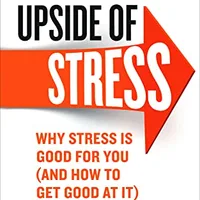
The Upside of Stress — Kelly McGonigal
As an Amazon Associate, we earn from qualifying purchases — at no extra cost to you.
Kelly McGonigal's The Upside of Stress draws on Crum's research and is one of the more honest popular books on this topic — it names the limits of the evidence as clearly as it names the findings.
Design Your Evolution isn't about removing difficult things from your week. It's about distinguishing load that builds something from load that merely crushes, and carrying the former deliberately while releasing the latter before it compounds into something you didn't choose.
What stress are you carrying right now that's actually developing something in you — and what have you been tolerating that you could simply remove?
Was this helpful?