Mindset· 12 min read
The Bandwagon Effect: Is Everyone Really Doing It?

The Bandwagon Effect: Is Everyone Really Doing It?
A few years back, I almost signed up for a polarizing productivity system — not because I had done any research, but because it felt like every person I followed online had already moved on to it. Newsletter after newsletter. Podcast guest after podcast guest. "This changed how I work." "I can't imagine going back."
I hadn't looked up a single study. I hadn't thought about whether it matched how I actually think. I just felt late to something. That feeling even has a name: the bandwagon effect.
I didn't sign up in the end — not out of principle, but because I ran out of time that week. Six months later, when I finally checked the numbers, adoption figures were a fraction of what the noise had suggested. Most of the voices were early adopters in a narrow niche. The majority of people doing similar work had never tried it, and many hadn't heard of it.
That gap between the perceived crowd and the actual crowd is the bandwagon effect in practice.
What makes it worth examining closely is not that it exists — social learning is natural and often genuinely useful — but that the crowd you think you're reading is frequently distorted in ways that compound the pull while hiding the distortion itself.
Here's where it gets complicated: the crowd you're inferring often isn't the crowd that exists.
Psychologists Deborah Prentice and Dale Miller studied this at Princeton in the early 1990s. They found that students consistently overestimated how comfortable their peers were with heavy drinking on campus. Each individual privately felt discomfort — but assumed everyone else was fine with it, because no one was saying otherwise out loud. Prentice and Miller called this pluralistic ignorance: the majority privately holds one view while publicly conforming to what they believe the group norm to be (Journal of Personality and Social Psychology, 1993).
Variations of the same pattern have appeared in classrooms, workplaces, and online communities. A room full of people unsure whether to raise a question, each assuming the silence of others means understanding. A team that privately doubts a strategy, but reads collective quiet as consensus. The crowd you imagine watching you is partly a projection. And your brain has a strong interest in keeping that projection intact.
The Gap Between Loud and Large
Social media didn't create social pressure. It compressed it and distorted the signal. What once required physical proximity — seeing what your neighbors chose, hearing colleagues talk at lunch — now arrives through engagement algorithms that surface the loudest content, not a representative sample of what people actually do.
This creates a specific measurement error. When you scan your feed and conclude "everyone is doing X," what you've actually measured is "the people most vocal about X appear in my feed disproportionately." Those are not the same thing. A habit practiced quietly by forty percent of a population generates far less visible signal than one practiced loudly by eight percent. The volume dial and the prevalence dial are simply not connected.
Noah Goldstein, Robert Cialdini, and Vladas Griskevicius tested the mechanics of social norms in a study published in the Journal of Consumer Research in 2008. They ran field experiments with a hotel towel-reuse program and compared different message framings. The most effective message wasn't a general environmental appeal — it was a descriptive norm tied to a specific, local reference group: guests who stayed in this very room. Concrete and contextual. It worked because the listener could place themselves inside it (Journal of Consumer Research, 35(3), 2008).
The key phrase: relevant reference group. The norm moved behavior most when it described people in the same exact situation. Vague, universal claims — "most people care about the environment" — were measurably weaker.
This is worth sitting with. The trends most likely to pull you in are framed as universal norms: everyone is building a second income, everyone is rethinking how they sleep, everyone has already made this shift. The research suggests those vague, large-scale claims are the least reliable guide to what's actually happening — and the most effective at manufacturing the feeling of pressure.
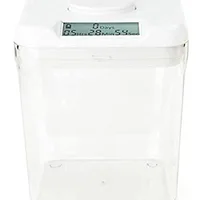
Kitchen Safe kSafe Time Locking Container (Medium)
As an Amazon Associate, we earn from qualifying purchases — at no extra cost to you.
Why Your Brain Defaults to the Crowd
Conformity isn't a character flaw. It's an ancient default. Humans have roughly 300,000 years of history as deeply social animals, during which deviating from the group carried genuine costs — social exclusion, reduced access to resources, real danger. Some neuroscience research suggests social rejection engages brain regions that also respond to physical pain, though how far that overlap goes is still debated.
What's changed is the environment your nervous system is reading. In a small, stable community, social signals were accurate because you could observe real people in real situations. The norms you perceived were, more or less, the norms that existed.
Now the signal is distorted at the source. Online visibility is not proportional to prevalence.
Jim Rohn used to say you become the average of the five people you spend the most time with. That framing still holds, but it needs extending. The five feeds you scroll most, the five newsletters you open each week — they're shaping your sense of what counts as normal. And they may represent a profoundly unrepresentative sample.
Influence, New and Expanded — Robert B. Cialdini
As an Amazon Associate, we earn from qualifying purchases — at no extra cost to you.
how to audit your information environment for bias
The Difference Between Joining and Deciding
There's a real gap between adopting a behavior because it fits your life and adopting it because you feel behind. The outcomes tend to diverge — and the divergence usually shows up three months in, not three days.
Research on intrinsic versus extrinsic motivation — Edward Deci and Richard Ryan's self-determination theory, developed across decades of studies — consistently finds that behaviors driven by internal reasons last longer and produce more satisfaction than behaviors driven by external pressure. When the engine of your behavior is outside you, it runs on social fuel. The moment the trend loses visibility, the motivation drains with it.
The distinction shows up clearly when you map it out:
| Following the bandwagon | Intentional adoption | |
|---|---|---|
| What drives it | Social pressure, fear of missing out | Internal fit with your actual goals |
| How long it lasts | Until the trend loses visibility | Until it stops serving you |
| How it feels three months in | Flat, or already abandoned | Ownership — even when it's difficult |
| Main question you asked | "Am I falling behind?" | "Does this match how I actually work?" |
The social proof pulling at you might be real — or it might be pluralistic ignorance wearing a convincing outfit.
Thinking, Fast and Slow — Daniel Kahneman
As an Amazon Associate, we earn from qualifying purchases — at no extra cost to you.
Three Checks Before You Jump On
None of this is a case for contrarianism. Being automatically against whatever is popular is still conformity — it just hands the steering wheel to the crowd in reverse. The goal isn't to avoid what's trending. It's to decide before you move.
Check 1: How big is the actual crowd? Find a number with a denominator. "40 out of 100 people surveyed in a workplace study" tells you something you can reason about. "Everyone is doing this" tells you the person hasn't looked. When you track down a primary source, the crowd almost always shrinks to something manageable.
Check 2: Is the reference group actually yours? The norm that shifts behavior is local and specific, not universal. The relevant question isn't "are people doing this?" — it's "are people at my stage, with my constraints, in my kind of work, finding this useful?" A practice that works well for solo founders may do nothing for someone managing a team. A morning routine built for someone who works from home may be useless for someone with a ninety-minute commute. The reference group matters more than the headcount.
Check 3: What would you choose if no one else were watching? This one is almost too simple to trust, but it surfaces clean answers quickly. Strip away the social signal and ask what you'd actually pick. If the answer is the same as before, you're probably deciding for real reasons. If it shifts — that's information worth having.

Kindle Paperwhite (12th Gen, 16GB)
As an Amazon Associate, we earn from qualifying purchases — at no extra cost to you.
How to Start This Week
The practical version of all this fits a two-step habit you can run whenever you notice the pull of a trend.
Write it down — just the behavior and the source of the pull. "I'm considering trying X because I saw Y and Z both talk about it." Getting it onto paper breaks the automatic loop. You're no longer inside the feeling; you're looking at it from outside the room.
Then sit with it for 72 hours. Not because hesitation is always wise, but because the urgency you feel around trends is usually manufactured — by the mechanics of algorithmic feeds and by the social pressure dynamics above. If you still want it after three days of not seeing it mentioned, that's a much stronger signal than the initial pull.
decision-making frameworks for intentional choices
Two steps, a notebook, and three days. Not every decision needs this treatment. But the ones that triggered the "am I falling behind?" feeling — those almost always do.

Sony WH-1000XM5 Noise Cancelling Headphones
As an Amazon Associate, we earn from qualifying purchases — at no extra cost to you.
Designing your evolution doesn't mean going it alone or rejecting every popular idea. It means choosing which parades you join on purpose, with your eyes open.
The research on pluralistic ignorance and descriptive norms doesn't say the crowd is always wrong. It says the crowd is often smaller than it looks, louder than it is large, and working from a sample that may not include you at all. That's not cynicism. That's precision — which is exactly what intentional decisions require.
An intentional life isn't built by opting out of everything popular. It's built by opting in with your eyes open, on your own terms, for your own reasons.
What's a trend you felt pulled toward lately — and when you looked closely, was the crowd as big as it seemed?
Was this helpful?