Mindset· 11 min read
The Power of Regret: How Looking Back Moves You Forward
Regret is data, not damage. Daniel Pink's 16,000-person survey and Gilovich's research reveal four universal regrets — and how to use them.

The Power of Regret: How Looking Back Moves You Forward
The email sat in my drafts folder for three years.
I'd written it to a mentor who'd helped me through a particularly rough stretch — never thanked him properly, kept meaning to, kept not doing it. The barrier wasn't indifference. It was something more embarrassing than that: it felt uncomfortable to admit how much someone's words had mattered. I kept telling myself I'd send it when I had more time to write it properly. When I had the right words. Eventually.
Eventually never came. He died, and I stood at the edge of his service knowing the thing I'd meant to say had died somewhere in my outbox.
That's the particular cruelty of a by-omission regret. It doesn't announce itself as a choice. It disguises itself as a pause.

The Problem With "Live Without Regrets"
Here's the cultural wisdom you've been sold: regret is toxic. "No regrets" appears on bumper stickers, graduation speeches, and motivational posters in airport bookshops. The advice is packaged as liberation — freedom from the backward gaze that poisons your present.
The only problem is that this advice is, from a psychological standpoint, genuinely bad. Not unhelpful. Bad. It asks you to suppress one of the most informative emotional signals your motivational system produces. It instructs you to ignore a compass precisely when you need direction.
Daniel Pink — the author who once served as chief speechwriter for Vice President Al Gore and has spent the better part of two decades translating behavioral science into prose that actual humans can use — did something unusual in 2020. He launched the World Regret Survey: an open platform where anyone, anywhere, could submit their biggest regrets anonymously. By the time he sat down to analyze the data for his book on the subject
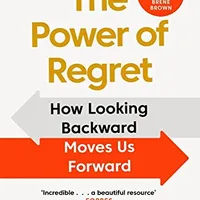
The Power of Regret — Daniel H. Pink
The source that powers this article — Pink's World Regret Survey with 16,000 people and the four universal categories that reveal what we value most.
As an Amazon Associate, we earn from qualifying purchases — at no extra cost to you.
, he had collected more than 16,000 regrets from 105 countries. The largest regret dataset ever assembled.
What he found turned the bumper sticker wisdom completely upside down.
Regret, it turns out, is not the problem. Avoiding regret — suppressing it, denying it, refusing to examine it — is the problem. The emotion itself, when engaged with skillfully, is one of the most reliable compasses the human mind possesses. It tells you, with uncommon precision, what you actually value. And that makes it one of the most underused tools in intentional personal development.
The science of self-compassion: what 20 years of research reveal about how you treat yourself
What 16,000 Regrets From 105 Countries Actually Found
Pink's survey had a structure that made it unusually revealing. He wasn't asking people whether they had regrets — everyone does, and anyone who tells you otherwise hasn't done much living or isn't being honest. He was asking people to describe their most significant regret: the one that, when they thought about it, carried the most lasting emotional weight.
The first finding that jumped out: regret is universal. Every culture, every age group, every income bracket, every gender. The person who claims to have no regrets hasn't achieved enlightenment. They've either achieved suppression or they've confused not thinking about something with not having it.
The second finding was more unexpected. When Pink analyzed the content of all 16,000 regrets — looking for patterns in what people actually wished had been different — he expected to find enormous cultural variation. Different societies, different values, different regrets.
He found the opposite.
Four categories accounted for nearly the entire dataset, regardless of where people came from or what their lives had looked like. Pink called them foundation regrets, boldness regrets, moral regrets, and connection regrets.
Foundation regrets: wishing you'd built the stable platform earlier — the education, the financial discipline, the health habits — that your later life turned out to require. These tend to arrive late, recognized only in retrospect when the missing foundation becomes a visible constraint. The person at 55 who wishes they'd taken their cardiovascular health seriously at 35. The one at 60 who wishes they'd invested consistently in their 30s instead of spending first and saving never.
Boldness regrets: the chances you didn't take. The business not started, the relationship not pursued, the creative work not attempted, the city not moved to, the hard conversation not had. Across cultures and age groups, these are typically the most numerous and most aching long-term regrets.
Moral regrets: having done something wrong — betrayed a trust, hurt someone who didn't deserve it, failed to live up to your own ethical code when it cost you something to do so. These are often the most acute in the short term and the most resolvable over time.
Connection regrets: relationships allowed to drift. The friend you stopped calling. The family bond you didn't invest in. The rift you never repaired. The thing you meant to say and didn't. My mentor. My drafts folder.
The universality of these four categories across 105 countries isn't arbitrary. Pink argues — and the data supports him — that they map to what human beings most fundamentally care about: stability, growth, goodness, and love. The four regrets aren't a catalogue of personal failure. They're a map of human values. Your regrets are pointing you directly at what matters to you most.
Why Inaction Will Haunt You More Than Action
Here's the finding that surprises most people, because it runs directly against the way we instinctively think about risk.
When you ask someone about their regrets immediately after something goes wrong — a business decision that failed, a relationship that ended badly, an investment that didn't work out — they're more likely to regret the actions they took than the actions they didn't. Which makes intuitive sense: you can point to the thing you did and draw a direct causal line to the consequence.
But Thomas Gilovich and Victoria Medvec at Cornell University found something entirely different when they asked a different question: which regrets do people carry most intensely across the full span of a life?
The pattern reverses completely.
Long-term regret is dominated, overwhelmingly, by inactions. Things you didn't do. Words you didn't say. Paths you didn't pursue. Chances you didn't take.
The mechanism is specific, and once you understand it you'll recognize it everywhere. Actions that go wrong can be explained, adapted to, and eventually resolved through the human mind's remarkable capacity for rationalization and meaning-making. You can look back at a failed business and construct a narrative about what you learned, who you became, what you'd do differently. That narrative closes the loop.
The thing you didn't do remains an open question. An unrealized possibility, permanently unconstrained by reality, that your imagination tends to make increasingly attractive over time rather than less. The "what if I'd done that" can never be definitively answered. And so it doesn't close. It stays open. And the open counterfactual, free from the moderating influence of what actually happened, grows in the dark.
Annie Duke, the former professional poker player who became one of the sharper thinkers on decision quality, captures this well — and her framework for separating good decisions from good outcomes is an essential complement to regret research
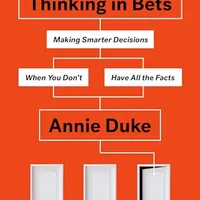
Thinking in Bets — Annie Duke
Separating good decisions from good outcomes — the essential companion to regret research on why the bets you never placed cost you the most.
As an Amazon Associate, we earn from qualifying purchases — at no extra cost to you.
. The worst bets aren't the ones that lose. The worst bets are the ones you never placed because you didn't recognize them as bets at all. At least the hand you played gave you information. The one you folded preemptively gave you nothing — except, eventually, the particular ache of the unchosen path.
The practical implication is uncomfortable: the risk calculus you're using right now to avoid difficult choices is systematically underweighting the long-term cost of inaction. The awkward conversation not had. The project not started. The creative work not attempted. The conversation you've been meaning to have.
Your brain is doing bad math on your behalf. The Gilovich research is its error report.
The Four Regret Types as a Personal GPS
Back to Pink's four categories — because there's something important about how to actually use them that goes beyond categorizing the past.
They're not just a taxonomy of things that hurt. They're a signal about present priorities.
If your most significant regrets cluster around foundation — you wish you'd taken your health seriously earlier, built better financial habits, completed the education you started — that's a specific instruction for what your evolution currently requires. Not general self-improvement. Structural work. The kind that's unglamorous and slow and exactly right.
If your regrets cluster around boldness, that's a different instruction. Your brain is telling you something very specific about where you're still choosing comfort over growth. The creative project that's been in your head for three years. The conversation you're waiting for the right moment to have. The version of yourself you keep scheduling for later.
Bronnie Ware, an Australian palliative carer who spent years sitting with people in the final weeks of their lives, documented the most common end-of-life regrets with a precision that Pink's global survey subsequently confirmed statistically. The number one regret she encountered, again and again, across hundreds of patients: "I wish I'd had the courage to live a life true to myself, not the life others expected of me."
A boldness regret. Every time.
The moral and connection regrets tend to have more direct repair pathways than the foundation or boldness regrets do — and that distinction matters practically. A connection regret about a drifting friendship can, in most cases, be addressed with a message today. A foundation regret about three decades of neglected health has a longer, slower timeline. Understanding which type of regret you're carrying tells you something important about both the urgency and the nature of the response it requires.

The Bezos Test: Using Anticipated Regret to Decide Better
Jeff Bezos, when he left a comfortable job at a hedge fund in 1994 to start a company selling books on the internet, used a decision framework he has described in numerous interviews and speeches since. He called it the "regret minimization framework."
The exercise is deceptively simple: project yourself forward to age 80. Look back at the choice you're currently facing from that vantage point. Which version of yourself, looking back from 80, carries more weight? The one who tried and failed? Or the one who never found out?
Not the choice that minimizes present-moment discomfort. The choice that minimizes the regret you'll carry at the end.
Research on anticipated regret — a concept rigorously developed by Marcel Zeelenberg at Tilburg University — offers empirical support for the mechanism behind this kind of exercise. Zeelenberg's research shows that imagining how you'll feel about a decision in the future shifts choice toward options more consistent with a decision-maker's deeper long-term values. The mechanism is precise: creating temporal distance from the present emotional state — the fear of embarrassment, the anxiety about failure, the comfort of staying put — allows you to access the values that will actually matter at long range. Values that are almost always obscured by the emotional weather of the immediate moment.
This phenomenon, called "anticipated regret," has been documented across health choices, financial decisions, and relationship behaviors. The consistent finding: people who were prompted to consider how they'd feel about a decision at a future point made choices more aligned with their expressed values than those who decided without that temporal framing.
If you want to understand what the end-of-life data looks like in clinical practice — not as survey numbers but as human reality — Atul Gawande's medical account of what people actually need and regret in their final months
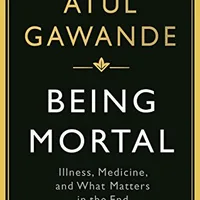
Being Mortal — Atul Gawande
The most honest clinical account of what people actually regret in their final months — confirms exactly what Bezos's framework predicts.
As an Amazon Associate, we earn from qualifying purchases — at no extra cost to you.
is the most honest available. His observations align precisely with what Bezos's framework predicts: almost no one at the end says they regret having tried something that failed. Almost everyone regrets the things they chose not to attempt — the life they protected themselves from living.
The "live without regrets" philosophy, in this light, isn't liberation. It's navigation without a compass. It removes the most useful forward-looking tool from your decision-making kit precisely when you need it most.
What Determines Whether Regret Helps or Destroys You
Here's the variable that determines whether your regret becomes fuel or becomes a wound: how you respond to it in the hour after it surfaces.
The research on this, assembled largely by Kristin Neff at the University of Texas and Mark Leary at Duke, is counterintuitive in the best way. The people who show the least ongoing psychological damage from regret — who process it most effectively, who extract the lesson and release the residual pain — are not the people with the fewest regrets. They're the people who respond to their regrets with self-compassion rather than self-attack. Neff's work at self-compassion.org has documented this effect across thousands of participants in peer-reviewed research.
This sounds like the soft, motivational-poster version of psychology. It isn't. There's a precise mechanism.
Harsh self-criticism after a regret doesn't close the emotional wound. It reopens it. Every episode of self-attack reactivates the pain, reinforces the shame, and adds an additional layer of anticipated self-punishment to the next decision involving similar risk. The person who treats their regrets with contempt doesn't just feel bad about the past. They become systematically more risk-averse about the future — which is the exact opposite of what the boldness-regret data suggests they need to be. The self-criticism creates the very pattern of avoidance that will generate the next wave of regrets.
Self-compassion, in this context, doesn't mean making excuses or lowering your standards. It means acknowledging what happened with honesty, extracting what's useful, and releasing the residual self-condemnation that continues well past the point where it serves any productive function.
Ethan Kross at the University of Michigan, whose research on the inner voice documents how the language we use in self-directed thinking shapes emotional outcomes, identifies a specific technique for regret processing: distanced self-talk. When you're sitting with a regret, addressing yourself in the third person — "What should [your name] do with this?" rather than "What should I do with this?" — activates the perspective-taking function that allows you to respond with the same quality of wisdom you'd offer a close friend. Which is almost always more useful than what you'd say to yourself in the first person.
Viktor Frankl, writing from circumstances that dwarf anything most of us will ever face, described the human capacity to choose your response to what cannot be changed. That's the fundamental act that regret processing requires: not the elimination of the feeling, but the deliberate direction of what you do with it. The regret that surfaces at 3 a.m. isn't asking to be suppressed. It's asking a question. The question is always some version of the same thing: what do you actually value, and are you living accordingly?
How to Start Today
The goal isn't to feel better about your regrets. It's to use them better.
Step 1: Run a regret inventory. Spend 20 minutes with a notebook — a proper one you'll return to, not a scrap of paper — and map your regrets against Pink's four categories: foundation, boldness, moral, connection. Don't filter or judge as you go. Just sort.

Habit Tracker Journal — Clever Fox
A durable structured journal to map your regrets against Pink's four categories and track the action steps that follow.
As an Amazon Associate, we earn from qualifying purchases — at no extra cost to you.
Which category carries the most weight for you right now? That's your signal.
Step 2: Act on the one connection regret that still has a repair pathway. Not all regrets do — some paths are permanently closed. But most connection regrets still have a door. Identify one. Send the message today, not tomorrow. The discomfort of reaching out is roughly 1% of the discomfort of not having done it at 80.
Step 3: Apply the Bezos test to a decision you've been avoiding. Pick the choice you keep postponing. Project to age 80. Which version of yourself carries more weight: the one who tried and failed, or the one who never found out? Write the answer down before the present-moment fear talks you back out of it.
Step 4: Start a decision journal. Not for emotions — for decisions. Write down what you're choosing, what values you think you're serving, and what fears you're managing. Review it in six months. The gap between what you thought you were doing and what you were actually doing is where most useful self-knowledge lives.
Step 5: Treat recurring regret as a compass reading, not a verdict. The regret that keeps coming back isn't punishing you. It's pointing at something. The recurrence means the signal hasn't been received yet. Your job is to receive it.

The Compass You Already Have
The "live without regrets" advice got one thing right: you shouldn't let regret consume you. Rumination is not reflection. Shame loops are not learning. Running the same painful movie on repeat, without ever extracting the lesson, is not what any of this is for.
But the answer to destructive regret isn't suppression. It's skillful engagement — treating the emotion as data from your deepest values about where your attention is most needed.
Here's what's probably true: you already know which category your biggest regrets fall into. You already know what the Bezos test would tell you about the decision you've been postponing. You have the compass. The question is whether you're willing to look at what it's pointing toward.
Vanulos exists for exactly this — helping you design your evolution, not away from the discomfort of honest self-examination, but toward the clarity that makes the discomfort worth it. A life where the regrets you carry at 80 are the small ones. The unavoidable ones. The ones that come with having lived fully rather than carefully.
What does your regret inventory tell you? And more importantly — what's the one thing it's been trying to get you to do?
Was this helpful?