Productivity· 9 min read
Your Real Problem Isn't Information — It's Attention
When information is nearly free, attention becomes your scarcest resource. Here's the science — and how to run your own attention audit.

Your Real Problem Isn't Information — It's Attention
My reading list has 347 articles in it.
Not an exaggeration. Pocket, Instapaper, a folder of starred emails, a notes app full of links I've screenshotted "for later" — together they represent somewhere between 200 and 400 hours of reading. At my current pace, I'll clear the backlog around 2031. Which would be fine, except that by then the list will have grown to about 1,400.
Here's what I had to confront: I don't have an information problem. I have an attention problem.
And the distinction matters more than almost anything else you could understand about how your mind actually works in 2026.
The 1971 Economist Who Saw This Coming
Herbert Simon wasn't a self-help writer. He was an economist and cognitive scientist who won the Nobel Prize in Economics in 1978 for his work on bounded rationality — the idea that humans make decisions under real constraints, not as perfectly rational optimizers with unlimited processing power.
In 1971, he wrote a paper called "Designing Organizations for an Information-Rich World." Most people have never heard of it. But one sentence from that paper gets quoted constantly without anyone knowing where it came from:
"A wealth of information creates a poverty of attention."
Think about what Simon was actually claiming. He wasn't saying information is bad. He was making a structural observation about scarcity. When something becomes truly abundant — cheaply and easily accessible to everyone — it stops being the limiting resource. Something else becomes scarce instead.
In 1971, information was genuinely scarce. Books were expensive. Research was locked behind university walls. Expertise was bottlenecked by geography and credentials. If you wanted to understand, say, the neuroscience of habit formation, you'd need to be in a specialist library, and even then you'd need to know exactly which journals to pull.
Now you can learn almost anything in about four minutes of searching. And therein lies the problem.
The moment information became abundant — through the internet, through digitization, through AI-generated content that now produces more text in a single day than humanity published in entire centuries — the thing that became genuinely scarce wasn't information. It was the human capacity to attend to any of it.
And human attentional capacity, unlike information supply, doesn't scale with demand.
Why Your Brain Has a Hard Ceiling
Here's where it gets biological — and where the self-help industry tends to go quiet, because the truth is less comfortable than "you just need a better system."
In 1958, a British psychologist named Donald Broadbent proposed what he called the filter model of attention. His core finding: the human mind processes incoming information through a narrow bottleneck — a selective filter that lets through only a fraction of the sensory information arriving at any given moment, passing it into conscious awareness while everything else drops away before you're even aware it arrived.
The filter doesn't get bigger. It doesn't upgrade across generations. It's a fixed constraint of biological architecture.
What this means is that more information arriving doesn't produce more information processed. It produces more filtering, more skipping, and more abandonment — not because people are lazy or distracted by choice, but because the bottleneck is structural.
This is why, as content volume has exploded, actual engagement with it hasn't followed. Nielsen Norman Group's research on web reading behavior has found that users typically read at most 20 to 28 percent of the words on an average page visit, scanning rather than reading in full — attention drops off within seconds of arriving on most pages. Reading-analytics firm Jellybooks, which has tracked completion data across thousands of purchased titles, found that fewer than half of readers typically finish a book once they've started it, with most readers abandoning titles within the first few chapters.
The problem isn't a lack of good content. It's that everyone reading has a fixed attentional budget, and most available content loses the competition for it before a single conscious decision to quit is ever made.
Simon called this in 1971. Broadbent provided the neural architecture to explain why. And now, five decades later, most of us are living inside the experiment.

Sony WH-1000XM5 Noise Cancelling Headphones
The article's 'silent tax' section is about external competition for your awareness — notifications, ambient noise, the environment bidding against your focus. A physical noise barrier is the most direct way to defend…
As an Amazon Associate, we earn from qualifying purchases — at no extra cost to you.
What Actually Stays Valuable When Everything Is Free
Kevin Kelly, the founding executive editor of Wired, wrote an influential essay on exactly this question: if digital copies of anything can be made and distributed at near-zero marginal cost, what still holds genuine value?
His answer was a list of what he called "generatives" — qualities that can't simply be replicated by copying information. Several of them map almost exactly onto Simon's original attention insight:
Immediacy — getting something before the crowd has it. When access to information becomes universal, the person who had it first still had something real. Being early is worth something precisely because everyone else's attention is now directed the same way.
Personalization — something configured specifically for your situation, your constraints, your context. The generic version is free. The version that addresses your exact problem, with your exact constraints, is still worth paying for.
Findability — being discoverable in an overwhelming sea of equally accessible alternatives. When there are a million options, the capacity to surface this specific thing for this specific person becomes genuinely scarce and genuinely valuable.
Notice what all three of these share: they're not about the content itself. They're about the attention that locates, filters, and contextualizes it. Simon's structural insight — that attention becomes the scarce resource once information becomes cheap — is exactly what Kelly's analysis of value keeps returning to from a different direction.
The practical implication is uncomfortable but important: in a world where everything is freely available, the skill of directing attention deliberately — and protecting it from the constant competition to own it — isn't a vague aspiration toward focus or mindfulness. It's the single most economically important cognitive skill a person can build.

Kitchen Safe kSafe Time Locking Container (Medium)
Directly follows 'the internal competition... what your environment has trained your nervous system to reach for.' The phone is most people's single biggest attention leak (Step 3 of the audit). A time-lock box remove…
As an Amazon Associate, we earn from qualifying purchases — at no extra cost to you.
The Silent Tax You Pay Before Breakfast
Here's what nobody talks about, though.
You probably think of the attention economy as something that happens to you from the outside — notifications, algorithms, infinite scroll, ads engineered to interrupt. The external environment competing for your awareness.
That part is real. But there's a second version of the same tax that's even more invisible: the internal competition between what you've decided matters and what your environment has trained your nervous system to reach for out of habit.
Think about the last time you sat down to do something genuinely important — a project, a hard conversation you needed to prepare for, a skill you were trying to build. How long before a tab opened? Before you checked your phone? Before your mind drifted to something smaller, more immediately rewarding, easier to complete?
That's not a character flaw. That's an attention budget being bid against by a dozen competing uses — some external, some internal habits — that are specifically structured to win the competition.
Jim Rohn used to say time is more valuable than money, because you can always get more money, but you can never get more time. The deeper version of that insight in 2026 is this: you can't manufacture more attention. You have what you have. What you control is the allocation.
And most people have never actually looked at where their allocation goes.
decision fatigue and why your morning routine matters
How to Run Your Own Attention Audit
This is practical. No philosophy required beyond what's already been laid out.
An attention audit is exactly what it sounds like: a deliberate look at where your attention actually goes across a day, versus where you believe it goes, versus where you want it to go.
Those three things are almost never the same.
Step 1: Track one day, unfiltered.
Set a timer for every 90 minutes across a single workday. When it fires, write down what you were actually attending to for the previous 90 minutes. Not what you were supposed to be doing — what your attention actually landed on, including the tangents, the distracted scrolling, the useful and the useless and everything in between.
Don't judge it. Just record it. You can't audit what you haven't measured.
Step 2: Categorize by return.
Not every use of attention is created equal. Some attention pays forward: work on a project that compounds, a conversation that deepens a relationship, learning that builds on itself. Some is neutral: genuine rest, maintenance tasks, necessary administration. Some is negative-return: reactive scrolling, pseudo-productivity (reorganizing things instead of doing them), low-value inputs that cost energy to process and leave nothing behind.
Sort your blocks. See what the actual split looks like. Most people find it surprising in the same direction — more neutral and negative than they thought, less compounding than they intended.
Step 3: Find the single biggest leak.
You don't need to fix everything. Attention audits aren't about achieving monastic focus. They're about locating the one biggest drain in the budget — the single use of attention that you're paying the most for and getting the least from — and making one change to it.
The consistent finding in behavior change research is this: one change, implemented with specificity and followed through, outperforms five simultaneous partial commitments every time.

Clever Fox Habit Calendar Circle (2-Year Tracker)
Step 2 of the audit ('categorize by return' — compounding / neutral / negative) is a tracking exercise. A visual habit tracker turns the one-day audit into a sustained record of where attention actually lands.
As an Amazon Associate, we earn from qualifying purchases — at no extra cost to you.
Step 4: Build one protected block.
Whatever matters most to you right now — the project, the skill, the relationship — assign it a fixed daily window that belongs to it alone. Not scheduled around everything else. Scheduled first, with everything else arranged around it.
Nir Eyal calls this timeboxing. Cal Newport calls it time blocking. The mechanism behind both labels is identical: if you don't pre-assign a protected block to your highest-value use of attention, the competition for that attention will fill the vacancy. Every time. Without exception.
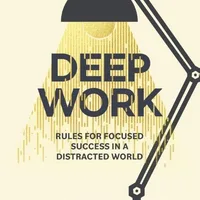
Deep Work — Cal Newport (Paperback)
The 'skill nobody actually teaches' section names deliberate attention direction as the upstream skill. Deep Work is the canonical text on exactly this — protecting focus in a distracted world. (Only book in the EN se…
As an Amazon Associate, we earn from qualifying purchases — at no extra cost to you.
The Skill Nobody Actually Teaches
Information literacy gets taught in schools — how to evaluate sources, how to distinguish reliable from unreliable. Media literacy is increasingly on the curriculum. But attention literacy — knowing where your awareness actually goes, understanding what it costs to shift it between tasks, recognizing the difference between chosen focus and hijacked focus — almost no one teaches this explicitly.
And yet it's the upstream skill. Every other form of productivity, every habit you want to build, every piece of knowledge you want to compound — all of it depends first on attention actually reaching the thing.
habit formation neuroscience and why willpower alone fails
Research by psychologist Wendy Wood at USC — who has spent decades studying habit formation and automatic behavior — found that roughly 43 percent of everyday behaviors are performed habitually, in stable contexts, without conscious deliberation at the moment they occur. In other words: almost half your day runs on autopilot. An attention audit is, in a meaningful sense, a way of making those automatic patterns visible — of seeing which ones are quietly governing your attention allocation and which ones you'd actually choose if you were choosing deliberately.
Simon saw this coming in a single sentence in 1971. The challenge he named — building a practice of deliberate attention direction in an environment specifically designed to pull it in every direction at once — has only gotten harder since.
The good news is that the hardest part isn't the practice itself. It's the moment of recognition: realizing that your information access was never the bottleneck. Your attention was. And that's something you can actually do something about.
How to Start This Week
No overhaul needed. Three things:
1. Do the audit. One day, one unfiltered record of where your attention actually went. You can't course-correct what you can't see. A paper notebook, a digital doc, a dedicated focus journal — whatever format you'll actually use for a single day is the right format.
2. Name your one highest-value target. What is the single thing that, if your attention went there consistently for the next 90 days, would compound most significantly? Not five things. One. Write it somewhere you'll see it when you sit down tomorrow morning.
3. Protect 90 minutes tomorrow. One block, phone on do-not-disturb, notifications off, browser closed. For that one thing. Don't measure the output the first day. Measure only whether the block happened clean.
That's the whole system to start. Simon's insight wasn't that attention requires elaborate management. It was that attention requires recognition — the deliberate acknowledgment that it is your actual scarce resource, not your to-do list, not your information access, not some abstract sense of effort.

Kindle Paperwhite 2024 (16GB, Black, Without Ads)
The article opens with a 347-item reading backlog and closes on intentional, deliberate consumption. A distraction-free e-reader (no app notifications, single-purpose) is the antidote to scanning 20-28% of everything…
As an Amazon Associate, we earn from qualifying purchases — at no extra cost to you.
Design Your Attention, Design Your Evolution
There's a phrase that sits at the center of what Vanulos is trying to do: Design Your Evolution.
Most people's evolution gets designed by default — shaped by whatever their environment keeps presenting, by what's engineered to capture their attention most effectively, by the loudest signal in the room at any given moment. In an attention economy, that's what undesigned evolution looks like. You drift toward whatever wins the bid.
Designed evolution means something different. It means looking honestly at where your attention goes and asking: Did I choose this? And if the answer is no — What would I actually choose?
Herbert Simon gave us the map in 1971. The territory has only become more relevant since.
Where did your attention go today?
Was this helpful?