Mindset· 10 min read
The Victim-Owner Switch: How to Take Back Your Story
Playing the victim keeps you stuck — and Rotter's research shows why. Here's the psychology of the ownership mindset shift that changes everything.

The Victim-Owner Switch: How to Take Back Your Story

A mentor once asked me a question I wasn't ready for.
I'd spent twenty minutes describing everything that was working against me — the manager who never gave me credit, the market conditions, the timing that always seemed slightly off. I'd built a case so thorough it felt airtight. When I finally stopped talking, he waited a beat and said: "What part of that is actually within your power to change?"
I didn't answer for a long time. Not because I didn't know. Because I hadn't been asking.
That's the uncomfortable truth about the victim position: it doesn't feel like a position. It feels like accurate observation. You're not exaggerating — the manager really is difficult, the market really is hard. But somewhere between accurate description and the way you orient your attention, a door quietly closes. You stop looking for leverage. You stop generating options. You start narrating your life instead of designing it.
That door has a name. And there's sixty years of research on how to reopen it.
Why Some People Get Unstuck and Others Don't
In 1966, Julian Rotter at the University of Connecticut published a landmark paper on locus of control that most people have never read — but one that may explain more about why lives diverge in the directions they do than almost any other single piece of research.
Rotter distinguished between two fundamental orientations: an internal locus of control (the belief that your outcomes are primarily shaped by your own choices, effort, and decisions) and an external locus of control (the belief that outcomes are determined by luck, circumstance, powerful others, or forces beyond your reach). What made his research striking — and what six decades of follow-up studies across dozens of cultures have consistently confirmed — is that this distinction is one of the most reliable predictors of life outcomes we know of.
Internal locus predicts higher academic performance. Better career trajectories. More consistent health behavior. Stronger financial outcomes and emotional resilience.
External locus predicts the opposite. And something more specific: it predicts that a person will stop trying even when circumstances change in their favor.
Here's the part most self-help writing buries: locus of control isn't a fixed personality trait you either have or don't. It's a learned attribution style — a habitual pattern of explaining causality that forms through experience and can be deliberately revised. That's not optimism. That's what the data shows.
You're not stuck with it.
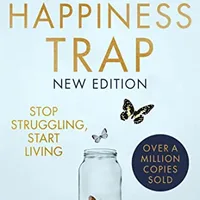
The Happiness Trap (2nd Edition) — Russ Harris
Rotter showed locus of control is a learned attribution style, not a fixed trait — Russ Harris's ACT toolkit teaches the exact disputation skills that rewire it. The book most directly mirrors Seligman's intervention…
As an Amazon Associate, we earn from qualifying purchases — at no extra cost to you.
The Mechanism: How Helplessness Gets Learned
Martin Seligman's name has become synonymous with positive psychology. But his earlier work — the experiments he and Steven Maier ran beginning in 1967, examined again in a 50-year retrospective that confirmed the core findings — is what explains how the victim position becomes so psychologically durable that it survives even when conditions change.
In those original experiments, dogs exposed to inescapable electric shocks stopped trying to escape. When later given the clear ability to avoid the shocks by jumping a simple barrier, most of them didn't try. They lay down and waited. They had learned that their responses didn't affect their outcomes — and that learning generalized, even into situations where it was factually wrong.
The human equivalent is quieter but just as stubborn.
It's the person who sent out applications for months and heard nothing back, who now scrolls job listings without clicking because the experience of uncontrollability has calcified into the assumption that applying doesn't matter. It's the person who brought three ideas to three consecutive meetings that went nowhere, and who stopped contributing — not because they ran out of ideas, but because they concluded their input was disconnected from results.
The helplessness isn't learned from the adversity itself. It's learned from the subjective experience of uncontrollability — from repeatedly feeling that what you do doesn't shape what happens.
This is the mechanism behind the victim position. Not weakness. Not character flaw. A reasonable cognitive inference drawn from a specific sequence of painful experiences.
Which also means it can be unlearned. Specifically.
The Three Thought Habits That Keep the Story Stuck
Seligman's later work identified three dimensions along which learned helplessness tends to spread — what he called explanatory style. If you've felt genuinely stuck in a victim pattern, you'll probably recognize at least one of these in yourself.
Permanence — the interpretation that this is how it always will be. "Things never work out for me." "I always end up back here." The linguistic tells are the absolutes: always, never, forever. When a setback is explained as permanent, the motivation to respond collapses because response couldn't possibly matter across a permanent condition.
Pervasiveness — the interpretation that one failure is evidence of a global pattern. Lose one client and you're "bad at business." Have one difficult conversation and you're "bad with people." A single adverse event colonizes the entire self-concept, spreading from the specific incident into every adjacent domain.
Personalization — attributing what happened to who you are rather than what occurred. This one is the most psychologically damaging because it fuses circumstance with identity. You didn't make a poor decision; you are bad at decisions. The situation didn't go wrong; you are the kind of person for whom situations go wrong.
Seligman's intervention challenges each dimension directly. Not with positive thinking — with honest disputation. Is this actually permanent, or does it feel permanent right now? Is this truly pervasive, or is it specific to this situation? Is this really about who I am, or about what happened this time?
The shift from victim narrative to owner narrative often comes down to those three grammatical adjustments. They sound small. They aren't.

Clever Fox Habit Calendar Circle (2-Year Habit Tracker)
Seligman's disputation of permanence and pervasiveness works best when written and tracked, not just thought — a visible record of small repeatable wins is the raw material of a new explanatory style.
As an Amazon Associate, we earn from qualifying purchases — at no extra cost to you.
What Viktor Frankl Got Right That Most People Miss
Viktor Frankl survived Auschwitz and Dachau. He lost his wife, his parents, his brother. He had no meaningful control over the material conditions of his existence for years.
And yet his central insight — developed during those years and articulated in Man's Search for Meaning — was precise: everything can be taken from a man but one thing: the last of the human freedoms — to choose one's attitude in any given set of circumstances, to choose one's own way.
This isn't an inspirational poster. It's a philosophical precision.
The ownership mindset doesn't require that circumstances be controllable. Frankl's weren't. It doesn't require that life be fair. His wasn't. It requires only the recognition that the response to circumstances contains a degree of choice — however constrained — that is always, in some measure, yours to exercise.
This is where a lot of ownership content gets the argument badly wrong: it implies that if you're in the victim position, you're somehow lazy or weak. Frankl's contribution is to establish that ownership is available across the full spectrum of human experience — not because everything is within your power, but because your response always involves a choice, even when that choice is only about how you orient yourself internally to what's happening externally.
The person who loses a job through restructuring has no ownership over the decision. They have full ownership over what they do with the following six months.
Responsibility Is Not the Same Thing as Blame
Here's the sticking point that makes the ownership mindset genuinely hard to adopt: it sounds, on first hearing, like you're being asked to blame yourself for everything.
You're not. And that distinction matters enormously.
Blame is retrospective and punitive. It assigns fault for something that already happened. Responsibility is forward-facing and agentic — it identifies what you can do about what comes next. You can take full responsibility for your response to a situation while holding zero blame for the situation itself.
This nuance is non-negotiable for people who've experienced genuine injustice, real systemic disadvantage, or circumstances where external forces were genuinely the primary cause. Demanding ownership without acknowledging this is both insulting and unhelpful. The question the ownership mindset asks is never who caused this? It's: given that this happened, what lies within my sphere of influence right now?
Marcus Aurelius — Roman emperor, Stoic philosopher, managing plagues and political instability — returned to this question almost daily in the Meditations. Not because he had nothing to complain about, but because he recognized that directing cognitive energy toward what he couldn't control was a form of waste he couldn't afford.
Bob Proctor used to say: "You're either living in the problem or you're living in the answer." It's pithy enough to dismiss. But the research confirms it: owners and victims often face identical circumstances and allocate their attention to entirely different aspects of them. One group analyzes causes. The other generates options.
Both are rational. Only one has leverage.

How to Start Today
The shift from victim to owner isn't a decision you make once and store. It's a practice — a daily reconditioning of explanatory habits that have formed over years. Here's what the research actually supports, in order of impact.
1. Run the responsibility inventory. Not as a punishment — as an honest map. Pick one area where you feel stuck and write (not think, write) your answers to these three questions: Where am I treating this situation as permanent when it might not be? Where am I allowing this setback to contaminate my entire self-concept? Where do I have more room to move than I'm currently using? Writing activates a different level of cognitive processing than the mental complaint loop.
2. Dispute the absolutes. Every time you catch yourself using "always," "never," or "everyone," treat it as a hypothesis rather than a fact. Seligman's research shows that challenging permanence and pervasiveness attributions is one of the most reliably effective interventions against learned helplessness. This doesn't require a therapist. It requires the habit of asking: is this actually true at this scale, or does it feel true right now?
3. Define your sphere — then stay in it. Draw two circles on a page. The outer circle contains everything that concerns you. The inner circle contains what you can actually influence this week. Your task is to spend the majority of your thinking time inside the inner circle. The outer one doesn't ignore itself because you stop analyzing it — but it also doesn't respond to your attention the way the inner one does.
4. Build controllability deliberately. The antidote to learned helplessness isn't positive self-talk. It's the actual, repeated experience of controllability — the recurring discovery that your actions produce the outcomes you intended. Exercise is the most reliable starting point: effort → measurable result, compressible into thirty minutes. The experience of agency in any domain begins to generalize. Small wins of ownership aren't consolation prizes. They're the raw material of a new explanatory style.
5. Read for reorganization, not information. The books that make this shift durable aren't the ones you skim for takeaways. They're the ones you sit with long enough for them to reorganize how you think about the problem. The ownership mindset isn't a concept you understand intellectually and then apply — it's a way of orienting that has to be practiced until it becomes the default explanation your brain reaches for first.

Kindle Paperwhite (2024, 12th Gen, 16GB)
The closing CTA — 'read for reorganization, not information' — is about sitting with a book long enough to change how you think. The high-ticket anchor of the set and a frictionless way to make that reading habit dura…
As an Amazon Associate, we earn from qualifying purchases — at no extra cost to you.
The Inventory No One Wants to Take
Jim Rohn used to say that you can't change the seasons, but you can change yourself. He meant it warmly — life has conditions you didn't choose and can't reverse. But the second clause was always the operative one.
The victim position is psychologically comfortable in the short term precisely because it relieves you of the discomfort of agency. If circumstances are the cause, then circumstances need to change, and you can wait — feeling fully justified. The owner position is uncomfortable because it asks you to find leverage points inside situations you didn't choose, with no guarantee the leverage will work, and then to use them anyway.
That's the inventory no one volunteers for: not what has happened to me? but where am I allowing circumstances to determine my choices when, if I'm genuinely honest, I have more room to move than I'm using?
The answer is never zero.
And wherever you find it — that's where your evolution is currently waiting.
Designing your story doesn't mean rewriting what happened. It means deciding who the author is going forward.
What's one area of your life where you've been narrating circumstances when you could be writing a response? Name it in the comments — the act of saying it out loud changes its relationship to your thinking.
Related read: Locus of Control: How Rotter's Research Explains Coping
Was this helpful?