Mindset· 11 min read
Victim to Owner: Take Back Control of Your Story
Locus of control research reveals why victim thinking feels accurate — and how to shift to ownership in 5 concrete steps. Backed by Rotter, Seligman & Frankl.
The Victim-Owner Switch: How to Stop Letting Circumstances Write Your Story
My friend Marcus spent three years convinced his career was stuck because his company didn't value people like him.
He might have been right. But nothing changed at the next company either. Or the one after that. Three jobs in four years — different bosses, different colleagues, same pattern, same outcome, same explanation. The circumstances kept shifting. The story never did.
Psychologists have a name for the belief system underneath that repeating story: external locus of control. The consistent conviction that your outcomes are primarily shaped by forces outside you — luck, circumstance, other people's decisions. And six decades of research suggest it may be the single most consequential psychological variable most people have never paused to examine.
The morning Marcus finally asked — not as self-punishment, but as genuine inquiry — "what if the common denominator here is me?" was the morning everything began to change. Not his situation. Him.
That question is one of the hardest a person can ask. It is also, according to that same research, one of the most consequential.

The 1966 Research That Predicted Your Life Outcomes
In 1966, a psychologist at the University of Connecticut named Julian Rotter published a landmark paper formally introducing a concept that may be the single most powerful predictor of life outcomes most people have never heard named.
He called it locus of control.
The idea is deceptively simple. Some people consistently believe their outcomes — their successes, failures, health, relationships, financial position — are primarily determined by their own choices, effort, and decisions. Others consistently believe those outcomes are primarily shaped by luck, circumstance, powerful others, or forces beyond their control. Rotter called the first group "internal" and the second group "external."
Over sixty subsequent years of research spanning dozens of cultures and hundreds of thousands of participants confirmed what Rotter's early studies suggested: locus of control predicts academic achievement, career advancement, health behavior adherence, relationship quality, and reported wellbeing with remarkable consistency. Not perfectly — life is far too complicated for that — but persistently enough that when researchers need a single psychological variable to explain a large variance in life outcomes, this is often the one they reach for.
Here's the part most people miss, though. Rotter explicitly argued that locus of control is not a personality trait you're born with. It is a learned attribution style. A habitual pattern of explaining causes and effects that develops through experience — and can be deliberately revised.
You weren't handed an internal or external locus of control at birth. You learned one. Which means you can learn the other.
how self-limiting beliefs lock in external attribution patterns
How Victim Thinking Gets Wired In (It's Not a Character Flaw)
This is where the research becomes simultaneously uncomfortable and genuinely useful.
In 1967, Martin Seligman and Steven Maier published one of the most influential experiments in psychology's history. They exposed dogs to electric shocks in three conditions. One group could stop the shocks by pressing a lever. Another received identical shocks with no means of escape. A third received no shocks at all.
Then all three groups were placed in a new environment — a simple shuttle box where any dog could easily escape by jumping a low barrier.
The dogs that had previously controlled their shocks figured it out immediately. The shock-free dogs figured it out too. But the dogs that had experienced uncontrollable shocks? They lay down. They didn't explore, didn't test the barrier, didn't try. They had learned — through repeated experience — that their actions had no reliable effect on their outcomes. So they stopped acting.
Seligman called this "learned helplessness."
Learned Optimism — Martin E. P. Seligman
The book where Seligman lays out both the learned-helplessness research and the full cognitive-retraining protocol to reverse it — the direct source behind the article's core argument.
As an Amazon Associate, we earn from qualifying purchases — at no extra cost to you.
The human version of this pattern emerges from genuinely painful experience: the child whose best efforts to connect with a parent are met with random reward or punishment; the employee whose quality of work bears no relationship to recognition or promotion; the person whose relationships collapse despite real attempts at care. The organism learns from what happens to it — and sometimes what it learns is that trying doesn't reliably help.
That's the part worth sitting with: the person playing the victim role isn't necessarily weak-willed or lazy or morally deficient. They may have simply experienced enough uncontrollable adversity in a specific domain that they stopped generating options. They stopped noticing the spaces where their choices still matter. The helplessness was learned from real experience — which means it can be unlearned through new experience. That is the biology. That is the hope.
The Three Dimensions That Turn Setbacks Into Identities
Seligman didn't stop at learned helplessness. His later work on explanatory style identified the three specific dimensions along which localized helplessness generalizes into a global worldview — the mechanism by which a specific bad experience becomes "my whole life."
The first dimension is permanence: "This will always be this way." A temporary setback hardens into a permanent verdict. The project fails and becomes "I'm the kind of person who fails at projects." The relationship ends and becomes "I'm someone who can't maintain connections." One data point gets assigned infinite duration.
The second is pervasiveness: "This affects everything about my life." A difficult quarter at work bleeds into self-assessments about creativity, relationships, physical vitality. A single domain's difficulty expands to occupy the whole landscape of identity.
The third is personalization: "This is who I am, not something that happened to me." The failure becomes identity. Not "I made a mistake in that situation" but "I am the kind of person who makes that mistake." The event becomes the self.
These three — permanent, pervasive, personal — are the cognitive architecture of the victim position. And Seligman's intervention directly challenges each one. He asks: Is this temporary rather than permanent? Is it specific rather than pervasive? Is it behavioral rather than identity-defining? Those three questions, asked consistently about every significant setback, interrupt the generalization process before it calcifies.
Mindset: The New Psychology of Success — Carol Dweck
Growth-mindset research that directly counters the permanence and personalization dimensions sustaining learned helplessness.
As an Amazon Associate, we earn from qualifying purchases — at no extra cost to you.
how to challenge automatic negative thoughts using cognitive reframing
Viktor Frankl and the Last Freedom No One Can Take
Here's where the psychological framework meets something harder to measure but impossible to ignore.
Viktor Frankl was an Austrian psychiatrist who survived three years in Nazi concentration camps, including Auschwitz. What he observed in himself and in the people around him defied the simple stimulus-response model of human behavior.
Some people, in conditions of absolute powerlessness — where external locus of control would seem not just rational but accurate — still found ways to choose their response. They shared the last of their food. They maintained human dignity in systematically undignified circumstances. They chose their attitude toward what they couldn't choose to avoid.
Frankl built his entire system of logotherapy on a single foundational observation: that between any stimulus and a human being's response lies a space, and that the capacity to inhabit that space — to choose how to respond rather than react automatically — is what distinguishes human beings from conditioned animals. He called this the "last of human freedoms," one that no external force could take away.

Man's Search for Meaning — Viktor E. Frankl
The most powerful existential argument for human agency ever written — the 'last freedom' passage the article quotes directly.
As an Amazon Associate, we earn from qualifying purchases — at no extra cost to you.
That's not spiritual language dressed up as psychology. It's a precise phenomenological observation with radical practical implications. In every situation — including genuinely constrained, genuinely unjust ones — there is some range, however narrow, over which the response is a choice. The consistent exercise of that choice, however small, is what reconstructs the person making it over time.
Marcus didn't need his company to become fair. He didn't need his bosses to change. He needed to expand his range of perceived options within his actual circumstances — and then start taking them, one by one, until his experience of himself as an agent rebuilt itself through the evidence of his own choices.
The Steward Mindset: What Ownership Actually Looks Like
The ownership mindset gets misrepresented in popular culture as something punitive — a way of blaming yourself, shouldering guilt, treating every failure as a personal indictment. That's not ownership. That's just relocating the victim position inward.
Genuine ownership looks more like what former Navy SEAL commanders Jocko Willink and Leif Babin describe in Extreme Ownership: the habitual orientation of someone who asks, when something goes wrong, "what could I have done differently?" — not because they're responsible for every variable in a complex situation, but because that question is the only one that produces useful information.
The victim question is: Why did this happen to me?
The owner question is: What can I do with what I've got right now?
Both questions can coexist with an honest assessment of injustice. The owner isn't blind to unfairness. They simply refuse to let unfairness become the explanation that terminates inquiry — because the explanation that terminates inquiry terminates options along with it.
Extreme Ownership — Jocko Willink & Leif Babin
The military-grade ownership framework — the source of the article's 'what could I have done differently?' owner question.
As an Amazon Associate, we earn from qualifying purchases — at no extra cost to you.
Ryan Holiday's distillation of Stoic philosophy adds the strategic layer: the obstacle itself — the injustice, the failure, the constraint — can be made to serve the objective. Not by pretending it isn't there, but by treating it as raw material for development rather than as the final word on what's possible.
Marcus eventually did stay at a company for five years. Same kind of imperfect culture, same kind of difficult dynamics. What changed is that he stopped waiting for the environment to become supportive before he started performing. He started treating every difficult working relationship as a problem to understand rather than an injustice to endure. The career moved — not because the circumstances improved, but because his orientation to the circumstances did.
How to Start Today: Five Practices That Actually Rebuild Agency
The shift from victim to owner isn't a one-time realization. It's a daily discipline — the repeated choosing of the owner question over the victim question until it becomes the automatic default. Here is what that practice looks like in concrete terms.
1. Run the attribution audit. Take the situation that feels most stuck in your life right now. Write down every factor contributing to it. Then circle the factors where you have even partial influence. If anything is circled — and it almost always is — those are your starting points. Not because the uncircled factors don't exist, but because only the circled ones give you traction.
2. Challenge the three dimensions. For each significant setback you're carrying, ask three questions in sequence: Is this permanent, or is it temporary and potentially changeable? Is this pervasive (touching everything), or is it specific to one domain? Is it a statement about your identity ("I am"), or about a behavior ("I did that, in that context")? These questions don't require optimism. They require accuracy.
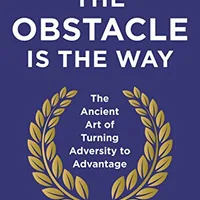
The Obstacle Is the Way — Ryan Holiday
The Stoic framework for converting adversity into fuel — the strategic layer the article adds to the ownership mindset.
As an Amazon Associate, we earn from qualifying purchases — at no extra cost to you.
3. Find the smallest controllable variable. You don't need to control an entire situation to reclaim agency. Locus of control research consistently shows that small, genuine experiences of efficacy — moments where your action reliably produced an intended outcome — rebuild the sense of agency that learned helplessness eroded. Find one thing you can influence and do it. Repeatedly. The psychological rebuilding follows from the behavioral evidence.
4. Track your explanatory style for one week. When something goes wrong, notice the automatic explanation before you evaluate or edit it. Permanent or temporary? Pervasive or specific? Identity or behavior? The goal isn't to manufacture positive thinking. It's to interrupt attribution patterns that have been running automatically, without your conscious participation, for years. You can't change what you haven't noticed.
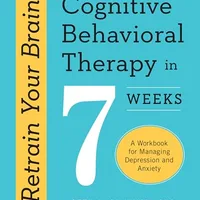
Retrain Your Brain: Cognitive Behavioral Therapy in 7 Weeks — Seth J. Gillihan
A practical CBT workbook with weekly worksheets — fits the article's 'track your explanatory style for one week' agency-audit practice.
As an Amazon Associate, we earn from qualifying purchases — at no extra cost to you.
5. Read the science, not just the maxims. The ownership mindset is sometimes presented as an attitude — something you decide to adopt through sheer will. But it's a trainable cognitive skill with decades of research behind it. Understanding why the practices work makes them easier to deploy when circumstances make them feel hardest — because when the victim position feels most like accuracy is exactly when the tools matter most.

Design Your Evolution, Not Your Excuses
Here's the counterintuitive truth that all of this research converges on: the victim position doesn't feel like victimhood. It feels like accuracy. Like an honest read of a genuinely difficult situation.
And that is precisely what makes it so effective at keeping people stuck.
Julian Rotter spent his career demonstrating that the belief "my outcomes are primarily determined by forces outside my control" tends to produce exactly the evidence it predicts — not because the belief is necessarily wrong about any given external factor (plenty of external factors genuinely exist), but because it shapes which behaviors get initiated, which options get noticed, and which actions get attempted in response to those factors. The belief becomes self-confirming at the behavioral level.
The ownership mindset doesn't ask you to deny reality. It asks you to expand your definition of reality to include the variable you can influence most directly: your response to what's happening.
Seligman's dogs didn't fail to jump the barrier because they had forgotten how to jump. They didn't jump because their learning told them jumping wouldn't help. The moment someone helped one of them experience that jumping did help — that their action reliably produced a different outcome — the behavioral change followed immediately.
You don't need a near-death experience or a spiritual awakening to make the switch Marcus made. You need enough evidence, gathered through enough small chosen actions, that your choices actually matter.
Viktor Frankl, writing from inside Auschwitz, put it in terms no one has matched in the decades since: "When we are no longer able to change a situation, we are challenged to change ourselves."
That's what designing your evolution means. Not changing the world first, then living in it differently. Changing the person navigating the world — and watching what that person is capable of building.
What's the story you've been telling about why your life looks the way it does — and what would you start doing differently tomorrow if you decided that story wasn't the final draft?
how to build personal agency through consistent daily routines and habit design
Was this helpful?