Mindset· 9 min read
Why Your Day Runs on Autopilot — The Real Science
Bargh and Chartrand's research found much of daily behavior happens automatically, without conscious choice. Here's the real science — not the hype.

Why Most of Your Day Runs on Autopilot (And What the Science Actually Says)
Here's a question worth sitting with. Yesterday morning, how many of your first hour's decisions do you actually remember making? The phone picked up before your eyes fully focused. The coffee started before the mental fog cleared. You scrolled something — news, social media, messages — without ever consciously deciding to reach for the screen. That's not a character flaw. But it is exactly what John Bargh and Tanya Chartrand were measuring when they published one of psychology's most quietly unsettling papers.
Their 1999 paper was called "The Unbearable Automaticity of Being." The title alone deserves a moment. Not "some habits, once formed." Not "routine behaviors when tired." They were describing the broad, ordinary, unremarkable reality of how human minds work across every single day — and what they found was that how much of daily behavior actually happens automatically, without conscious choice, is significantly larger than almost anyone wants to accept.

The "95% Subconscious" Claim Is Worth Unpacking
You've probably heard the number. Ninety-five percent. The claim that ninety-five percent of your daily life runs on subconscious programs — often attached to hypnotherapy content, manifestation frameworks, or personal development coaches working a particular angle. The problem isn't that it's entirely wrong. The problem is that it comes from informal estimates rather than controlled experimental research. And when you swap it for what Bargh and Chartrand actually measured, the story gets more useful, not less interesting.
What automaticity actually means: Automaticity refers to the capacity of learned behaviors and perceptual processes to operate without conscious intention, attention, or control. In Bargh and Chartrand's framework, this unfolds across three specific domains — perception, evaluation, and goal pursuit — each running faster than deliberate thought and triggered by environmental cues rather than voluntary decision-making. It's not a shadowy percentage of a hidden mind. It's a set of specific, testable mechanisms.
Their paper wasn't a single experiment. It was a synthesis of decades of accumulated laboratory evidence across multiple domains of psychology, arguing a specific and testable claim: that perception, evaluation, emotion, and goal pursuit routinely run without deliberate conscious initiation, triggered directly by features of the environment rather than by an active, voluntary decision each time. The research didn't describe a shadowy percentage of a hidden mind. It identified specific, replicated conditions under which automatic processing measurably overrides what you'd choose if you were paying full attention.
That distinction matters. Because it tells you exactly where to look.
Where Bargh and Chartrand's work pointed — and this is the part that genuinely changes things — is at your environment. Not your willpower. Not your intentions. The room you're in, the objects within reach, the sequences that repeat across your days: these are what activate your automatic behavior before conscious deliberation ever gets a chance to weigh in.
The Experiment That Stopped People in Their Tracks
One of the most famous demonstrations from this body of research is almost absurdly simple in design. Participants were asked to complete a word-scramble task. For one group, the scrambled words included terms associated with the elderly — words like "Florida," "bingo," "wrinkled," "ancient." For the control group, the words were neutral. After completing the task, each participant was thanked and told the study was over. The real measurement began when they walked down the hallway to leave.
The participants primed with elderly-associated words walked measurably more slowly.
They hadn't been told to walk slowly. They hadn't consciously connected the word-scramble to anything about walking. But their behavior had shifted — automatically, outside awareness — because a cue in the environment had activated a concept that shaped their subsequent action without a deliberate decision being made. This is behavioral priming. Not magic. Not a trick. The mechanism the original researchers proposed for how the mind takes a shortcut based on recent environmental input. Worth noting: this specific finding (from a 1996 Bargh, Chen, and Burrows study that fed into the 1999 synthesis) became one of the most scrutinized results in the "replication crisis" debates of the 2010s — later attempts to reproduce it were mixed. The broader automaticity research program has held up well across many other paradigms, but this particular walking-speed demonstration is best treated as a famous illustration of the idea rather than settled, uncontested proof.
The uncomfortable part: when participants were asked afterward if the word task had influenced their walking, they said no. And they weren't lying. They genuinely didn't know. The automaticity happened below the level at which they could report on it.
You're not always the narrator of your own behavior. Sometimes you're the audience, constructing the story after the fact.
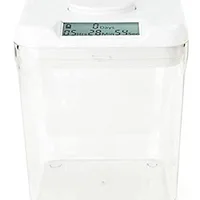
Kitchen Safe kSafe Time Locking Container (Medium, White Lid + Clear Base)
Slot sits directly after the priming experiment and the line 'You're not always the narrator of your own behavior.' The kSafe is the purest physical expression of the article's argument: it does not require willpower,…
As an Amazon Associate, we earn from qualifying purchases — at no extra cost to you.
Three Things Your Brain Does Before You've "Decided" Anything
Bargh and Chartrand's synthesis pointed to three specific types of automatic processing that operate in ordinary daily life — not just in contrived lab settings.
Automatic perception is the most immediate. Before you consciously evaluate a person, a situation, or an object, your perceptual system has already tagged it with meaning. Walk into a cluttered room and your stress response may begin before you've formed a single thought about clutter. Hear a name in a meeting and your prior associations with that person activate instantly, quietly coloring what you're about to hear from them. You didn't decide to have these initial responses. They arrived.
Automatic evaluation follows directly. Research on what's sometimes called the "affective priming" effect found that exposure to a positive or negative stimulus shifts how you subsequently evaluate an unrelated target — again, without awareness. The warm smile on a colleague's face before they share a mediocre idea makes the idea seem better than it would have a moment before. The cluttered desk that signals "chaos" shifts how you process the proposal sitting on top of it. These aren't irrational quirks. They're the mind processing efficiently at a speed deliberate thought simply can't match.
Automatic goal pursuit is the most significant finding for anyone interested in behavior change. Bargh and colleagues demonstrated that goals themselves — not just habits, but the underlying motivational states that drive behavior toward a specific outcome — can be activated by environmental cues and pursued automatically, without a conscious decision to pursue them. Exposure to a high-achiever's photo in a waiting room measurably increased subsequent performance on a task. Being around people who strongly valued a particular kind of social belonging shifted participants' behavior toward that goal, without any deliberate adoption of it.
Sit with that implication for a moment. You may be pursuing goals right now that you didn't consciously choose this morning. You absorbed them from something in your environment — a context, a social cue, a pattern that repeats — and your behavior is moving toward them anyway.
Stop Blaming Yourself — Redesign the System Instead
Why the Consciousness Illusion Is So Convincing
Here's what makes this research genuinely uncomfortable. The reason most people resist it isn't stubbornness. It's that the experience of being conscious is deeply convincing. You feel like you're deciding things. You have an inner monologue. You reason, you deliberate, you weigh options. None of that is false — it's just not the whole picture.
Neuroscientist Benjamin Libet's classic 1983 experiments found that detectable brain activity signaling a voluntary movement began several hundred milliseconds before participants reported consciously deciding to move. The decision arrived in awareness after the neural machinery had already set it in motion. Bargh and Chartrand's work extends that principle far beyond simple physical movements into the full sweep of everyday social, evaluative, and motivational behavior.
Your deliberate processing is real. It's also slower than you think, and it operates on a landscape that automatic processing has already partially shaped before you get there.
Here's the counterintuitive part — the one most self-improvement frameworks get exactly backward. Conscious effort is a limited and expensive resource. A functioning mind sensibly offloads everything it can onto automatic processing to preserve that resource for situations that genuinely need it. Automaticity isn't a bug. It's what allows you to function at all.
The problem is that your automatic processes are running on the environmental cues you've already accumulated — not the ones you'd deliberately choose if you were designing from scratch. And that distinction is where all the leverage is.

Philips SmartSleep Wake-Up Light HF3520 (Coloured Sunrise Simulation, 5 Natural Sounds, FM Radio)
Follows the Libet section and the line 'automatic processing has already partially shaped the landscape before you get there.' The article opens on an unconscious morning — phone picked up before the eyes focus. A sun…
As an Amazon Associate, we earn from qualifying purchases — at no extra cost to you.
Your Environment Is Already Choosing for You
If automaticity is driven by environmental cues, then the most effective thing you can do isn't to try harder to be deliberate. It's to redesign the environment that's triggering your automatic behavior in the first place. This is what nudge theory — formalized by behavioral economists Richard Thaler and Cass Sunstein in their book Nudge — translated from Bargh and Chartrand's research into practical application.
A water bottle on your desk gets picked up automatically. A phone face-up on your desk gets checked automatically. The book sitting beside your coffee maker gets opened in those two idle minutes while the brew finishes. The running shoes placed beside the bed get noticed first thing. These aren't tricks. They're deliberate cue placements that leverage the same mechanism the research documented — environmental exposure triggering automatic behavior — but in a direction you've chosen in advance rather than accumulated by accident.
The difference between an environment you've designed and one you've simply drifted into is the difference between your automatic behavior serving your goals and quietly competing with them. Most people have never audited their environment for this. They've arranged their spaces for convenience or aesthetics or inertia, without ever asking what behavioral sequence each object, placement, or daily sequence is automatically priming.
This isn't abstract. Walk through any room you spend significant time in and ask a single question for each object you can see: what does encountering this trigger me to do? You'll notice patterns. Some of them you chose. Many of them you didn't.
How to Build a Morning Routine That Actually Sticks
How to Start Today
You don't need to rebuild your life to work with this research. You need to do four things, and none of them require unusual willpower.
First, run a cue audit. Spend ten minutes walking through your most-used spaces and asking what each element primes. Phone on the nightstand: primes checking before sleep and immediately on waking. Snack bowl on the counter: primes eating without hunger. Open browser tabs left from yesterday: prime context-switching before you've started your own work. You're not judging these — you're mapping them. You can't redesign what you haven't seen.
Second, remove or relocate two things that trigger behavior you don't want. Not all of them. Two. The research doesn't require dramatic overhauls. It suggests that a single cue removal or replacement is often enough to disrupt an automatic sequence that's been running on context rather than intention. The phone moved to another room doesn't require willpower not to check it. It just requires the initial decision to move it.
Third, place one deliberate cue for a behavior you actually want to trigger. Make it visible, specific, and positioned close to the moment you want the behavior to occur. The walking speed experiment didn't require hours of exposure — a brief, clear cue was enough to shift behavior. Your journal on the kitchen table, your workout clothes set out the night before, your reading glasses placed on top of the book you're working through: each is an environmental instruction to your automatic processing, issued in advance.
Fourth, schedule your hardest decisions before your environment has accumulated a full day's worth of competing primes. Every hour you spend in an environment, the automatic processes it's activating build a kind of behavioral gravity. Your sense of identity, your energy level, your available attention — all of it gets quietly shaped by what your environment has been priming since you woke up.

Clever Fox Habit Calendar Circle (24-Month Habit Tracker, Dark Blue & Red)
Sits in 'How to Start Today', beside step one — the cue audit. The article insists 'You can't redesign what you haven't seen' and 'you're not judging these, you're mapping them.' A tracker is the mapping instrument fo…
As an Amazon Associate, we earn from qualifying purchases — at no extra cost to you.
Atomic Habits — James Clear (Paperback)
Closing slot. Clear's environment-design chapters ('make it obvious', 'design your environment') are the popular-press continuation of exactly the Bargh/Chartrand cue mechanism the article dissects. Natural next-read…
As an Amazon Associate, we earn from qualifying purchases — at no extra cost to you.
Decision Fatigue: Why Your Morning Wrecks Deep Work
The Design You Didn't Know You Were Making
Here's what Bargh and Chartrand's research quietly forces on anyone who takes it seriously. You've been designing your environment your whole life. You've arranged your spaces, built your routines, established the sequences of your days. The only real question is whether you did it deliberately or by default.
Designing your evolution doesn't mean escaping automaticity. That's neither possible nor desirable — automatic processing is what allows you to function at all, to drive and talk and cook and navigate a conversation without burning out by noon. It means accepting that a significant share of your daily perception, evaluation, and behavior is already being shaped by your environment, and then asking whether the environment you have is the one you'd build if you were choosing consciously.
Most people haven't asked that question. They're running on cues they accumulated rather than selected. The research doesn't make that a character flaw. It makes it a design problem.
And design problems have solutions.
What's one object in your environment right now that's triggering a behavior you haven't consciously chosen — and what would happen if you moved it?
References: John A. Bargh and Tanya L. Chartrand, "The Unbearable Automaticity of Being," American Psychologist, 54(7), 1999, pp. 462–479. Benjamin Libet, Curtis A. Gleason, Elwood W. Wright, and Dennis K. Pearl, "Time of Conscious Intention to Act in Relation to Onset of Cerebral Activity," Brain, 106(3), 1983, pp. 623–642. Richard H. Thaler and Cass R. Sunstein, Nudge: Improving Decisions About Health, Wealth, and Happiness, Yale University Press, 2008.
→ You Know the AI Is Wrong. You'll Do What It Says Anyway.
Related read: Why Unpredictable Rewards Build Stronger Habits
Was this helpful?