Mindset· 12 min read
Can You Change Your Personality on Purpose?

Can You Change Your Personality on Purpose?
There's a sentence people reach for when they've stopped fighting something about themselves: "That's just who I am."
You've probably said it. About being disorganised, or anxious before difficult conversations, or terrible at finishing what you start. It sounds like self-awareness — the mature acceptance of limits. But a quieter reading of it is closer to resignation. It carries an assumption that personality is a fixed fact, handed down at birth like eye colour, and the sensible strategy is to work around it rather than through it.
The science doesn't agree. Not with the confidence of a TED talk, but carefully, in longitudinal data and controlled experiments collected over two decades. And what it says is specific enough to be useful: yes, you can change personality traits on purpose. The effect is real, it's moderate, and the mechanism is simpler than most people expect.
The Stable-Personality Idea Is Only Half True
The belief that adult personality doesn't change has a long pedigree. Gordon Allport was mapping traits in the 1930s, and decades of longitudinal research confirmed something real: your rank order among peers on core traits tends to stay stable. If you're more conscientious than most people around you at 25, you'll probably still be more conscientious than most of them at 55.
But rank-order stability isn't the same as absolute stability. And absolute levels do shift.
The Big Five — openness, conscientiousness, extraversion, agreeableness and neuroticism — have all been shown to change gradually across adulthood. People on average become more conscientious and agreeable as they age, and somewhat less neurotic. The effect is slow, like a river changing course: no single day looks dramatic, but the channel shifts. And it happens even when nobody is trying. The drift suggests plasticity. Drift, though, isn't the same as design.
What happens when people stop waiting for that natural drift and try to steer it themselves? That's the question psychologists Nathan Hudson and R. Chris Fraley set out to answer.
What the Evidence Shows About Deliberate Change
Hudson and Fraley's 2015 study, published in the Journal of Personality and Social Psychology, followed 135 undergraduates. Participants first said which personality traits they wanted to change, then retook personality measures every week for 16 weeks.
People who started with a goal to increase a Big Five trait tended to report actual increases in that trait, along with more trait-relevant daily behaviour. The study also tested two randomised interventions. One didn't work. The other, which trained participants to form implementation intentions (specific "if-then" plans), helped them achieve trait change.
The caveats matter. The measures were self-reports, with no observer ratings or behavioural tests, and it's unclear how long the changes last or whether the goals themselves caused them.
The mechanism the researchers proposed is clarifying. Traits are statistical summaries of behaviour patterns. If you consistently behave in more conscientious ways — arriving prepared, following through on commitments, planning before acting — your conscientiousness score eventually rises to reflect that average. The trait isn't the cause of the behaviour. It's the ledger of it.
You can't reach into your personality and adjust it directly. You can adjust what you do repeatedly, and the personality follows.
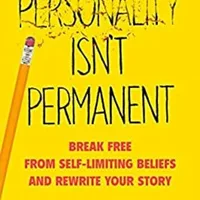
Personality Isn't Permanent — Benjamin Hardy (Paperback)
As an Amazon Associate, we earn from qualifying purchases — at no extra cost to you.
A Meta-Analysis That Put Numbers on the Effect
In 2017, Brent Roberts and colleagues published a meta-analysis in Psychological Bulletin covering 207 studies that tracked personality measures during interventions. The result: interventions, mostly therapeutic, produced measurable trait change, with a mean effect size of about d = 0.37 over an average intervention length of roughly 24 weeks. The changes held across experimental and non-experimental designs and persisted in follow-ups after treatment ended.
That's a clear, directional shift, not a transformation.
Some traits were more responsive than others. Emotional stability (the flip side of neuroticism) showed the largest change, followed by extraversion. Anxiety and emotional reactivity, in particular, seem to respond to targeted therapeutic work. Among clinical populations in the review, patients treated for anxiety disorders showed the largest gains; those treated for substance use disorders showed the least — a gap that points to how much the specific target of the intervention matters, not just its duration.
Longer interventions are plausibly more likely to show signal. A protocol you run for eight weeks has a better chance than one you abandon after eight days.
The caveats are also worth stating plainly. Much of this evidence is self-reported. Samples lean Western and college-educated. Observer-rated change — what the people around you actually notice — tends to be smaller than what you report about yourself. The change is real, and it's more moderate than popular accounts of personality transformation suggest. Set your expectations accordingly: you're running an experiment, not a surgery.

Kindle Paperwhite 2024 (12th Gen, 16GB)
As an Amazon Associate, we earn from qualifying purchases — at no extra cost to you.
Behaviour Is the Lever, Not Willpower
The practical implication here is easy to overlook, because it cuts against how most people think about changing themselves.
Personality change doesn't happen through affirmations, through deciding to be different, or through force of will alone. It happens through repeated behaviour that contradicts the old pattern, sustained long enough to shift the average the trait is built on. Notably, the one intervention in Hudson and Fraley's study that helped was the one that turned goals into concrete plans.
Intention tells you which trait to target; consistent behaviour is how you actually move it.
This reframes every question you might ask. "How do I become more open to experience?" is the wrong question — it points at a feeling you can't produce on command. The right question is: what is the smallest, most repeatable behaviour that an open person performs regularly? Reading outside your usual domain. Asking two genuine follow-up questions in every conversation. Attempting one skill you're currently bad at. That's your entry point — not the trait, which you can't access directly, but the behaviour the trait is made of.
Tracking matters more than most people anticipate. Without feedback, habits slide back to their resting state. With a record, you can see whether the behaviour is actually happening — and that visibility changes what you do.
behavioural design for better decisions

Clever Fox Habit Calendar Circle (24-Month)
As an Amazon Associate, we earn from qualifying purchases — at no extra cost to you.
The 8-Week Experiment
Four to eight weeks is a reasonable minimum to start seeing signal in your own data. Here's a structure built on what the research supports.
Week 1: Define the trait behaviourally. Don't write "I want to be more conscientious." Write three specific, countable behaviours instead: arrive prepared to every commitment, finish your priority task before opening messages, review tomorrow's plan before you sleep. Observable. Scoreable.
Weeks 2–5: Track the behaviours, not the feelings. Log each behaviour yes or no, each day. A journal, a habit-tracking app, a printed calendar with X marks — the medium is irrelevant. The record isn't. If you keep skipping the log, the problem usually isn't discipline; the behaviours are probably too complex or the logging takes too long. Simplify both.
Weeks 6–7: Add one social layer. Tell one person what you're working on and ask them at week seven whether they've noticed anything different. Observer-rated change tends to be smaller than self-reported change, but asking primes their attention and gives you a second data point. Even a neutral response tells you something.
Week 8: Run a comparison. Take a free Big Five assessment — the IPIP-NEO and the BFI are both publicly available and take about fifteen minutes — and compare your score on the target trait to a baseline you took at week one. Don't expect a dramatic number. Look for direction: a small shift in the right direction, paired with a consistent behaviour log, is a meaningful result.

Amazfit GTR 4 Smart Watch (46mm)
As an Amazon Associate, we earn from qualifying purchases — at no extra cost to you.
How to Start Today
You don't need the full eight-week protocol to begin. You need one decision before today ends.
- Choose one Big Five trait. Write a single sentence defining it as a behaviour — not a feeling, a behaviour.
- Identify the smallest daily action. The most repeatable thing a high scorer on that trait does, reduced to its simplest form.
- Set up a tracking system tonight. A notebook page, a habit app, a spreadsheet. The medium doesn't matter. The record does.
- Take a free baseline assessment now. The IPIP-NEO takes about fifteen minutes. Save the scores somewhere you'll find them in eight weeks.
Atomic Habits — James Clear (Paperback)
As an Amazon Associate, we earn from qualifying purchases — at no extra cost to you.
The research says the needle moves when you attach consistent behaviour to a clear target, over weeks, with feedback. Not guaranteed. Not effortless. But replicable enough to treat as a testable proposition rather than a wish.
Your Personality Is a Design Brief, Not a Verdict
"Design Your Evolution" is not a metaphor here.
You were shaped by your history — by patterns that reinforced themselves, by environments that rewarded certain behaviours and punished others, by the accumulated weight of ten thousand small choices. And you're also being shaped, right now, by what you choose to do next.
The research gives you a specific margin to work with: real, moderate, directional. Most people never find out how much of their personality is negotiable because they treat it as given. The data says the question is worth testing.
Pick one trait. Write the behaviour. Start the log.
Eight weeks from now, you won't have a new personality. You'll have data — and data is how you move from hoping things will change to actively building the change in.
What's the one trait you'd most want to shift over the next eight weeks, and what behaviour are you planning to use? Drop it in the comments — I read every one.
Was this helpful?