Mindset· 10 min read
Why Who You're Around Actually Changes You
Behaviors spread through social networks three degrees out—to people you've never met. Christakis and Fowler's research on social contagion, explained.

Why Who You're Around Actually Changes You (The Science Is Darker Than You Think)
For three years, I was surrounded by people who complained constantly. About their jobs, their money, their health, the commute, the news. The specific content rotated, but the orientation stayed fixed — everything was something that was happening to them, never something they were choosing.
I didn't notice when I started doing it too.
That's the part nobody warns you about. It doesn't feel like influence. It feels like you've finally figured out how the world actually works.
Researchers call this social contagion — the spread of behaviors, attitudes, and emotional states through social networks, mostly without anyone noticing it's happening. The science of how far it actually reaches is more unsettling than any motivational speech will tell you.

The Study That Made Scientists Rethink Human Behavior
In 2007, Nicholas Christakis, a physician and sociologist at Harvard Medical School, and James Fowler, a political scientist then at the University of California, San Diego, published something unexpected in the New England Journal of Medicine. The paper was titled "The Spread of Obesity in a Large Social Network over 32 Years."
The title sounds narrow. The finding wasn't.
Christakis and Fowler had access to decades of detailed relational data from the Framingham Heart Study, a long-running cardiovascular project that tracked thousands of people in Massachusetts and meticulously documented not just their health outcomes, but their social ties — who knew whom, who named whom as a friend, how those relationships changed across time. That social-tie data gave them something most research never has: a real, granular map of who was actually connected to whom, tracked across thirty-two years.
What they found when they overlaid behavioral data onto that map is still discussed in research circles today.
A person's odds of a given outcome rose measurably not only when a close friend experienced it — it rose when a friend of a friend experienced it. And, this is the part that tends to go quiet in the room when you say it out loud, it rose measurably even when a friend of a friend of a friend experienced it. Someone the original person had almost certainly never met.
This wasn't a small signal lost in noise. It was statistically robust, and Christakis and Fowler went on to find the same three-degree pattern in follow-up studies of other behaviors — smoking cessation, happiness, and loneliness — using the same Framingham social-tie data. Christakis and Fowler named it the "three degrees of influence" rule, and it held consistently enough that the researchers proposed it as a general property of human social life — not a quirk specific to body weight or any single behavior.
Their 2009 book Connected laid out the full scope of this research program for a general audience. It remains one of the more useful and genuinely unsettling things you can read if you want to understand why your own behavior doesn't happen in a vacuum.
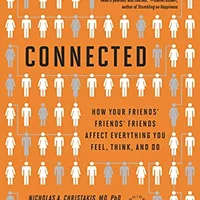
Connected: The Surprising Power of Our Social Networks — Christakis & Fowler
This is the book the article explicitly recommends as one of the more useful and genuinely unsettling things you can read. The reader has just absorbed the three-degrees finding and is told where the full research pro…
As an Amazon Associate, we earn from qualifying purchases — at no extra cost to you.
Three Degrees Out — Including People You've Never Met
The three-degree finding is the one that tends to rearrange how people think about personal change.
Most of us operate from a mental model that looks something like this: the people I consciously choose to spend time with directly influence me. Close friends, a partner, maybe a few colleagues. That model isn't wrong — it's just radically incomplete.
What Christakis and Fowler's data showed is that the influence doesn't stop at the edge of your direct relationships. It propagates outward, weakening predictably at each additional link until it fades out entirely beyond three degrees. But three degrees is, in most people's actual social networks, an enormous number of people.
Think about it practically. You have a friend — call her Sarah. Sarah has a friend you've never met — call him Marcus. Marcus has a friend neither you nor Sarah knows. Whatever is traveling through that chain — a shift in how much someone exercises, a change in drinking patterns, a growing pessimism about the future, or a new orientation toward getting up early — the data suggests a measurable portion of it reaches you.
Not through any direct message. Not through any conversation you'd recognize as influential. Through the quiet, ongoing process by which the network resets what feels normal at every link, until that reset arrives at you.
Related read: Why Your Day Runs on Autopilot — The Real Science
This is a fundamentally different picture of human behavior than the one most self-improvement frameworks are built on. The standard model treats behavior change as a decision made by an individual with sufficient motivation and the right information. Christakis and Fowler's data suggests the individual is downstream of a social current they can barely see — let alone fully control by deciding harder.
The Network Doesn't Just Reflect You — It Reshapes You
There's a predictable objection to all of this, and it's a fair one.
"Couldn't it just be that similar people cluster together? You and your overweight friends are overweight for the same reasons — shared neighborhood, shared food environment, shared circumstances — not because weight is actually spreading between you."
Christakis and Fowler anticipated this. They spent considerable methodological care distinguishing what researchers call "homophily" — the tendency to associate with people who already resemble you — from genuine social contagion, where the resemblance is caused by the connection rather than the other way around.
The way they separated the two was elegant. They used the directionality of the social ties in their Framingham data. If person A named person B as a friend, but person B didn't name person A back, the data captured that asymmetry. If genuine contagion was operating rather than mere clustering, the person named as a friend should have more influence on the person doing the naming than vice versa. That's exactly the pattern the data showed.

The mechanism Christakis and Fowler proposed is that social networks function as genuine conduits for behavioral norms, not passive maps of existing similarity. A shift in one person's behavior or expectations propagates through the specific ties connecting them to others — quietly resetting what feels acceptable or unremarkable to the people they're linked to, and then to the people those people are linked to.
Your social network, in other words, isn't a record of who you happen to know. It's an active system shaping what feels normal for you, most of the time without your awareness that it's doing it at all.
The Mutuality Asymmetry Nobody Mentions
Here's the detail from this research that gets left out of almost every summary you'll encounter.
The three-degree influence effect isn't uniform across all social ties. It showed a specific, actionable asymmetry: a person's behavior spread more strongly to people who considered them a mutual, reciprocated friend — someone who named them back — than to people who named them as a friend without reciprocation. The genuine closeness and mutuality of a tie determines how much influence actually flows through it. Not simply whether the tie exists on paper.
This has a real implication for how you think about your own environment. It's not simply a matter of who's physically near you, or who you see most often by circumstance. It's a matter of which relationships are genuinely reciprocated — the ones where influence travels in both directions and where the contagion effect is correspondingly stronger.
Most people, when they think about "who I'm around," picture their five or ten closest relationships. But they're rarely asking: which of these are the genuinely mutual ones? And what's currently spreading through those specific ties?
Lee Ross and Richard Nisbett's foundational The Person and the Situation does something complementary to Christakis and Fowler's work — it establishes, through decades of social psychology research, just how systematically most people underestimate the power of situational and social context to drive behavior, and overestimate the role of individual disposition and willpower. Together, these two bodies of work make the same uncomfortable case from different angles.
The Person and the Situation: Perspectives of Social Psychology — Ross & Nisbett
Named in the article as the complementary body of work to Christakis and Fowler — establishing how systematically people underestimate situational power and overestimate willpower. Directly reinforces the article's co…
As an Amazon Associate, we earn from qualifying purchases — at no extra cost to you.
Why "Just Have More Willpower" Keeps Missing the Point
Jim Rohn's line — "You are the average of the five people you spend the most time with" — has been quoted so many times it's gone numb. Most people file it under productivity advice: find more ambitious people, become more ambitious.
But the Christakis and Fowler data suggests Rohn was, if anything, understating the mechanism.
It's not five people. It's the entire extended network those five are embedded in. And the effect isn't motivational in the way we usually mean that word — it's structural. The network is quietly setting what feels like normal effort, normal ambition, normal rest, normal attitude, long before conscious motivation enters the picture.
This is part of why pure willpower-based approaches to behavior change have such poor long-term track records outside of highly controlled conditions. You can summon real short-term motivation and use it to force a new behavior. But if the surrounding social network is still quietly normalizing the old pattern — through the people you're around, through the people they're around — you're swimming against a current you can't fully see and can't out-muscle indefinitely.
The durable intervention isn't adding more motivation. It's changing what the network is normalizing.
Tony Robbins has made this point for decades in a less technical frame: proximity is power. What Christakis and Fowler's research did was give that intuition a measurable mechanism and extend it three degrees further than almost anyone expected.
Related read: Stop Blaming Yourself — Redesign the System Instead
How to Audit Your Own Social Network
This isn't about dramatic social surgery. It doesn't require ending friendships or making announcements. What it requires is honest attention to what your current network is actually normalizing for you — and whether that matches what you say you want your life to look like.
Here's a practical process that takes about an hour:
-
Map the mutual ties. Write down the ten people you interact with most across a typical week — not just the ones you'd call close, but everyone who shows up repeatedly. For each one, note whether the relationship is genuinely reciprocal or primarily runs one direction. The mutual ones are where the contagion runs strongest.
-
Note what each normalizes. For each mutual tie, honestly finish this sentence: "When I spend real time with this person, [specific behavior or attitude] feels more normal afterward." Don't evaluate it yet. Just observe it. Some of what surfaces will be clearly positive. Some will surprise you.
-
Look one degree further. Who are the key people in your closest connections' own circles? You won't always know, but you often have some sense. The Framingham data suggests the influence arriving from that ring is real, even when it's indirect. This step is less about taking action and more about being honest about what you're embedded in.
-
Identify one addition before one subtraction. The temptation after this kind of audit is to immediately start removing relationships. That's rarely the right first move, and it often isn't necessary. The more productive first step is usually identifying where to add exposure — a community, a group, a recurring context where the behaviors and norms you actually want to internalize are already running as the default. Let a new current start before you worry about the old one.
-
Apply the three-degree lens to any addition. The people you're gaining exposure to — who are they embedded with? One person's direct influence matters. But so does the broader network they're woven into and what that network normalizes. It's worth thinking one step further than the immediate relationship.

Clever Fox Habit Tracker Calendar (24-Month)
Lands immediately after the 5-step network audit. Steps 1-3 ask the reader to map ten people, note what each normalizes, and observe changes over time — that is literally a tracking exercise, and this is the cheapest…
As an Amazon Associate, we earn from qualifying purchases — at no extra cost to you.

The People You Haven't Met Are Already in the Room
The cleanest summary of what Christakis and Fowler found is this: you're not just influenced by the people you know. You're influenced by the people they know, and by the people those people know — three degrees out, weakening but real, through a web of social ties you've probably never thought to map.
That's not an argument for paranoia about who you associate with. It's an argument for taking the composition of your social environment at least as seriously as you take the individual habits and routines you're working to build.
Earl Nightingale put it plainly, in the recording that became known as The Strangest Secret: "You become what you think about." He was right. What Christakis and Fowler added was the research showing that what you think about is, to a measurable and surprising degree, downstream of what the people around you — and the people around them — are thinking about first.
Designing your evolution isn't just about choosing better morning routines or reading more useful books. It's about being honest about the social current you're swimming in, and whether it's quietly moving you toward the person you're trying to become, or quietly pulling you somewhere else.
Related read: How to Shed Your Old Identity and Become Someone New
The Framingham Heart Study ran for decades. The social-tie data it generated wasn't the point of the study — but it turned out to be some of the most revealing evidence ever collected about how human beings actually change.
What does an honest look at your own network reveal? And when's the last time you genuinely mapped it?
Was this helpful?