Mindset· 9 min read
Why Most Confidence Advice Fails — The Science That Works
Confidence is built from four specific sources — and most popular advice targets the weakest. Here's the psychology that actually works.

Why Most Confidence Advice Fails — The Science That Works
A few years ago, a colleague of mine — sharp, genuinely talented, the kind of person everyone in the room wanted on their team — told me she'd been working on her confidence for almost a year. Power poses before presentations. A "confidence playlist" she played on the commute. Mirror affirmations every morning, which she admitted felt increasingly hollow the more she did them. She'd read three books on the subject, watched the Amy Cuddy TED Talk twice, and still walked into every leadership meeting with the quiet, grinding certainty that she didn't belong there.
She wasn't failing because she lacked commitment. She was failing because every single technique she'd tried was targeting the wrong source of confidence — the weakest one, as it turns out — while the source that would have actually moved the needle stayed completely untouched.
This isn't her failure. It's a failure of how confidence is almost universally taught.
The Hierarchy Nobody Tells You About: How to Build Confidence and Self-Esteem From Scratch
In 1977, Stanford psychologist Albert Bandura published his theory of self-efficacy — your belief that you can execute a specific behavior well enough to produce a specific outcome in a specific domain. It is now considered the most practically useful framework in all of personality psychology.
That last phrase — in a specific domain — matters more than most people realize. Self-efficacy isn't global. It's a collection of domain-specific assessments, each built separately. You can have high self-efficacy as a writer and low self-efficacy as a public speaker. You can feel completely solid managing a team while doubting yourself intensely in one-on-one difficult conversations. These aren't contradictions of your personality. They're the predictable result of the precise mechanism through which confidence is constructed.
Bandura identified four sources of self-efficacy, and he ranked them. The ranking is the thing almost no popular confidence advice ever mentions — and ignoring it is why most advice fails.
Source 1: Mastery experiences. Actually succeeding at a genuinely challenging task in the target domain. This is the most powerful source by a significant margin, because it provides direct, personal, irrefutable evidence of capability. Your brain has a very hard time arguing with what your own hands have already done.
Source 2: Vicarious learning. Watching someone genuinely similar to yourself succeed. Not admiring an elite performer whose life looks nothing like yours, but observing someone close enough to your situation that your brain can run the computation: if they can, I probably can.
Source 3: Social persuasion. Specific, credible encouragement from someone whose judgment you respect. Note the precision required: vague praise ("you're great at this") barely registers. What actually lands is specific: "The way you handled that client objection last Tuesday — that's exactly the skill this role needs."
Source 4: Physiological and emotional states. Interpreting your pre-performance arousal as excitement rather than threat. Reframing a racing heart before a difficult conversation as readiness, not warning.
Here's the thing. Virtually every popular confidence technique — power poses, affirmations, self-talk scripts, visualization, "fake it till you make it" — operates exclusively at source four. The weakest source. The one with the smallest and most temporary effect size on actual confidence.
Meanwhile, source one — the only source that produces durable, evidence-based self-belief — requires doing the difficult thing in the domain that matters, repeatedly, before you feel ready to do it.

Clever Fox Habit Tracker Journal
If confidence follows evidence, you need a structured way to capture that evidence as it arrives — not a vague mental impression that fades by next week.
As an Amazon Associate, we earn from qualifying purchases — at no extra cost to you.
Why "Fake It Till You Make It" Works Exactly Once
I want to be precise here, because "fake it till you make it" does have a narrow legitimate application. When you're attempting something for the absolute first time and no personal evidence base yet exists, you genuinely need a borrowed belief to lower the activation energy enough to take the first action. You can't wait to feel confident before you begin, because beginning is the only way confidence gets created.
But that's the full extent of its usefulness.
Every time you walk into a difficult situation performing confidence — rather than building the competence that would make confidence warranted — you generate one of two outcomes. You succeed, and your brain attributes it to luck, circumstance, or the outfit. Or you stumble, and you add a data point to the "I knew I couldn't do this" file. Neither outcome compounds into anything resembling genuine self-belief.
There's also a deeper structural problem. Carol Dweck's growth mindset research reveals that people who frame ability as a fixed trait — which "fake it" implicitly reinforces, since you're performing the trait rather than developing it — are dramatically less likely to persist through the setbacks that mastery experiences inevitably require. Sustained effort through difficulty is only tolerable when you believe you're building something, not proving something you either have or don't.
The developmental frame — I'm accumulating evidence here, not demonstrating a fixed quality — is what makes the awkward middle stage survivable. And the awkward middle stage is where all real confidence is built.
The Mastery Experience Loop: How Confidence Actually Compounds
The insight that changed how I think about this: mastery experiences don't require perfection. They require doing something at a level just above your current comfortable ceiling — often enough that your brain accumulates evidence it can no longer honestly argue with.
The architecture looks like this.
You identify the precise domain where increased confidence would most change your trajectory. This has to be specific. "I want to be more confident" is too diffuse to design anything around. "I want to feel solid presenting my analysis in senior leadership meetings" or "I want to stop hedging every time I disagree with someone who has more authority than me" — those are domains you can actually build a practice around.
Then you design a graduated sequence of challenges in that domain, starting at the difficulty level just above your current comfortable ceiling. The graduation matters. Throwing yourself at the hardest available version of the challenge before you have any evidence base doesn't produce mastery — it produces overwhelm, and overwhelm confirms the low-confidence narrative rather than dismantling it.
Jia Jiang's "100 Days of Rejection Therapy" is the most vivid public illustration of this at work. Terrified of social rejection, he designed a 100-day experiment asking increasingly unlikely things of strangers — a burger refill at a restaurant, a "donut with Olympic rings" at Krispy Kreme, a role as a live mannequin at Abercrombie — and documented what happened each time. He didn't become fearless. He became evidence-rich: 100 documented data points demonstrating that rejection doesn't end you, that people often say yes when you've already decided they'll say no, and that his capacity to tolerate discomfort was significantly larger than his anxiety had suggested. That's mastery experience producing self-efficacy, exactly as Bandura described it.
The compounding works because each successful experience doesn't just produce evidence — it slightly expands the ceiling of what you're willing to attempt next. That incremental ceiling expansion is the mechanism of genuine confidence growth.
Pick the Right Domain First
One trap that derails otherwise committed people: trying to build confidence everywhere simultaneously. Spreading your effort across five domains produces faint, barely perceptible progress in each. Concentrating it in the one domain where a step-change in confidence would most change your outcomes produces momentum that eventually spills into adjacent areas.
The question worth sitting with is: where is my current confidence ceiling also my output ceiling? Where are you holding back contribution, visibility, or risk because you're not yet convinced of your own capability there?
Usually the honest answer has something to do with your work — the context where confidence directly determines the quality of what you produce, the opportunities you pursue, and how other people perceive your potential.
Once you've identified that domain, vicarious learning — source two — becomes strategically deployable. The person to observe isn't the most impressive performer you can find. It's the person whose starting conditions were closest to yours and who has made genuine progress in the specific domain you're working on. The "if they can, I can" computation only runs when the similarity is real.
Social persuasion — source three — works the same way. Seeking out genuinely credible, specific feedback from someone whose judgment you respect (not flattery, not vague encouragement, but precise observation of what you're doing well and what's already working) can provide a temporary lift that makes the next mastery experience more accessible.
The Layer Most Confidence Conversations Never Reach
Richard Petty and Pablo Briñol at Ohio State identified something that rarely makes it into popular confidence discussions: meta-cognitive confidence — your confidence in your own assessments of your performance.
Here's the counterintuitive finding. People with weak meta-cognitive confidence remain unconfident even when their actual performance record is strong. They have the evidence. They just don't trust their own reading of it. Wins get minimized. Successes get attributed to luck and favorable circumstances. Setbacks get catastrophized as revealing the truth about what they're capable of. The deficit isn't capability — it's the capacity to accurately receive the evidence they're already generating.
This is the mechanism behind imposter syndrome in high performers. They're not actually underperforming. They're systematically misreading their own evidence — and since confidence is built on evidence, misreading it breaks the feedback loop that would otherwise compound over time.
The practical response is to build a deliberate evidence log. Not a gratitude journal. Not a wins list you write once and never open again. A running, specific record that you actually revisit — brief entries noting the precise situation, what you did, what it demonstrated about your capability. Reviewed weekly, particularly before you enter the specific domain where your confidence is lowest. The goal is to develop the habit of accurately perceiving your own evidence, so that evidence does the work it's supposed to do rather than disappearing into the background noise of self-doubt.
How to Build Confidence From Scratch: A Practical Architecture
You don't need a personality overhaul. You need four decisions made specifically — and acted on this week.
1. Name the domain. Public speaking. Negotiation. Creative output. Difficult conversations. Visible leadership. Make it concrete enough to design practice around. "Confidence in general" is not a domain.
2. Design this week's mastery experience. Not your hardest version — the next version. The one that's genuinely challenging but where success is more likely than failure if you prepare. This calibration is everything: too easy and no evidence accumulates, too hard and overwhelm derails the loop before it starts.
3. Find your real model. One person whose starting conditions were close to yours and who has made meaningful progress in your domain. Watch specifically. What did they actually do? What did they tolerate? What did they repeat enough times to change?
4. Start the evidence log. Five minutes at the end of any day where you attempted something in your target domain. Situation → what you did → what it demonstrated. Revisit every week before you step into the domain again.

Moleskine Classic Notebook — Hardcover, Large
A single dedicated notebook — used only for the evidence log — turns scattered observations into a re-readable record your brain can no longer dismiss.
As an Amazon Associate, we earn from qualifying purchases — at no extra cost to you.
For the reading that will best support this architecture: Susan Jeffers' Feel the Fear and Do It Anyway is the most practical guide to exposure-based confidence building — it's essentially a manual for why doing the thing before you feel ready is the actual mechanism, not a temporary workaround. And Olivia Fox Cabane's The Charisma Myth is the best treatment of the specific learned behaviors — presence, warmth, confident projection — that translate internal self-efficacy into the external signals that others (and you) can actually perceive.
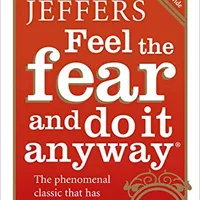
Feel the Fear and Do It Anyway — Susan Jeffers
The most practical guide to exposure-based confidence building — it's essentially a manual for why doing the thing before you feel ready is the actual mechanism, not a temporary workaround.
As an Amazon Associate, we earn from qualifying purchases — at no extra cost to you.

The Charisma Myth — Olivia Fox Cabane
The best treatment of the specific learned behaviours — presence, warmth, confident projection — that translate internal self-efficacy into the external signals that others (and you) can actually perceive.
As an Amazon Associate, we earn from qualifying purchases — at no extra cost to you.

The Design Behind the Belief
My colleague — the one with the affirmations and the confidence playlist — eventually stopped trying to feel confident and started trying to generate evidence. She volunteered to run a working session at a conference she'd attended for three years without once speaking publicly. It was imperfect. She also knew exactly what she was talking about, and the room could tell. She ran two more sessions in the four months that followed.
She told me recently that she doesn't think much about confidence anymore. Not because she's completely unbothered — that's not how any of this works — but because she has enough entries in her evidence file that the old story can't get much traction. The data keeps arriving. The story keeps updating.
That's the design. Not the performance of confidence. The architecture of it: specific domain, graduated challenges, real models, accurate evidence, repeated until your brain runs out of honest objections.
Bandura published the framework nearly 50 years ago. The self-help industry mostly ignored the hierarchy and sold source four — because source four is faster to perform and easier to package as a workshop. But the science has been clear the whole time.
Confidence follows evidence. Evidence follows attempt. And attempt is the one variable you can control starting today. That is, precisely, what it means to design your own evolution — not by performing the trait before you have it, but by building the architecture that makes it inevitable.
Which domain would most change your life right now if you genuinely stepped into it? And what's the next challenge — not the hardest, just the next one — you could design for this week?
Was this helpful?
Continue Your Evolution
The Frozen Goal Problem: Why Tiny Wins Beat Grand Plans
Rejection Sensitivity: Why You Keep Assuming They're Upset
The Science of Nostalgia: Why Looking Back Helps
Sedikides and Wildschut found nostalgia boosts mood, meaning, and social connection — not mere sentimentality. Here's the science and how to use it.