Mindset· 9 min read
Perfectionism Is Not High Standards — Research Explains Why
Research shows perfectionism is not high standards — it's a fear of evaluation that prevents action. Here's what 30 years of psychology reveals.

Perfectionism Isn't High Standards. Here's What the Research Shows It Actually Is.
There's a file on my laptop I should've deleted years ago. I called it Final_Draft_v7. Seven versions of the same project, written over three months, none of which were ever shared. Version 1 was solid. Version 7 was also solid — slightly rearranged, marginally cleaner, fundamentally the same. I wasn't improving it. I was orbiting it.
The project never shipped.
If that story feels familiar, you've probably spent years telling yourself what most of us tell ourselves: I'm a perfectionist — it means I care, it means I have standards. And here's the honest part: you do care. The problem is that "high standards" and "perfectionism" are not the same thing. They correlate enough to feel identical from the inside, but the psychology distinguishes them sharply — and conflating them carries a cost that most people are paying without knowing it.
In 2019, a meta-analysis published in Psychological Bulletin synthesized data from 164 samples conducted over 27 years. The researchers — Thomas Curran at the London School of Economics and Andrew Hill at York St. John University — documented that socially prescribed perfectionism among young adults had increased by roughly 33% since 1989 — with self-oriented perfectionism up 10% and other-oriented up 16% over the same period. Anxiety, depression, and burnout rose in the same period. That's not a coincidence. That's a mechanism.
Seth Godin captured it in a May 2026 blog post: "The search for perfect never ends, and it's a great place to hide." It sounds like a productivity tip. It's actually a description of a psychological trap that research has been mapping for three decades. Let's look at what that map actually shows.

The Three Faces of Perfectionism (Only One of Them Actually Helps You)
Paul Hewitt at the University of British Columbia and Gordon Flett at York University have produced the most comprehensive research program on perfectionism in the psychological literature. Their core contribution isn't just measuring perfectionism — it's the discovery that the single word bundles together three fundamentally different psychological experiences with entirely different consequences.
Self-oriented perfectionism: You hold yourself to high standards and you're internally motivated to meet them. In moderate doses, this correlates with conscientiousness, goal achievement, and genuine skill development. This is the version most people imagine when they say "I'm a perfectionist." It's real, it's functional, and it's the least common form among people who are actually struggling.
Other-oriented perfectionism: You hold other people to perfectionist standards. This tends to create chronic frustration in relationships and is associated with interpersonal control dynamics — the colleague who redoes your work, the partner who can't relax about minor imperfections in shared spaces.
Socially prescribed perfectionism: You believe that other people expect you to be perfect, and you're distressed by the chronic gap between that perceived demand and your actual performance. Not just wanting to do well — being convinced that falling short will expose a fundamental personal inadequacy, that others are watching, evaluating, and quietly revising their opinion of you with each imperfect output.
That third type is the one the research consistently links to depression, anxiety, chronic burnout, imposter syndrome, and — across multiple studies by Hewitt, Flett, and colleagues — significantly elevated risk of suicidal ideation.
The practical consequence of lumping all three under "I'm a perfectionist": interventions designed for adaptive high standards — work harder, set clearer goals, track your progress more rigorously — are actively counterproductive for socially prescribed perfectionism. They raise the performance stakes without addressing the underlying fear of evaluation. They amplify the threat rather than defusing it.
Most self-improvement content addresses the first type of perfectionism. Most people who are genuinely struggling are living in the third.
The All-or-Nothing Engine: How Perfectionism Generates Paralysis
The most distinctive cognitive feature of maladaptive perfectionism isn't high standards. It's all-or-nothing thinking — the mental pattern that categorizes outcomes as either complete success or total failure, with no functional territory in between.
Where someone without perfectionism sees a partially successful attempt as useful evidence and progress, the perfectionist experiences the same result as failure. It wasn't perfect, therefore it doesn't count. This re-categorization has a direct and measurable behavioral consequence.
If 80% success is processed as failure, the motivational system receives failure signals for what are, by any objective standard, strong performances. Over time, this progressively erodes approach motivation while increasing behavioral avoidance. The person does less, enjoys it less, and — critically — maintains the belief that the failure to perform is the problem, when the failure to process success is.
Brené Brown's research on shame identifies the deeper relational mechanism. In The Gifts of Imperfection and the two decades of qualitative and quantitative research behind it, she documents the same dynamic from a different angle: perfectionism isn't about high standards — it's fundamentally about the fear that an imperfect product will reveal an imperfect person. The perfectionist's internal logic: if I do this perfectly, I can avoid criticism and the shame that criticism triggers.
That logic is structurally identical to every other anxiety-driven avoidance pattern. And it has the same self-reinforcing quality. The more you avoid releasing imperfect work, the more the fear maintains itself — because you never generate the disconfirming evidence that gradual exposure would have built. You never discover that 90% is well-received, that criticism is survivable, that the world doesn't read your outputs as verdicts on your adequacy.
The paralysis isn't a side effect of perfectionism. It's the mechanism.
Why Perfectionism Is Increasing — And Who It's Hurting Most
Return to the Curran and Hill meta-analysis for a moment. Their data didn't just show that perfectionism has increased — it showed that socially prescribed perfectionism, the most psychologically costly form, showed the largest increase of all three types.
Their interpretation is worth sitting with carefully. A culture of public performance — social media as perpetual, visible audience — combined with meritocratic messaging that ties personal worth to measurable achievement has produced environmental conditions that systematically cultivate the most damaging form of perfectionism in the people who are most developmentally vulnerable to it. Young people entering adulthood are doing so in a context that functions, at scale, like a machine for producing socially prescribed perfectionism.
The paradox: the broader professional and creative world has embraced imperfection as a design principle. Software ships in beta. Books get revised editions. Products iterate publicly. The expectation, at the structural level, is that version 1 exists so version 2 can be better. And yet the internal pressure many people bring to their own work — the expectation of perfection before sharing — has intensified, not relaxed.
That gap between the world's implicit expectations and the internal demand is where the cost accumulates. It's not just procrastination. It's the foregone learning. The feedback that would have arrived at version 1 never arrives, so version 10 doesn't benefit from it.

Kindle Paperwhite (2024, 12th Gen, 16GB)
The feedback that arrives at v1 never arrives for the perfectionist. A reading device lowers the friction of consuming the research-backed books below — the upstream interventions.
As an Amazon Associate, we earn from qualifying purchases — at no extra cost to you.

Process vs. Outcome: The Distinction That Changes Everything
Here's the research distinction that the psychology most consistently supports as practically useful — and the one that most self-improvement content misses entirely.
Process perfectionism is a commitment to doing the work with full attention, care, and skill. It's associated with the adaptive outcomes that genuinely high standards produce. The surgeon who checks every instrument before an operation isn't suffering from perfectionism; they're exercising professional precision. The writer who checks facts before publishing isn't being neurotic; they're being responsible. Process perfectionism isn't the problem.
Outcome perfectionism is a refusal to release, share, or commit to anything that doesn't meet an internal ideal standard — regardless of whether that standard is achievable, clearly defined, or even internally consistent. It's associated with chronic incompletion, escalating procrastination, and the loss of feedback that imperfect-but-shipped work would have generated.
Voltaire's aphorism — "the perfect is the enemy of the good" — is the compressed version. The psychologically precise version: outcome perfectionism is the enemy of learning, of genuine competence development, of completion, and ultimately of the very high standards it was ostensibly protecting.
The person who ships a 90% solution and iterates based on how the world responds will outperform the person who spends twice as long polishing a 95% solution that never leaves their hard drive. Not sometimes. Systematically. Because the feedback loop that produces mastery requires outputs.
The Books That Actually Address the Mechanism
If you're recognizing yourself in any of this, the question becomes: what actually helps? "Just lower your standards" is not an intervention — it's noise. Here's an honest account of the resources that engage the actual mechanism.
When Perfect Isn't Good Enough by Martin Antony and Richard Swinson is the most directly targeted clinical resource for maladaptive perfectionism. CBT-based, it works with the specific cognitive patterns — all-or-nothing thinking, catastrophizing, reassurance-seeking — rather than around them. Not a light read, but it's the book that addresses the mechanism rather than the symptom.
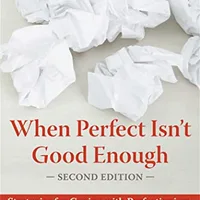
When Perfect Isn't Good Enough: Strategies for Coping with Perfectionism — Antony & Swinson
The most directly targeted clinical resource for maladaptive perfectionism — CBT-based, works with all-or-nothing thinking and reassurance-seeking rather than around them.
As an Amazon Associate, we earn from qualifying purchases — at no extra cost to you.
Carol Dweck's Mindset is the upstream intervention. The fixed mindset — the belief that your abilities are fixed traits being evaluated with every performance — is the cognitive soil in which socially prescribed perfectionism grows. Dweck's research on the growth mindset isn't simply about praising effort; it's about restructuring the relationship between performance and identity. When performance stops being verdict and becomes data, the shame-avoidance loop loses its primary fuel source.
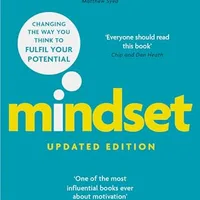
Mindset: Changing The Way You Think To Fulfil Your Potential (Updated Edition) — Carol Dweck
The upstream intervention: the fixed mindset is the cognitive soil socially-prescribed perfectionism grows in. Dweck restructures the link between performance and identity — performance becomes data, not verdict.
As an Amazon Associate, we earn from qualifying purchases — at no extra cost to you.
Greg McKeown's Essentialism takes a different angle but arrives at the same place. The disciplined pursuit of less isn't about lowering standards — it's about recognizing that perfect execution across everything you're trying to do is structurally impossible, and that the attempt to achieve it produces worse outcomes than focused excellence on fewer, more deliberately chosen commitments. McKeown's insight: the person who tries to do everything perfectly ends up doing nothing excellently.
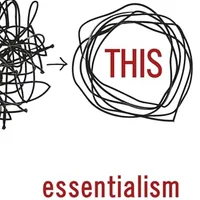
Essentialism: The Disciplined Pursuit of Less — Greg McKeown
Perfect execution across everything is structurally impossible; the disciplined pursuit of less is not lowering standards but focusing them. The one who tries to do everything perfectly does nothing excellently.
As an Amazon Associate, we earn from qualifying purchases — at no extra cost to you.
how to stop overthinking and start taking action
How to Start Today
The intervention the research most consistently supports isn't "lower your standards." It's a specific cognitive shift: from outcome as verdict to outcome as information.
When an imperfect result is experienced as evidence of personal inadequacy, it produces shame and avoidance. When the same result is experienced as data about a skill currently in development, it produces curiosity and continued engagement. That reframe sounds modest. Its behavioral consequences are not.
Here's how to practice it concretely:
-
Define "good enough" before you start. Not as capitulation, but as decision architecture. What would 80% of this look like? Set that as your release threshold before you begin — so the internal standard doesn't silently inflate as you approach it, which it will if you don't.
-
Ship the draft. Not because it's perfect. Because the feedback the world provides is an education you cannot get in the revision stage. Imperfect work in the world generates more actual knowledge than polished work that stays on your hard drive.
-
Separate the work from the self. The quality of the output tells you about the current state of a developing skill. It does not tell you about your worth as a person. Treating those as different conversations is the foundational cognitive move.
-
Track what you shipped, not just what you finished. A dedicated journal or progress tracker rewires the internal feedback loop toward completion rather than perfection. What gets measured gets repeated — and completion is a skill that benefits from repetition.
daily habits of genuinely happy people — what the science shows

The Version That's Better Than What Exists Right Now
Godin's observation bears repeating: "The search for perfect never ends, and it's a great place to hide."
Better is available right now. Better than the draft you wrote last month. Better than the version you've been polishing for three months. Better than the outcome you'd get by shipping nothing at all.
The evolution you're designing doesn't happen in the revision stage. It happens in the release stage, then the feedback stage, then the next attempt. The perfectionist who never finishes isn't building toward mastery. They're maintaining the permanent safety of the almost-done — a place where the work can't be judged because it hasn't been released, and where growth can't happen because there's no feedback.
Hewitt and Flett spent thirty years studying what perfectionism actually produces at scale. The consistent finding: the people most trapped by it are frequently among the most capable. They have the ability to do excellent work. What they've developed alongside that ability is a terror of evidence that the work isn't perfect yet.
The courage that evolution requires isn't the courage to get it right. It's the courage to let the imperfect version into the world — because the right version can only exist downstream of that.

Clever Fox Habit Tracker Journal / Calendar
Track what you shipped, not just what you finished. A dedicated tracker rewires the internal feedback loop toward completion rather than perfection — what gets measured gets repeated.
As an Amazon Associate, we earn from qualifying purchases — at no extra cost to you.
What's one thing you've been holding back because it's "not quite ready"? Leave it in the comments — and then go ship it.
Was this helpful?