Mindset· 10 min read
Why the Finish Line Always Looks Closer Than It Is
Trope and Liberman's construal level theory explains why distant goals look deceptively simple — and what you can do before the obstacles appear.

Why the Finish Line Always Looks Closer Than It Is

Three years ago, I sat down with a fresh notebook and what I was completely convinced was a realistic six-month plan. New project. Clear milestones. A spreadsheet with every week accounted for. I remember that particular afternoon — the calm that comes from seeing something complex laid out in clean, manageable-looking steps. Everything fit. Nothing seemed unreasonable. I remember feeling genuinely prepared. Construal level theory would later explain exactly why that calm was so misleading.
You already know how this ends.
Nine months later, still fighting through logistics I hadn't even thought to consider when I made that plan, I started genuinely questioning whether I was simply bad at estimating. But then I came across a 2003 paper by two psychologists, Yaacov Trope and Nira Liberman, that gave me something more useful than a lesson in humility: an actual structural explanation for what had gone wrong. And the explanation wasn't flattering, but it wasn't about me. It was about how the human brain processes distance — and the specific way that processing changes what a goal looks like before you've started versus after you're already in it.
The View From Far Away: Why Distant Goals Look Deceptively Simple
Seth Godin wrote something just yesterday that stuck with me. He called it "as the crow flies." The crow, looking down from altitude, sees a perfectly straight line from A to B. What the crow doesn't see from up there is the terrain — the swamp, the ridge, the fence that cuts across the path at an inconvenient angle nobody mentioned. From altitude, the journey is a line. At ground level, it's something else entirely.
That image is a near-perfect lay description of what Trope and Liberman proposed in Temporal Construal, published in Psychological Review. Construal level theory begins with a deceptively simple claim: psychological distance changes the way your mind represents the exact same goal. Not just how much you know about it. The actual mental structure — what gets rendered and what doesn't.
When something sits far away from you — whether that distance is temporal, spatial, social, or hypothetical — your brain represents it abstractly. It pictures the high-level essence, the core meaning, the inspiring purpose. "I'll build the business." "I'll finish the book." "I'll get into shape by spring." Clean. Purposeful. Manageable-looking.
When the same goal draws near, your brain shifts modes. It starts generating concrete, specific, situational detail — the particular Tuesday this has to happen, the exact email that needs to be written, the specific person who hasn't replied yet, the obstacle that wasn't in any of the early planning conversations. The goal hasn't changed. The terrain was always there. Only the psychological distance has changed — and with it, the mental picture your brain produces.
This is the core of what Trope and Liberman documented: the distant version and the near version of the same goal genuinely look different to the human brain — not because more information has arrived, but because distance itself systematically strips out the low-level concrete detail that hasn't yet become psychologically relevant. The far-away goal is mentally compressed. The nearby goal is uncompressed. And what spills out when it decompresses is the actual terrain.

Getting Things Done — David Allen (Revised)
Placed right after the article explains that distant goals get mentally compressed and lose their detail. GTD is the canonical system for the opposite move — forcing every commitment down to its concrete next physical…
As an Amazon Associate, we earn from qualifying purchases — at no extra cost to you.
Why the Obstacles Always Seem to Appear "Out of Nowhere"
Here's the part that's easy to miss: the obstacles weren't hidden. They were always there. You just weren't positioned to see them.
Think about the last big project you committed to. You probably saw the outcome — the finished thing, the end state, what it would mean — with real clarity. What you almost certainly didn't see with the same resolution was the specific sequence of handoffs required to get there, the coordination problems that would only surface when you tried to pass work to someone else, the dependency on something outside your control that only became visible once you were already committed. Those weren't unknowns you could have discovered with more research. They were below the rendering threshold that far-away goals produce by design.
This is what makes construal level theory genuinely unsettling once you sit with it. It's not a character flaw. It's not naïvety. It's a structural feature of how your brain processes distance. Distant things get compressed into their essence. And compression, by definition, drops the detail.
There's an old farming truth in this: the season you plant in and the season you harvest in look nothing alike. It isn't just about patience — it's pointing at this: proximity reveals what distance hides. The planting season feels clean and full of potential. The harvest season is where you find out what the soil actually did.
There's a reason experienced project managers build in contingency time that looks wildly excessive to anyone who hasn't managed enough projects. They've been surprised enough times by the decompression. They've learned not to trust the crow's-eye view of the timeline.
This Isn't the Planning Fallacy — And the Distinction Matters
At this point you might be thinking: isn't this just the planning fallacy? The well-documented tendency to underestimate how long things take?
It's related. But they're mechanically different, and that difference has practical consequences.
The planning fallacy, documented by Kahneman and Tversky in the 1970s, describes a specific reasoning error: ignoring the outside view — statistical base rates of how long comparable projects have historically taken — in favor of an optimistic inside view of your own particular plan. The fix is relatively direct: look at what similar things have actually taken before. Consult the base rate. Regress toward it.
Construal level theory is more fundamental. It doesn't just describe an error in your time estimate. It describes a systematic shift in the structure of your mental representation as a function of distance — a shift that happens before you ever sit down to estimate. The planning fallacy helps explain why your number is wrong. Construal level theory helps explain why the goal looked the way it did when you formed the number — why the obstacles weren't part of the picture at all, not just why the timeline was optimistic.
You can correct for the planning fallacy and still fall victim to construal-level distortion. They're separate problems that require separate fixes.

Kindle Paperwhite (2024, 12th Gen, 16GB, Black, Without Ads)
Follows the Kahneman/Tversky planning-fallacy section, where the article distinguishes two separate research literatures. Positioned as the tool for the reader who has just realised there is a whole body of decision s…
As an Amazon Associate, we earn from qualifying purchases — at no extra cost to you.
There's another important nuance in Trope and Liberman's broader research program: this isn't a correctable error in the ordinary sense. Simply resolving to "think more concretely" about a distant goal doesn't reliably work. The abstraction is largely automatic — a feature of how psychological distance gets processed, not a habit of careless thinking. Which means the practical fix isn't trying harder from the same distance. It's building a deliberate system that imports concrete detail before the goal gets close enough to generate it naturally.
For a deeper look at why willpower alone can't force that shift, see why you procrastinate and what psychology actually recommends — the same structural gap between intention and ground-level action shows up there too.
How to Map the Ground Before You're Already Walking It
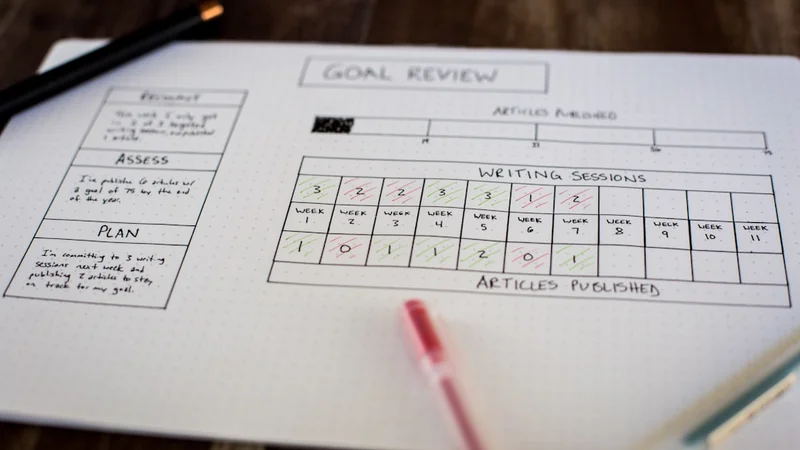
So if the abstraction is largely automatic — if you genuinely can't just decide to see the terrain from far away — what can you actually do?
Trope and Liberman's research points toward a practical answer, even though they weren't writing a productivity guide. The key insight is this: you can't change your distance from the goal before you start. But you can simulate the view from closer range before you commit to the plan. There are three moves that consistently work:
Do the failure pre-mortem before you write the plan. This technique, developed by psychologist Gary Klein, is a deliberate exercise in forced perspective. Before you commit to the timeline and the steps, imagine you're already twelve months in and the thing has clearly stalled. Write down what broke down. Be specific — not "motivation faded" but "the third-party approval took six weeks instead of two and everything downstream shifted." This forces your brain to generate concrete failure scenarios rather than abstract intentions. It's a hack for artificially collapsing psychological distance before you've actually moved — making the near future's concrete mode available while you're still in the planning stage.
Map the dependencies, not just the steps. Most plans are really lists of what you will do. The terrain that creates the actual problems is almost always what someone else needs to do, or what needs to happen before something else can happen. Write those explicitly. Not "get design feedback" — "wait for [specific person] to complete their review and respond." The concreteness of naming the person and the asymmetry of the dependency is exactly where the ground-level view starts to appear. If you can't name the person, that's the obstacle right there.
Compress your planning horizon deliberately. There's a reason short-horizon planning systems work better for execution than annual goal-setting, and construal level theory is part of that reason. When you plan in twelve-week blocks rather than twelve-month arcs, your brain is forced into concrete mode from the start — because twelve weeks is close enough to generate detail. You can't set a vague "ship the product" goal for next month. Next month is near enough that your brain starts asking: which day? Which version? Which person signs off? The detail arrives because the psychological distance is short enough to produce it.
The counterintuitive implication of all this is that ambitious, long-horizon goals aren't the problem — vague, long-horizon plans are. The goal can be big and distant. But the plan needs to be built at ground level, which means it needs to be built from a perspective your brain doesn't naturally produce until you're already close to the thing.
How to Start Today
The research doesn't ask much. Here's what it actually suggests, stripped down:
Step 1: Pick one ambitious goal you've been confident about but haven't started or haven't finished. Write it down as a single sentence.
Step 2: Write the failure pre-mortem. Two paragraphs, imagined future tense — the project has stalled, it's been six months, what broke down first? Be specific enough that you'd recognize the scenario if it happened.
Step 3: List every step that depends on someone or something outside your direct control. These are your terrain features — write them as dependencies, not tasks.
Step 4: Set the nearest meaningful milestone — not the end state, not the half-point, the thing that needs to happen in the next two weeks — and write the specific next physical action that moves toward it.
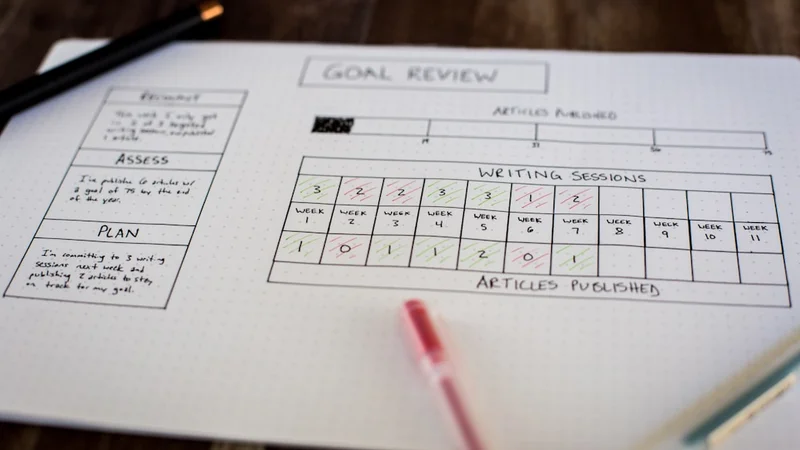
Step 5: Use a structured planning journal to make this a repeatable system rather than a one-time exercise. The goal is to build the habit of zooming in before you commit, not to do a great pre-mortem once and then go back to crow's-eye planning.

Full Focus Planner by Michael Hyatt (Gray Linen Hardcover)
The single strongest thematic match in the catalog. The article's third practical move is 'compress your planning horizon deliberately — twelve weeks rather than twelve months'; the Full Focus Planner is built around…
As an Amazon Associate, we earn from qualifying purchases — at no extra cost to you.

Clever Fox Habit Calendar Circle (24-Month Habit Tracker)
Directly serves Step 5 of the article, which explicitly asks the reader to 'use a structured planning journal to make this a repeatable system rather than a one-time exercise'. Lowest-friction purchase in the set, pla…
As an Amazon Associate, we earn from qualifying purchases — at no extra cost to you.
Related read: How to build habits that actually stick without relying on motivation
Doing this once is useful. Doing it every time you take on something that matters is the actual practice.
The Crow's View Is Beautiful — But You Don't Live Up There
Here's what's worth keeping in mind: the abstract, high-altitude view of a distant goal isn't wrong. That clarity of purpose, that inspiring sense of what something could mean — that's real, and it's worth preserving. The problem isn't having the vision. It's operating the plan from the vision's altitude.
Construal level theory doesn't tell you to stop dreaming big or setting ambitious goals. It tells you that the brain has two modes — and that executing anything real requires you to bridge them deliberately, instead of waiting for proximity to do it for you at the most inconvenient possible moment.
The people who consistently finish what they start aren't just more disciplined than everyone else. They've built the habit of asking early: what does this actually look like from ground level? They've learned to distrust the clean bird's-eye picture just enough to check the terrain before committing to the map.
Napoleon Hill built much of Think and Grow Rich around what he called a "definite chief aim" — the idea that achievement starts with a clear, specific purpose. He was right about the aim. What he didn't spell out is that the aim, alone, is never sufficient — because the aim is a crow's-eye view, and execution lives at ground level.
Designing your evolution means designing for the terrain, not just the destination. The finish line will be exactly where you think it is. The path to it rarely is.
What's the last goal you mapped out from altitude that looked completely different once you were in it — and what piece of terrain do you wish you'd seen before you started?
Was this helpful?
Continue Your Evolution
The Frozen Goal Problem: Why Tiny Wins Beat Grand Plans
Rejection Sensitivity: Why You Keep Assuming They're Upset
The Science of Nostalgia: Why Looking Back Helps
Sedikides and Wildschut found nostalgia boosts mood, meaning, and social connection — not mere sentimentality. Here's the science and how to use it.