Habits· 9 min read
Why Willpower Isn't What Builds Habits
Wendy Wood's research shows 43% of daily behavior is habitual. Habits run on context, not willpower — here's the design approach that actually works.

Why Willpower Isn't What Builds Habits
I kept a tally once, in the back of a notebook I bought specifically to journal in but mostly used to write lists.
Every habit I'd tried to build on pure determination. Gym before work. Daily journaling. Reading before bed instead of doomscrolling. No coffee until I'd done an hour of focused work. The dates were painfully consistent: anywhere from six to nineteen days, then nothing. Not a gradual fade — a cliff. One day I was doing the thing, the next I'd decided (without quite deciding) that I'd restart on Monday.
The failure never felt like the habit's fault. It always felt like mine. I just didn't want it badly enough. Didn't care enough. Wasn't disciplined enough. That internal explanation is so plausible, so intuitive, so culturally baked-in that I never once questioned whether it was actually true.
It isn't. And the research that dismantles it is some of the most practically useful science I've come across.
The Willpower Story Has a Major Flaw
Wendy Wood spent roughly three decades researching how habits actually form. She's a psychologist at the University of Southern California, and her 2019 book Good Habits, Bad Habits consolidates decades of diary studies, field surveys, and lab experiments she ran with colleagues including David Neal and Jeffrey Quinn.
Atomic Habits — James Clear (Paperback)
The article names James Clear's 'habit stacking' and sits right after Wendy Wood's 2019 research is introduced — the foundational text on building habits by design, not willpower.
As an Amazon Associate, we earn from qualifying purchases — at no extra cost to you.
The finding that stopped me cold when I first read it: roughly 43 percent of daily behavior is habitual — performed in the same location, triggered by the same recurring context, without any fresh decision being made.
That number is worth sitting with. Nearly half of what you do on a given Tuesday isn't a choice in any meaningful sense. It's a response. The context showed up, the behavior followed. No deliberation required.
What determines whether that happens? Not how much you wanted it. Not how motivated you felt. Not how clearly you visualized the outcome. According to Wood's research, the single strongest predictor of whether a behavior becomes habitual is the consistency of the surrounding context — same place, same time, same preceding cue — far more than how many times you've repeated it or how intensely you've wanted to change.
This distinction matters enormously, because it means most people are solving the wrong problem entirely.
When a habit doesn't stick, the standard move is to try harder. More motivation. Stronger intention. A better why. What the research says instead is that you probably needed a better where and when.
What Habits Actually Run On
Once you have the mechanism, the next step is applying it to your mornings specifically — where cue consistency compounds fastest.
Here's what changes when you understand Wood's framework.
Habits aren't decisions you repeat until they become automatic. They're context-triggered responses your brain learns to generate without involving the decision-making parts at all. The context — the specific environment, the time of day, the cue that precedes the behavior — does the initiating. Your prefrontal cortex, the part that deliberates and decides, largely stays out of it.
This is why a habit you've built feels effortless on a normal day and nearly impossible when you're traveling. Your brain isn't being lazy or inconsistent. The cue is literally missing. The context that used to do the triggering doesn't exist in the hotel room, so there's nothing to initiate the behavior automatically. You're back to needing a decision — and decisions require energy you may not have at 6 AM in an unfamiliar city.
It also explains why environment redesign is so much more durable than motivation. Motivation fluctuates. Your context, if you build it deliberately, stays mostly stable. And a stable context keeps triggering the behavior whether you feel like it or not.
Wood's team found something particularly counterintuitive in their studies: once a behavior becomes genuinely habitual, a person who reports low motivation on a given day still performs the habit at nearly the same rate as on high-motivation days. Not slightly lower. Nearly the same.
That's not willpower. That's what a context-cued habit looks like from the inside. You're out the door in your running shoes before you've consciously registered that you didn't particularly feel like running.
The Cue Is Doing the Heavy Lifting
If you accept that context drives automaticity more than repetition count or motivation, then the practical question changes.
Instead of how do I stay motivated to do this? — the question becomes what cue is reliable enough to do the triggering for me?
The most effective cues from Wood's research share a few properties. They're specific. They're already happening reliably — you don't have to create the cue, just attach the habit to it. And they reduce the friction between the cue and the behavior to nearly zero, so there's no gap where a decision can sneak in and override the pattern.
James Clear popularized this as "habit stacking" — tagging a new behavior to an existing reliable one. After I pour my morning coffee, I write three sentences. The coffee isn't just a cue. It's an anchor. It was happening anyway. Your new habit rides it.
But the environmental piece goes deeper than simple anchoring. Wood's work also found that the physical environment itself acts as a cue — not just the preceding action. In her research, people ate significantly less food when it required extra reach or effort to access, and more when it was placed within easy view and arm's reach — the same friction principle behind advice like setting out gym clothes the night before to make a workout more likely. The behavior was in the environment, not in the mind.

This is frustrating news if you've been treating habit formation as primarily a psychological problem — a matter of mindset, vision, or willpower. Because it means the most leveraged intervention probably isn't a mindset shift. It's moving things around on your desk.
Why "Wanting It More" Keeps Failing
Wood's research offers a specific explanation for why motivation-based approaches collapse right around day twelve to nineteen — the exact window where most people's habits die.
The early phase of any habit attempt runs on motivation. You're excited. You've made a commitment. The behavior feels new and interesting. Motivation can carry you through this phase because you're actively thinking about the habit — it hasn't transferred to automatic processing yet.
But genuine automaticity takes longer than two weeks to build. Wood herself puts it at roughly two to three months for a simple habit to become truly automatic — and separate research tracking real-world habit formation found the timeline stretches even further for more complex behaviors, with a median around 66 days and a range as wide as about three weeks to eight months, depending on the habit's complexity and how stable the surrounding context is. The studies suggesting twenty-one days originated from an observation by cosmetic surgeon Maxwell Maltz in the 1960s — not controlled research — and have been thoroughly contradicted by the data.
So here's the trap: motivation works during the conscious phase, then naturally drops as the novelty fades, typically around weeks two to three. But the habit hasn't built enough context-cued automaticity to run without motivation yet. That's the gap. That's the cliff. The behavior collapses not because you're weak, but because you were running on fuel that was always going to run out before the real engine kicked in.
This is also why a single if-then sentence can double your follow-through — it's the same context-cueing principle applied to intention.
The solution isn't to maintain artificially high motivation across that gap. It's to build the contextual scaffolding that reduces how much the behavior needs motivation in the first place — so the automatic processing takes over before the motivational fuel runs out.
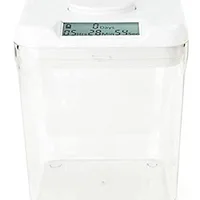
Kitchen Safe kSafe Time Locking Container (Medium)
Directly serves the 'increase friction for competing behaviours' lever — the article's phone-in-another-room advice made physical. A timed lock box engineers the friction the research says matters most.
As an Amazon Associate, we earn from qualifying purchases — at no extra cost to you.
How to Actually Design a Context That Works
Wood's research doesn't just diagnose the problem. It points toward specific, practical levers.
Map where and when the habit needs to happen. Not "I'll meditate daily." Rather: "I'll meditate at my desk, immediately after I close my laptop for the day, before I pick up my phone." The specificity isn't rigidity — it's a cue. The more specific the context, the more reliably it triggers the behavior.
Reduce friction to near zero. If getting started requires three preparatory steps, there are three chances for a competing behavior to take over. Wood's research found that making the desired behavior the path of least resistance in a given context dramatically increased its consistency — more than reminders, more than rewards, more than intention. The book goes on the nightstand, not the shelf. The running shoes go next to the bed, not in the closet.
Increase friction for competing behaviors. This is the flip side. If you want to stop checking your phone first thing in the morning, putting it in another room overnight changes the context in a way that charging it next to your bed never will. The context now favors the behavior you want. The competing behavior requires effort. That asymmetry does the work.
Don't overhaul everything at once. One of Wood's consistent findings is that stable contexts build habits; disrupted contexts break them. If you try to rebuild your mornings, your evenings, your workspace, and your diet simultaneously, you're creating instability across every area at once — eliminating the contextual consistency that each habit needs. One well-placed, context-locked habit compounds. A dozen simultaneous overhauls cancel each other out.
How to Start This Week
None of this requires a personality change. It requires an environment audit.
Step one: Pick one behavior you've tried and failed to build at least twice. Not the most important habit you can imagine — the one you actually want to test.
Step two: Write down where and when it would realistically happen, given your actual schedule. Not the schedule you wish you had. The one that exists.
Step three: Identify what already happens reliably just before that moment. That's your anchor. Attach the new behavior to it with a sentence: After I [existing reliable action], I will [new habit] for [specific short duration].
Step four: Redesign the physical environment so the first action of the new habit — just the first action — requires zero decision-making. The journal is open on the desk. The yoga mat is already unrolled. The protein powder is next to the kettle.
Step five: Track context consistency, not streak length. The question to ask yourself each night isn't "did I do the habit?" — it's "did the cue show up, and if it showed up, did I do the habit?" The cue is the variable you're building. The behavior will follow once the cue is reliable.

Clever Fox Habit Calendar Circle (24-Month Tracker)
Placed at the 'track cue-behaviour pairings, not streaks' step — the article explicitly calls for 'a good habit tracker designed around cue-behaviour pairing'. This is that tracker.
As an Amazon Associate, we earn from qualifying purchases — at no extra cost to you.
A good habit tracker designed around cue-behavior pairing can make this concrete in a way that a simple checkbox never does. You want to see the pattern — cue present, behavior followed — until it stops requiring active attention.

And if the habit you're redesigning is actually one you're trying to stop, the mechanism flips: see the neuroscience of replacing a bad habit instead of deleting it.
The Real Work Is Upstream
Here's the counterintuitive conclusion from Wood's decades of research: the real work of building a habit is almost all done before the behavior starts.
It happens when you choose the cue. When you reduce the friction. When you arrange the environment so the automatic trigger is in place. Once that scaffolding exists, the behavior happens — not because you decided, not because you were motivated, not because you're particularly disciplined. Because the context showed up, and your brain does what brains that have built a stable context do: it responds.

Philips SmartSleep Wake-Up Light HF3520
The closing 'the real work is upstream' section is about engineering the environment so the behaviour triggers itself. A sunrise light is a pure context-cue device — it does the triggering for morning habits without w…
As an Amazon Associate, we earn from qualifying purchases — at no extra cost to you.
This reframes what "Design Your Evolution" actually looks like in practice. It isn't about installing a more disciplined version of yourself through force of will. It's about designing the conditions in which the behaviors you want become what's easiest and most natural in a given moment. That's a design problem. And design problems have solutions.
The version of you who runs consistently, reads regularly, and shows up for your work every morning isn't running on superior willpower. They built a better context. The gap between you and that version isn't motivation. It's furniture arrangement.
What's one habit you've tried to build on willpower alone — and what would the context look like if you tried Wood's approach instead?
→ The Mere Urgency Effect: Why You Choose Busy Over Important
---Sources
- Wood, Wendy. Good Habits, Bad Habits: The Science of Making Positive Changes That Stick. Farrar, Straus and Giroux, 2019. https://www.goodreads.com/book/show/43565368-good-habits-bad-habits
- Neal, David T., Wendy Wood, and Jeffrey M. Quinn. "Habits — A Repeat Performance." Current Directions in Psychological Science 15, no. 4 (2006): 198–202. https://doi.org/10.1111/j.1467-8721.2006.00435.x
- Wood, Wendy, Jeffrey M. Quinn, and Deborah A. Kashy. "Habits in Everyday Life: Thought, Emotion, and Action." Journal of Personality and Social Psychology 83, no. 6 (2002): 1281–1297. https://doi.org/10.1037/0022-3514.83.6.1281
- Lally, Phillippa, et al. "How Are Habits Formed: Modelling Habit Formation in the Real World." European Journal of Social Psychology 40, no. 6 (2010): 998–1009. https://doi.org/10.1002/ejsp.674
→ Job Crafting: How to Redesign Your Work Without Quitting
→ You Were a Creative Genius at Age 5. What Changed?
→ Why Vision Boards Alone Rarely Work
Related read: Self-Efficacy: The Belief That Predicts Follow-Through
Related read: Why Unpredictable Rewards Build Stronger Habits
Related read: Parkinson's Law: The Reason Every Task Takes Too Long
Related read: Why Waiting for Inspiration Kills Your Best Work
Related read: Why the Finish Line Always Looks Closer Than It Is
Related read: Why Morning Habits Stick Better: The Decision Science
Was this helpful?