Habits· 10 min read
Why You Can't Switch Off After a Stressful Day
Research on psychological detachment shows why stress follows you home, and how a simple evening shutdown routine helps you actually recover.

Why You Can't Switch Off After a Stressful Day

It's 10:47 PM. You haven't thought about work since... actually, you haven't stopped thinking about work. The inbox is closed. Your laptop is in another room. But that conversation with your manager at 3 PM is still running on a loop — same words, same inflection, fresh irritation each time it plays.
You're exhausted. But you're not off.
This isn't a willpower problem. It's not even a bad-day problem, and it's not something an extra hour of sleep will fix. Researchers have been studying this specific experience since the early 2000s, and the core idea is precise: the ability to mentally disengage from work is a skill that can be practiced — and most people have never been taught to practice it.
Why Your Brain Keeps the Overtime Running
In 2007, psychologists Sabine Sonnentag and Charlotte Fritz published a widely cited paper in the Journal of Occupational Health Psychology. It introduced the Recovery Experience Questionnaire, a tool for measuring how people unwind from work in their off-job time. Across three studies, they identified four separable recovery experiences, and psychological detachment is the one that matters most for this article.
Psychological detachment isn't distraction. It's not the glass of wine you pour to take the edge off, or the Netflix episode you put on hoping to stop thinking. It's genuine mental separation from work — not thinking about it and not doing work-related activities outside of it. In the original validation studies, the four recovery experiences showed moderate links to job stressors and well-being. Related research by Sonnentag and colleagues has linked detachment with lower exhaustion and better well-being. Worth noting: much of this work relies on self-report, and effect sizes are moderate rather than dramatic.
Psychological detachment, in plain terms: you are not thinking about work, not running a background tab of office problems through dinner, not planning tomorrow's email over your evening tea. It is a mental state, not an activity — which is exactly why most "wind down" routines fail to produce it.
You've probably felt the difference. The night you couldn't stop replaying a difficult email. The Sunday afternoon that didn't feel like Sunday because Monday had already started in your head. That's not anxiety spiraling out of control. That's your mind doing what it tends to do: keeping an unresolved problem active until something resolves it.
The Zeigarnik Effect: Why Open Loops Are Expensive
In 1927, Bluma Zeigarnik, a student of Kurt Lewin in Berlin, published experiments showing that people tended to remember interrupted tasks better than completed ones. The popular origin story involves a waiter who remembered unpaid orders but forgot them once the bill was settled. That anecdote is usually traced to Lewin's circle rather than to Zeigarnik's own observation, and retellings vary.
One honest caveat: later attempts to replicate the Zeigarnik effect have been inconsistent, and the memory advantage for unfinished tasks is not universal. A more robust finding comes from Masicampo and Baumeister (2011, Journal of Personality and Social Psychology): unfulfilled goals intruded on people's thoughts and hurt performance on unrelated tasks, and making a specific plan for those goals eliminated much of that interference.
What this means after a stressful workday: every ambiguous email, every meeting that ended without a decision, every task you didn't quite close can keep pulling at your attention. Not because you're bad at relaxing, but because unresolved goals tend to stay active until you have a plan for them.
The complication is that knowledge work almost never provides clean closures. Projects stretch across weeks. Conversations end ambiguously. The inbox replenishes overnight. Without a deliberate shutdown signal, your brain defaults to one setting: we're still on. This is especially true if you work from home, where there's no commute, no colleague heading for the door, no physical marker that the workday ended.
Working from home removes the entire commute layer. That forty-minute train journey you never particularly enjoyed? It was doing cognitive work — a buffer zone where your brain began the slow downshift from work mode. Most remote workers never replaced it with anything deliberate, and the gap shows up most clearly in the evenings.
The Recovery Gap Nobody Talks About
Sonnentag and Fritz identified four types of experience that support recovery during time off from work:
- Psychological detachment — mentally stepping away from work
- Relaxation — low-activation activities with positive affect
- Mastery — challenge and learning experiences outside of work
- Control — having autonomy over how you spend your free time
Here's the part that's easy to miss: these are distinct experiences, and an evening can supply one without the others. You can spend an entire evening in a warm bath, glass of something good in hand, and still ruminate through every mistake you made that day. The quality of your rest likely depends less on the activity and more on whether your mind has actually left the office.
Most people's evening habits optimise for relaxation or comfort. Few address detachment directly — and that's the specific gap that a shutdown ritual is designed to close. If anything, a lot of productivity advice makes it worse: the more you optimise your evenings for efficiency, the more likely you are to slot in one more check of messages before bed — which keeps the psychological boundary between work and home perpetually porous.
attention residue and task switching cost
What a Real Shutdown Ritual Does
A transition ritual is a deliberate signal to your brain that work is genuinely over. Not a gradual drift toward sleep. A clear gate with a defined closing time.
Part of what makes a shutdown ritual work is that it gives the brain a receipt. Writing "reply to Marcus re: budget sign-off — first thing Thursday" doesn't solve the problem. But it converts an open loop into a parked task. The system now holds it; your mind no longer has to. That's the mechanism.
The Masicampo and Baumeister findings suggest why this can work: a concrete plan can give the mind enough of a closure signal to release an unfinished task from active attention, even when the task itself isn't finished.
Here's a version you can start tonight:
Write every open loop down before closing the laptop. Take five minutes at the end of your workday to transfer unfinished tasks, tomorrow's priorities, and anything still circling onto paper. Making a specific plan for an unfinished task is what reduced intrusive thoughts in the Masicampo and Baumeister experiments. A separate study by Scullin and colleagues (2018) found that people who spent five minutes writing a detailed to-do list before bed fell asleep faster than those who wrote about completed tasks, though that sample was small (57 young adults).
Declare a verbal close. This feels strange until you try it. Saying quietly to yourself — "Work is done for today" — creates an auditory anchor. The same principle underlies the end-of-meditation bell, the final whistle, the curtain call. The ritual marks what cognition alone struggles to accomplish. (This is a practical suggestion rather than a research-tested step.)
Change your physical context. Change out of your work clothes. Leave the room you work in. Take a ten-minute walk around the block. Physical transition can reinforce mental transition, and Sonnentag and Fritz's framework describes detachment as including not doing work-related activities during off-job time. Give your mind different input.
Choose your first post-work activity deliberately. Not "what should I put on," but what mode you want to inhabit. Dinner with someone whose company you actually enjoy. A book you're genuinely curious about. Thirty minutes cooking something from scratch. The specific activity matters less than whether it absorbs your attention cleanly on something that has nothing to do with your job.

Kindle Paperwhite (12th Gen, 16GB)
As an Amazon Associate, we earn from qualifying purchases — at no extra cost to you.
How to Start Your Evening Reset Tonight
You don't need a perfect evening routine. You need a workable one you'll actually do tonight — not after the next busy stretch settles down (it won't).
Here's the minimum viable version:
-
Set a shutdown time and treat it like a meeting you can't move. If you work from home, this matters more, not less — the physical proximity to your workspace keeps the psychological boundary porous without a deliberate line.
-
Use a shutdown notebook. Write tomorrow's top three priorities before you close everything down. Planning for unfinished tasks is the step with the clearest experimental support for quieting open loops.
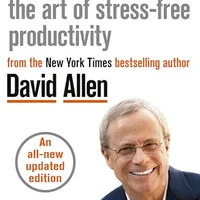
Getting Things Done — David Allen (Revised)
As an Amazon Associate, we earn from qualifying purchases — at no extra cost to you.
-
Build a physical transition into the ritual. Five minutes is enough. A short walk, a few stretches, a change into different clothes. Something embodied that marks the shift from work mode to life mode.
-
Protect the first 30 minutes after your shutdown ritual. No email, no Slack, no just-one-quick-check. Give yourself enough time to register that the day is actually over. This window is where detachment either takes hold or collapses.
burnout recovery what it takes to feel like yourself again

A note of honesty: for people dealing with significant work-related anxiety — persistent dread, regular 3 AM wake-ups, difficulty concentrating even on weekends — these techniques are genuinely useful at the margin but are not a replacement for working with a therapist. The research on psychological detachment describes a spectrum, and at the far end of that spectrum the experience has a different name.
Recovery Is Part of the Design
Think of how well-designed systems build in downtime. Machines get maintenance windows, and athletes schedule rest days, because performance without recovery tends to erode.
You're not different.
The evenings you spend mentally still at the office don't count as rest. They keep your attention and your stress response engaged, and they leave tomorrow's version of you starting from a deficit. They just keep the bill running.
There's a sleep dimension to this, too. Ongoing rumination at bedtime has been linked to longer sleep onset times and less restorative sleep architecture — meaning the hours you get are doing less work than they should. Recovery doesn't wait for you to decide to prioritise it. It stops accruing while you're still thinking about work.
Designing your recovery — with the same intentionality you'd bring to your schedule, your goals, your morning — is how you make sure you start each day from a fuller tank rather than a deficit carried forward from the last one. Not ragged. Not still holding yesterday's unresolved threads. Fresh. That's what designing your evolution looks like in practice: not a grand gesture, but a deliberate close.
And it starts tonight — about thirty minutes before you'd normally give up and scroll yourself to sleep.
What does the end of your workday actually look like right now — and where does work genuinely end?
Was this helpful?