Habits· 10 min read
Why You Forget Everything You Read — What Science Says
You forget 70% of what you read within 24 hours. Cognitive science has actual solutions — and highlighting isn't one of them.

Why You Forget Everything You Read — What Science Says
Last year I finished a 300-page book on decision-making that genuinely changed how I thought. Took me three weeks. I highlighted sentences on nearly every other page. Felt brilliant the entire time I was reading it.
Six weeks later, a friend asked me what the book was about.
I could remember the cover. Something about cognitive biases, maybe. I remembered underlining things that felt important.
That was it. I'd spent three weeks asking how to read more. I'd never stopped to ask how to actually remember what I read.
Here's the part that bothered me most: this wasn't unusual. Most books I'd read in the previous two years had quietly dissolved into the same fog — a vague sense that I'd encountered something valuable, plus the ability to say "oh yeah, I've read that" at dinner parties. Not one idea I could explain from memory. Not one principle I was actually applying.
The problem isn't retention. It's method.
Almost everything you've been taught about learning from books — and most of what popular reading advice promotes — is designed to help you finish books, not retain them. Finishing and retaining are not the same activity. And the strategies that feel most productive turn out, in many cases, to be the ones that produce the least lasting knowledge.
Here's what the cognitive science actually says about how to remember what you read — and why the approach most people use has been working against them.
The Uncomfortable Mathematics of Forgetting
In the 1880s, a German psychologist named Hermann Ebbinghaus conducted what may be the most obsessive self-experiment in the history of learning science. He memorized lists of nonsense syllables — strings of letters with no meaning, no associations, no memory hooks — and then tested his own recall at precise intervals, recording exactly how much he'd forgotten each time.
He had no funding. No lab. No research assistants. Just himself, a notebook, and an uncomfortable willingness to document how bad his memory actually was.
What he found has been replicated more than a hundred times in the 140 years since.
Without deliberate intervention, you forget approximately 50% of newly learned information within one hour of encountering it. By 24 hours, roughly 70% is gone. After a week, nearly 90% has evaporated.

The forgetting curve is steep. And it applies to everything you read.
That chapter you found genuinely interesting last Tuesday? If you haven't actively returned to it since, you've probably retained maybe one idea — and that idea is likely one you already half-believed before you read the chapter.
This isn't a character flaw or a weak memory. It's the default operating mode of human cognition. The brain treats unretrieved information as low priority and begins offloading it almost immediately. The forgetting isn't a malfunction. It's a feature — one that made perfect evolutionary sense in an environment where important things got repeated and everything else was safely discarded.
The problem is that reading generates the sensation of learning while doing almost nothing to override this default. Reading feels productive. The experience of following an argument, recognizing an insight, feeling your thinking expand — these are real experiences. They're just not the same as encoding.
John Dunlosky, a cognitive psychologist at Kent State University, published a landmark 2013 review in Psychological Science in the Public Interest that evaluated ten of the most common study and learning strategies against the quality of evidence supporting them. The results were uncomfortable: highlighting and underlining — by far the most popular reading strategy — received a "low utility" rating. Not because they do nothing, but because they create what researchers call fluency illusions. The material feels familiar after you've highlighted it, so it feels known. That familiarity is real. The retention is not.
Re-reading scores only marginally better. It generates recognition — "I've seen this before" — while creating almost no durable memory trace.
So if the most common strategies don't work, what does?

Sony WH-1000XM5 Noise Cancelling Headphones
Retrieval practice demands real focus — closing the book and pulling ideas from memory only works if your environment isn't fighting you for attention.
As an Amazon Associate, we earn from qualifying purchases — at no extra cost to you.
The Strategy That Doubles Retention (Almost Nobody Uses It)
In 2006, Henry Roediger and Jeffrey Karpicke at Washington University ran an experiment that should have changed how everyone reads.
They gave college students a prose passage to study. One group re-read it four times. Another group read it once and then, without looking at the text, wrote down everything they could remember.
One week later, the recall group remembered 50% more.
Not 10% more. Fifty percent more. From a single reading followed by a memory attempt.
The mechanism is direct: every time you try to retrieve information from memory, you strengthen the neural pathways associated with it. The struggle to pull something back — including the errors, the blanks, the uncertain half-memories — is itself the learning event. Re-reading strengthens familiarity. Retrieval strengthens memory.
Robert Bjork at UCLA, who has spent decades studying what he calls "desirable difficulties" — challenges that feel harder in the moment but produce dramatically better long-term retention — identifies retrieval practice as the single most reliably powerful intervention in the learning research literature. The discomfort of not immediately recalling something isn't evidence of failure. It's the mechanism by which deeper learning happens.
The practical implementation is almost aggressively simple: after reading a section or a chapter, close the book and write down everything you can remember without looking. Not a summary from someone else. Not your highlights. Everything you can pull from memory, in your own words, onto a blank page.
A dedicated notebook for this practice is worth far more than an elaborate annotation system.

Full Focus Planner by Michael Hyatt
The article explicitly recommends a dedicated notebook for the blank-page free-recall method — a structured planner gives that practice a permanent home.
As an Amazon Associate, we earn from qualifying purchases — at no extra cost to you.
Then open the book and check what you missed or got wrong. The gaps you find are exactly what need revisiting — and the act of discovering them is itself an encoding event. You're not looking for a perfect score. You're looking for the precise locations where your understanding broke down.
This goes by different names — "the blank page method," "free recall," "retrieval practice." What you call it doesn't matter. What matters is the principle: attempting to retrieve information from memory, even unsuccessfully, produces more durable learning than any amount of re-reading.
The book you most want to actually know is the one most worth closing early.
building better learning habits into your daily routine
The Review Timing That Makes the Forgetting Curve Work For You
Ebbinghaus didn't just document how quickly we forget. He also found something more practically useful: the optimal moment to review.
When you revisit material just before you'd otherwise forget it — not immediately after reading, and not months later, but at the edge of forgetting — the memory strengthens more than it would at any other point. This is the principle behind spaced repetition: reviewing information at progressively increasing intervals produces dramatically better long-term retention than reviewing the same material repeatedly in a compressed window.

The intervals that the research supports roughly look like this: review the day after initial learning, then four days later, then one week after that, then two weeks, then a month. Each review at the right moment extends the interval before the next one is needed. The sessions grow farther apart as the memory consolidates.
Sebastian Leitner operationalized this insight in the 1970s with a simple card box system. Apps like Anki automate the scheduling entirely — you add what you want to retain, the algorithm handles the timing.

Kindle Paperwhite 2024 (16GB)
Spaced reviews are easiest when your library is searchable and portable — a Kindle lets you revisit highlighted passages exactly when the forgetting curve says you should.
As an Amazon Associate, we earn from qualifying purchases — at no extra cost to you.
You might review a concept you learned six months ago for thirty seconds today and not see it again for two months.
The counterintuitive implication: reviewing a chapter three times in a single week produces far less long-term retention than reviewing it once a week for three weeks. Massed repetition feels productive because you're generating short-term familiarity. Spaced repetition feels slower because you're deliberately letting yourself partially forget between reviews.
That partial forgetting is the mechanism. Not the obstacle.
The Feynman Test: If You Can't Explain It, You Don't Know It
Richard Feynman won the Nobel Prize in Physics and was widely considered the finest science teacher of his generation. Both attributes came from the same source: he flatly refused to accept any explanation he couldn't immediately give back in plain language.
His learning method: after studying something, explain the central idea to someone with no prior exposure to the subject. No jargon. No technical shorthand. Just the idea itself, in the simplest terms that preserve the actual meaning.
The places where your explanation breaks down — where you reach for vocabulary the listener couldn't understand, or where you lose the thread of the mechanism — those are the places where your understanding is a fluency illusion rather than genuine comprehension. You've been tracking the sentences without grasping how the thing actually works.
Nassim Taleb draws a useful distinction here between episteme — theoretical knowledge, knowing about something — and techne — practical knowledge, knowing how something actually works. Most reading produces episteme. You know about the topic. The Feynman test is the bridge from knowing about to actually knowing, because attempting to explain something forces you to either construct the mechanism clearly in your mind or discover that you can't.
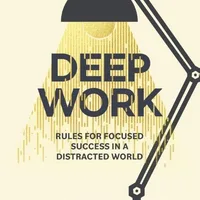
Deep Work — Cal Newport (Productivity Books, Deep Work edition)
The Feynman test is about genuine comprehension over fluency illusions — Newport's case for deliberate, distraction-free learning is the natural companion read.
As an Amazon Associate, we earn from qualifying purchases — at no extra cost to you.
A book you can explain in your own words to someone who hasn't read it is a book that's in your memory. A book you can reference but not explain is in your highlights.
Try this with the last chapter you finished. Pick the most important idea. Explain it out loud, as if a smart friend with no background in the subject just asked you what it said. Give yourself two minutes.
The parts where you stumble are exactly the parts worth returning to.
mental models for better thinking and decision-making
Why Reading One Book at a Time Might Be Holding You Back
This one will feel wrong before it feels right.
Bjork's desirable difficulties research also documents the advantage of interleaving — mixing different types of material during a learning session rather than blocking practice of a single type. Instead of reading three consecutive chapters of the same book, try reading one chapter from three different books and interleaving your recall attempts between them.
It feels slower. It feels less focused. Learners consistently rate interleaved practice as harder and less effective than blocked practice — while consistently performing better on delayed retention tests.
The mechanism is transfer: every time you shift topic, the brain has to reload and re-identify the relevant knowledge framework for the new material. This reloading strengthens the associations between concepts and makes the knowledge more flexible — accessible in new contexts, not just in the original context where you learned it.
Blocked practice produces knowledge that's highly accessible when you're thinking about that text. Interleaved practice produces knowledge you can actually use when you're not thinking about the text at all.
This is also why reading across genres and disciplines — not staying inside your professional lane — produces the cross-domain thinking most people associate with genuine insight. The person who reads widely isn't diluted by the breadth. They're equipped by it.
How to Start Today: The Minimum Effective System
You don't need to redesign your entire reading life at once. The minimum effective version:
Step one: Close the book after every chapter. Write down everything you remember on a blank page without looking.
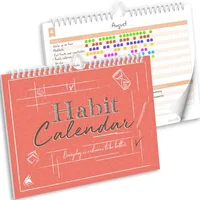
Clever Fox Habit Tracker Journal
Step one is closing the book and writing recall on a blank page — a habit journal turns that into a daily, trackable ritual rather than a one-off.
As an Amazon Associate, we earn from qualifying purchases — at no extra cost to you.
Don't worry about what you miss — the attempt is the point. Then check what you got wrong or forgot. That gap is your next study session.
Step two: Space your reviews. Don't reread the same chapter that evening. Come back to your recall notes 48 hours later. Try to recall again without re-reading. Review again one week after that. The intervals are the method, not the content.
Step three: Apply the Feynman test to anything that genuinely matters. If you can't explain it to an intelligent person who hasn't read the book, you don't know it yet. Go back and read to understand, not to finish the chapter.
Step four: Stop treating highlighting as a learning event. If you highlight, treat it strictly as a bookmark — a flag for things to test yourself on later, not as retention itself.
Step five: Build a lightweight spaced repetition system for ideas worth keeping. The ideas worth keeping are worth ten seconds of setup. The review load stays manageable because the intervals grow as memories strengthen.
None of this requires more reading time. It requires redirecting your attention from pages consumed to information retained. Those aren't the same metric — and most reading advice optimizes for entirely the wrong one.
daily planning routines that compound knowledge over time
The Gap Between Reading and Knowing
Hermann Ebbinghaus had no smartphone, no app, no productivity system. He had a notebook, some nonsense syllables, and a clear-eyed willingness to document how unreliable his memory was. What he discovered wasn't discouraging — it was precise. The forgetting curve isn't a character flaw. It's the default setting. And like any default setting, it can be deliberately changed.
The research is unambiguous about one thing that almost no popular reading advice acknowledges: reading is a method of generating material for your memory to work on. The memory work is what produces retention. Not the reading itself.
A book read once with genuine retrieval practice will be retained more durably than a book read four times with highlighting. A book you can explain, from memory, in your own words — that book is yours. A book you can reference but not explain belongs to your highlights, not your thinking.
Designing your evolution requires that the knowledge you invest time in acquiring actually becomes part of how you think — not just part of your reading history. There is a real difference between a reading list and an education. That difference is what you've tested yourself on.

TIJN Blue Light Blocking Glasses (Clear Frame Square)
Sustained reading and review sessions on screens are easier on the eyes with blue-light filtering — a small comfort upgrade for anyone reading to actually remember.
As an Amazon Associate, we earn from qualifying purchases — at no extra cost to you.
So here's a question worth sitting with: what's the central argument of the last chapter you read — not the book, just the last chapter — and can you explain it right now, from memory, in two sentences?
That answer tells you more about where your reading practice actually stands than any list of books you've finished. And it tells you exactly where it can start to change.
Was this helpful?