Mindset· 9 min read
Experiential Avoidance: Why Fighting Feelings Backfires
ACT research found that fighting unwanted feelings — called experiential avoidance — makes them worse. Here's what actually works instead.

Why Every Attempt to Fight an Unwanted Feeling Makes It Harder to Shake
There's a presentation you have to give in three hours. Your hands are already slightly cold. Your mind is doing that thing where it replays every version of how this could go wrong, and you catch yourself thinking: stop it, just stop thinking about this.
So you try. You push the anxiety to the side. You distract yourself, scroll your phone, make a second coffee you don't need. And the feeling — somehow — gets louder. By the time you walk into the room, the anxiety you spent three hours fighting is sitting right there with you, heavier than it was at the start.
This isn't a character flaw. It's a well-documented psychological mechanism called experiential avoidance — and understanding it, not just as a vague idea but as a specific research finding, changes how you approach every hard moment that comes after.

The Promise That Set Most of Us Up to Fail
The self-help industry has an implicit operating model: negative feelings are the enemy. The job is to reduce them, manage them, reframe them into something more useful, or push through them fast enough that they don't slow you down.
This model is intuitively appealing. It matches how we treat physical pain — if something hurts, you find the source and remove it. It fits neatly with the productivity culture that frames uncomfortable emotions as inefficiencies to be optimized away. Get in the right headspace, then execute. Feel confident first, then make the call. Resolve the anxiety, then do the thing.
The problem is that the research doesn't support it. And the research that contradicts it most directly came from a group of psychologists who spent years building one of the most thoroughly tested psychological frameworks of the last four decades.
Steven Hayes, Kirk Strosahl, and Kelly Wilson formalized Acceptance and Commitment Therapy — known as ACT — in their 1999 book Acceptance and Commitment Therapy: An Experiential Approach to Behavior Change.
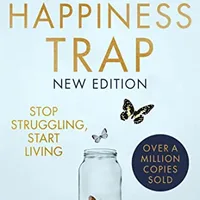
The Happiness Trap, 2nd Edition — Russ Harris
The article names the foundational 1999 ACT text, which is a clinical textbook. The Happiness Trap is the accessible trade version of the same framework by an ACT trainer — the correct reader-facing next step, not a b…
As an Amazon Associate, we earn from qualifying purchases — at no extra cost to you.
At the center of the framework was a finding that ran against decades of conventional therapeutic advice: the more deliberate effort a person puts into suppressing, avoiding, or eliminating an unwanted internal experience — a difficult emotion, an intrusive thought, an uncomfortable memory — the more psychological suffering that effort tends to produce.
They gave this pattern a name: experiential avoidance.
What Experiential Avoidance Actually Looks Like
Most people picture emotional avoidance as something dramatic — numbing pain with alcohol, fleeing a difficult relationship, refusing to talk about grief. And yes, those count. But experiential avoidance, in the clinical sense Hayes and colleagues described, is far more ordinary than that.
It's changing the subject in your own head the moment a hard thought surfaces. It's keeping your schedule so full there's no quiet moment where difficult feelings might catch you. It's the second-guessing loop that looks like problem-solving but is actually a way of not sitting with uncertainty. It's telling yourself "I just need to get in the right headspace" before doing the thing that scares you — and never quite arriving there.
The range is wide: distraction, suppression, rumination disguised as analysis, busyness used as armor. What all of these share is the same underlying logic — that the unwanted internal experience is the problem, and that your job is to reduce or eliminate it before doing what you actually want to do with your life.
ACT's research found that logic is wrong. Not just unhelpful — empirically wrong, in the sense that the data show it reliably produces more of what you're trying to get away from.
A large body of subsequent research, summarized in Hayes and colleagues' 2006 meta-analytic review published in Behaviour Research and Therapy, found that experiential avoidance was a consistent predictor of poor outcomes across anxiety, chronic pain, workplace stress, and trauma — not because these conditions were inherently harder to deal with, but because the avoidance strategy itself was making them harder.
See also: Rumination: Why Overthinking Makes You Feel Worse
The mechanism isn't mysterious. When you're actively trying not to feel something, your brain has to keep checking whether you're succeeding. Monitoring requires the thing being monitored to remain activated. The more vigilantly you try to push a feeling out of awareness, the more reliably it stays in awareness. You're not removing the thought. You're putting it on patrol.
Acceptance Isn't What You Think It Is
Here's where most people get stuck — because the logical alternative to fighting a feeling sounds like simply enduring it. Accept that you're anxious. Accept that you're grieving. Accept that you're terrified of the presentation. And then what? Sit there feeling awful?
That's not what ACT describes. And this distinction is the part of the research that most popular treatments of it flatten into something less useful.
In Hayes and colleagues' framework, acceptance of an internal experience is always paired with something else: continued, deliberate action toward your actual values. The acceptance isn't the destination. It's the condition under which you keep moving.
The model's data suggest a specific revision to the sequence most of us are running: we tend to operate on a "feel better first, then act" model. Deal with the anxiety, then make the call. Resolve the self-doubt, then write the thing. Shake the grief, then re-engage. ACT's research found this sequence is backwards — or at least, that waiting for it to complete reliably delays action indefinitely while doing nothing to reduce the difficult feeling.
The sequence the data support is different: act on your values while carrying the discomfort. Not despite it, not after it clears, but alongside it — with the discomfort still fully present.
This doesn't mean white-knuckling your way through every hard moment. It means noticing the unwanted feeling with something closer to curiosity than combat, and then asking: what would I do right now if I weren't trying to make this feeling go away first?

What This Has to Do With Psychological Flexibility
The core outcome variable in ACT's research isn't reduced anxiety. It isn't more positive emotional states. It's psychological flexibility — defined by Hayes and colleagues as the capacity to stay present with your internal experience, including the uncomfortable parts, while still taking action in the direction of what matters to you.
This might sound like a subtle distinction from standard emotional management. In practice, it produces meaningfully different outcomes.
The 2006 meta-analysis found that psychological flexibility — not symptom reduction — predicted functional outcomes across multiple domains. People who developed the capacity to carry difficult feelings alongside their actions, rather than requiring those feelings to resolve first, showed measurably better results in treating anxiety, chronic pain, and workplace stress than people whose interventions targeted symptom elimination as the primary goal.
This is also where ACT separates clearly from Aaron Beck's cognitive behavioral research on catastrophizing — a common point of confusion worth clearing up. Beck's CBT work, which is genuinely well-supported, targets the specific content of a distorted thought. If you're catastrophizing, the intervention involves examining whether the thought reflects an accurate probability estimate of a worst-case outcome, and correcting the distortion.
ACT isn't targeting the thought's content at all. It's targeting your relationship to the thought. The goal isn't to conclude the anxious thought is irrational. It's to notice that you're having the thought, treat it as a mental event rather than a fact about the world, and continue acting on your values regardless. You can hold a fear and take the step. The research suggests that capacity — not the elimination of the fear — is what actually produces a workable life.
See also: Cognitive Reappraisal: The Science of Changing Emotions
How to Start Using This Today
Understanding a research finding and actually applying it are two different things. Here's a practical translation of what Hayes and colleagues' work suggests.
Step 1: Name the experience without labeling it a problem.
When a difficult feeling surfaces, the first move is simply to notice and name it — "I'm noticing anxiety," "there's a lot of dread here," "I'm aware of the urge to avoid this" — without immediately treating the feeling as a problem to solve. This isn't suppression, and it isn't dramatizing. It's observing.
A good journal for this kind of structured reflection helps significantly, especially when you're building the habit from scratch.

Clever Fox Habit Calendar Circle (24-Month Habit & Goal Tracker)
Step 1 asks the reader to name an experience without labelling it a problem — a repeated daily noticing practice. This is the only slot the article pre-sells itself; the product must match the sentence exactly or the…
As an Amazon Associate, we earn from qualifying purchases — at no extra cost to you.
Step 2: Notice what you're doing to avoid or fight it.
This requires honest inventory. What's the avoidance behavior? Checking the phone when the anxiety spikes? Replanning instead of executing? Saying "I'll do it when I feel more ready"? The avoidance is almost always more subtle than you expect. Naming it is the first way to interrupt it.
Step 3: Identify one value — one actual thing that matters to you — that you can act on right now.
ACT's framework distinguishes between goals (endpoints) and values (directions). A goal is finish the project. A value is doing work you can stand behind. You can act on a value even when the goal feels impossibly far away, and even when the anxiety is still fully present. What would acting on your actual value look like in the next ten minutes?
Step 4: Take the step while the feeling is still there.
This is the move that runs counter to every instinct. Not "push through it" in a grit-your-teeth sense. More like: pick up the phone, open the document, or send the email — with the discomfort sitting right there alongside you, acknowledged but not obeyed. The data suggest this specific action, repeated, is what builds the psychological flexibility ACT's research measured.
A good timer or focus tool can be useful here, particularly for people who find that extended unstructured time is where the avoidance tends to settle in. Structured intervals — twenty-five minutes of work followed by a deliberate break — remove the open-endedness that avoidance loves.
See also: Why You Procrastinate: It's Not Laziness, It's Emotion


Philips SmartSleep Wake-Up Light HF3520 (Coloured Sunrise Simulation)
The closing argument is that you design the relationship you hold with friction rather than removing the friction. A device that changes how you enter the day — rather than one that removes a problem — is the on-thesi…
As an Amazon Associate, we earn from qualifying purchases — at no extra cost to you.
The Design Insight
Jim Rohn used to say that you can't hire someone else to do your push-ups for you. There's a parallel insight in ACT's research: you can't eliminate your way to a flexible life. Psychological flexibility — the measured outcome that actually predicted better functioning across Hayes and colleagues' research — isn't the result of successfully removing discomfort from the equation. It's built precisely through the repeated act of moving toward what matters while the discomfort is still in the room.
This is a genuinely different operating model than most productivity frameworks offer. The standard version says: optimize your state first, then perform. ACT's data say: perform while your state is what it is.
It means the anxious presentation you're about to give isn't something to overcome before the growth happens. It's where the growth is happening. The discomfort you're carrying into the room isn't noise in the system. Carried deliberately, alongside continued action, it's the mechanism itself.
"Design Your Evolution" doesn't mean designing a life without friction. It means designing the relationship you hold with that friction — because that relationship, more than the friction's presence or absence, is what determines whether you actually move.
What's the feeling you've been trying to resolve before allowing yourself to act on something that genuinely matters to you? And what would one step in that direction look like — right now, with the feeling still present?
Was this helpful?
Continue Your Evolution
The Frozen Goal Problem: Why Tiny Wins Beat Grand Plans
Rejection Sensitivity: Why You Keep Assuming They're Upset
The Science of Nostalgia: Why Looking Back Helps
Sedikides and Wildschut found nostalgia boosts mood, meaning, and social connection — not mere sentimentality. Here's the science and how to use it.