Habits· 10 min read
4 Daily Habits That Are Quietly Holding You Back
ACT research links experiential avoidance to 4 everyday habits that quietly keep you stuck. What they are, why they work, and how to break them.
4 Daily Habits That Are Quietly Holding You Back
There's a specific moment I want you to picture. You've just sat down. No meeting for another 20 minutes, inbox cleared, coffee in hand. And before the silence even fully settles — before your mind has a chance to wander anywhere — your thumb unlocks your phone.
You're not looking for anything. You don't even want to scroll. But you do it anyway.
That's not a small thing. That automatic reach — and the daily habits built around it — is the same mechanism behind the email you rewrote 11 times before sending, the goal you've been "preparing" for since January, and the evenings that somehow disappear into Netflix and ambient noise. It has a name in psychology: experiential avoidance. And according to more than three decades of research, it's one of the most reliable predictors of whether your life gets better or stays exactly where it is.
The Science Behind Habits That Feel Harmless
Steven Hayes is a psychologist at the University of Nevada who spent his career building a therapeutic framework called Acceptance and Commitment Therapy — ACT, pronounced as one word. The central idea is something he calls psychological flexibility: the capacity to stay in contact with the present moment and keep moving toward what actually matters to you, even when doing so is uncomfortable.
Its opposite — psychological inflexibility — is driven by a single mechanism more than any other: the attempt to control, suppress, or escape your own internal experiences. Thoughts. Feelings. Memories. Physical sensations. The discomfort of uncertainty, boredom, or inadequacy. When you organize your daily behavior around avoiding those internal experiences, you are practicing experiential avoidance. And the tricky part is that it almost never looks like avoidance.
It looks like productivity. Like preference. Like self-care.
Experiential avoidance defined: the habitual attempt to reduce, control, or escape uncomfortable internal states — thoughts, emotions, physical sensations — even when doing so conflicts with your values and long-term goals. It is the opposite of psychological flexibility, and it predicts poor outcomes across nearly every domain of human functioning.
Todd Kashdan and Jonathan Rottenberg's 2010 literature review in Clinical Psychology Review synthesized research across multiple psychological domains to establish psychological flexibility as a strong predictor of wellbeing, work performance, relationship quality, and physical health. Its inverse — inflexibility driven by avoidance — predicted anxiety, depression, chronic pain disability, and substance use problems with effect sizes comparable to major life events.
Read that again: daily avoidance habits carry the weight of major life events. Accumulated quietly, over years.
Dan Wegner at Harvard added the cognitive mechanism that makes this so hard to escape. His research on ironic processes documented that the attempt to suppress a thought actively keeps that thought in circulation — the monitoring system required to enforce the suppression has to continuously search for the avoided content, which paradoxically prioritizes it. Trying not to think about something increases how often you think about it. Trying not to feel anxiety before a presentation generates more anxiety.
The habits that trap the most capable, self-aware people aren't dramatic. They're Tuesday afternoon. They're completely ordinary. Here are the four that show up most consistently in the research.
psychological flexibility stop getting trapped in your mind
Habit 1: Rumination Disguised as Problem-Solving
You know the loop. Something's unresolved — a conversation that didn't land right, a decision you haven't made, a goal you haven't started — and you think about it. Then you think about it again. And again.
Each cycle feels like you're working on it. You're processing, considering angles, being thorough. You're not procrastinating; you're being responsible.
Except nothing new enters the loop. You're revisiting the same information, the same scenarios, the same concerns, without generating anything that would actually resolve them. That's the distinction between genuine problem-solving (which requires new information or a new decision) and rumination (which is the brain's way of avoiding the discomfort of uncertainty by staying busy near the problem without engaging with it).
Rumination is avoidance because the thing you're actually avoiding isn't the problem — it's the discomfort of not knowing. Sitting with uncertainty long enough that you might have to act without certainty.
The research on rumination is unambiguous: it doesn't clarify. It amplifies. Psychologist Susan Nolen-Hoeksema — who held professorships at Stanford, the University of Michigan, and Yale — spent more than two decades documenting that ruminative thinking styles are among the strongest predictors of clinical depression. The 2008 review she co-authored in Perspectives on Psychological Science with Blair Wisco and Sonja Lyubomirsky established that it's not the severity of problems being ruminated about that drives distress — the loop itself is the mechanism.
The fix isn't to think less. It's to give the thinking a container and an exit: write the concern down in full, decide whether there's an action to take today, and consciously close the loop. If there's no action, it goes on the list. If there is one, you schedule it. The loop doesn't get to run freely.

Clever Fox Habit Calendar Circle (2-Year Habit Tracker)
Rumination needs a container and an exit. Writing the concern down in full — then deciding whether there's an action today — closes the loop instead of letting it run freely.
As an Amazon Associate, we earn from qualifying purchases — at no extra cost to you.
Habit 2: Excessive Planning as Postponement
This one is harder to see, because planning is valuable. The issue is the ratio of planning to doing — and what the planning is protecting you from.
Here's the tell: your plans are very detailed. You've researched the topic thoroughly. You've bought the notebook. You've outlined the approach, identified the obstacles, mapped the first three months. What you haven't done is start.
Excessive planning is the intellectually sophisticated version of the same avoidance mechanism. The discomfort you're avoiding isn't laziness — it's the specific vulnerability of attempting something that could fail. As long as you're planning, you're in a position of potential. The moment you start, you're in a position of evidence. You might find out you're not as capable as you believed. You might make visible mistakes.
Planning feels productive because it is productive — right up until it becomes the primary activity instead of the preparation for the primary activity.
Jim Rohn captured this with characteristic economy: "Discipline is the bridge between goals and accomplishment." Planning builds one bank of the bridge. At some point you have to walk across.
The ACT framework offers a useful reframe here: the willingness to fail at the thing is the prerequisite for succeeding at it. Not the willingness to fail conceptually (anyone can accept failure in the abstract), but the concrete willingness to sit with the uncertainty of a real first attempt.
Habit 3: Scrolling and Comparison as Identity Avoidance
Of the four habits, this is the one most people are aware of but least equipped to address — because the solutions usually focus on the behavior (stop scrolling) rather than the function (what the scrolling is doing).
Here's what it's doing: it's answering a question you haven't directly asked yourself. Am I doing okay? Am I where I should be? Do I measure up?
Social media scrolling functions as a continuous external audit of your own adequacy. Each pass through the feed collects data points about how others appear to be performing, how your life compares to the constructed highlights of people you've never met, what success and relationship and productivity look like from the outside. It feels passive — you're just watching. But internally, it's actively engaged in the work of answering identity questions through external comparison.
The problem is that the answer is never satisfying, because the question can't be answered this way. How you're doing relative to strangers' highlight reels is not the same question as whether you're living in alignment with your own values. And the only place the second question gets answered is in direct contact with your own values — which is precisely the kind of inward attention that scrolling perpetually postpones.
social comparison theory why you cant stop measuring yourself
The research on social comparison and wellbeing is consistent: upward social comparison (comparing yourself to people who appear to be doing better) reliably decreases motivation and increases envy, particularly when the comparison target feels both relevant and unattainable. Downward comparison produces temporary reassurance that dissipates quickly. Neither answers the question actually driving the behavior.
What does? Deliberate, even uncomfortable, contact with your own values. What do you actually want? Not what looks good. Not what the feed says you should want. What genuinely matters, to you specifically, right now.
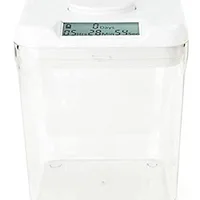
Kitchen Safe kSafe Time Locking Container (Medium)
Scrolling is an external audit of your own adequacy that never resolves. A physical time-lock removes the device from the loop so inward attention can actually happen.
As an Amazon Associate, we earn from qualifying purchases — at no extra cost to you.

Habit 4: Emotional Numbing Through Stimulation
The fourth habit is the most invisible, because it looks like leisure.
After a hard day — or an ordinary day that felt hard — you fill the evening with content. A show you're not that invested in, a podcast running as background noise, music through headphones while you move through the apartment. Not because you're enjoying it particularly. Because silence has started to feel uncomfortable.
The specific discomfort silence activates varies by person: loneliness, inadequacy, unresolved grief, the low-grade dread of a life that isn't quite what you imagined. Whatever it is, it surfaces in stillness. And so you fill the stillness.
This is emotional numbing, and it's one of the most common applications of experiential avoidance in modern life. The cost isn't immediately visible — you're resting, right? You're not doing anything harmful. But what you're systematically preventing is the quiet in which unresolved feelings get processed, in which genuine insights surface, in which the mind does the background work that only happens in the absence of external stimulation.
Malia Mason's research at Columbia Business School on the default mode network — the constellation of brain regions that activate specifically during rest and undirected mental activity — established that this network is not idle. It's handling imagination, perspective-taking, autobiographical memory integration, and future planning. These are not minor functions. They're the substrate of the most valuable thinking you do.
Chronic stimulation suppresses the default mode network. The Netflix habit isn't just time you're not spending on other things — it's actively suppressing the neural conditions under which your most important mental work occurs.

Kindle Paperwhite (2024, 16GB)
The Netflix/background-noise habit suppresses the default mode network. Replacing passive stimulation with intentional reading restores the quiet where insight surfaces.
As an Amazon Associate, we earn from qualifying purchases — at no extra cost to you.
How to Start Today
The goal here isn't to eliminate discomfort. That's the avoidance reflex talking. The goal is to develop the capacity to notice when you're avoiding something — and to make a conscious choice about whether the short-term relief is worth the long-term cost.
Here's what that looks like in practice:
1. Run a 24-hour avoidance audit. For one day, every time you feel a pull to check your phone, reread a plan, scroll, or put something on in the background, pause for three seconds and ask: What am I not wanting to feel right now? You don't have to do anything differently. Just notice.
2. Name the feeling before the behavior. The two-second gap between the impulse and the action is where psychological flexibility lives. "I notice I want to open Instagram. What's here underneath that?" Often the answer is vague discomfort — and vague discomfort, once named, loses much of its urgency. Research on affect labeling — putting feelings into words — consistently shows reduced amygdala activation when emotions are identified rather than suppressed, which is why even imprecise naming ("there's something uncomfortable here") moves the needle.
3. Use a structured worry time. For rumination specifically: designate 15 minutes in the early afternoon to think about whatever is unresolved. Everything else that surfaces during the day gets deferred to that window. The loop doesn't disappear — but it has a container.

Full Focus Planner by Michael Hyatt (Linen Hardcover)
A structured 15-minute worry window and deferred concerns need somewhere to live. A planner gives rumination a fixed container and a scheduled exit.
As an Amazon Associate, we earn from qualifying purchases — at no extra cost to you.
4. Replace stimulation with tolerated boredom. Start with ten minutes. No phone, no podcast, no background TV. Just whatever surfaces. The first week this is uncomfortable. The second week it becomes interesting. By the fourth week, it's the most productive ten minutes of your day — because the default mode network has been given space to run.
5. Read the ACT framework properly. Russ Harris's The Happiness Trap is the most accessible entry point to Steven Hayes's work — a practical, exercise-driven guide to building psychological flexibility that treats your daily avoidance patterns not as character flaws but as learned behaviors with clear, trainable alternatives.
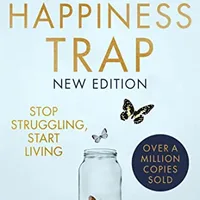
The Happiness Trap (2nd Edition) — Russ Harris
Explicitly named in the article as the most accessible entry point to Steven Hayes's ACT work — a practical, exercise-driven guide to psychological flexibility.
As an Amazon Associate, we earn from qualifying purchases — at no extra cost to you.
why willpower never breaks a bad habit

The Uncomfortable Truth About "Productive" Avoidance
Here's the counter-intuitive claim, and I stand by it: the most capable, motivated, high-functioning people are often the most sophisticated avoiders. Because the less sophisticated forms of avoidance — obvious procrastination, distraction, inertia — have already been engineered out of their systems. What remains is the elegant kind. The kind that wears the clothes of productivity.
The person preparing obsessively for the launch they won't make. The person solving the problem they've already solved, again. The person whose evenings are full and whose inner life is very, very quiet.
Designing your evolution doesn't mean removing difficulty from your experience. It means developing the capacity to stay present with difficulty long enough that you can actually do something with it.
The habits holding you back aren't dramatic failures. They're the small, reasonable, completely understandable choices you make 40 times a day to feel slightly more comfortable — at the expense of the growth that slightly more discomfort would have produced.
Start with one. Just one habit, one week. Notice what's underneath it.
What you find might surprise you. But it won't keep you stuck.
Which of these four patterns do you recognize most in yourself — and what does it tend to appear around? The comments are the most honest place in this whole site.
→ The Fresh Start Effect: Why September Feels Like a New Beginning
Was this helpful?
Continue Your Evolution
The Frozen Goal Problem: Why Tiny Wins Beat Grand Plans
Rejection Sensitivity: Why You Keep Assuming They're Upset
The Science of Nostalgia: Why Looking Back Helps
Sedikides and Wildschut found nostalgia boosts mood, meaning, and social connection — not mere sentimentality. Here's the science and how to use it.