Productivity· 9 min read
Parkinson's Law: The Reason Every Task Takes Too Long
C. Northcote Parkinson found work reliably expands to fill all available time. Here's the science behind deadlines — and how to use it to finish faster.

Parkinson's Law: Why Every Task Expands to Fill the Time You Give It
The email was supposed to take twenty minutes.
That was the plan, anyway. By the time I finally sent it — three hours and forty minutes later — I'd rewritten the opening four times, Googled two tangential facts I didn't need, and spent a full seventeen minutes debating whether to end with "Best" or "Thanks." The email was four sentences long. The email was always going to be four sentences long.
I'd bet you've done something almost identical this week — this is Parkinson's Law in action, and it runs on a logic that's worth understanding. Maybe it wasn't an email. Maybe it was a presentation that ate an entire afternoon when two solid hours would have been more than enough. Maybe it was a report that quietly expanded to swallow your Friday. The experience is reliable enough that understanding why it happens is the only thing that actually changes it.

What C. Northcote Parkinson Actually Found
C. Northcote Parkinson wasn't a productivity coach or a behavioral psychologist. He was a British naval historian, and in November 1955 he published what he probably intended as a satirical essay in The Economist. The piece opened with what has since become one of the most quoted lines in management: "Work expands so as to fill the time available for its completion."
Parkinson wasn't writing fiction. He was describing something he'd observed in real organizational data — specifically, the staffing levels of the British Colonial Office.
Here's what the numbers showed: between 1935 and 1954, Colonial Office staff grew from 372 to 1,661 — an increase of roughly 350 percent. During the same period, the number of colonies being administered — the actual workload — had been shrinking steadily as the British Empire contracted. By 1954, the office employed more people than it ever had, managing fewer colonies than it had in decades.
This wasn't a mystery of laziness or malice. Parkinson identified two mechanical forces driving it. First, officials in any bureaucracy tend to multiply subordinates rather than rivals — it's safer to your position to add someone beneath you than alongside you. Second, those additional officials generate additional work for one another simply by existing: more memos, more sign-offs, more coordination loops. The output didn't grow. The activity did.
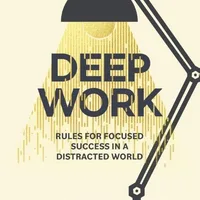
Deep Work: Rules for Focused Success in a Distracted World — Cal Newport
Parkinson's Colonial Office data shows activity multiplying without output. Newport's book is the structural counter-argument: fewer, deeper blocks beat expanded busywork.
As an Amazon Associate, we earn from qualifying purchases — at no extra cost to you.
Parkinson expanded this observation into his 1958 book, Parkinson's Law, or The Pursuit of Progress, but the core principle needs almost no elaboration beyond those first eight words. Expanded to the individual level, the pattern holds with uncomfortable precision. A project given three weeks will use three weeks. The same project given one week will, astonishingly often, also be completed in one week — with no meaningful drop in quality.
Why Your Brain Lets This Happen
The instinct when you first hear Parkinson's Law is to treat it as a character problem. If your tasks keep expanding to fill available time, the obvious inference is that you're not disciplined enough, focused enough, or serious enough.
That framing is both wrong and unhelpful.
Parkinson's Law isn't about laziness. It's about how a perceived time boundary shapes your brain's assessment of a task's complexity. When you sit down with eight hours available for something, your mind genuinely treats it as an eight-hour problem. You elaborate more. You question more. You revisit decisions already made. You hunt for one more source you probably don't need. Each move feels productive — and some of them genuinely are. But most of them are the task expanding to justify the space you gave it.
A tight deadline does something different. It doesn't make you work harder. It forces your brain to prioritize. When you have ninety minutes to write that report, you don't agonize over the perfect opening metaphor — you write the clearest first sentence you can and move on. You make decisions faster, not because you're under pressure in some motivational-poster sense, but because the boundary makes the actual required work visible. The elaboration that a loose deadline permits simply has no room to exist.

Sony WH-1000XM5 Noise Cancelling Wireless Headphones (Black)
A tight deadline forces prioritisation — but only if the environment doesn't keep reopening decisions. Physical silence is the cheapest form of deadline enforcement.
As an Amazon Associate, we earn from qualifying purchases — at no extra cost to you.
This is the crucial distinction: Parkinson's Law isn't telling you to rush. It's telling you that the quality ceiling of most tasks is reached much sooner than the generous time allocation you've given them. The extra hours aren't filling that task with more quality. They're filling with task-shaped activity that feels like work.
Related read: Decision Fatigue: Why Your Morning Wrecks Deep Work
Parkinson's Law vs. The Planning Fallacy — Not the Same Thing
It's worth pausing here, because Parkinson's Law frequently gets confused with another well-documented cognitive pattern: the planning fallacy.
The planning fallacy, documented carefully by Roger Buehler, Dale Griffin, and Michael Ross in a landmark 1994 study published in the Journal of Personality and Social Psychology, describes our systematic tendency to underestimate how long a task will actually take. You think the kitchen renovation will take two weeks; it takes six. You think the report will take an afternoon; it takes three days. The planning fallacy is why software projects are famously late and why you've probably never finished a home improvement project on schedule.
Parkinson's Law is a different animal entirely.
The planning fallacy says: you'll misjudge a task's true duration before you start. Parkinson's Law says: whatever time you allocate, the task will find a way to use all of it once you're inside it. These can happen simultaneously — you underestimate the true duration and the work expands to consume even that estimate — but they're driven by different mechanisms. The planning fallacy is about prediction bias before a task starts. Parkinson's Law is about effort allocation once you're inside it.
The practical implication matters enormously. Fixing your planning estimates — the advice most time-management content gives — doesn't fix the expansion problem. Even when you correctly estimate that something should take two hours and block exactly two hours for it, that generous two-hour block still shapes how the work unfolds. The lever Parkinson identifies isn't about better estimation. It's about deliberately compressing the deadline itself.

How to Use Parkinson's Law Deliberately
Here's the counterintuitive move: instead of asking "how long will this take?", start asking "what's the minimum time in which I could do this well enough?"
Those are entirely different questions. The first invites elaboration — it invites you to think about everything the task could include, the ideal version, the version with all the extra research and polished edges. The second forces you toward what's actually essential. It's the same cognitive shift Greg McKeown describes in Essentialism: the discipline of asking not what you could do, but what you must do.
The Half-Time Test. Take the next three tasks on your list. For each one, write down how long you'd normally give it. Then cut that number in half and treat that as your hard end time. Not a target — the actual finish line. What you find, more often than you expect, is that the task completes just fine. Not perfect. Fine. And fine is usually what was needed.
The Single-Sentence Scope Rule. Before you start any task, write one sentence that defines exactly what "done" means. Not a paragraph — one sentence. If you can't write it in one sentence, the task doesn't have clear enough edges yet, and it will expand to fill any time you give it simply because neither you nor it knows where it ends. Clear scope is the structure that makes a tight deadline realistic.
Time-box, don't just block. There's a real difference between blocking time for a task and time-boxing it. Blocking says: "I'll work on the report from 10 to 12." Time-boxing says: "The report will be finished by 12." The subtle shift in language maps onto a genuine shift in cognitive commitment. Blocking is a reservation. Time-boxing is a deadline. Parkinson's Law responds to deadlines.
Constrain the inputs, not just the clock. Open a blank document with the internet available, unlimited research time, and no word limit, and almost any writing task will expand to fill days. Constrain the inputs deliberately: close the other tabs, set a word cap, limit yourself to three sources. The constraints aren't about creating difficulty. They're about manufacturing the edges that a loose deadline fails to provide.
Related read: Why Willpower Isn't What Builds Habits
The Deeper Pattern Parkinson Was Actually Describing
It's worth remembering that Parkinson wasn't primarily writing about individual productivity. He was observing organizational behavior. And the pattern he identified in the Colonial Office scales up and down with uncomfortable consistency.
Jim Rohn used to say that without a genuine deadline, a goal isn't a goal — it's a wish. He wasn't being poetic. He was pointing at the same mechanism Parkinson quantified. The absence of a real time boundary doesn't free you to do the work at your own pace. It invites the work to expand until a boundary eventually appears, whether that's an actual deadline, a crisis, or simply the end of the week.
Here's a detail from the Colonial Office story that tends to get overlooked: the office wasn't staffed by people trying to do less. Most of them were working hard, filling their days with genuine activity. The problem wasn't motivation — it was structure. The organizational shape made expansion possible, so expansion happened. Motivation had nothing to do with it.
The same dynamic plays out on your task list every day. Your most open, unconstrained afternoons rarely produce your best work. Your best work tends to come from the days when something genuinely needed to be done by a specific time and you did it.
Related read: How to Build a Morning Routine That Actually Sticks
How to Start Today
You don't need to overhaul your entire schedule. Three moves are enough to start applying Parkinson's Law deliberately this week:
-
Pick one open-ended task from your list today. It should be something you've been vaguely aware of that doesn't have a hard external deadline. That vagueness is exactly why it's been sitting there.
-
Compress the deadline to its minimum plausible time. Not a comfortable estimate — the minimum. If you think it'll take two hours, give it sixty minutes. Use a physical countdown timer rather than a phone notification if you can; the visible countdown creates a different psychological relationship with the clock than a buzz you can dismiss.
-
Write your done sentence before you start. At the top of the page or document, write the one sentence that defines when this is finished. When you reach that definition, stop. Don't elaborate. The task is done.
That's the whole system. No app, no subscription, no complex methodology. One compressed deadline, one sentence defining done, and the willingness to stop when you get there.
Designing Your Evolution, Deadline by Deadline
Here's what I find genuinely strange about Parkinson's Law: the evidence for it is completely visible in everyday life, and yet almost nobody actually changes how they set deadlines. We keep giving ourselves three days for the four-hour job, then wonder why it somehow consumed the three days. We stay in the fog of a too-long timeline and call it being thorough.
Being thorough is real and valuable. But most of the thoroughness we apply to most tasks is the task expanding to justify the time we gave it — not actual quality improvement. The honest work, the part that actually needed doing, was usually finished well before the allotted time ran out.
The real version of designing your evolution isn't about squeezing more activity into each day. It's about developing an increasingly honest relationship with what things actually require — and then giving them exactly that, and nothing more. Parkinson called this out in 1955 using staffing records from a shrinking empire. Seventy years later, the same dynamic plays out in your inbox, your project list, and your Friday afternoons.
What's one task you've been giving far more time than it actually needs?
Sources: C. Northcote Parkinson, "Parkinson's Law," The Economist (November 19, 1955); C. Northcote Parkinson, Parkinson's Law, or The Pursuit of Progress (John Murray, 1958); Roger Buehler, Dale Griffin, and Michael Ross, "Exploring the 'Planning Fallacy': Why People Underestimate Their Task Completion Times," Journal of Personality and Social Psychology, 67(3), 366–381 (1994).
Was this helpful?
Continue Your Evolution
The Frozen Goal Problem: Why Tiny Wins Beat Grand Plans
Rejection Sensitivity: Why You Keep Assuming They're Upset
The Science of Nostalgia: Why Looking Back Helps
Sedikides and Wildschut found nostalgia boosts mood, meaning, and social connection — not mere sentimentality. Here's the science and how to use it.