Mindset· 10 min read
How to Deal with Rejection Without Losing Your Drive
Rejection activates the same brain regions as physical pain. Here's why it hurts so much — and what the psychology says about keeping your drive intact.

How to Deal with Rejection Without Losing Your Drive
The email came back in three sentences.
No explanation, no feedback, just: "We've decided to move in a different direction." I read it twice — the way you re-read something when the words aren't quite computing. Third time, they computed. The project I'd spent weeks on, the one I'd quietly told people about, was dead. And rather than closing my laptop and going for a walk, I spent the next four hours doing something far more damaging than being rejected: I built a precise, internally consistent case for why I was fundamentally bad at what I do.
Sound familiar?
Here's what nobody tells you about how to deal with rejection without losing your drive: the part that makes it stick isn't the rejection — it's what you do with it next.
Seth Godin wrote something earlier this month that's been sitting with me. He argued that the rejections which feel most devastating in the moment are almost always the ones that, in retrospect, become the most motivating data points in your story. Not because rejection is secretly good. But because the pattern of your rejections is the most honest map of your attempts — and everyone who has ever built anything meaningful has a map covered in red ink.
That sounds like optimism. It isn't. It's what the psychology of resilience consistently documents about the long-term trajectories of people who keep going after being told no.
But here's the thing: before that reframe can work for you, you need to understand why rejection feels so physically real. Because that's where most advice on this topic fails. It tells you to "thicken your skin" or "not take it personally" — without acknowledging that the pain you feel isn't a character flaw. It's biology.
Your Brain Treats Rejection Like a Punch
In the early 2000s, Naomi Eisenberger at UCLA ran an experiment with one of the simplest setups in modern neuroscience.
Participants were placed in an fMRI scanner and told they were playing an online ball-tossing game — called Cyberball — with two other people. For a few rounds, everything was normal. Then, without warning, the other "players" stopped throwing the ball to them. They were excluded.
The fMRI results were unambiguous.
The brain regions that lit up during social exclusion — the dorsal anterior cingulate cortex and the anterior insula — were the same regions that activate during physical pain. Not similar regions. Not regions associated with "negative emotion." The exact same circuitry that processes a burn or a bruise.
Eisenberger's 2003 study in Science reached an unambiguous conclusion: social rejection and physical pain share neural architecture.
This completely reframes the question of how to deal with rejection. The question isn't "why can't I just brush it off?" It becomes: given that rejection produces a real physiological pain response, what's the most effective way to process it?
You're not oversensitive. You're not thin-skinned. You're responding to something your nervous system treats as a survival threat — because for most of human evolutionary history, social exclusion genuinely was one. Being cast out from the group meant exposure, scarcity, and danger. Your brain hasn't gotten the memo that the modern "no" rarely carries those stakes.
Understanding this is the first step toward learning how to deal with rejection without losing your drive, because it shifts your response from "why am I like this?" to "how do I work with this system rather than against it?"

Sony WH-1000XM5 Noise Cancelling Headphones
If your nervous system treats rejection as a survival threat, the first practical move is creating a physical environment where the threat signal has space to dissipate. A pair of noise-cancelling headphones is one of…
As an Amazon Associate, we earn from qualifying purchases — at no extra cost to you.
→ how to stop taking things personally and reclaim your emotional stability
The Two Mistakes That Make Rejection Stick Longer Than It Should
Guy Winch, a psychologist who dedicated an entire book to the concept of emotional first aid, makes an argument that tends to land hard when people hear it: rejection is the most undertreated psychological wound in everyday human experience.
Not because it's rare. Because of how we typically respond to it.
When most people get rejected, they make two moves — both feel instinctive, both make things worse.
The first is rumination. They replay the rejection, again and again, each iteration generating a slightly larger explanation for what it means. Nobody ever wants to work with me. I'm just not the kind of person who succeeds at this. There must be something fundamentally wrong with how I present myself. The original rejection was specific and bounded — one person, one decision, one moment. The rumination converts it into a global verdict on permanent worth.
This is the critical mechanism. Not the rejection itself. The story you construct from it.
The second mistake is seeking validation from people who weren't there. You call a friend, describe what happened, they reassure you. Temporarily it helps. Then the feeling comes back, because the reassurance provided comfort without addressing the actual wound.
Winch's prescription is precise: when you notice your brain generating global conclusions from a specific rejection, don't dismiss them — challenge them directly. If the story is "nobody ever wants to work with me," treat that claim as a hypothesis. Look for counterexamples. Write them down. The brain has a much harder time sustaining catastrophic narratives when they're examined against real evidence rather than allowed to circulate freely in the privacy of anxious thought.
The shift from global narrative to specific evidence isn't positive thinking. It's honest thinking — which is both more accurate and significantly less painful.
Rejection Sensitivity: The Hidden Loop That Makes It Worse Over Time
Here's something most people don't realize: if you handle rejection the way most people handle it — avoiding situations where it's possible, treating each new rejection as confirmation of a pattern — it doesn't get easier with experience. It gets harder.
Geraldine Downey at Columbia University spent years studying what she called rejection sensitivity: the degree to which someone anxiously expects rejection, perceives it in ambiguous signals, and overreacts when it's confirmed. Her finding was both fascinating and slightly uncomfortable if you recognize yourself in it.
People high in rejection sensitivity don't just suffer more when they're turned down. They're more likely to create the rejections they fear.
Here's the mechanism. Someone high in rejection sensitivity enters social situations on alert. A delayed reply reads as disinterest. A colleague's neutral expression reads as disapproval. A vague response to a pitch reads as polite dismissal. This hypervigilance generates anxiety and withdrawal — behaviors that make genuine connection harder and genuine rejection more likely. It becomes a self-fulfilling loop.
The important thing Downey established: rejection sensitivity is not a fixed personality trait. It's a learned expectation system — built from real experiences of painful rejection, often early, often formative — and it can be deliberately recalibrated.
The recalibration requires something counterintuitive: moving toward small, manageable rejections rather than away from them. Not because you should stop caring. But because your nervous system needs real-world data to replace the catastrophic predictions it's been generating.

Clever Fox Habit Calendar Circle (24-Month)
Recalibrating rejection sensitivity requires real-world data — small exposures, repeated, tracked. A visual habit tracker turns the 'do one uncomfortable ask per week' commitment into something your eye can verify. Th…
As an Amazon Associate, we earn from qualifying purchases — at no extra cost to you.
→ self-limiting beliefs that quietly hold you back from the life you actually want
The Man Who Asked to Be Rejected 100 Times
In 2012, Jia Jiang was working on a startup. He pitched for investment and got turned down. The rejection hit him so hard he nearly quit entrepreneurship entirely.
Instead, he designed an experiment.
For 100 consecutive days, he deliberately sought out one rejection per day. Not random social discomfort — engineered rejections, each one slightly outside his comfort zone. He asked a stranger if he could play soccer in their backyard. He asked a police officer if he could sit in the squad car. He walked into a Krispy Kreme and asked if they could make him donuts shaped like the Olympic rings.
That last one is the story people remember.
The employee behind the counter — Jackie — didn't laugh at him. She spent fifteen minutes making exactly what he'd described, gave them to him for free, and handed them over with genuine pride in her work. Jiang had expected embarrassment. He walked out with Olympic-ring donuts and a revised theory of what rejection actually costs.
Over 100 days, his fear didn't disappear. It shrank. Not because he stopped caring about the outcome — but because he'd accumulated enough real-world data to override the catastrophic predictions his mind had been generating. The gap between how terrible he'd imagined rejection would feel and how it actually felt narrowed, exposure by exposure, until it was no longer the wall it had been.
This is what psychologists call habituation. And it's the most powerful practical tool for learning how to deal with rejection without losing your drive — not by becoming indifferent to it, but by discovering that the fear of rejection almost always exceeds the actual experience of it.
Most people, given the chance to say no to something reasonable, are kind. The world is significantly less judgmental than the anxious mind believes.
The Framework: Three Moves That Actually Work
The research above points to a specific architecture. Not "stay positive." Not "grow thicker skin." Here's what actually holds up.
Specific evidence, not global verdict. The moment a rejection lands, your brain will want to extract a universal conclusion. Don't let it. Ask instead: what does this rejection tell me, specifically? A single publisher passing on your manuscript doesn't mean your book is unpublishable. It means one editor, at one press, on one day, decided it wasn't the right fit for their list. That's all. A rejected job application tells you about one hiring decision — nothing permanent about your competence in the field.
Replace "what does this mean about me?" with "what does this tell me about this specific situation?"
Challenge the narrative in writing. Whatever story your mind generates in the hours after a rejection — write it down. Then interrogate it seriously. List three specific pieces of evidence that contradict the story. Writing forces a kind of epistemic honesty that internal rumination never does. You can believe almost anything in your head. On paper, it becomes much harder to sustain a claim without evidence.
Redirect the activation. The physiological arousal of rejection — the tension, the heightened alertness, the almost-crackling feeling in your chest — is energy. Not pleasant energy. But energy. Alison Wood Brooks at Harvard Business School showed in several studies that labeling this arousal as "excitement" rather than "anxiety" measurably improves performance in subsequent tasks. You don't have to feel grateful for the rejection. You can redirect what the rejection mobilizes.
How to Start Today
Five moves. This week. No major life overhaul required.
-
Do a rejection audit. Pull up the five rejections that have stayed with you longest — the ones that still flash through your mind unexpectedly. For each one, write a single sentence: what did this rejection actually prove, specifically? Watch how often the global narrative ("I'm not cut out for this") has almost no direct support from the actual evidence of what happened.
-
Start a rejection log. For the next two weeks, write down every rejection you receive — any scale, any context. What you asked for. What happened. How it actually felt compared to how you'd feared it would. A dedicated notebook works best — something you open daily and keep separate from your other notes. The ritual of writing it down is half the practice.

Moleskine Classic Notebook (Hardcover, Large, Ruled, Black)
The article literally says "a dedicated notebook works best — something you open daily and keep separate from your other notes." The Moleskine Classic Hardcover is the canonical match: durable enough to survive being…
As an Amazon Associate, we earn from qualifying purchases — at no extra cost to you.
-
Pick the one thing you've been sitting on. One pitch you haven't sent. One application you've half-finished. One conversation you've been postponing because of what they might say. Send it or have it this week — not because rejection won't happen, but because your drive doesn't depend on the answer. It depends on the asking.
-
Read the actual research. Jia Jiang documented his 100-day rejection therapy project in a book that reads more like field notes from a self-experiment than a self-help manual — which is exactly what makes it useful. If you want to understand the behavioral exposure approach to rejection desensitization from someone who actually lived it, start here.
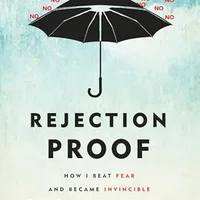
Rejection Proof — Jia Jiang
The article's action #4 explicitly directs readers here: "Jia Jiang documented his 100-day rejection therapy project in a book that reads more like field notes from a self-experiment than a self-help manual — start he…
As an Amazon Associate, we earn from qualifying purchases — at no extra cost to you.
- Recategorize your rejection history. Take the most significant rejection of the last five years. Ask: what did I learn from it? What did I try next because of it? What did I eventually build, find, or become that wouldn't have happened if I'd gotten a yes that time? This isn't mandatory optimism. It's pattern recognition. The data is usually there — you just haven't looked at it that way.

The Five Minute Journal — Intelligent Change
Action #5 is about pattern recognition across rejections — what you tried next because of them, what you eventually built. The Five Minute Journal's structured prompt format (gratitude + reflection + intention) is the…
As an Amazon Associate, we earn from qualifying purchases — at no extra cost to you.
→ how to develop a growth mindset as an adult — the science of getting better at getting better
Here's what Seth Godin's argument about early rejections ultimately points to: the people who build something worth having — in work, in relationships, in any domain where standards exist — don't have thinner skin than the people who give up. They have a different relationship with the evidence.
Every rejection is evidence of an attempt. Every attempt is evidence of drive. The people who accumulate the most attempts — and therefore the most rejections — are, statistically, also the people who accumulate the most successes.
You're not trying to become someone who doesn't feel rejection. That's not the goal, and it's not possible anyway — Eisenberger's fMRI data is clear on that. The goal is to become someone whose relationship with rejection has been updated by real evidence: that the pain is real but temporary, that the story you tell about it is more dangerous than the rejection itself, and that the nerve required to keep going after being told no is a capacity that grows with use.
That's what designing your evolution actually looks like in the moments that count.
What's the rejection you've been letting define you — and what becomes possible the moment you recategorize it as evidence of attempt rather than evidence of inadequacy?
Was this helpful?