Mindset· 10 min read
Self-Limiting Beliefs: 10 That Hold Your Potential Hostage
Self-limiting beliefs operate silently, shrinking what you pursue and who you become. Here's how to spot and dismantle the 10 most destructive ones.

Self-Limiting Beliefs: 10 That Hold Your Potential Hostage
There's a particular kind of frustration that doesn't make sense on paper.
You have the schedule blocked. You have the journal. You've read the right books, optimized the morning routine, maybe even invested in a coach. And yet — something keeps pulling you back. You set the goal, make the plan, announce the intention. Then, weeks later, you're back where you started, with a slightly longer list of reasons why this time wasn't quite right.
Most people decide they have a discipline problem. Or a motivation problem. What rarely crosses their mind is that the real culprit might be self-limiting beliefs — invisible convictions quietly managing their ceiling. So they look for a better app, start a new system, and try again.
Here's what I've come to believe — and what decades of cognitive psychology research backs up: the problem usually isn't your system. It's the operating system running underneath it.
You can layer new habits on top of an old belief structure, but the foundation keeps cracking. You can consume every piece of self-improvement content available and still find yourself circling the same patterns — because beliefs aren't updated by information alone. They're updated by direct confrontation.
Consider this article that confrontation.
These are 10 beliefs that quietly hold potential hostage. Not the obvious, dramatic ones. The beliefs that feel like realism. The ones that sound like self-awareness. The ones that have been living rent-free in your head so long, you've stopped noticing they're there.
The Invisible Operating System Nobody Told You About
Self-limiting beliefs are subconscious convictions about yourself and what's possible for you — typically installed before age seven — that silently shrink the range of goals you pursue, risks you take, and outcomes you allow yourself to deserve. They don't announce themselves with alarm bells. They feel like honest self-assessment.
Here's something most personal development content skips: your beliefs were largely installed before you turned seven.
That's not a metaphor. Bruce Lipton, in his research on cellular biology and consciousness, describes how children spend their earliest years in theta brainwave states — essentially the same state adults enter during hypnosis. In that highly receptive condition, every repeated message from parents, teachers, and the surrounding culture doesn't just inform. It programs.
That program has been running ever since.
The challenge isn't that you have limiting beliefs — everyone does, without exception. The challenge is that they don't feel like beliefs. They feel like facts. "I've never been great at finishing things." "I'm not really a disciplined person." "Success like that isn't really for people like me." These statements don't trigger alarm bells because they're phrased as observations, not restrictions.
Carol Dweck, whose decades of research at Stanford on fixed versus growth mindsets reshaped how we understand human development, documented something precise about this: beliefs about ability don't just affect behavior — they determine which opportunities people consider worth attempting in the first place. A person running a fixed mindset doesn't avoid challenges because they're lazy. They avoid them because failure feels like proof of who they permanently are.

Moleskine Classic Notebook
A physical place to run the belief audit — structured enough to make the process systematic, open enough to follow wherever the work leads.
As an Amazon Associate, we earn from qualifying purchases — at no extra cost to you.
That's the quiet mechanism. Limiting beliefs don't stop you with a dramatic "you can't do that." They stop you by narrowing the list of things you allow yourself to try.
Three Daily Habits That Could Be Quietly Draining Your Potential
The good news — and this is the part that matters most — is that every belief on this list was installed. And anything that was installed can be uninstalled.
"I'm Not Smart or Talented Enough"
This one is sneaky because it disguises itself as humility.
There's a version of it that sounds almost reasonable: "I'm just being realistic about my limitations." But realism doesn't require setting a permanent ceiling on your future self. You're assessing your current capabilities and extrapolating them as fixed.
Intelligence isn't fixed. Neither is skill. Anders Ericsson, the Swedish psychologist who spent his career studying elite performers — surgeons, chess grandmasters, concert musicians — found that expertise is almost entirely a function of deliberate practice, not innate talent. Most of what looks like "natural ability" from the outside is invisible hours on the inside.
The replacement belief: "I'm not there yet — and yet is the only word that matters."
"I Don't Deserve to Be Successful"
Worthiness beliefs are among the quietest and most destructive on this list. They rarely announce themselves. Instead, they show up as self-sabotage at the exact moment things start going well — missed opportunities, unconscious avoidance, a strange compulsion to undermine the very outcomes you've been working toward.
Jen Sincero writes about this pattern with real directness: most people don't have a strategy problem or an execution problem. They have a worthiness problem. They're not unwilling to succeed — they're secretly convinced they don't qualify.
The replacement belief: "My past doesn't determine what I'm available for now."
"I Need to Wait Until I'm Fully Ready"
Readiness is a myth. It has never existed, and it will never exist.
The belief that a "ready" state precedes action is one of the most effective ways the brain delays anything uncomfortable indefinitely. There's always one more course to complete, one more certification to earn, one more sign to wait for. Meanwhile, the people who are actually building things don't feel ready either. They just started anyway.
The truth worth writing down: most people are waiting to start until they have more confidence. But confidence is almost always a byproduct of starting — not a product of preparing.
The replacement belief: "Readiness isn't a prerequisite. It's a byproduct of starting."
"What Other People Think of Me Defines My Worth"
This is possibly the belief with the highest opportunity cost on this list.
When approval from others becomes the operating currency of your decisions, you stop building toward your own vision and start performing for an audience that isn't paying that close attention to begin with. The projects you don't start. The ideas you kill before they're spoken. The paths you don't take because you can't imagine explaining them at the next family gathering.
There's a truth here that stings precisely because it's accurate: what other people think of you is none of your business. It sounds blunt. It's supposed to.
The replacement belief: "The only approval that drives my evolution is the one I give myself."
Stop People-Pleasing and Rebuild Self-Trust

"Big Success Means Sacrificing Everything Else"
This belief creates an artificial binary: you either pursue your potential or you keep your relationships, health, and peace of mind. Not both.
That's a false choice — and believing it stops more people from even attempting something meaningful than almost any other entry on this list. The origin is real enough. You've seen high-achievers who burned everything down for their goals. But survivorship bias is doing enormous work there. The people who built ambition and life, who found integration rather than demolition, don't get the dramatic documentary treatment. They just quietly have both.
The replacement belief: "I get to define what success looks like — on my terms, in my life."
"Things Always Work Out for Other People — Not Me"
This belief feels like pattern recognition. It feels like honesty.
You've taken swings and missed. You've watched things fall apart. So you construct a narrative: some people have luck, have connections, have something you don't have. And that narrative becomes a quiet justification for not trying again.
Here's what that story conveniently hides: most people who appear to "have it work out" have failure rates that would genuinely terrify you if you saw the full record. What looks like things "just working out for them" is almost always the selective visibility of their outcomes — not their attempts.
The replacement belief: "Every setback has been building data. My direction is getting sharper."
"I've Always Been This Way — I Can't Change"
Neuroscience has a strong, unambiguous opinion on this one.
Until roughly twenty years ago, it was accepted scientific orthodoxy that adult brains were essentially fixed. Neuroplasticity, the brain's ability to physically rewire itself, was thought to be something that only happened in childhood. We now know this is wrong. The adult brain continues to form new neural pathways in response to new experiences, new thinking patterns, and new behaviors throughout the entire lifespan.
Joe Dispenza has built an extensive body of work — including a book that synthesizes neuroscience and quantum models of change — around exactly this argument: your personality is not a fixed entity. It's a set of habitual responses. All of which can be redesigned.
The replacement belief: "Who I've been is the draft. The revision is ongoing."
"I'm Too Old, Too Young, or Too Late"
Whatever age you are right now, there's a version of this belief that technically applies. Too young to be taken seriously. Too old to start over. Too far behind everyone else. Too committed to what you've already built to change direction now.
Vera Wang designed her first dress at 40. Julia Child published her first cookbook at 49. Morgan Freeman landed his first major film role at 52. These aren't motivational exceptions curated for Instagram. They're evidence that the timeline narrative is a story you tell yourself — not a law governing what's available to you.
The replacement belief: "The best time to start building was then. The second-best time is now."
"Money and Success Are for a Different Kind of Person"
T. Harv Eker dedicated much of his research to one central idea: your financial outcomes are a printout of your financial thermostat — the subconscious setting calibrated by what you observed and absorbed growing up.
If success was framed in your household as something requiring moral compromise, exceptional luck, or membership in a certain social class, that framing is still running quietly in the background. It's not stopping you from wanting more. It's stopping you from feeling entitled to pursue it without guilt.
The replacement belief: "Success isn't reserved for a type. It's available to whoever decides to design for it."
"Wanting More Makes Me Greedy or Ungrateful"
This one tends to live in the most thoughtful, self-aware people.
It grew from something genuinely good — real gratitude, awareness of privilege, the honest desire not to be the kind of person who is perpetually dissatisfied. But somewhere along the way it calcified into something that equates ambition with selfishness and growth with ingratitude.
Here's the distinction worth holding: wanting more doesn't negate what you already have. Gratitude and ambition aren't opposites. One is how you relate to the present. The other is how you design the future. You can be genuinely, deeply thankful for today and still committed to building something better tomorrow. The two positions aren't in conflict — they're the engine and the foundation.
The replacement belief: "Ambition and gratitude aren't opposites. I can hold both."
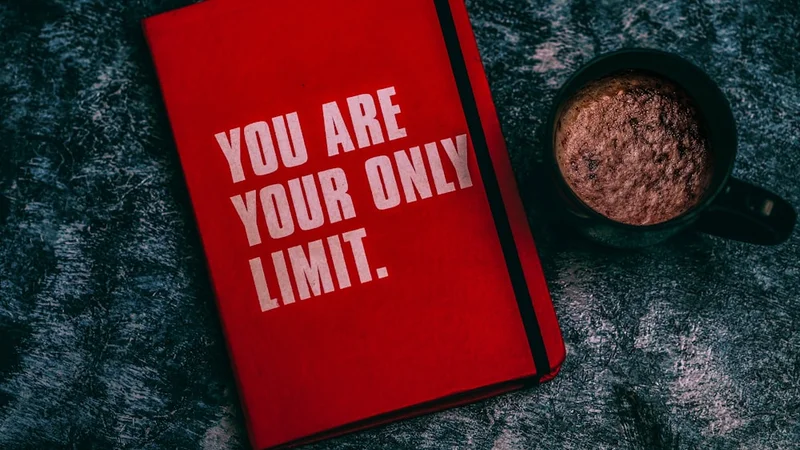
How to Run Your Own Belief Audit This Week
Reading this list is useful. Working with it is where the actual change happens.
Here's a four-step diagnostic you can run this week — no special tools required, though the right materials make it significantly more effective.
Step 1 — Track patterns, not beliefs. Beliefs are slippery and hard to catch directly. Patterns aren't. Where do you consistently stop just before a breakthrough? Where do you routinely self-sabotage? Where do you hear yourself say "I'm just not that kind of person"? Those behavioral fingerprints point directly to the underlying belief. Write them down without judgment — you're collecting evidence, not issuing a verdict.

Clever Fox Habit Calendar
A dedicated habit-tracking system that makes the pattern-observation in Step 1 concrete and visible over time — you can't rewire what you can't track.
As an Amazon Associate, we earn from qualifying purchases — at no extra cost to you.
Step 2 — Surface the belief with one question. For every pattern you identified, ask: "What would have to be true for this behavior to make complete sense?" This single question almost always brings the belief into the open. If you consistently avoid visibility at work, the answer might be: "If people really see me, they'll find out I'm not as capable as they think." Name it. Write it down exactly as it sounds in your head.
Step 3 — Write the replacement before you believe it. You don't need to feel the new belief yet. Write it anyway. This is what the neuroplasticity research actually shows: the repetition of a new thought pattern begins the rewiring process before emotional conviction arrives. The feeling follows the practice, not the other way around.
Step 4 — Build an evidence file. Find three specific examples from your own life that support the new belief, not the old one. Not abstract affirmations — real, concrete evidence you personally lived. Your brain weighs proof from your own experience far more heavily than borrowed inspiration. A structured growth journal makes this process dramatically more rigorous and trackable than mental notes alone.
Atomic Habits — James Clear
The framework for understanding how small behavioral shifts compound into identity change — the mechanism directly underneath every belief you're trying to install.
As an Amazon Associate, we earn from qualifying purchases — at no extra cost to you.
Run this process for every belief on this list that felt like recognition rather than description. The ones that stung slightly. The ones you wanted to skim past.
Those are exactly the ones doing the most work.
Best Gratitude Journals 2026 — Structured Tools for Daily Reflection
The Version of You That's Already Waiting
Here's the thing about ceilings: the ones that cost you the most aren't made of circumstance. They're made of thought.
"Design Your Evolution" isn't a motivational phrase. It's a precise description of what's actually available to you when you treat your inner architecture with the same intentionality you bring to your calendar, your fitness, and your goals. The most consequential upgrade you'll ever make isn't a new system or a better routine. It's the belief structure that determines which systems you'll allow yourself to sustain and which goals you'll allow yourself to deserve.
You don't have to dismantle everything at once. Start with one. The one on this list that landed the hardest — the one you felt in your chest, not just in your head.
Give it a replacement. Build the evidence. Let it take root.
Which of these 10 beliefs has been the most persistent voice in your mind? Drop it in the comments. I want to know which one shows up most.
Was this helpful?