Habits· 9 min read
How to Remember What You Read (And Actually Use It)
Reading without retention is just entertainment. Here's the science-backed system that turns books into lasting knowledge you can actually apply.

How to Remember What You Read (And Actually Use It)
Six weeks ago, a friend asked me what the most useful idea from Ultralearning was.
I'd read it. I remembered the cover. I remembered feeling genuinely energized after finishing the last chapter. I'd been casually recommending it to people for months.
I couldn't give her a single specific thing.
Not a principle. Not an example. Not even a rough summary of what the book actually argued. I'd spent seven or eight hours with those pages, highlighted maybe forty passages, and come away with essentially nothing I could access when it counted.
If reading is supposed to build you — sharpen your thinking, expand your models, compound your understanding over time — then what I'd been doing wasn't reading. It was the performance of reading. The book was sitting on my shelf. The answers were presumably somewhere inside it. But there was a complete disconnect between having read something and actually knowing it.
I suspect you know exactly what I mean.
Retention isn't a memory problem. It's a system problem.
Hermann Ebbinghaus, a German psychologist working in the 1880s, mapped what he called the "forgetting curve" — a precise graph of how fast newly learned information disappears without reinforcement. His core finding was unsettling: you forget roughly 50% of new material within an hour. Around 70% is gone within 24 hours. By the end of the week, without any deliberate review, close to 90% has evaporated.
That's not a flaw in your brain. It's how your brain was designed. Memory is a biological system optimized for immediate survival, not for retaining the nuanced arguments in chapter seven of a nonfiction book.
The problem is that most people's reading strategy operates in direct conflict with that reality. You sit down, read linearly from start to finish, maybe drag a highlighter across lines that feel important, close the book — and expect the knowledge to stay. It doesn't. And it won't, regardless of how many books you push through.
There's also a more subtle trap: the more you read, the more confidently you believe you're building knowledge. That confidence makes the gap between reading volume and actual retention almost invisible. You can read fifty books a year and walk away knowing approximately nothing you didn't know before, if the approach is wrong.
Jim Rohn put it plainly: "Formal education will make you a living; self-education will make you a fortune." But self-education only delivers on that promise if the knowledge actually lands somewhere it can be used. A shelf full of books you can't recall isn't self-education. It's self-soothing with good paper and a satisfying ISBN.
The gap between reading and retaining doesn't close by reading more slowly, more carefully, or better books. It closes when you build a system. Here's the one that works.
The Fluency Trap: Why You Think You're Learning When You're Not
There's a phenomenon cognitive scientists call the "fluency illusion." When information flows smoothly — when it feels like you're understanding as you read — your brain interprets that ease as comprehension. The feeling of reading well gets mistaken for the fact of learning well.
Highlighting is the perfect instrument for this trap. When you drag your marker across a sentence, you signal to yourself that you've captured something important. But the act requires almost no cognitive work. You haven't paused to translate the idea into your own language. You haven't asked how it connects to something you already know. You've colored some text and moved on feeling productive.
Think about the last time you finished a chapter feeling sharp and clear about what you'd just read. Then someone asked you about it two hours later and the clarity dissolved. That's the fluency illusion in real time — not a failure of memory, but a failure to distinguish between the ease of reading and the actual work of learning.
The research compiled in Make It Stick — a book about the science of durable learning by Peter Brown, Henry Roediger III, and Mark McDaniel — confirmed what cognitive scientists have known for decades: highlighting and rereading rank among the least effective retention strategies available. And also the most popular ones. The techniques that actually work — retrieval practice, spaced review, self-testing — feel harder because they are harder. The difficulty is the point. Your brain doesn't strengthen memories through passive exposure. It strengthens them through effortful retrieval.
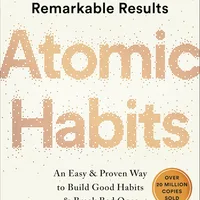
Atomic Habits — James Clear
The book the scientific community points to when discussing what actually changes behavior long-term — and why building a retention system around nonfiction makes sense.
As an Amazon Associate, we earn from qualifying purchases — at no extra cost to you.
The first move in any working retention system is to stop confusing the feeling of learning with actual learning. Most reading habits are built on exactly that confusion.
How to Remember What You Read from Books Long Term: Start Before Page One
The single highest-leverage shift in how to remember what you read from books long term happens before you open the cover.
Prime your brain first. Before you start a chapter — or an entire book — spend two minutes writing down two or three questions you want the book to answer. What do you already believe about this topic? What gap are you hoping this fills? What specific problem are you trying to solve right now?
This isn't ritual for its own sake. It's a cognitive function. When your brain knows what it's hunting for, it acts like a search engine with active queries rather than a passive receiver with no filter. You'll notice relevant passages you'd otherwise skim straight past. You'll feel the friction when an idea challenges something you already believe — and friction is exactly where real learning happens.
Then read with a pen, not a highlighter. Not to underline, but to annotate in the margins: "this contradicts what Newport says about depth" or "real example: the project I abandoned in February" or simply "why?" next to a claim that feels incomplete. These micro-notes are your thinking on the page, not just the author's. They're evidence that your brain was actually engaged, not just processing characters.
When the margins run out — and they always do — keep a notebook beside the book. Write the ideas that don't fit in the margins. Respond to them. Push back on them. A dotted-grid format gives you flexibility between structured notes and loose thinking without the tyranny of ruled lines.
Related: Daily Writing Habit for Clearer Thinking
The Capture Loop: How to Take Notes From Books and Actually Use Them Later
Reading actively gets ideas into your short-term memory. The capture loop is what moves them somewhere permanent.
The core rule: synthesize, don't transcribe. When you stop to take a note — mid-chapter or at the end of a section — don't copy the author's sentence. Force yourself to articulate the idea from scratch, in completely different words, as if you were explaining it to someone who hasn't read the book and has three minutes to spare.
This single constraint does more for retention than almost anything else you can do, because it forces your brain to actually process the concept rather than just relocate it. You can transcribe something without understanding it. You cannot genuinely explain it in your own words without understanding it. The act of translation is the learning.
What's worth capturing:
- The central argument of each chapter in one or two sentences
- Any idea that genuinely surprised you or challenged something you believed
- A specific story or example that made an abstract concept concrete
- Any connection you noticed to something else you've read, lived through, or argued against
Keep the format simple. A dotted notebook with one section per book — something you'll actually enjoy opening — is enough to build a reading archive that compounds over years.

Moleskine Classic Notebook (Large, Hardcover)
The reading journal that stays on the desk because you actually want to open it — one section per book, durable hardcover that holds up to years of active reading practice.
As an Amazon Associate, we earn from qualifying purchases — at no extra cost to you.
If you read primarily on a device, the Kindle's highlighting-plus-note feature lets you attach a typed comment to any passage. That comment — your reaction, your question, your doubt — is worth exponentially more than the highlight alone. It captures your thinking at the moment of contact, not just the author's sentence in isolation.
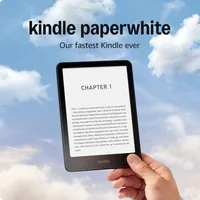
Kindle Paperwhite (2024, 16GB, Without Ads)
If you read on a device, the Paperwhite's highlight-plus-note feature turns passive reading into a real capture loop — attach your own comment to any passage the moment you read it.
As an Amazon Associate, we earn from qualifying purchases — at no extra cost to you.

The Review Ritual: How to Beat the Forgetting Curve
Here is where most systems collapse entirely. You read actively, you take decent notes — and then you never look at any of it again.
The forgetting curve only gets defeated one way: spaced repetition. You have to review material at increasing intervals, just before your brain would naturally lose it. The spacing effect — confirmed by Ebbinghaus and replicated across hundreds of peer-reviewed trials since — means that reviewing an idea at the right interval strengthens the memory trace far more efficiently than re-reading it immediately after first encountering it.
A three-pass system works for most readers:
Same day. Before bed on the day you finish a chapter, write a three-sentence summary from memory — without looking at your notes. What did you actually retain? This is your first retrieval practice event, and it's where real encoding happens. You'll be surprised how little you can recall, and that surprise is useful information.
One week later. Review your notes from the book so far. Add anything that connects to what you've been thinking or experiencing that week. Cross out or flag anything that turned out to be less important than it seemed in the moment of reading.
One month later. Try to explain the book's central argument out loud — as if someone had asked you "what was that book actually about?" This is the highest-level test of retention. It reveals exactly which ideas have genuinely integrated and which ones were just temporarily interesting.
Three calendar reminders. Set them the moment you finish a book. Before you close the cover and reach for the next one.
The Connection Layer: Where Reading Starts to Compound
Single books don't change people. The relationship between books does.
This is the piece that most retention guides skip entirely. When a new idea enters your practice, the question isn't just "did I capture this?" It's "where does this connect to something I already know or believe?"
Richard Feynman had a method for truly learning anything: explain it in plain language, find where your explanation breaks down, go back to the source to fix the gap, then explain it again. The technique works because it forces you to locate the new idea inside your existing map of the world. That integration is what makes memory durable. Isolated facts decay. Connected ideas compound.
The books that most shape how effective thinkers see the world aren't necessarily the most recent books they've read. They're the ones that connected hardest to things they already knew — ideas that reinforced, challenged, or extended frameworks built over years of reading and experience. That connection is what elevates a book from an interesting read to something that actually changes how you move through the world.
Practically: at the end of every monthly review, ask one extra question. What does this change, add to, or challenge in something I already believe? A single sentence in your notebook connecting two ideas from different books is enough. Over time, those connections are the mechanism by which reading returns real compound interest.
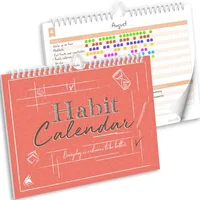
Clever Fox Habit Calendar Circle (24-Month Tracker)
A 24-month visual habit tracker that makes the same-day / one-week / one-month review rhythm visible at a glance — the kind of system that turns review intentions into actual practice.
As an Amazon Associate, we earn from qualifying purchases — at no extra cost to you.
Related: How Confirmation Bias Warps Your Best Decisions
How to Start Today: Your Book Retention System in Five Steps
You don't need to redesign your entire reading practice this week. Pick one book you're currently reading — or one you plan to start — and run this process from the beginning.
Step 1: Prime before you open it. Spend two minutes writing three questions you want the book to answer. Keep them on a sticky note inside the front cover where you'll see them every time you pick it up.
Step 2: Annotate as you go. Use a pen, not a highlighter. Write your reaction to ideas, not just a mark beneath them. When the margins run out, reach for your notebook.
Step 3: Synthesize each chapter. After every major section, pause and write the central idea in your own words before moving on. Three sentences is enough. If you can't produce three sentences, you haven't understood it yet.
Step 4: Run the three-pass review. Same day, one week, one month. Set three calendar reminders right now, before you close this tab and forget you intended to.
Step 5: Build the connection. At the end of the book, write one paragraph: what did this change or add to how you see the world? That paragraph is worth more than every highlight you made along the way.
Related: I Stopped Procrastinating Small Tasks with the One Minute Rule
There are people who've read three books and can deploy ideas from all three in any relevant conversation. There are people who've read three hundred books and can barely recall the authors' names.
The difference isn't intelligence. It isn't how much they love reading.
It's whether reading was treated as a consumption event or as a deliberate practice with a system behind it.
Every nonfiction book contains somewhere between two and thirty years of someone else's thinking, distilled and compressed into something you can hold in your hands. When you build a system to actually retain what you read — to capture it, review it, and connect it to everything else you know — you're not just improving your memory. You're deciding that the time and attention you invest in learning is genuinely worth something. That the ideas you encounter deserve to become permanent parts of how you see and move through the world.
That's what "Design Your Evolution" means in practice. Not consuming more. Compounding better.
What's the last book you read that felt genuinely important — but that you couldn't accurately summarize today if someone put you on the spot?
Was this helpful?