Mindset· 10 min read
Why Hyper-Independence Is Secretly Holding You Back
Hyper-independence often feels like strength — but it's a trauma response that blocks the growth, connection, and support you genuinely need.

Why Hyper-Independence Is Secretly Holding You Back
She offered to proofread the report. It would have taken her twenty minutes and saved me two hours of tired, error-prone review at the end of a long day. I said "no thanks, I've got it" — and then spent the next two hours alone at my desk making exactly the kind of mistakes I was too exhausted to catch.
What I told myself at the time: I didn't want to burden her. I had my own standards. I was being responsible.
What was actually happening: something in my system had already labelled that offer as a threat before I'd thought about it for even a second. The reflex fired. The logic arrived after, dressing the reflex in reasonable clothes.
That's hyper-independence. It wears the costume of strength. It keeps excellent records of everything it handles. And it is, quietly and systematically, one of the most effective ceilings on personal growth you'll ever encounter — precisely because it looks so much like a foundation.
Healthy self-reliance is worth keeping. The capacity to function when support isn't available, to know your own mind, to execute on your commitments without constant external validation — that's genuinely valuable. None of what follows is an argument against it.
Hyper-independence is a different thing entirely. The difference is in the compulsion. Healthy independence is a choice: you can handle this, and you've decided to. Hyper-independence is a reflex: you must handle this, and the alternative — actually relying on someone — triggers a response that bypasses rational evaluation entirely.
You don't decide to be hyper-independent. The mechanism engages before the decision point arrives. And the particularly disorienting part is that it produces results that feel like evidence of its own correctness. You get things done. People describe you as capable and reliable. The success confirms the behavior. The behavior calcifies into identity. "That's just how I am," you tell yourself — with a quiet pride that conceals something lonelier than it lets on.
The Hyper-Independence Psychology: Signs You've Actually Crossed the Line
The question isn't "am I independent?" — you probably are, and that's not the relevant distinction. The question worth asking honestly is: does independence ever feel compulsive?
Here are five behavioral markers worth examining:
The reflexive no. Someone offers to help — covers something for you, offers input on a problem, proposes sharing a load. You decline before consciously evaluating whether you actually need it. The refusal comes first; the justification follows. If you find yourself constructing reasons after the fact, the reflex is doing the work, not the reasoning.
You share tasks but never weight. Delegating a spreadsheet or a project task is fine. Sharing what's actually hard — what's wearing you down, what you're genuinely uncertain about, what's keeping you awake — that's where the door locks. You outsource workload. You never quite outsource the burden.
Relationships have an invisible ceiling. People get close enough to be company but not close enough to be genuinely needed. You enjoy connection, sincerely. You also maintain, without consciously engineering it, a buffer zone where the real version of you — doubts, struggles, actual needs included — stays inaccessible.
You track the reciprocity ledger obsessively. When someone does do something for you, a background awareness of what you now "owe" immediately activates. You move quickly to zero the balance. Receiving feels uncomfortable in a way that giving doesn't. That compulsion to reciprocate fast is often a sign that sitting in the receiving position feels unsafe — not just mildly awkward.
Need registers as weakness. This one is the root. Not just a preference for self-sufficiency, but a quiet, settled belief that needing people is a form of failure. If that equation is running in your background operating system — even partially, even mostly below awareness — it's making decisions you haven't consciously authorized.
Brené Brown spent years researching vulnerability and human connection across thousands of interviews, and the finding she couldn't get past was this: the people who report the most authentic, sustaining connection aren't the ones who need less. They're the ones who became willing to acknowledge that they need at all. Her research and the framework she built from it are distilled in Daring Greatly — and if you recognize yourself in any of the five patterns above, it's probably worth reading not as self-help but as a diagnostic tool.
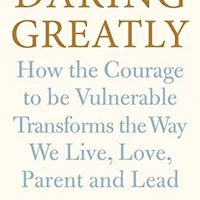
Daring Greatly — Brené Brown
The landmark study on vulnerability and authentic connection — cited in therapy rooms worldwide. Read it not as self-help but as a diagnostic tool for the five patterns above.
As an Amazon Associate, we earn from qualifying purchases — at no extra cost to you.
The armor is real. So is the cost of wearing it every day.
Ultra-Independence as a Trauma Response: The Origin Story
Here's what makes hyper-independence so hard to simply decide your way out of: it was smart. It worked. There was a specific context in which it was the correct strategy.
Somewhere in your history — most often in childhood, sometimes through accumulated adult experience — relying on others produced an outcome that felt unsafe. A parent who was inconsistent, or whose availability came with invisible conditions. A caregiver who was physically present but emotionally absent in every way that mattered. An environment where showing need was met with ridicule, dismissal, or that particular cruelty of being told you were "too much."
Your nervous system is exceptionally good at pattern recognition. It observed the data: when I rely on this person, I get hurt. And it built a protocol: don't rely on anyone, and you won't get hurt. That protocol was not irrational. It was a highly intelligent adaptation to a specific environment. It kept you functional under conditions that required going it alone.
The problem is that nervous system patterns don't automatically update when the environment changes. Bessel van der Kolk spent decades documenting precisely this — how the body holds the imprints of past threat responses and continues running them long after the original context has dissolved. The strategy your younger self invented for survival becomes, in adulthood, the wall that keeps you safe and the wall that keeps growth out. Both simultaneously, indistinguishable from each other until you look carefully enough to see the seam.
What makes this even harder to catch is that hyper-independence doesn't just survive into adulthood — it thrives. It produces genuinely impressive side effects. You become capable. Highly reliable. The person others can count on without question. You build a substantial track record of functioning well under conditions where others struggle. The identity it creates isn't false. It's real. It just isn't the whole story.
Bruce Lipton's research on subconscious belief programming offers one more frame worth holding: the programs running your moment-to-moment behavior — including "relying on others is dangerous" — operate at speeds that bypass conscious choice. You don't decide to feel threatened by an offer of help. The program runs faster than your awareness can intercept it. Which means working on hyper-independence isn't simply a matter of deciding to be different. It requires working at the level of the program itself — with patience and deliberate practice, not just insight.
Self-Limiting Beliefs: 10 That Hold Your Potential Hostage
Why Asking for Help Feels So Dangerous: The Real Calculation Your Brain Is Running
Try this: think of a specific ask you've been avoiding. Someone you could contact for input, support, a second opinion, or a conversation you keep postponing because it would require admitting, even slightly, that you don't have this entirely figured out.
What's the first thing that comes up when you imagine making that ask?
For most people with strong hyper-independent patterns, it isn't "I wonder if they'll say yes." It's a rapid, mostly unconscious calculation of risk: What will they think of me? Will I owe them something I can't repay? What if they do it badly? What if they use this against me later? The ask hasn't happened yet. The threat response is already fully online.
This isn't irrational. It's logical — given the program that's running. The problem is that the program consistently and dramatically overestimates interpersonal threat. A 2022 study published in Psychological Science found that people significantly underestimate how willing others are to help when sincerely and directly asked. The gap between predicted response and actual response is substantial. We forecast refusal and judgment with high confidence. The real interpersonal world is far more generous than the internal calculation allows for.
This matters because the cost of not asking is rarely abstract. It accumulates. Loneliness researcher John Cacioppo at the University of Chicago documented extensively that perceived social isolation — the internal experience of disconnection, regardless of how many people are physically around you — is one of the strongest predictors of accelerated cognitive decline, elevated chronic cortisol, and shortened lifespan. The hyper-independent person is often surrounded by people who genuinely care and is, simultaneously, deeply alone. Not because they lack access to connection. Because the access they've calibrated stays at a depth that feels safe — which is also the exact depth that doesn't actually nourish.
Attachment science offers the most precise map of why asking feels so loaded, and why willpower alone can't close that gap. The research on avoidant attachment shows that the nervous system isn't indifferent to connection — it's actively, effortfully working to suppress the awareness of need, because need has been coded as danger. The effort is enormous. The result looks like independence. The inner experience is loneliness with a very convincing cover story.
The Hyper-Independent Person in Relationships: Patterns That Push People Away Quietly
In romantic relationships, the hyper-independent person tends to present as stable, composed, and admirably self-sufficient — right up until a partner needs genuine emotional reciprocity and discovers, with some confusion, that there's a wall exactly where vulnerability should be.
The wall doesn't look like a wall from the outside. It looks like having it together. Like composure. Like not being "needy" — a word the hyper-independent person has probably used as an insult for most of their adult life, usually directed inward. And then, over time, it starts to look like distance. The partner experiences someone who shows up reliably, handles everything capably, and remains somehow just out of real reach.
In friendships, it's the person who's there for everyone else but never quite lets anyone be there for them. Generous. Present when it matters. Somehow permanently just beyond the depth of genuine connection.

At work, it shows up as an inability to delegate meaningfully — not tasks, but real decisions. As a quiet resentment when credit gets distributed. As the particular exhaustion of running every significant choice through a single processor, and wondering why the load never seems to lighten.
Here's the part worth naming honestly: hyper-independence in relationships isn't just a personal pattern. It's a relational offer — and it isn't a complete one. The people who care about you are relating to a curated version of you, the capable and composed version, the one who has it handled. The real version — with doubts and exhaustion and the specific weight of carrying too much alone — isn't available to them. They can feel the absence even when they can't name what's missing.
11 Relationship Habits Modern Couples Have Abandoned
How to Stop Doing Everything Alone: The Case for Chosen Interdependence
The goal here isn't dependence. Dependence is a different failure mode — outsourcing your judgment, collapsing into others, making someone else responsible for your inner stability. That's not what this is pointing toward.
The alternative is interdependence: the deliberate, chosen, selective act of letting specific people in at specific depths for specific reasons. Not because you need everyone for everything. Because you've looked clearly at what becomes available through genuine collaboration and chosen connection — and because you recognize that some problems think better with two minds, that some weight is specifically designed to be shared, and that the acceleration possible through real partnership is categorically different from what's available through solo effort.
Jim Rohn used to say that you become the average of the five people you spend the most time with. That's only true if you actually let those five people in.
Sue Johnson's decades of research on emotionally focused therapy, brought together in Hold Me Tight, offers the clearest framework I've found for understanding what genuine secure connection actually requires — and why the patterns that prevent it don't respond to willpower or intellectual understanding alone. If you want to understand the mechanics of your own relational architecture, rather than just cataloguing the symptoms, this is where to start.
The journaling component matters more than most people give it credit for. Not venting — structured reflection with specific prompts: What did I resist asking for today, and why? What is the actual worst case if someone sees me need something? What version of connection would I want if I genuinely believed it was safe? A quality guided journal built for this kind of self-inquiry — the kind that takes you somewhere rather than letting you circle the same observations — makes a real and measurable difference to how fast the pattern shifts.
The path back to interdependence isn't a single dramatic opening-up. It's a series of small, deliberate experiments, conducted with curiosity rather than expectation. Each experiment that ends in something other than catastrophe updates your nervous system's threat map by a fraction. Enough experiments. Enough fractions. Enough time. The map eventually starts to look different.
How to Shed Your Old Identity and Become Someone New
How to Start Today
You don't need to overhaul your attachment patterns this week. Here's what you can actually do, starting today:
1. Run the audit. For one full day, keep a count. How many times did you decline an offer of help? Say "I'm fine" when you weren't? Default to handling something alone that you could reasonably have shared? Don't change anything yet — just count. The number will probably be higher than you expect, and the surprise itself is useful data.
2. Name one wall. In one relationship — a partner, a close friend, a colleague you trust — identify one area where you've kept the depth deliberately shallow. You don't have to change it immediately. Just name it to yourself with honesty and specificity. Awareness before action. Every time.
3. Make one ask this week. Something small and concrete. Not a large emotionally exposed ask — something bounded enough that the stakes feel manageable. Could you look over this? Do you have five minutes for a quick conversation? Then notice what happened in your body before the ask, during, and after. The data is more useful than the outcome.
4. Sit with one question for three days: What would I genuinely want — in my relationships, my work, my daily experience — if I actually believed it was safe to need it? Write it down. Resist answering it quickly. Let it stay uncomfortable and open. Let the question work on you.
5. Read toward your own pattern. Understanding the attachment science and neurological mechanics behind hyper-independence strips some of its shame and replaces it with something workable: mechanism. Character flaws feel permanent. Nervous system patterns, once you understand what built them, become things you can actually work with — at your own pace, without forcing a timeline the nervous system won't accept.

Hyper-independence is, in its way, a tribute to your younger self's resourcefulness. It kept you functional when functioning required going it alone. That version of you was not wrong. They were working with what they had, in the conditions they were in.
But you're not in that environment anymore. The protocol built for safety in a past context is limiting you in the present — limiting the depth of your relationships, the range of what you can collaborate on, and the quality of life that becomes genuinely available when people are let in rather than managed from a careful distance.
Designing your evolution means auditing the defaults you inherited, not just the habits you chose consciously. Hyper-independence, almost always, is inherited — a pattern that ran long enough to start presenting as personality. It isn't personality. It's a learned adaptation. And learned adaptations can change when you bring the right kind of attention to them, with the right pace, without demanding results on a timeline the nervous system won't accept.
The cage that looks like freedom is still a cage.
What's one thing you've been carrying alone that you didn't actually have to? Drop it in the comments — you might be surprised how many people recognize exactly that weight.
Was this helpful?