Habits· 10 min read
How to Set SMART Goals That Actually Work
Most goals fail before February. Here's the evidence-backed SMART framework — and the neuroscience that explains why goal structure determines success.

How to Set SMART Goals That Actually Work (And Why Most People Skip the Most Important Step)
The notebook cost me £14 and lasted about six days.
I'd bought it specifically to write down my goals for the year — twelve of them, each one more ambitious than the last. Career milestone. Daily exercise. A savings target that felt aggressive even to say out loud. The kind of list that makes you feel energized when you write it and quietly embarrassed when you find it under a pile of mail in March. The problem wasn't that I didn't want those things. The problem, which I'd spend the following year actually understanding, was that I hadn't set goals at all. I'd written wishes. And the difference between a wish and a SMART goal isn't poetic — it's structural.
The Real Reason Your Goals Don't Survive February
Here's a number that should bother you more than it does: longitudinal research by Dr. John Norcross at the University of Scranton found that only about 19% of people successfully maintain their New Year's resolutions after two years — meaning more than 80% eventually abandon them. Even at the six-month mark, just 46% are still on track. Not most. Less than half.
The reflexive explanation is motivation. You wanted it badly enough at the start, then life got in the way, then the feeling faded. That explanation is comfortable because it suggests the problem was circumstantial rather than architectural. But Edwin Locke and Gary Latham's Goal Setting Theory — the most extensively researched motivation framework in organizational psychology, supported by over 1,000 studies across 40 years — points to a more specific diagnosis.
Goal structure predicts follow-through more reliably than motivation level, goal importance, or stated commitment.
Read that again. You could be genuinely, urgently motivated to achieve something and still be nearly certain to fail if the goal is formulated poorly. And most goals are formulated poorly — not through carelessness, but because nobody ever showed what a well-formed goal actually looks like versus what most of us write down.
George Doran was a consultant and former director of corporate planning for Washington Water Power Company who published a short paper in the November 1981 issue of Management Review introducing what he called the SMART framework. In his original version the letters stood for Specific, Measurable, Assignable, Realistic, and Time-related; the version in wide use today — Specific, Measurable, Achievable, Relevant, Time-bound — evolved in subsequent decades. Four decades and thousands of replications later, it remains the most validated and most casually dismissed piece of goal-setting research in existence. Casually dismissed not because people don't know about it — most people have heard the acronym — but because they treat it as a checklist to nod at rather than a set of mechanisms to understand.
Diana Scharf Hunt put it simply: "goals are dreams with deadlines." She was right. She just stopped half a sentence too early.
What SMART Really Means (Beyond the Acronym)
The SMART framework gets taught as five boxes to tick. But each component exists because it addresses a specific, well-documented failure mode. Understanding the why behind each one is what separates people who use the framework from people who benefit from it.
Specific goals produce higher performance than vague ones for a precise neurological reason. When you set a specific goal — "I will write 500 words before 8am every weekday" — your brain registers an unambiguous gap between your current state and your intended state. That gap functions as an open cognitive loop, a problem requiring closure. The brain's goal-directed systems engage automatically in a way that "I want to write more" simply cannot trigger, because "more" provides nothing concrete to act on. You've given yourself a direction but not a destination.

Clever Fox Habit Calendar Circle
A visual calendar that tracks up to 8 daily, 8 weekly, and 8 monthly habits — the exact type of measurement system that converts an unmeasurable goal into a trackable signal.
As an Amazon Associate, we earn from qualifying purchases — at no extra cost to you.
Measurable goals create the feedback loop that Locke and Latham identify as a non-negotiable precondition for sustained motivation. Without a clear measurement system, you can't know whether you're making progress. Without progress signals, the brain's reward circuitry disengages — not because you're weak-willed, but because the motivational architecture that drives continued effort requires evidence that the gap is closing. A goal you can't measure is a goal you can't track, and a goal you can't track quietly converts into something you check on occasionally and hope for the best.
Achievable doesn't mean easy. The research is actually counterintuitive here: challenging goals — ones that require genuine stretch — consistently produce higher performance than comfortable ones. The distinction that matters is between challenging and impossible. A goal set far beyond your realistic capacity doesn't generate urgency. It generates anxiety, then avoidance, then the particular demoralization of having set a goal so large you never seriously tried.
Relevant is the dimension most people agree with and then ignore. Napoleon Hill spent twenty years documenting this pattern across 500 highly successful people: the goals that produced lasting transformation were invariably connected to something the person authentically cared about — not goals they adopted because someone else admired them, not goals that sounded impressive, not goals inherited from a previous version of themselves. Relevance is the motivational substrate everything else runs on. A SMART goal that doesn't connect to anything you actually value is an efficient road to somewhere you don't want to go.
Time-bound activates what motivational psychologists call temporal motivation theory. Effort intensity scales with proximity to a deadline. Without a specific endpoint, even a clear, measurable goal quietly converts into a preference — something you want, but feel no particular urgency to pursue today. The deadline isn't manufactured pressure. It's the cognitive mechanism that keeps the problem-signal active rather than dormant. A goal without a deadline is a wish with extra steps.
The Piece Everyone Gets Wrong — Process Goals
Here's the insight that most separates people who consistently achieve their goals from people who consistently intend to.
Outcome goals and process goals are not interchangeable. They serve completely different functions. And you need both.
An outcome goal answers: what do I want to achieve? "I want to lose 20 pounds." "I want to save £5,000 by December." These are legitimate and necessary — they create direction and the emotional pull that makes sustained effort feel worthwhile over time. But an outcome goal contains zero information about how to close the gap between where you are and where you want to be. It's the destination without the route.
A process goal answers: what will I actually do? "I will walk 30 minutes every morning before breakfast, six days a week." "I will transfer £400 to savings the day my salary arrives." Process goals are the behavioral bridge between your current position and the outcome. They convert the abstract destination into a daily instruction — something specific enough that there's no decision to make when the moment arrives.
Think of it the way a sports coach would. "Win the championship" is a legitimate outcome goal. But the athlete who shows up each Tuesday purely motivated by the championship with no structured practice commitments will lose to the athlete with a clear, weekly process goal every time. The outcome gives you the why. The process gives you the what, when, and how often.
The research here is unambiguous. People who pair specific process goals with their outcome goals are significantly more likely to achieve the outcome than those who set the outcome goal alone. Not because the process goal provides extra inspiration — it doesn't. Because it provides a pre-made decision. When Tuesday arrives and you're exhausted and the couch looks enormously reasonable, the outcome goal gives you a reason to want to exercise. The process goal tells you exactly what to do about it.
A useful test: if someone asked you "what will you do differently this week specifically because of this goal?" and you couldn't answer precisely, the goal is incomplete. The destination may be clear. The path isn't yet.
WOOP — The Mental Framework That Makes Goals Stick
Here's the part that most goal-setting advice conveniently skips — and the part backed by the most consistent experimental evidence.
Gabriele Oettingen is a psychology professor at New York University who has spent decades studying why people fail to translate clear intentions into actual behavior. Her most striking finding is one that most personal development content actively contradicts: pure positive visualization — imagining your goal's success vividly and in detail — actually reduces the likelihood of achievement.
It doesn't energize you. It relaxes you.
Your brain processes the imagined success as partial progress toward the real thing, quietly reducing the urgency to act. The feeling of having-almost-gotten-there softens the motivational gap. Oettingen's research, replicated across multiple contexts and populations, shows that people who purely visualize success consistently underperform people who don't visualize at all. Which means every vision board session, every "feel it as if it's already real" exercise, every mentally-living-in-your-future-life ritual is — at best — neutral. And often actively counterproductive.
What works instead is her WOOP framework: Wish, Outcome, Obstacle, Plan.
You begin with the goal (Wish) and its best possible result (Outcome). This gives you direction and emotional pull. But then, immediately, you identify the most likely internal obstacle that will prevent follow-through. Not external obstacles — those matter too, but they're not what derails most goal attempts. Internal ones. The specific moment you'll want to skip the workout. The exact emotional state that makes spending feel justified. The particular evening when starting the project will feel premature because you're tired and Netflix is right there.
Then you pre-commit to a specific response: If [obstacle] occurs, I will [specific action].
This is called an implementation intention, and it's one of the most consistently replicated findings in behavioral science. Peter Gollwitzer, whose research on implementation intentions spans three decades, found that people who form "if-then" commitments follow through at dramatically higher rates than those who simply decide to do something. The mechanism is straightforward: your brain, having pre-decided how to respond when friction arrives, doesn't have to make a decision in that moment under cognitive load and competing desires. The decision has already been made in a different, clearer moment.
Most goal failures don't happen at the goal-setting stage. They happen at specific, predictable moments of friction — Tuesday evening when you're depleted, the third week when novelty has faded, the precise moment a more comfortable option appears. WOOP is the practice of mapping those moments in advance and pre-loading your response. It converts what would otherwise be a live willpower decision into something approaching an automatic behavior. Which is exactly where you want it to live.
Building Your Actual Goal System
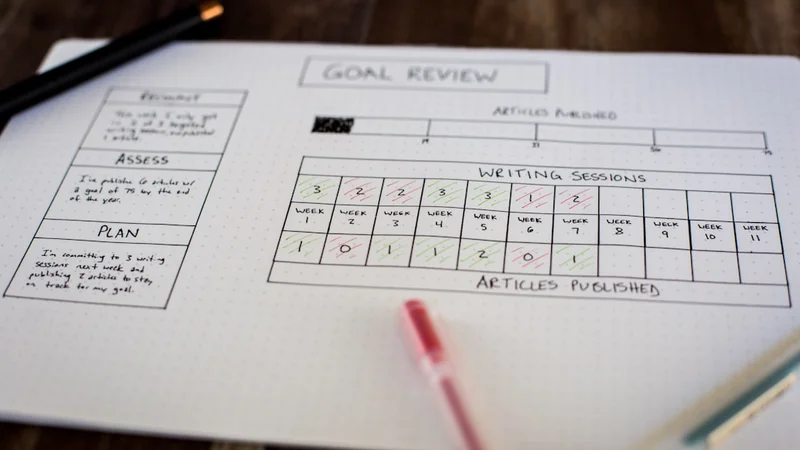
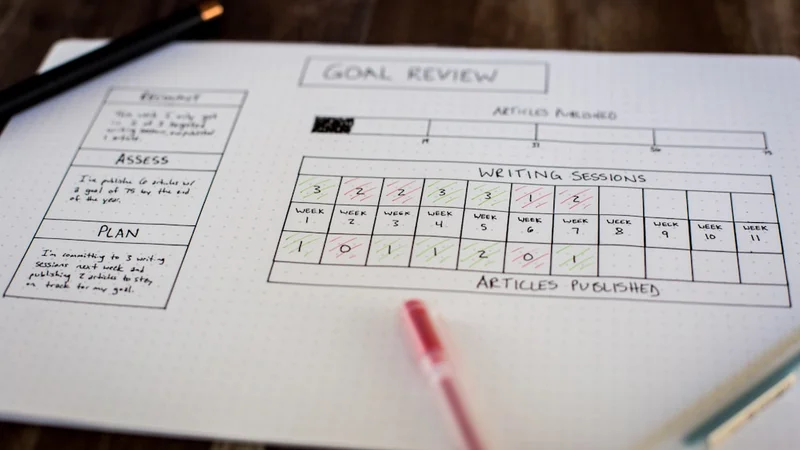
Good goals need a physical home.
This sounds like advice for someone who still uses paper calendars, but the cognitive science of working memory supports it directly. When your goals exist exclusively in your head, they compete with everything else your working memory is managing — the email you owe someone, the thing you said you'd look into, the vague background anxiety about next month's deadline. Goals stored in memory don't guide behavior. They nag you from a distance.
When they live in a structured external system — a planner, a dedicated notebook, a document you open weekly — they stop consuming mental bandwidth and start generating consistent behavioral prompts. The cognitive load of remembering your goals is eliminated. What remains is the cleaner work of executing them.
The basic architecture of a functional goal system needs four components:
A quarterly review cadence. The annual goal cycle is psychologically miscalibrated. Twelve months is too long to maintain urgency and too short to achieve anything significant without consistent momentum. Compressing goals into 90-day sprints — treating each quarter as a complete execution year — activates temporal motivation more frequently and builds in course corrections before drift becomes entrenched.
A weekly process goal audit. Every Sunday, ten minutes: which process goals did you execute this week? Which didn't happen? What needs to change? Not a guilt session. A recalibration session. The goal isn't to judge yourself — it's to update your plan before another week runs on outdated assumptions.
A daily goal anchor. One sentence each morning connecting the day's work to your primary goal. It doesn't require a journaling practice. It requires a visible reminder of what today is for. This can live on a notecard, your phone lock screen, or the top of your daily planner page. Visibility drives behavior in ways that memory doesn't.
A deviation log. When you miss a process goal, write one sentence explaining why. Not to punish yourself — to build the pattern recognition that WOOP requires. Your obstacles will repeat. The ones you document become the ones you can pre-empt.
How to Start Today
You don't need a new year, a new notebook, or a better version of yourself. Here's the minimum viable start:
1. Write one outcome goal with a specific deadline. Not "get fit." "Complete a 5K in under 30 minutes by September 1st." Not "save money." "Have £3,000 in savings by December 31st." The specificity isn't pedantic — it's the mechanism.
2. Write the process goal that directly drives it. What will you do, when, and how often? It needs to be specific enough that there's no ambiguity when the moment arrives. "I'll try to run sometimes" is not a process goal. "I'll run 20 minutes on Monday, Wednesday, and Friday mornings before 7:30am" is.
3. Run the WOOP sequence. Spend two minutes on this. Visualize the best possible outcome. Then name your most likely internal obstacle. Then write: If [obstacle], I will [specific action]. You're pre-loading the decision before the high-friction moment makes it harder.
Atomic Habits — James Clear
The essential deeper read: Atomic Habits maps the behavioral mechanics underneath the process-goal structure this article describes — habit stacking, identity-based goals, and the 1% improvement framework.
As an Amazon Associate, we earn from qualifying purchases — at no extra cost to you.
4. Give your goal a physical home. Phone lock screen. Desk notepad. First page of your planner. Somewhere you'll encounter it daily without having to go looking for it. A goal that lives only in a journal you open twice a year isn't a goal — it's an intention that hasn't been designed yet.
5. Set a 90-day checkpoint now. Put a date in your calendar. Not to evaluate whether you achieved the outcome — to review whether the process goal is working. Did you execute it? What needs to change? Adjust the process before it's too late to recover the quarter.
That's the whole system. It fits on a single index card. The simplicity isn't a limitation — it's the architecture. Complexity in goal systems doesn't produce better outcomes. It produces more reasons to avoid engaging with them.
The gap between intending and deciding is the gap between a wish list and a goal structure. SMART isn't a corporate buzzword from 1981. WOOP isn't a self-help gimmick from a TED talk. They're design tools — and designing your goals with the same precision you'd bring to any project that actually matters is what separates the notebook that lasts six days from the year that changes something real. This is how you design your evolution.
Every person who's built a life they actually wanted started by building goals they could actually follow. Not perfect goals. Not comprehensive goals. Just goals with enough structure that the brain could act on them each day without heroic motivation.
The aspiration was never the problem. You already know what you want. The question is whether you've built the goal that's designed well enough to take you there — or whether you've written it down and hoped for the best.
What's one goal you've been carrying as a wish that deserves to become a decision?
Was this helpful?
Continue Your Evolution
The Frozen Goal Problem: Why Tiny Wins Beat Grand Plans
Rejection Sensitivity: Why You Keep Assuming They're Upset
The Science of Nostalgia: Why Looking Back Helps
Sedikides and Wildschut found nostalgia boosts mood, meaning, and social connection — not mere sentimentality. Here's the science and how to use it.